


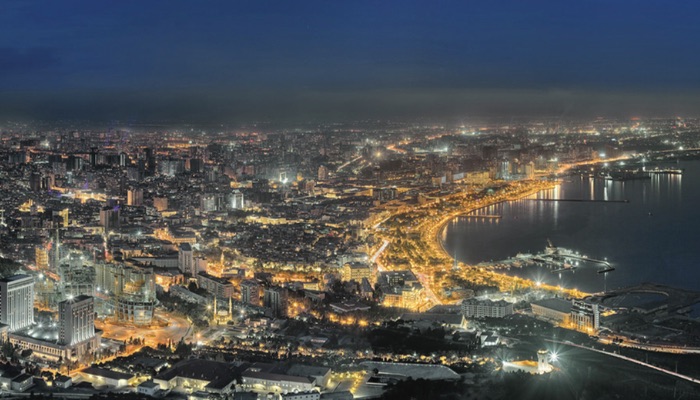
The economy of Azerbaijan is experiencing a rapid development and promotes a stable growth of demand for electricity. Long-term programs are currently implemented in Azerbaijan with the purpose to meet new needs. “Over the last ten years about 2,800 megawatts of new energy capacities were created and 14 power plants were built in Azerbaijan. One can say that 50 percent of the existing energy potential was created over the last ten years”, President of Azerbaijan Ilham Aliyev says during the inauguration (September 25, 2013) of substation No 204 in the Nizami district of Baku.
Generation
The growth of generating capacities in Azerbaijan testifies that the volumes of new generating capacities created during the last 10 years are equal to all capacities that had been created before and they form solid potential for the entire history of the country.
“I strongly believe that in the future we will need to erect new substations. The development of Azerbaijan is so fast that in 5-10 years the current capacities will not be already enough”, the President of Azerbaijan emphasizes.
“In the forthcoming months, until the end of the year we will take additional measures across the power industry. Today we have enough energy capacities. But in some regions transmission lines are unfit for use. During my visits to regions I interested with such issues. Until the end of this year, and especially next year, transmission lines that are in the worst condition now should be upgraded”, the Head of State said at the government session dedicated to the results of the social and economic development of Azerbaijan for the 9 months of 2013.
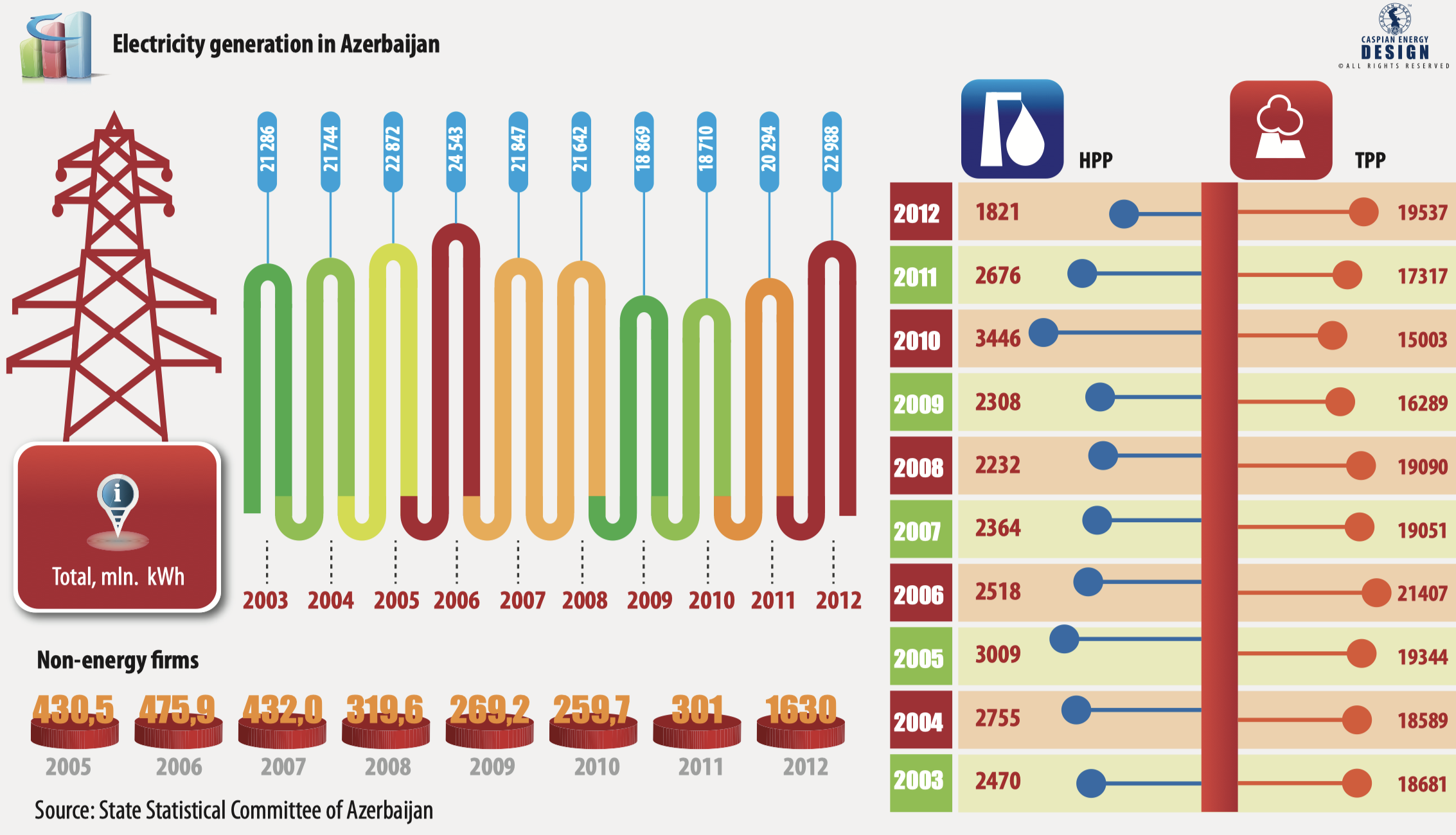
Over the last 10 years in Azerbaijan large investments were provided from the state budget and foreign loans attracted to enhance volumes of generated electricity and construct new generation capacities. In the 2004 year the construction of modular power plants, new power-generating units was commenced as well as modernization of the old thermal power stations.
Power plants in Astara, Shaki and Khachmaz regions and in Nakhchyvan city with the capacity of 87 MW each were constructed and commissioned in 2006 and one more station in Baku with the capacity of 105 MW came on stream in February 2007. In December 2008 a 300-megawatt source of generation was commissioned in the south of the Absheron Peninsula near the Sangachaly settlement.
190 MW of additional capacity was fed to the grid in December 2008 after the reconstruction of the first hydroelectric set of the Shamkir HPP.
The Shahdagh power plant consisting of 12 units has been commissioned to supply electricity to the Shahdagh tourism complex located in the territory of the Gusar region.
In 2009 the first combined cycle power plant with the capacity of 525MW was erected in Sumgayit. This station has no analogues across the CIS in terms of its construction and performance characteristics.
The 20-megawatt Bilav HPP was commissioned in late 2010. At the same time power-generating units of Azerbaijan TPP were repaired from 2005 to 2011.
Construction of a 400-megawatt power unit of the Shimal (North) HPP was launched in 2011. The construction is now underway.
The inauguration of Janub (Southern) power station with the capacity of 780 MW was held on July 1, 2013 in Shirvan city. This station is the largest among all the plants built during the period of independence. The station will strengthen the energy potential of Azerbaijan and be a helping hand in the further development of the domestic economy.
It should be noted that before 2003 Azerbaijan felt deficiency of electricity supply, whereas in 2013 the situation changed fundamentally. Azerbaijan was successful to meet its local electricity needs and by this ensured its energy security for a long run. Along with its being the oil and gas exporter, Azerbaijan has become an exporter of electricity in the region.
Export potential
According to President’s policy on energy security, the volume of electrical energy generated in the country has to be always higher than the actual demand for it.
In this connection Azerbaijan continues expanding its potential for electricity export. For instance, in 2007 the volume of electricity imported by Azerbaijan exceeded exports 1.75 times. However, one by one a number of new power plants were constructed and commissioned, thus giving the start to changes across the industry in 2008. Through the 2008 year electricity export by Azerbaijan exceeded 3 times its import and the favourable balance made 2.6 times. Already in 2009 electricity export by Azerbaijan exceeded its import by more than 7 times.
The countries involved in sales of Azerbaijan electricity and energy exchange are Russia, Iran, Georgia and Turkey. There is a surplus in the electricity export/import.
President Ilham Aliyev has set up the objective to continue expanding the electricity exports as a part of the policy on reinforcing positions of Azerbaijan as the energy resources exporting country, both across the region and globally. So, besides oil and gas Azerbaijan will be exporting large volumes of electricity.
The current energy potential of Azerbaijan makes 6,500 MW. It helps meet needs of the current year and several follow-up years. One by one new power stations have been inaugurated over the last years. As a result, volumes of electricity generation continue growing, which, in turn, boosts the development of the industry in the region and gives a push to the development of the non-oil sector. Due to the 10-year successful activity of President Ilham Aliyev as the Head of State, Azerbaijan has provided non-stop and stable energy supply for the residential sector and other consumers and ensured a long-term energy security.
Capital’s power grid
One of the major directions of the government policy aimed at supporting the social and economic development of Baku and its suburbs was to perform a full reconstruction of the power supply system, which in turn ensured stable electricity supply for the residential sector and other consumers.
As early as in 2003 the problem of power supply in the capital and its suburbs was still urgent. Especially low level of power supply was in the settlements around the capital and newly constructed residual buildings. The large territory was supplied with electricity from transmission lines constructed by the rule-of-thumb methods. The provision with meters was poor and power losses happened because of the problems in the energy grid.
President Ilham Aliyev defined reconstruction of the power-supply system of the capital by the appropriate government bodies as one of the main objectives. Large state investments were contributed to this area year over year. With a due consideration of the situation with energy supply in the country, President of the Republic of Azerbaijan Ilham Aliyev signed the Executive Order on Recovery of Bakielektrikshebeke OJSC’s Activity dated August 10, 2006 to ensure modernization of the grid, improve electricity supply for consumers and also provide a timely collection of fees for consumed electricity. Tens of 35-kilowatt substations were repaired and put into operation till 2012. Transformer facilities with the expired operating life were reconstructed and lots of new transformer units were put in operation in all districts of the city.
More than 2,000 transformer facilities were constructed or reconstructed, about 300,000 subscribers were provided with electric counters and as much as 16,000 kilometers of transmission lines and cables were laid in all districts of the capital in 2006-2013.
To repair the grid unfit for use, simplify the use of electricity and reduce power losses across the city of Baku, the 0.4kW lines were replaced with self-conductive insulating wires (cable).
The performed works have considerably improved electricity supply to consumers of the capital and its suburbs. The power supply industry shifted to a quite new level.
Activities in this area were also continued within the frames of the State Program on Development of Baku and its Suburbs for 2011-2013. To improve power supply for the residential consumers of Baku and its suburbs in 2012, about 2,000 kilometers of cable lines were laid, repair work on the available transmission lines was performed, tens of substations were constructed and reconstructed and the work on installation of smart meters continued.
As a result of the social and economic policy currently implemented by Ilham Aliyev to ensure stable power supply of Baku and its suburbs, effective use of alternative and renewable sources is planned in the future.
Alternative energy
It should be noted that up to 2013 Azerbaijan has traditionally used oil, gas and partially water as energy sources. Immediately after his re-election President Ilham Aliyev got closely involved in addressing this actual global problem. In October 2004 he, for the first time in Azerbaijan, signed the State Program on Use of Alternative and Renewable Energy Sources. In 2011 President Aliyev issued a decree on development of a state strategy on use and development of alternative and renewable energy sources.
The measures taken by President Ilham Aliyev to create legal and state mechanisms for introduction and use of alternative and renewable energy sources started yielding fruit. Since then till today a number of projects have been implemented in the field of alternative and renewable energy sources, including a 2.7-megawat wind power plant, a 1.8-megawat solar power station, the ‘Gobustan experimental range and training center’ with the capacity of 5.5 MW. Construction of 25-megawatt solar panels was performed within the frames of the State Program.
In 2011 the share of energy from alternative sources made 10% of the total amount of generated electricity. Here, 9.8% account for water resources and the rest 0.2% for other sources. In 2012 this sector received 100 million AZN as investments. In 2013 the amount of investments is going to increase by more than 450 million AZN.
Azerbaijan has the potential for 800 MW of wind and 1,500-2,000MW solar capacities as well as the capacity to build small hydropower plants. According to the Government Strategy approved in 2011, as early as in 2020 investments contributed to the production of alternative and renewable energy sources will be completely paid off. Moreover, 600 million AZN are expected to be reinvested again into the same objectives.
As a result of the conducted policy, Azerbaijan besides its being the oil-gas country will join the number of countries that efficiently use alternative energy sources.