


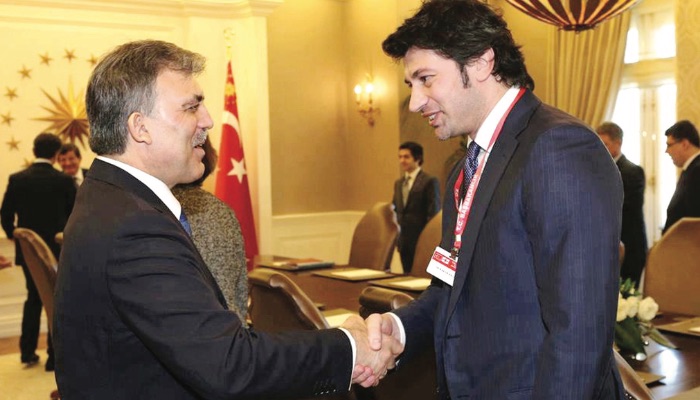
Caspian Energy (CE): Energy cooperation that Georgia and Azerbaijan has been maintaining for almost 20 years is the basis of stability in the region. Will Georgia keep developing cooperation with Baku in the same way?
Kakha Kaladze, Minister of Energy and Natural Resources of Georgia: Let me take the chance and emphasize that the relations between Azerbaijan and Georgia have always been very strong, especially in energy sector. As far as our continued co-operation is concerned, Azerbaijan has long proved itself to be a reliable and important partner. As you are aware after the 2006 energy crisis, Georgia managed to diversify its energy supply with the support of Azerbaijan. The strategic importance of our cooperation is reflected by the wide-range initiatives and the policy of cooperation as well. At the same time through the participation in different international energy projects, aiming at delivery of Caspian energy resources to the international energy markets, our countries managed to increase not only their own energy security, but also the security of the whole region.
I would like to underline that thanks to the successful strategic decisions of the leaders relating to the development of the country, the republic of Azerbaijan become one of the most successful states with the largest and the fastest growing economy in the Caspian and Black Sea region.
We are very pleased with the increasingly close co-operation that has been developing between Georgia and Azerbaijan many years ago and express hereby my goodwill to continue these successful relations in the future as well.
CE: What are the main vectors of energy security of Georgia?
Kakha Kaladze: Georgia has always attached great importance to the energy security issues. In this direction main priorities of country’s energy strategy are the following: to enhance regional energy cooperation through the implementation of common energy projects directed to development of regional energy markets; to develop alternative route of energy through Caspian and Black Sea basins; to develop country’s own energy recourses (utilize the country’s renewable energy potential); promote investment activities within energy sector; implement rehabilitation and construction of energy infrastructure.
In this regard we continue active participation in international projects aiming at development of Southern Energy Corridor. Georgia together with its neighbors Azerbaijan and Turkey is ready to play the role of a bridge in the region. The successful realization of Baku-Tbilisi-Ceyhan (BTC), Baku-Tbilisi-Erzurum (BTE) pipelines passing through the countries ensure that feasible transit corridors in the region exist to transport Caspian energy resources to the European energy markets in safe way.
Georgia’s joining Nabucco, AGRI, EAOTC, White Stream as well as other projects, with our recently developed oil and gas pipelines, Black Sea ports, with well-developed railway systems, is playing an important role in the development of Southern Corridor route.
Owing to our geopolitical location, and thanks to our neighbors’ reliable partnership and assistance, we will further contribute to energy security of the region by creating a stable environment for transportation of hydrocarbon resources from the Caspian region to Europe.
Among the most essential priorities and the guarantee of energy security are to continue promotion activities of Greenfield (projects realized in unexplored areas) investment projects. Georgia, by promoting the clean energy production and with the goal of low-carbon future, made it possible to export the electricity towards of all neighboring countries and by introduction of the high voltage transmission line between Azerbaijan and Turkey in the nearest future Georgia will be able to further expand its relations within the region.
CE: Will Georgia join TANAP project? Will there be changes in Georgia’s participation conditions in case an independent gas pipeline is constructed?
Kakha Kaladze: Launching a new initiative of energy transportation project - TANAP within the framework of Southern Gas Corridor, has become a significant event. As far as, this project is aiming at delivery Caspian Gas from Azerbaijan through Georgia and Turkey to Europe, relevantly it means that Georgia is already to become a part of this project. Under this project Azerbaijani gas is to enter Erzurum in Turkey through Georgia. Thus, the BTE pipeline, also called - the South Caucasus Pipeline (SCP) will be used as a part of the TANAP project. In this regard, Georgia can provide safe infrastructure and relevant legislative framework regulating transportation of additional gas volume. Georgia, as an important transit country, through the successful participation in BTE and BTC project has already proved, that it is a stable and strong partner in the region. To follow this strategy, participation in the construction of alternative routes to transport energy sources from new sites in central Asia to the EU markets will remain as the main goal of Georgia’s future energy strategy.
CE: Which renewable energy sources applied in Georgia are more efficient?
Kakha Kaladze: Hydro resources occupy the first place among the natural riches of Georgia. There are 26 000 rivers on the territory of the country. Their total annual potential capacity is equivalent to 15,000 MW, while the average annual production equals to 50 bln. kWh.
As you know , dependence on a limited number of energy producers causes a serious risk to the stability and security of energy supply of the country. In this regard, to increase country’s energy security Georgia intends to develop its own energy recourses, therefore development of hydro potential of the country and construction new energy infrastructure still remain the main priorities of country’s energy policy. As you know Georgia plays an important role in terms of developing the Electricity Market and trade in the region as a supplier of “Green” energy to the countries that suffer from the deficit of energy, it is one of promising areas for cooperation in this region. Georgia’s hydro potential can be used to offset part of the growing demand in neighboring countries.
For the purposes of enhanced cross border electricity trading Georgia continues its activities in the sphere of construction and rehabilitation of electricity transmission infrastructure connecting with neighboring countries. For these purposes Georgia is actively attracting investments to develop economically attractive and environmentally friendly Greenfield projects.
It should be noted that effective use of hydro resources carried out by construction of new hydro power plants and electric transmission lines in its turn will promote sustainable energy development. Therefore Georgian Government is committed to expand hydro generation capacity in the coming years.
It should be mentioned that Georgia among other renewable resources has significant wind potential as well: wind potential with average annual electricity generation is evaluated at 4 bln. kWh and fixed capacity – 1500 MW, solar energy potential is evaluated at 108 MW, besides Geothermal, and Biomass potential is also used. Nowadays the potential of existing renewable energy sources is not used in enough scopes. By attracting of investments it is possible to utilize electricity produced through renewable energy sources at regional level in order to reduce greenhouse gas emissions. Through these activities Georgia is able to contribute to global process of the development of clean environment and support development of sustainable energy strategy.
CE: How do innovative technologies develop in this sphere?
Kakha Kaladze: As you are aware, renewable energy technologies are essential contributors to development of sustainable energy as they generally support regional energy security, reducing dependence on fossil fuel resources. Moving towards energy sustainability will require changes not only in the way energy is supplied, but in the way it is used, and reducing the amount of energy required to deliver various goods or services is essential.
None of our goals can be reached without improvement in the quality and quantity of energy services. In this context, new technology provides better use of already available energy. Many remarkable, new, proven, cost-effective technologies could greatly contribute to sustainable development of power sector.
Collaborative approaches, focused on endogenous capacity development coupled to technology transfer, are necessary to introduce proven technologies to meet critical needs of the sector. In this regard, Georgia continues introducing of world’s best practicies and intends to continue import of „Know-how“ technologies in this direction.
CE: What success has been gained on AGRI project? What are the prospects of the project’s development in current conditions of global gas market?
Kakha Kaladze: It is necessary to emphasize that new pipelines are just one piece of energy security puzzle. Pipelines alone cannot sufficiently provide energy security. It is important to develop other direction as well. In this line, new LNG developments can offer many advantages. LNG will provide more price competition, new ways to consider long-term contracts, and the development of a real market for natural gas. In this regard, another way for which the Black Sea is becoming important, is the implementation of projects in the field of liquefied gas and Georgia in its turn is developing its transit role in this direction. The recently signed intergovernmental agreement between Azerbaijan-Georgia-Romania on the AGRI project is a result of that aspiration. The preparation of feasibility study for this project is underway and after the study is completed the needs for infrastructure development for the region will be determined, including the construction, reconstruction and improvement of Gas Transmission System from the gas fields to the final destination. Implementation of this project will open the possibility of the alternative route from the Caspian basin towards Europe via “non-territorial” Black Sea Waters.
CE: Do you believe there is a necessity for reanimation of White Stream project aimed at linking Georgia with Ukraine?
Kakha Kaladze: As you already know White Stream Project is nominated as one of the priority project of the Southern Energy Corridor. As far as one of the main components of our countries’ energy security strategy is to diversify energy supply routes, development of different international projects is of outmost importance.
Limited number of energy resources and regularly increasing production difficulties, forced national governments to look for new possibilities for energy diversification. We all know that Caspian Countries have considerable potential of oil and natural gas resources, but still due to the lack of infrastructure developed in the region Caspian suppliers facing difficulties in delivering the hydrocarbon resources from the remote, landlocked Caspian region to lucrative international markets.
It is important to form access to deliver the considerable natural gas reserves of the Caspian Sea to the east and west direction. In this regard, this pipeline project could encourage investments in Caspian gas field development by diversifying export options and transport routes directly to the European Union territory.
The proposed pipeline would become a branch from the Baku-Tbilisi-Erzurum main pipeline, once the second and third phases of Azerbaijan’s Shah-Deniz field development start. Initially named GUEU (Georgia-Ukraine-European Union), this project envisaged a seabed pipeline from Georgia to the Crimea, with options to continue toward EU territory either through Ukraine’s gas transit system or, alternatively, from the Crimea to Romania’s Black Sea coast, entering EU territory there.
At present, however, GUEU-White Stream project developers are also envisaging a direct route from Georgia to Romania on the seabed. With more than one trillion cubic meters in just commercial reserves at Shah Deniz, Azerbaijan has enough potential to support the existing Baku-Tbilisi-Erzurum pipeline (BTE) and its planned prolongation - Turkey-Greece-Italy and first stage of Nabucco - as well as the first string of White Stream. Thus, White Stream does not compete with BTE or Nabucco for upstream resources in the first stages of these projects. After the following stages start, the availability of all these pipeline outlets to Europe should attract major volumes of Central Asian gas.
CE: Is there information about presence of oil and gas deposits (shale gas) in Georgia? Are there plans on attracting international companies in this direction?
Kakha Kaladze: One of the main component of our energy strategy is to encourage the development of new oil and gas resources, promoting efficiency and conservation in the use of all energy resources, as well as alternative technologies. In 2010 with the support of the Ministry of Energy of Georgia and the USAID, a grant project “Preliminary Study for Feasibility Analysis of Shale Gas Exploration in Georgia” has been implemented. The main objective of the project was to estimate potential of shale gas exploitation in Georgia based on the information available. The study proved that shale gas potential exists on 85% of Georgia’s territory. The study classified the potential of Georgian Gas Shales as considerable with additional research required to prove gas resources. Further research, geological and reservoir data acquisition and analysis are necessary to confirm the technical recoverable potential of gas shale. In addition, it is important to present market regulatory and infrastructure reviews in order to verify economic viability of developing Shale Gas exploration in Georgia. For the future we are ready to continue further exploration Shale gas production opportunities in Georgia.
Thank you for the interview