


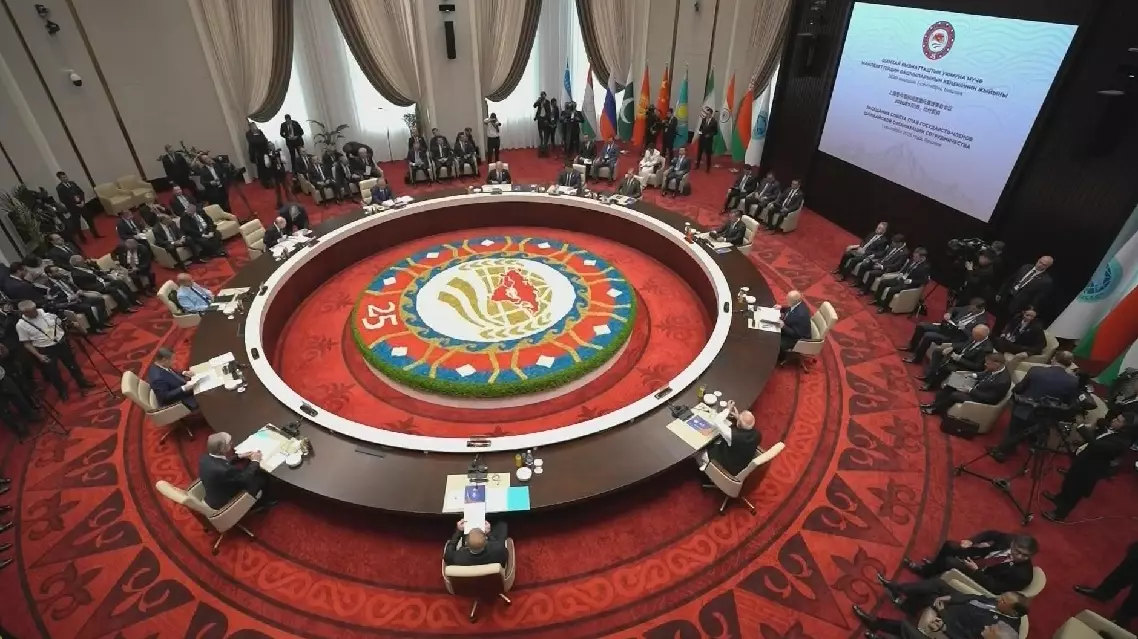
The "SCO Plus" meeting of heads of state and representatives of international organizations has kicked off in Bishkek. Representatives of 18 states and seven international organizations are taking part in it. It is taking place following the meeting of the Council of Heads of State of the Shanghai Cooperation Organization.
In 2025, the SCO summit in Tianjin, China, was attended by leaders of 21 countries and more than 10 international organizations. The main document adopted at the summit in China was the development strategy of the organization for the next 10 years — the period 2026–2035, which defines the priorities for deepening integration. Following the meeting, the heads of state also signed a package of official documents (including the Tianjin Declaration) aimed at strengthening security, trade-economic, and humanitarian partnership. As the chair country of the SCO summit in 2025, Chairman of the PRC Xi Jinping urged the Shanghai Cooperation Organization to set an example in implementing the Global Governance Initiative by adhering to the rejection of bloc thinking and confrontation for the sake of universal benefit.
A year later, today, international and regional security, sustainable development, the strengthening of cooperation, and interaction with other international associations are once again at the center of attention of the SCO leaders. However, the role of the UN in building a fair world order and the contribution of the "SCO Plus" states to the formation of a multipolar world have been placed at the forefront. It was precisely these themes that the host country of today's summit — Kyrgyzstan — outlined during the speech of its President, Sadyr Japarov, at the meeting of the Council of Heads of State of the Shanghai Cooperation Organization on September 1, 2026.
"Our organization must continue to remain free from bloc thinking and confrontation, as well as serve as a platform for strengthening trust and ensuring peace and stability," the head of the republic, Sadyr Japarov, emphasized on September 1, 2026.
Japarov named security as the second priority. He spoke in favor of the prompt launch of the Universal Center for Countering Challenges and Threats to the Security of the SCO Member States. According to him, Kyrgyzstan has also created the necessary conditions to begin the work of the Center for Countering International Organized Crime in Bishkek.
Speaking about the economy, the President of the Kyrgyz Republic noted the need for a practical solution to the issue of establishing the SCO Development Bank. He invited the member states of the organization and business circles to use the opportunities of the "Tamchy" special financial and investment territory for the implementation of joint projects.
He highlighted the construction of the China — Kyrgyzstan — Uzbekistan railway as an important project. The president noted the development of cultural and humanitarian cooperation and a common SCO technological space as another priority.
"It is important to ensure equal access of states to modern technologies so that the digital divide does not become a new dividing line," Sadyr Japarov stated.
Following the meeting, 28 documents were adopted and signed. In conclusion, Japarov handed over the SCO chairmanship to Pakistan.
Following the SCO meeting in 2025, 20 agreements and cooperation documents were signed; the themes of the speeches by the chair countries remained consonant, but relied on current temporal factors. Chairman of the PRC Xi Jinping said: "I look forward to working together with all countries to create a more fair global governance system and advance toward the building of a community with a shared future for mankind." He urged the Shanghai Cooperation Organization to set an example in implementing the Global Governance Initiative by adhering to the rejection of bloc thinking and confrontation for the sake of universal benefit. In the energy sector, according to Xi Jinping: "China will establish three major platforms for cooperation between China and the SCO in the fields of energy, green industry, and the digital economy, as well as three major cooperation centers in the fields of scientific and technological innovation, higher education, and vocational and technical education. We will work with other SCO countries to increase the installed capacity of solar and wind power plants by 10 million kilowatts over the next five years."
2025 was also marked by an improvement in relations between China and India. Xi Jinping stated that China and India should become good-neighborly and benevolent friends and partners who contribute to each other's success. Xi Jinping stated that both countries need to view bilateral relations and manage them from a strategic height and a long-term perspective.
"The joint pas de deux of the dragon and the elephant" must become the right choice for the two countries, he said at the time.
In addition, it can be noted that over the year, China's trade turnover with other member states of the Shanghai Cooperation Organization (SCO) grew significantly: while following the results of 2024 trade turnover reached approximately 524.4 billion US dollars, according to data published by the Ministry of Commerce of China in August 2026, trade between China and other members of the Shanghai Cooperation Organization (SCO) reached 523.5 billion US dollars in 2025, which accounted for approximately 8% of China's total foreign trade volume.
For 30 years of its existence, the Shanghai Cooperation Organization, initially created to address security issues, has turned into a comprehensive regional organization representing almost half of the world's population. At the same time, the main focus of the meetings is the situation with international and regional security, trade interaction, and the energy agenda.
The foundation of the SCO was laid by the leaders of Russia, China, Kazakhstan, Kyrgyzstan, and Tajikistan, who first gathered together in Shanghai in 1996 to sign an agreement on ensuring stability on the border between Russia and China.
Initially, the organization was called the "Shanghai Five", but in 2001, following the accession of Uzbekistan, it was renamed the Shanghai Cooperation Organization. In 2017, India and Pakistan joined the organization, and later Iran as well.
The observer countries in the SCO are Belarus, Mongolia, and Afghanistan; the dialogue partners are Türkiye, Azerbaijan, Egypt, Saudi Arabia, the United Arab Emirates, Bahrain, Qatar, Armenia, Cambodia, Kuwait, Maldives, Myanmar, Nepal, and Sri Lanka.
The main goals of the SCO include strengthening mutual trust among member states, developing cooperation to maintain peace, security, and stability in the region, jointly combating terrorism, developing economic cooperation, and expanding cultural interaction.