


The causes of the mass death of sturgeon are being investigated in the Mangistau region, reports 24.kz. Dead fish were found on a 15-kilometer stretch of the Caspian coast in the Karakiyan district during a joint raid by fish inspection officers and the wildlife protection service. According to a preliminary version, the fish could have been washed ashore by storm waves. To clarify the circumstances, a special commission has been created involving environmentalists, veterinarians, and the police. Specialists have already taken samples. The final causes of the fish death have not yet been established. Gulmira Utetleuova, Chief Specialist of the Mangistau Region Fish Inspection Department — A visual inspection of the carcasses revealed no traces of poachers' nets or hook damage. The fish was disposed of. Currently, specialists continue to monitor the coast. The circumstances of the fish death are being established.
The Caspian Sea, due to the presence of various representatives of flora and fauna in it, represents one of the richest repositories of biological diversity, but because a specialized organization for monitoring this biodiversity in the Caspian does not exist, the exact population size of sturgeon fish and other plant and animal species has not been established, writes parstoday.ir.
Among the many animal species inhabiting the Caspian Sea, sturgeon is the most valuable. "In Kazakhstan, Iran, Russia, and Turkmenistan, there are 65 protected zones of Caspian flora and fauna," said Esther Kuych Laroche, Director of the UNESCO Bureau in Tehran, on July 25, 2017, at the Conference on the Review of the Caspian Sea Biosphere. Due to ongoing oil pollution and the possible deterioration of the Caspian sturgeon's habitat associated with it, even the agreement of the five Caspian states on banning sturgeon fishing by 2020 failed to have a significant impact on the restoration of its populations.
While the Caspian sturgeon is endangered, the Caspian seal has also found itself under threat of extinction due to oil pollution. The Caspian seal (Pusa caspica) is one of the rarest marine mammals in the world, inhabiting only the Caspian Sea and rivers flowing into it. At least 90% of the nearly one million Caspian seals have died over the past 30 years, which is a serious catastrophe for the Caspian environment.
In April alone, the Sentinel-1A satellite detected 15 oil pollution spots with a total area of about 32 sq. km. This is equivalent to the area of 5,000 football fields, writes casp-geo.ru. TASS agency, analyzing the results of the "Transparent World of the Caspian" report for 2023–2024, separately emphasized an important conclusion of environmentalists: despite the large number of detected oil pollutions (about 537 sq. km over two years), key habitats of the Caspian seal remain out of the risk zone. The agency paid special attention to the effectiveness of satellite monitoring, which made it not only possible to quickly record oil slicks but also for the first time to compare their location with the habitat and migration areas of seals.
According to satellite imagery, the Kazakh sector of the Caspian Sea turned out to be the most polluted: 5 spill incidents with a total area of 17.6 sq. km were recorded. This is followed by the Russian sector (8 incidents, 13.4 sq. km) and the Azerbaijani sector (2 incidents, 1 sq. km). The largest of the recorded spills (4.9 sq. km) was discovered on April 24 in the Kazakh sector. Extensive zones of natural oil manifestations with a total area of over 11 sq. km were also identified there.
In June 2026, in the Pirallahi district (near Baku), an oil leak of about 9 tons into the Caspian Sea occurred due to an accident on a main oil pipeline. In July 2026, satellite imagery recorded two major oil pollutions with a total area of more than 600 square meters / hectares near Makhachkala.
The oil slick blocks the penetration of sunlight and disrupts gas exchange, reducing the oxygen level in the water. Damage to flora and fauna: Oil suppresses the development of phytoplankton and phytobenthos, accumulates in bottom sediments, poisons fish, and threatens the population of the endemic Caspian seal. The largest source of petroleum product inflow into the waters of the North Caspian is the runoff of the Volga River, which brings pollutants from industrial and economic territories.
SPOTLIGHT
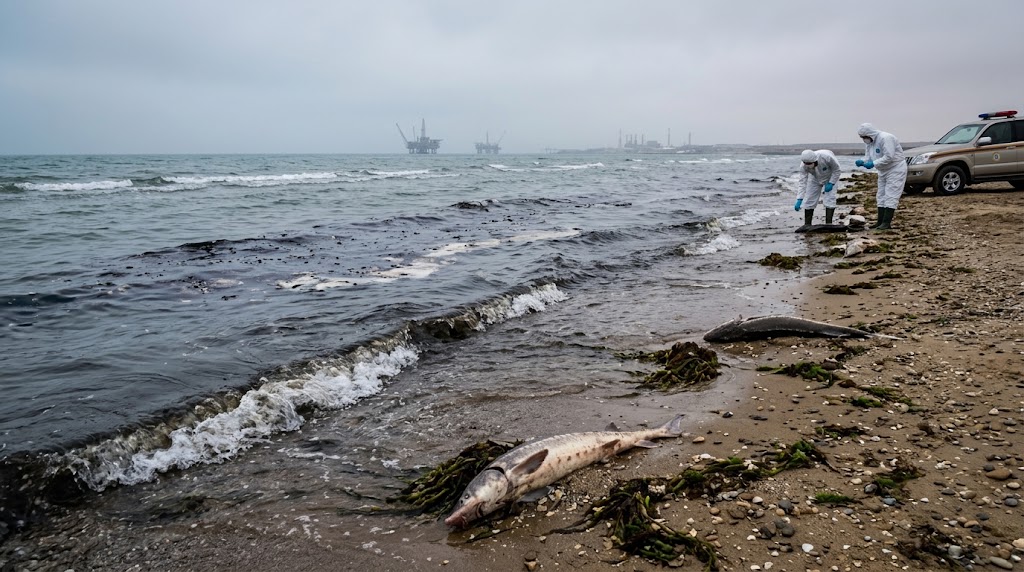
Causes of mass death of sturgeon investigated in Mangistau region
22 October 2026