


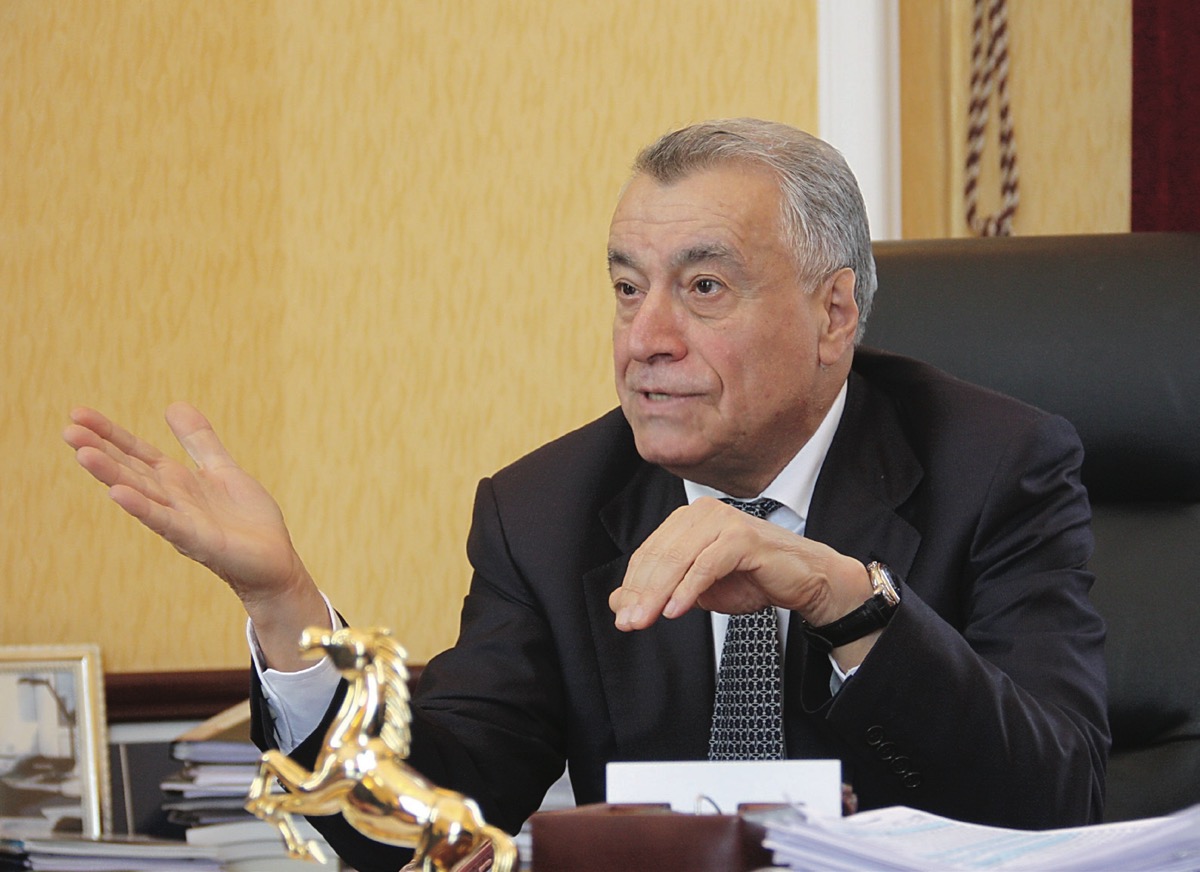
Caspian Energy (CE): Mr. Minister, OPEC has scheduled to hold the following meeting in June. Shall we expect the participants to reach consensus over the price regulation at this meeting? Is there a single opinion or full disunion among OPEC member states?
Natig Aliyev, Minister of Energy of Azerbaijan: First of all, I would offer to look at the oil price dynamics. As you know, oil price decline on world markets has started since mid of 2014. Unfortunately, no changes were made in November 2014 when OPEC members gathered for the first time after the decline of oil prices and everybody expected them to take some measures in order to restrain oil price decline or regulate them as they had enough levers for it. After this meeting of OPEC, when it was apparent that OPEC is going to take no preventive measures, the oil price has rapidly fallen down to $70 per barrel. Later, the price continued gradually declining throughout 2015 and finally fell below $30 per barrel early in 2016. Many experts explain this fact mainly by the influence of political factors and confrontation taking place between a number of countries. In this regard it would be enough to note the deterioration of Russia-Ukraine, Russia-Europe, Russia-Syria-Turkey relations which have serious economic consequences including the situation with price levels. It is the first reason.
The second reason lies namely in the OPEC countries. These are conflicts in North America, Syria and also the Middle East. We perfectly realize and know it. The third reason is the lifting of sanctions imposed earlier on Iran. These are three major political reasons which affected and caused an oil price collapse.
Among economic reasons concerning the oil industry noteworthy is the shale revolution in the USA – increase of shale oil production volumes. Owing to this, oil production in the USA exceeded 10 mln barrels per day. I mean annual production volume increased by 3-4 mln barrels just within 2-3 years. A set of laws, permitting the US oil export, was approved in the USA, and it definitely affected oil price decline. There are also important factors such as the situation and trends in development of the global economy. First of all, it is a decline of global economic development rates in China and India which substantially lowered its development rates and consumption of energy resources.
In this conditions OPEC was expected to take certain measures to reduce oil production rate which could have adjust market prices to certain extent. Unfortunately, it did not happen. On the contrary, in the course of sessions and meetings OPEC members noted that they have no intention to reduce oil production and export, and will not force the market. The main reason for OPEC countries’ choosing this stance was a certain market segment gained by each country, especially Saudi Arabia, and none of them wished to yield it to any extent.
The situation became more complicated at OPEC’s last session in Qatar because of cancellation of sanctions earlier imposed on Iran which added that its share in the OPEC reference basket of crudes used to total 4 mln barrels per day in due time and no oil production limiting would be negotiable until Iran resumes the pre-sanction level. Libya, which used to hold one of the leading positions among oil exporting countries until certain events, is in the same situation. On the other hand, oil production decline is recently observed in the USA and I believe that this trend is going to continue.
Therefore, considering the current global oil production rate, in reality there are three countries which can still afford oil production increase. They are Saudi Arabia, Iran and Libya. In this regard, everything depended on the wish and stance of these three countries at the OPEC’s Qatar meeting.
I would like to note that high oil prices ($100 or over per barrel) observed for a long time till mid of 2014 were not speculative. These were reasonable prices which reflected the market situation and were reached owing to an economic growth of countries, energy resource consumption and demand ratio, development of alternative and renewable energy and increase of energy efficiency.
Nowadays, it is evident to anyone that low prices observed for a long time have had a strong impact on the economies of not only energy resource producing but also consuming countries. It is abnormal when the oil price falls by 3-4 times and stays low for a long time. It became evident that something is wrong here and cannot continue just this way because all countries face losses, tremendous losses, especially producing countries.
Oil importing countries do not benefit from cheap oil prices either. We cannot observe rapid economic growth in Europe or South East Asia. Once I was told in India and China, which are big consumers of energy resources and crude oil importers, that the growth of oil price by one dollar causes additional budget deductions worth $400 bln for energy resources. But no rapid economic growth has taken place in India or China.
Therefore, Russia, Venezuela, Saudi Arabia and Qatar reached an agreement in February 2016 to either suspend or freeze oil production at the January rate of 2016. It was decided to hold a joint session of OPEC and non-OPEC countries. On the eve of the session the countries reached an agreement and were ready to sign it. However, early in the morning of the next day the meeting participants were asked to wait for a while because negotiations between Iran, Saudi Arabia and Qatar had not been completed yet. When the session finally started after a long delay, we were informed that the agreed project had been changed. A new draft agreement strongly differed from the previous one and stated that countries are ready to freeze oil production at the January rate if all the OPEC countries accept it. It was written word for word that the decision about freezing will enter into force as long as all OPEC countries join in this agreement. The matter involved Iran and Libya which did not attend this meeting. It has become clear that this clause would not work. Discussion took long. It was offered to freeze production at the rate of January. Then, suggestions were made to freeze production at the rate of 4 months of 2016, to create a working group for negotiations aimed at having Iran and Libya joined this agreement. After long unsuccessful discussions, we understood that we are not ready to adopt any declaration or agreement as there is a need for decision of all OPEC member countries without an exception. Once this is done, other non OPEC countries can joint it as well. Though, the meeting in Qatar turned out unsuccessful and I would even say very strange, it anyway managed to find out exporting countries’ positions over oil prices at the global market. It turned out that the oil price is not a simple issue at all. Everybody understood that sooner or later the development of the global economy would drive prices upwards. The only factor that could hold back the price increase was an entry of Iranian oil into the market. Lifting sanctions imposed on Iran was unambiguously perceived as a real opportunity to increase oil production. However, big investments and years will be necessary to bring production rate in Iran up to the pre-sanction level. But nevertheless, the factor of lifting of sanctions from Iran has played its role.
I think that recovery of Libyan fields will make it complicated as their technical condition is not good now. But nevertheless, the tendency will be directed towards oil production increase in Libya.
Please login or subscribe to read the full article.
Login / Subscribe