


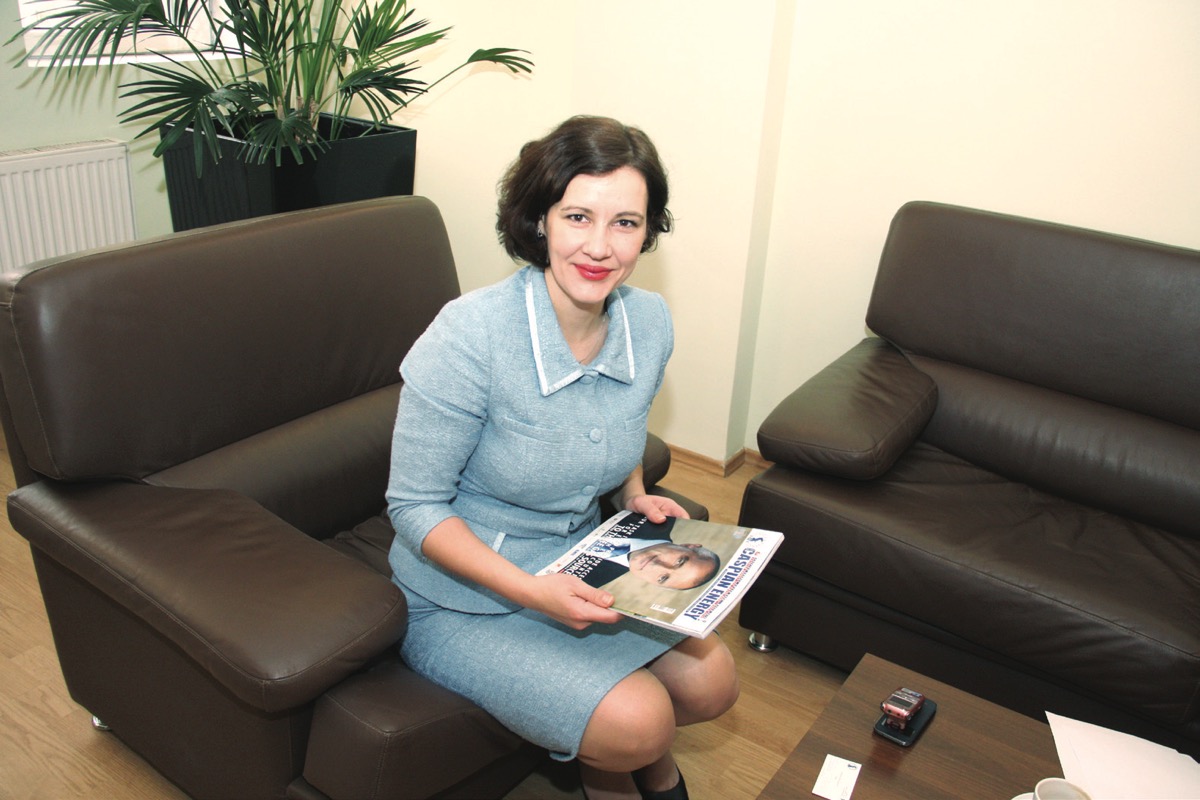
Caspian Energy (CE): Ms. Minister, how has the economic structure of Latvia, as part of the European Union, changed?
Dana Reizniece-Ozola, Minister of Economy of the Republic of Latvia: Latvia has a small open economy. The structure of the economy itself has strongly changed over the past 10 years as the volume and diversity of export increased. The number of trade partners of the country has grown as well. As early as 10 years ago we sold non-treated wood while now wood accounts for inconsiderable share in the export structure, in other words we add value, which means we are able not only sell our products but also make money, moreover good money. If we compare the rate of development with the European and eurozone countries, our development rates are much better. Our annual GDP growth will total 2.5% this year and already 3% next year. Comparing with the Eurozone countries, where this indicator totals approx 1.3% or 1.5%, we see that we are developing twice faster. Of course, the living condition has been still rather behind the middle level in the Europe Union, it makes about 60% of the middle level in the Eurozone. Thus, we have goals to reach.
CE: What is Latvia’s vision about the development of the Trans-Atlantic trade and investment partnership (TTIP) of the EU and USA?
Dana Reizniece-Ozola: Latvia supports this agreement. As I have already mentioned, we have a small open economy and it will provide new opportunities to our medium and small business. If such a big market as the USA works in accordance with the same conditions that Europe does, it will become considerably clearer for our market. Nevertheless, there are many issues to solve. For instance, as the EU country, we would like TTIP to be a separate part dedicated to energy. It involves LNG as an additional resource of energy supply to the European Union. But we know, our presidency has recently ended in the EU, that the agreement on this issue does not progress just the way the European Union desires it. It has been one of the most important issues that we were working on.
CE: The Ministers of Energy of the EU countries have met lately? Did they discuss this issue at the negotiatons?
Dana Reizniece-Ozola: I will speak both on behalf of Latvia, the EU and the former President of the European Union. In general, the European Union believes Azerbaijan to be a very important partner, strategic partner to expand power supply capacities. Europe is dependent on import and at present we are importing 56% of energy resources. Of this total, 36% falls to the share of Russia. It relates to the EU on the whole. As far as Latvia is concerned, we are dependent on a single source when it comes to gas supply and for this reasons for many years we have been paying prices considerably exceeding the market ones. We are currently actively working on the opening of our gas market in order to provide an opportunity, though a rather theoretical for now, to buy gas from other sources, for instance from the USA.
CE: Which initiatives does Latvia put forward concerning creation of the Energy Union? What is your position toward implementation of the single energy policy in EU?
Dana Reizniece-Ozola: We were initiators to create such a strategy. The European Commission even calls it Riga process because we commenced it in Riga. We started promoting the idea to create the strategy of the Energy Union at a big conference held in Riga on February 6, 2014. I think during our presidency we did a lot to create an Energy Union. It is very important that the European countries are ready to actively work on creation of the infrastructure for strengthening the domestic market. We can talk much about the possibility for the European countries to support one another in crisis situations, say, in case one country has disagreements with a supplier, the others should be able to help, provided they have infrastructure for that, otherwise it will be impossible.
The principle of solidarity and single vote of the EU is certainly of big importance. We witness EU hesitating often, especially in recent years, when it comes to make tough decisions in relation to different issues concerning the third countries. Sometimes, individual interests of certain states do prevail over common interests and I think that it is extremely important to maintain solidarity in the field of energy.
CE: What are the prospects for development of the LNG market in Latvia? What are the forecasts of development of the country’s market?
Dana Reizniece-Ozola: I would say that Lithuania is a very good example. Before they found alternative liquid gas supplies, they paid for gas approx by 20% higher compared to Latvia. A new LNG terminal started operating in Lithuania last year and now they pay by 20% less than we do. They buy the same Russian gas, but already at more favourable prices. Gas molecules have no nationality. The price and stability of supplies are of importance. Lithuania now covers approx one third of needs by gas supplied from Norway and other sources, consumes liquid gas while the rest volumes are bought from Gazprom. We think it is an optimal structure and are moving toward it.
CE: To what extent can the current situation at the global market of energy resources reflect on macroeconomic forecasts of Latvia?
Dana Reizniece-Ozola: This situation has already been reflecting. Expenditures on production and inflation are already falling. We are becoming more competitive. We are a country importing energy resources. We do not sell them. We realize that economic development depends on two factors – domestic consumption and export. The rate of export is increasing now.
CE: In your opinion, what energy price is favourable for development of Latvian economy?
Dana Reizniece-Ozola: The current prices, certainly have positive impact on development of our economy.
CE: Can the relations between Russia and Turkey somehow change an energy balance between EU and Russia?
Dana Reizniece-Ozola: I think, not decisively, because Russia also depends on the EU’s energy consumption. It is a big policy, and energy has been an important part of this policy. In the situation when prices for energy resources are so low, the projects in the direction of China are not also implemented fast and well enough as Russia would want it. I believe the price are unlikely to change much.
CE: Which projects does Latvia offer in order to connect railway arteries of the Baltic and Caspian countries?
Dana Reizniece-Ozola: We already enjoy a good developed infrastructure. We have Zubr and other projects. But now we are working on a new project called Real Baltic, which is to connect Helsinki with Berlin through Tallinn, Riga, Vilnius and Warsaw.
CE: What are the opportunities for cooperation of Latvia with the countries of the Caspian region? What are the results of recent meeting with President of Azerbaijan Ilham Aliyev?
Dana Reizniece-Ozola: We have long-standing good political relations. Heads of our states meet actively. Discussions are also held on the level of heads of different ministries and departments. The relations have been established and there is a wish to cooperate. But we would like to achieve much better results of the cooperation in the field of business since our trade turnover makes just 33 mln EUR, which is not really a very high figure. Azerbaijan is our strategic partner in this region. We spoke to the head of state of Azerbaijan, heads of relevant ministries, highlighted priority industries where we are going to cooperate in future. Basically, it is agriculture, transport sector. Development of the Baku-Tbilisi-Kars project is of importance for us so that it also reaches Baltic countries across Turkey. We have good link-ups and we can be a good part of the new Silk Road. It will be the right Silk Road because we have seen many versions that are called Silk Road.
In general, I can say that my visit to Baku turned out very fruitful. But I would like to add that I am already waiting for the next year in order to return to Baku when a global chess contest will be held here. I am going to take part in this contest and represent our country, not as minister but as a grandmaster.
CE: Good luck to you.
Thank you for the interview