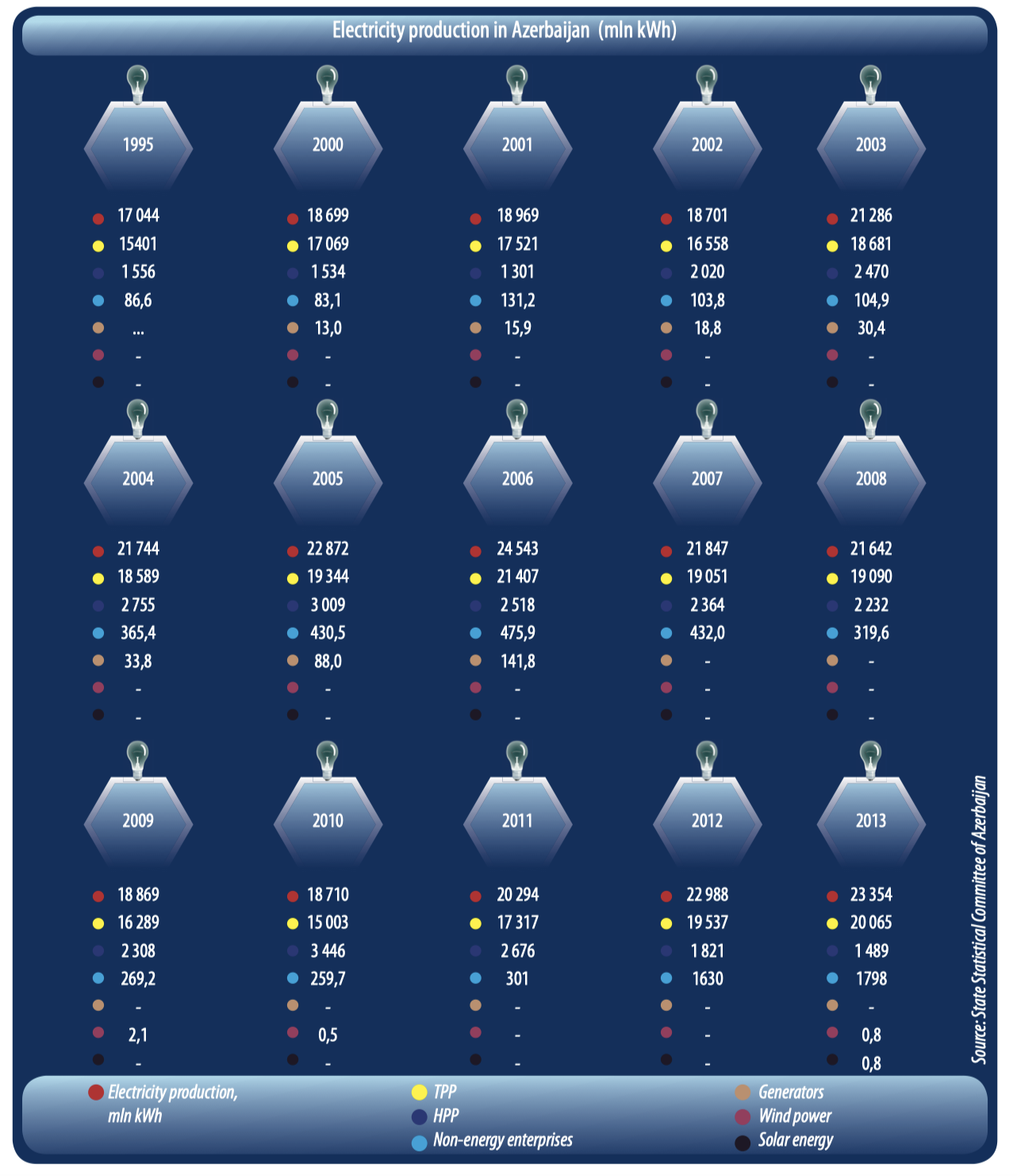


October 20 is celebrated as the Power Engineers’ Day in Azerbaijan. Azerbaijan which nowadays has an independent energy system is expanding its generating capacities.
“Power economy is the major sector of any country. No country is able to develop without the development of the energy sector. Generating capacities are certainly necessary to ensure development. We are creating and will keep creating new capacities”, President of Azerbaijan Ilham Aliyev said in one of his speeches.
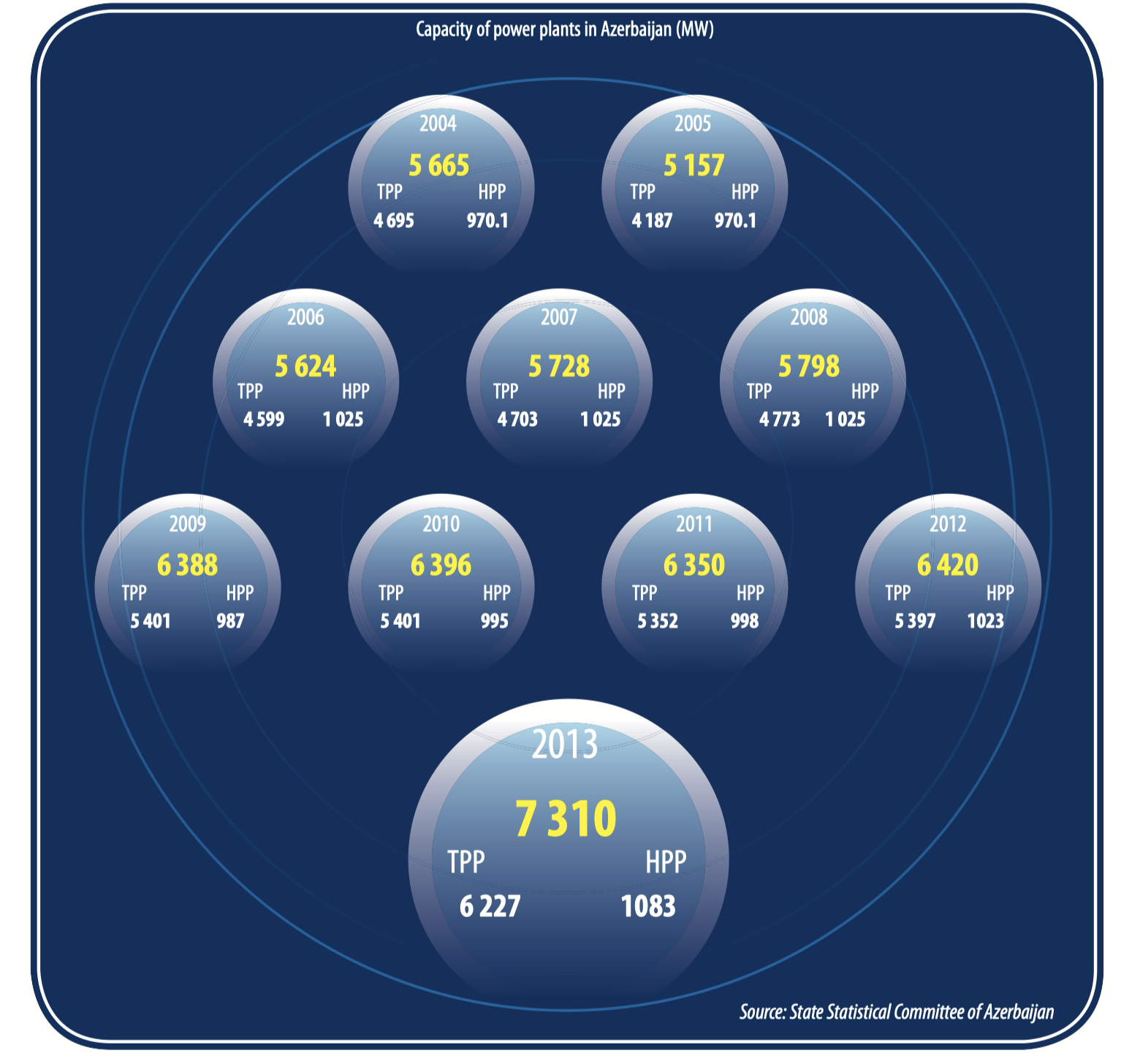
17 new power plants (their total amount is 26) were commissioned in the country over the past 10 years including laying of electricity lines to the length of over 10,000km, construction and reconstruction of over 1500 substations in general. Two new power plants have been commissioned annually starting from 2006. It is a record figure in the history of power industry of Azerbaijan. As the result, new generating capacities reaching over 2300 MW were obtained.
“Total generating capacities of the country reach 6300 MW. If these power plants had not been built, then approximately 30% of our country would have no electricity supply at present. Industrial development would be out of question since the development of industry in Azerbaijan should certainly be secured by infrastructure projects. Therefore, we focused mainly on erection of power plants. I may say that nowadays we are ensuring our energy security excessively. Our present export potential totals almost 600-700 MW”, President of Azerbaijan Ilham Aliyev noted.
Thus, thermal power plants with the capacity of 87 MW each were commissioned in Astara, Sheki, Khachmaz and Nakhchivan in 2006, a 105MW plant in Baku in 2007, a 300MW plant in Sangachal in 2008, a 105MW plant in Shakhdag and a 525MW plant in Sumgayit in 2009, and a 780MW plant in Shirvan in 2013.
One more station with the capacity of 409 MW (Shimal-2 thermal power plant) is planned to be commissioned by the end of this year. Apart from this, considering the challenging terrain of Lerik and Yardimly districts, certain operations have been completed at underconstruction 17MW power plant in Lerik in order to improve electricity supply of these districts. New 35 kV substations were built and electricity transmission lines were laid in Yardimly and Lerik regions within the framework of the project. Reconstruction of the distributing networks of these districts is one of the assigned tasks.
The work on rational use of water resources of the republic is ongoing. A hydroelectric power plant with the capacity of 25 MW was commissioned in Fizuli. Small hydroelectric power plants were commissioned in Gusar, Ismayilli and Geychay regions. Operations at other small hydroelectric power plants located in Balakan, Oghuz and Astara regions are scheduled to be completed by the end of this year.
The launch of the modern gas turbine power plant Shimal, construction of modular power plants in different regions of the republic, commissioning of the combined-cycle power plants Sumgayit and Djanub over the past 5 years increased almost by 30% and renewed generating capacities of the Azerbaijani power system.
At present this figure has reached 7105 MW that enables to generate on average 24 bln kWh and export about 2.1 bln kWh electricity.
Azerenergy OJSC built new power economy facilities in order to expand connection with energy systems of neighbor states: with Iran in the south, Russia in the north and Georgia in the western direction.
The Azerbaijan-Georgia-Turkey corridor has been created for electricity transmission. Starting from 2014 it will be possible to transmit 350 MW within the framework of energy exchange with the Western European countries. This figure will be 700 MW from 2015. Therefore, the Ministry of Energy of Azerbaijan prepared and signed the corresponding intergovernmental documents with the abovementioned countries.
Alternative energy
The researches held in this field revealed that the republic has a potential to save almost 40% of general need in energy resources. According to the results of 2013, the construction and commissioning of economical power plants, reconstruction of physically outdated power generating units as well as use of natural gas (97.8%) for power generation enabled to reduce consumption of fuel per generation of 1 kWh electricity from 413 grams down to 303.7 grams over the past ten years. It helped to save approximately 2 mln tons of reference fuel.
In the post soviet space the first wind polygon was built around Baku and its settlements. As early as 1970-80s launched was the first technological line on production of solar panels installed on the roofing of the sports complex in Baku.
Two projects are currently being implemented in Azerbaijan – creation of the Gobustan scientific polygon and 21 surveillance systems for evaluating the potential in this sphere. Over 100 mln AZN has already been allocated for this sphere. Apart from this, Azerbaijan undertook an important step by cancelling (for a ten year period) all customs and tax duties for the equipment designed for production of renewable energy and supplied to Azerbaijan.
The plan of actions on use of alternative and renewable sources of energy and energy efficiency for 2013-2015 is aimed at ensuring up to 25% of total capacity of the energy system of the country. By 2020 the alternative energy will have provided approx 2,500 MW in Azerbaijan.
In the meantime, it is the wind energy that has a bigger potential (240 MW in 2015 and 800 MW in 2020) and photovoltaic units (290MW and 600 MW respectively). Considering the potential of solar heating systems (50MW and 350 MW), solar energy is one of the promising types of alternative energy capable to provide 340 MW of generating capacity by 2015 and 950 MW by 2020. Minimal potential of liquefaction of domestic wastes shall total 25 MW in 2015 and 125Mw in 2020, geothermal sources (15MW and 150MW respectively) and small-scale water power engineering (80MW and 150 MW in 2020).
Nevertheless, for Azerbaijan, in order to reach the level of the developed countries in terms of installed generating capacity of power plants per capita, the total capacity of energy system must be increased from 10,000 MW up to a higher level at the cost of underconstruction power plants. 4 bln AZN will be allocated into the capital construction in order to reach this level. As the result, the volume of per capita electricity production in the country will rise up to the level of the developed countries of Europe and exceed 3600 kWh.
As the result of implementation of scheduled projects, the total capacity of transformers in the system of electricity transmission will in coming years increase by 3000 megavolt-ampere. The total length of 110, 220, 330 and 500 kV lines will be increased approx by 1500km.