


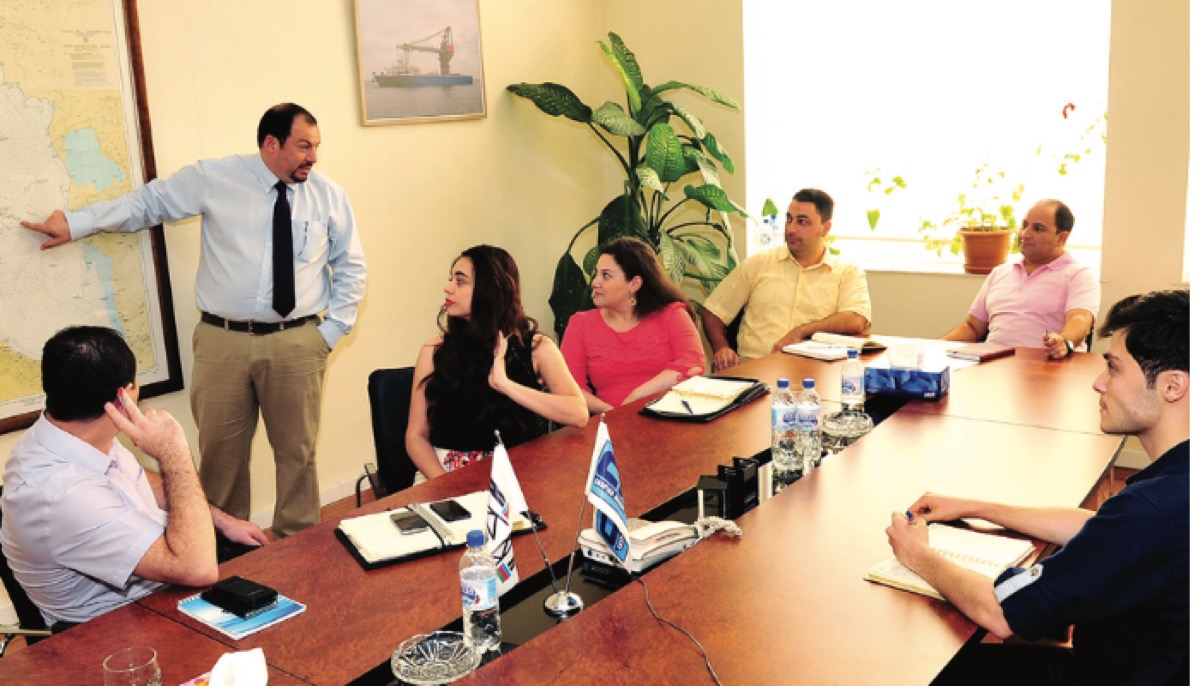
Caspian Energy (CE): Mr. Garrad, what are the main objectives? Which role is assigned to the Company in the Caspian?
Brian Garrad, Chief Operating Officer, CMS Limited: Our main role at the moment is the support of the offshore oil-gas industry in the Caspian Sea. We provide predominantly marine supports in the shape of; AHTS (Anchor Handling Tug Supply) vessels, dive support vessels, pipelay vessels, heavylift cranes and crew boats. We see BP and SOCAR two of our biggest clients and we provide support for their operations. We are in December starting a new project, a major project for the region, which is the Shah Deniz II platform. We have contracts with Saipem for the provision of the majority of the above mentioned offshore support vessels within the framework of this project. We were involved in the set up of the Baku Ship Yard project on the marine side, where we had our dredgers involved in clearing out the bay and in preparing facilities for vessels’ entry.
CE: To what extent are the vessels, operated by the company, technically ready for lending support to offshore operations in the Caspian? Do you plan to build new vessels and expand the fleet?
Brian Garrad: In the light of expansion of our activity and forth-coming Shah Deniz II project we are currently in the process of building and purchasing new vessels, specifically for the region. By December this year we will have 7 new vessels into the Caspian, predominantly for the Shah Deniz II. We will have a new anchor handling tug supply vessel (AHTS) called the ‘Lankaran’, it has 206 ton Bollard Pull which is the highest capacity in the region. The vessel has been purchased by Azerbaijan Caspian Shipping Company and we will manage the vessel.
All the vessels will be engaged in the offshore support function ranging from anchor handling to fast crew boats.
We have a new fast crew boat (FCB) coming into the region. It is currently being built in Australia and expected delivery to Baku in December, the FCB is called the ‘Muslim Magomayev’ and is a state of the art catamaran hull vessel for 150 passengers. The ‘Lankaran’ is currently in Turkey being made ready for passage through the canals. Two of the vessels we are buying are being delivered from UAE, and one from the Netherlands. The final two vessels are currently trading in the Mediterranean region and they will come to us by December.
We are on the discussion with our major clients for potential new vessels and expecting the arrival of those that we spoke about. We are on the discussion with our current clients for potentially two or three more new vessels, and as part of that expansion if we do, we are considering options of building them here locally.
CE: Could you please tell us about upgrading of vessels including Gurban Abbasov vessel?
Brian Garrad: The Gurban Abasov derrick barge (carrying capacity – 600 tonnes) has been reconstructed into a flotel (floating hotel). Based on the contract with BP, we have added an accommodation unit and all the supporting functions it goes with it. We have now got the capacity to have 217 people on board of Gurban Abbasov, living and working daily on board. The crane on ship is still being used but not necessarily for the heavy lift. The conversion is complete. All the installation and engineering work is done, and we are currently under testing. I would like to note one of the aspects of the Gurban Abbasov upgrade is the installation of a ‘motion compensated gangway system’ this involves a gangway system which remains steady whilst the vessel moves underneath it. This system allows the vessel to remain alongside the platform and provide a ‘walk to work’ function from the flotel to the platform.
Apart from this, the Israfil Huseynov vessel (PLBH) is being refitted with all new pipelaying equipment and this is all being done as part of the contract with Saipem for Shah Deniz II. Also, as part of the upgrading, the vessel is undergoing reengineering on the actual engines and the thrusters to improve maneuverability and reliability. There are also some upgrading works to the Akedemik Tofig Ismaylov (DSV), this is in more in line with its engines, thrusters and the generating power, and again to improve maneuverability and reliability.
The upgrades to PLBH and DSV are to ensure reliable operation of ours vessels for the next five years as well as reduce downtime. One thing we are conscious of with our customers and clients is that Shah Deniz II is a big project for the region, so we want to ensure that there are no delays in the project from our vessels, and make sure that our vessels are functioning to the best of their abilities. Operationally we have some big challenges ahead with the Shah Deniz II and the Flotel projects, and with other planned expansions. It is these challenges that give us experience, and it is generating more employment in the region.
CE: In which operations has the company been engaged in throughout a year and which operations are currently underway in the Caspian?
Brian Garrad: We have the Tofig Ismaylov, PLBH Huseynov both under the contract to Saipem at the moment and they are in the upgrade process for the Shah Deniz II, previously during the year both of the vessels were on various different charters for BP and for SOCAR. The DBA (derrick barge Azerbaijan) has just come back from a project in Turkmenistan on a project for ILK. The two main anchor handlers that we have the Islay and the Jura they have been engaged on full time contract with BP for supply operations to the platforms and also involved in rig moves for the Dede Gorgud rig, Istiglal rig and the Heydar Aliyev rig. We also have our five crew boats: Khudaferin, Gobustan, Giz Galasi, Araz and Gulustan on contracts with SOCAR throughout the year. Our dredgers CSD 500 and CSD 450 have been involved in the Baku Shipyard projects dredging the area around the shipyard. We have two small multipurpose tugs CMS 1 and CMS 2. CMS 1 is currently doing survey operations for Saipem in relation to Shah Deniz II. The CMS 2 is on various different charters.
We also have contracts outside of Azerbaijan region. Our vessels go up to Kazakhstan and go across to Turkmenistan supporting offshore operations there and across the Caspian region. In the job that DBA (derrick barge Azerbaijan) was on, we also had two of our chartered anchor handlers go across with us to Turkmenistan.
In general, we are looking to expand and eventually want to grow outside of the Caspian region. Our future plans are to expand our operations outside of the Caspian. The work we will be doing over the next 3-5 years here in the region will give us very good experience in working with larger vessels in cooperation with proper multinationals which will give us experience to go outside of the Caspian.
Caspian Energy (CE): Ms. Aliyeva, the company is developing, so are the new projects. What importance does the company attach to training of skilled human resources for servicing modern equipment and new vessels?
Sabina Aliyeva, HR and Training Manager, CMS Limited: As you know, the vessels operated by CMS will be engaged in the Shah Deniz-II project. CMS will provide the majority of the project-related vessels. Several vessels designed especially for the abovementioned project will be delivered to the Caspian region in near future. These are completely new vessels and as you hit the mark, the equipment installed on these vessels meets all modern standards, which in its turn requires involving the high-skilled personnel. It rests certain tasks on our department.
Timely provision of the company with qualified human resources is the major objective of our department. Apart from this, we also aspire to enhance their potential and working skills. We arrange trainings for the personnel, which works for our company, mainly in Baku. Apart from this, our management team supports training of the personnel abroad for gaining knowledge meeting much higher standard. This process has started since this year and will continue in the coming year as well.
In the meantime, we are trying to attract human resources back to Azerbaijan, i.e. those who left Azerbaijan in 1990s when the republic was going through a hard period. At present, we are in need of these high-skilled resources since we are about to commence new projects. In this regard, we have already managed to hire a number of employees and we keep working on it. I must note that along with the attraction of high skilled resources we should also manage to arouse an interest in them for a long-term cooperation and in this way avoid the so called “brain drain”. Therefore, provision of employees with additional social packages and other privileges is also of great importance to us.
CE: Shall we make allusion to multiple increase of the quantity of employees of the company?
Sabina Aliyeva: There are about 380 employees working currently for our company. Due to the upcoming commencement of the Shah Deniz –II, there are 8 more vessels, operated by our companies, to be involved into this project. We assume that it can involve hiring of additional 200 employees. By the end of the year we will have a staff increase by 60-70% which is a very high indicator for any company.
We also set the goal to support young resources. Therefore, we tightly cooperate with the Maritime Academy of Azerbaijan and have already employed part of students who successfully completed their internship in our company. We also work with current students of the Academy in order to encourage them to study and develop. This process has started this year and I hope it will proceed. It is safe to say that our joint work with the Academy will be an additional incentive for students and in general promote improvement of the human capacity in the maritime sphere.