


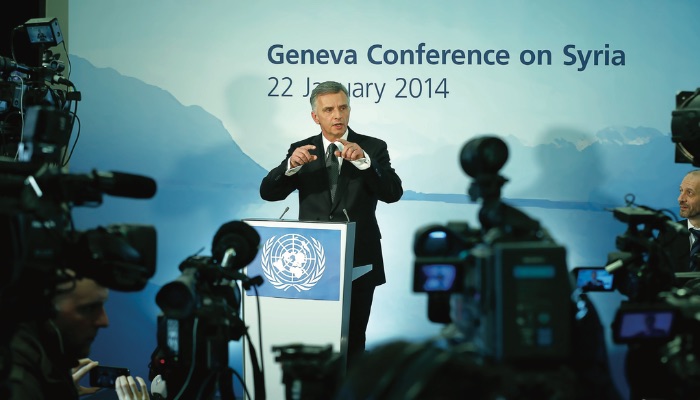
Caspian Energy (CE): Your Excellency, you characterized your presidency for 2014 as “Switzerland and Peace”. What will be your priorities for 2014? What kind of innovations do you plan to bring into cooperation of Switzerland with the leading world economies?
Didier Burkhalter, President of the Swiss Confederation: We do indeed wish to strengthen Switzerland's position as a place of peace and as an international platform which provides us with the opportunity to promote and discuss matters such as human rights, humanitarian aid, environmental protection, work and trade. With the UN located in Geneva, and given that Switzerland is neutral, belongs to no alliance and has no colonial past, it is able to achieve far more in these areas than its size would otherwise dictate. In assuming the Chairmanship of the OSCE this year, along with the added responsibility that entails, Switzerland has the opportunity to push for even greater stability and far-reaching peace in Europe. Dialogue in the South Caucasus, for example, is a priority for our Chairmanship.
But in answer to your question, Switzerland is not a member of any economic alliances or groupings of countries. That is why forging strategic partnerships with the most dynamic nations of today and tomorrow is vital. It is absolutely clear to me that in order to do that we need to have a strong presence on the ground through our network of representations abroad and a proactive foreign and economic policy. We will therefore continue to negotiate specific agreements to promote free trade and protect our investments, and enter into strategic partnerships in a targeted manner with countries and regional organisations such as ASEM, ASEAN, the GCC and the Pacific Alliance. These regions and markets are very important to an export-led economy like Switzerland’s. At the same time we are always mindful that our neighbours are our most important trading partners. A number of questions remain open with our neighbours – in the areas of taxation, road and air traffic, and energy – and these need to be answered.
CE: Greece, the present presiding country of the EU, declared that it attaches priority to cooperation with the countries located to the south of EU. In your opinion, which problems of the southern neighborhood of Europe need immediate solution?
Didier Burkhalter: The southern neighbourhood of Europe is marked by enormous changes and instability, with challenges for democratic transition becoming increasingly apparent. A consolidation of democratic reform in North Africa is hugely in Europe’s and Switzerland’s interest.
Underlining its support for North Africa, Switzerland responded rapidly to the upheavals of the “Arab Spring” by adopting, in March 2011, a strategy on developing its own substantial commitment. Our engagement focuses on democratic transition and human rights, economic development and promotion of employment, as well as migration and protection. It is conducted in partnership with both national authorities and civil society. A lot has already been done, but the “Arab Spring” is just beginning. Therefore, we are truly committed to continuing our support of North Africa.
CE: What is the position of Switzerland on cooperation with Azerbaijan, Georgia, Ukraine and Turkey?
Didier Burkhalter: With all these intertwined countries you are referring to a region which reminds me of a beautifully textured and colourful carpet. Switzerland has well established and increasingly intensive bilateral and multilateral relations with the countries mentioned. Considering the growing importance of this region, Switzerland – also in its position as OSCE chair in 2014 – is paying due attention to the challenges which have to be addressed in order to allow these countries to live up to their potential.
Speaking in alphabetical order, our cooperation with Azerbaijan is focussed on energy policy, economic relations, cooperation within the international financial institutions of the Bretton Woods system as well as international cooperation in the areas of economic development and employment, governance and public services, human security and protection. Azerbaijan is today Switzerland’s most important trading partner in the South Caucasus.
Our cooperation with Georgia is focussed on international exchanges, promoting economic development and employment, governance and public services, human security and protection. Since March 2009, Switzerland has represented Georgia’s interests in Moscow and Russia’s interests in Tbilisi. Based on this dual interest protecting mandate for Georgia and Russia, at the end of 2010 Switzerland was entrusted with the task of facilitating Russia’s accession to the WTO.
Our cooperation with Kazakhstan is focussed on increasingly close exchanges in the fields of economic development and international finance within the Bretton Woods system.
Our cooperation with Turkey is focussed on mutual interests, including the abolition of the death penalty, work within the Human Rights Council, the protection of cultural property, and economic relations. Turkey is an important economic partner for Switzerland. We envisage close cooperation with Turkey in major events such as the 2016 World Humanitarian Summit in Istanbul, the Swiss OSCE chairmanship and the G20 summit in Turkey 2015.
Our cooperation with Turkmenistan is focussed on political and economic relations and exchanges within the international financial institutions of the Bretton Woods system.
Our cooperation with Ukraine is focussed on political, economic and cultural cooperation. In the CIS, Ukraine is the second biggest destination for Swiss exports after Russia. In the framework of international cooperation, Swiss assistance focuses on reproductive health, local governance and public services, financial and economic sustainability as well as sustainable energy management.
CE: Which hopes does Switzerland rest on the TAP project? What will be the size of demand for energy resources in Switzerland in the coming years?
Didier Burkhalter: Security of supply through diversification is an important pillar of Switzerland’s energy foreign policy. We therefore welcome the selection of TAP as the pipeline infrastructure for the southern gas corridor. Switzerland supports the Trans Adriatic Pipeline (TAP) project for the following reasons: the diversification of Swiss gas supply, strengthening Switzerland’s geostrategic position and supporting the TAP company, which has its seat in Switzerland, and the Swiss electricity company AXPO, which is one of the TAP shareholders.
Switzerland’s demand for energy resources is expected to grow. After the accident at the Fukushima Daiichi nuclear power plant in March 2011, the government declared that nuclear power would be gradually phased out in Switzerland. Existing nuclear power stations will continue to run as long as they are safe, but they will not be replaced. Following the phase-out decision, the government has developed a long-term energy policy (“Energy Strategy 2050”) based on the revised energy outlook. It has also produced an initial package of measures aimed at securing the country’s energy supply over the long term.
CE: Switzerland’s close partner EU has overcome the crisis. How will the measures, that the European Commission and the leading European financial regulators are undertaking for limiting free bank transactions and developing the Banking Union of the EU, influence the economy of Switzerland?
Didier Burkhalter: In our understanding, the EU project of forbidding proprietary trading could be an attempt to limit free bank transactions. According to the proposal in its current form, about 30 of the 8000 banks in the EU would be concerned. Also a couple of banks of third States with branches/subsidiaries inside the EU would be affected, of which probably one of Switzerland’s two big banks. However, the proposal has to be discussed within the EU, a process which is not likely to be started before this autumn.
The European Banking Union could affect Swiss banks in two ways: First of all, it is planned that about 130 of the largest EU banks would be directly supervised by the European Central Bank (ECB). The Swiss Financial Supervisory Authority (FINMA) exercises the consolidated supervision of the Swiss banking groups worldwide. The shift of supervision responsibility towards the ECB could cause a degree of uncertainty. We hope that in future cooperation between FINMA, as the home supervisor of Swiss banks, and the European Central Bank, as host supervisor of their subsidiaries in the eurozone, can continue profitably.
Secondly the European Banking Union foresees creating a fund for saving banks that get in trouble. Such a fund would have to be financed beforehand – ex-ante – by banks in the EU. Branches of Swiss banks (or other third States) in the EU would probably be forced to participate. Concerning the framework for preventing and resolving banking crises, Switzerland opted for higher capital and liquidity requirements – comparable to Basel III and EU provisions – and not for an ex-ante financing scheme. If branches of Swiss banks have to meet the rules of both systems, they would suffer a comparative disadvantage compared to banking groups with the headquarters in a eurozone country.
CE: How do you evaluate Switzerland’s contribution to strengthening of the economic and financial stability of Europe and the world in general?
Didier Burkhalter: Through its development cooperation policy, Switzerland assists the Eastern European and Balkans countries (around EUR 3.6 billion since 1991). Within this framework, Switzerland supports the 12 member states who joined the European Union in 2004 and 2007 with a contribution of about EUR 1 billion. The funded projects are helping to fulfil the following objectives in particular: economic growth and improved working conditions, social security, environmental protection, public security and safety and strengthening civil society.
The enlargement contribution is also in Switzerland’s own interests. The projects promote numerous partnerships. Through this collaboration, Switzerland is not only cementing relations with the new EU member states, but also with the EU as a whole. The enlargement contribution is an important part of Swiss foreign policy in Europe and reinforces Switzerland’s image abroad.
But Swiss private companies also play an important role in the EU: Over 40 per cent of Swiss direct investments abroad go to the EU. In 2011 this equals more than USD 400 billion. Swiss companies have created more than 1.28 million jobs in the EU. Hundreds of thousands of EU citizens live and work in Switzerland. And a further 260,000 EU citizens commute across the border daily to work in our country. I think this is an important contribution to the economy and stability of the EU.
CE: How will the institutional issues be solved with the EU?
Didier Burkhalter: The Swiss government adopted the mandate regarding the negotiation of an institutional agreement between Switzerland and the European Union in December 2013. The Swiss government therefore wishes to reaffirm and strengthen its commitment to the bilateral approach, and to guarantee Switzerland’s continued prosperity and independence. The government has repeatedly affirmed its intention to keep following the bilateral path, fully convinced that it remains the best approach to preserving Switzerland’s interests. Negotiations are to begin once the EU has adopted its own mandate. The institutional issues are an important element of the government‘s medium-term strategy, encompassing all of the current European policy negotiations. The aim is to ensure a homogenous application of EU law incorporated in relevant bilateral agreements while fully respecting the autonomy and internal legal order of each party. The envisaged solution would provide for a homogeneous interpretation and dynamic adoption of relevant EU acquis in specific bilateral agreements, and for a role of the European Court of Justice in dispute settlement procedures. Any adoption of relevant EU law in the agreements would remain subject to the Swiss internal legislative procedures such as referendums.
CE: Today many countries rank the energy security with the state security. Which energy security–related tasks does Switzerland face today? To what degree are they associated with the European energy system?
Didier Burkhalter: Switzerland’s energy supply depends very highly (around 80 percent) on imports of fossil fuels and combustibles, and on imported nuclear fuels. Even the country’s electricity supply depends on imports, at least during winter months.
This high dependence on imports, the need to guarantee security of supply and the declared sustainability objectives of Switzerland’s energy policy mean that close cooperation with international energy organizations and foreign energy authorities is essential.
Switzerland maintains contacts at the highest level with neighbouring countries on a regular basis. The broad areas of cooperation range from security of supply through to the promotion of renewable energy, energy efficiency and energy research. Switzerland also has energy partnerships with countries outside the EU (Azerbaijan, Turkey, the United Arab Emirates and Russia). These partnerships serve the purpose of promoting sustainable energy sources and energy efficiency in these countries, but are also intended to help secure the southern gas corridor which is of considerable importance for Switzerland.
In discussions with the EU, Switzerland’s priority is to maintain its position on the European energy market. Switzerland has been negotiating an electricity agreement with the EU since 2007. The ultimate objective of these negotiations is to conclude a comprehensive energy agreement with the EU that encompasses not only electricity, but also aspects such as energy infrastructure, energy efficiency and gas.
CE: Do you think that the EU must implement a more coordinated-single energy policy?
Didier Burkhalter: The EU is completing a single energy market, has established the world’s largest emissions trading system and pursues common sustainability objectives, which, as with renewable energy, may be achieved through bloc-wide cooperation mechanisms. At the same time, important policy decisions, such as the shaping of a country’s energy mix, understandably remain within the remit of member states. The economic diversity of European countries also makes it difficult to implement some one-size-fits-all objectives, such as for energy efficiency. Recent developments, such as the soaring development of renewables, have had considerable ripple effects across member states, but also Switzerland. Some states are taking measures to avert unwanted loop flows or to bolster their conventional power plants. Such steps undermine the single energy market. Finally, Europe, because of its high import dependence, needs a more concerted approach to energy imports. European energy policy must, therefore, constantly strike a subtle balance between centralised policies which are required by a single market and national circumstances which reflect political concerns.
CE: Heads of leading energy concerns of Europe have recently expressed anxiety about possible “deindustrialization” of the European economy due to its low competitiveness. Do you agree with this opinion? What do you think the way out of this situation is?
Didier Burkhalter: Deindustrialization is a common phenomenon that is occurring in all advanced economies including Switzerland and most European countries. It is a process of long-term structural change, which entails a shift of production and employment shares from manufacturing to the service sectors. In Switzerland, this process was particularly pronounced until the end of the 1990s. Since then, it has become less marked in international comparison. Regarding competitiveness as well as export success, Switzerland is still in a very comfortable position. The Swiss manufacturing sector employs only a fifth of the economically active population but this sector is responsible for two thirds of all exports and for the biggest amount of private investments in research and development. According to studies carried out in Switzerland, but also by the IMF, the most important cause of deindustrialization is the strong productivity growth in the manufacturing sector, which cannot be achieved to the same extent in labour intensive service sectors. For this reason, the industry sector needs less workforce while a shifting of employment shares from the industry to the service sector takes place. The conclusion is that deindustrialization is not a negative phenomenon, but a natural consequence of further growth in advanced economies.
Export-oriented branches are currently experiencing transformations because of the progress made in the areas of informatics, telecommunication, transportation and logistics as well as the integration of emerging countries in the global economy. The production of goods and services occurs more and more globally and production is downsized in smaller work processes and increasingly takes place in different countries and by different producers - a phenomenon that has been described as “global value chains”. This means that a high degree of competitiveness can only be achieved through deep integration in the global economy and barrier-free access to international intermediate inputs. This is true for Switzerland but also for the rest of Europe. Export development, specialisation in high quality goods and services as well as our activity structure show that Switzerland, in the industrial sector, has, so far, been able to reach an excellent position in global value chains.
CE: How do you assess the outcomes of the Davos Forum? To what extent has it turned out successful this year?
Didier Burkhalter: The annual meeting of the World Economic Forum is a very interesting event because it provides all those taking part with a good opportunity to exchange views with a wide variety of people and pick up ideas from them. It also enables hands-on politicians like myself to fit a large number of bilateral talks into a short space of time. This year in Davos, for example, I was able to meet about ten different heads of state and discuss a multitude of issues with them.
CE: What kind of contribution is Switzerland ready to make to the process of reduction of CO2 emissions?
Didier Burkhalter: The impacts of climate change are a threat to all of humankind. We have only one Earth. Switzerland’s climate policy and its commitment to a rigorous reduction of its greenhouse gas emissions are a reflection of this fact. Switzerland has committed itself – both at the national and international level – to reduce its greenhouse gas emissions by 20 percent with respect to 1990 levels by 2020.
Together with a number of countries Switzerland has sent a strong signal in adhering to a second commitment period under the Kyoto Protocol. But together, the countries committed to the Protocol account for less than 15 percent of global emissions. It is thus crucial that all countries cooperate towards the elaboration of a new global climate regime for the time period beyond 2020. It is crucial that all countries contribute their fair share to the global effort to protect our climate.
The global community shares a responsibility to preserve a healthy and liveable environment, not only for our generation, but also for our children and their children. We can only reach this goal if we pull together and all do our utmost, both at the national and the global level.
CE: The 20th anniversary of the Contract of the Century signed in Baku is going to be celebrated this year. It is noteworthy that Caspian Energy is also celebrating its 15th anniversary this year. We kindly request you to assess these events from the standpoint of their regional significance and congratulate Caspian Energy’s readership in 50 countries of the world on the occasion of its jubilee.
Didier Burkhalter: It goes without saying that the “Contract of the Century” is one of the greatest chapters in Azerbaijan’s modern history. The oil contract, signed 20 years ago with important international energy players, helped Azerbaijan to increase its economic independence and dynamically integrate into the world economy. Thus, Azerbaijan has rapidly become an important regional energy hub and an important supplier of Europe. I would like to take this opportunity to congratulate the Azerbaijani people on the occasion of the 20th anniversary of the “Contract of the Century” and to wish them peace and prosperity! I would also like to congratulate Caspian Energy magazine which has accompanied this success story for 15 years.
Thank you for the interview