


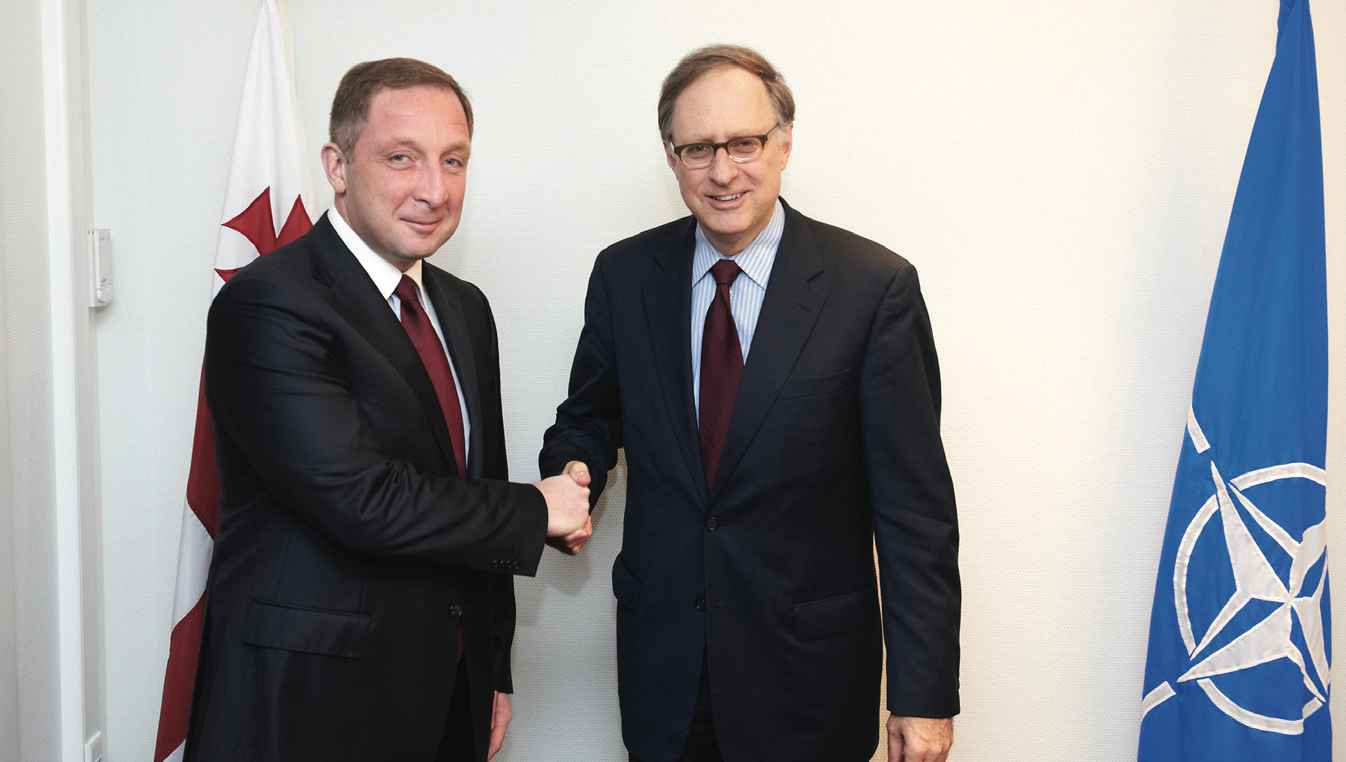
Caspian Energy (CE): To what degree was the past year successful for Georgia in terms of integration with Europe? What are the plans for 2014?
Alex Petriashvili, State Minister of Georgia on European and Euro-Atlantic Integration: The European and Euro-Atlantic integration is a cornerstone of Georgia’s foreign policy. This choice is confirmed by recent opinion polls and studies according to which up to 77 % of the population support Georgia’s European and Euro-Atlantic integration. We also have a consensus among the main political forces on Georgia’s European choice, reflected in the respective declaration of the Parliament of Georgia.
At present, we are witnessing the unprecedented dynamism in the EU-Georgia relations. The most important achievement was the initialling of the Association Agreement, including the Deep and Comprehensive Free Trade Area (DCFTA) with the EU at the Eastern Partnership Summit in Vilnius on 28-29 November.
The Government of Georgia is making its best efforts to deepen the EU-integration related reforms. We believe that Georgia’s integration into the EU will provide us with greater opportunities to build democratic institutions, ensure freedom and security.
It is well known that free and fair elections are the backbone of democracy. In October, Georgia passed a litmus test by successfully holding the Presidential elections. As underlined by the international observers, this was truly democratic elections conducted according to the highest international standards and revealing commitment of the Georgian people to the European values.
Georgia also advanced in the Visa Liberalisation Dialogue with the EU and has a good record of implementation of the respective action plan, which was underlined at the Vilnius Summit. The progress on mobility is one of the most important issues for ordinary citizens, as a real integration is impossible without close people-to-people contacts, cultural exchange and academic cooperation. There are all preconditions that visa free travel in the EU is not a long term perspective.
The Government of Georgia has already started preparations for the post-Vilnius period aiming to strengthen state institutions, including monitoring and coordination capacities for effective implementation of the AA/DCFTA commitments.
We will start the implementation of the Association Agreement before its signature. For this, we look forward to adopting the Association Agenda in April, which will replace the European Neighbourhood Action Plan. The EU’s increased political support, more engagement and visibility as well as relevant assistance, based on the main principles of differentiation and “more-for-more”, will play a crucial role for the success of this process.
Strengthening support of Georgian citizens and active engagement of society in the European integration processes is of utmost importance. With this aim, the Government of Georgia has adopted the “EU Communication and Information Strategy for 2014-2017” in order to increase the EU visibility and raise public awareness on the EU-Georgia cooperation.
CE: How would the EU evaluate the outcomes of the Eastern Partnership Summit in Vilnius? To what extent was it useful for Georgia?
Alex Petriashvili: The Government of Georgia welcomes the Vilnius Summit as a historic event for Georgia. The most significant deliverables was the initialling the Association Agreement, including the DCFTA. We are confident that the Association Agreement will bring the political and economic relations between the EU and Georgia to the qualitatively new level and will make the Europeanisation of the country irreversible.
The Vilnius Joint Declaration is a forward-looking document, which contains the main guidelines for implementation of the post-Summit goals. We believe that the Declaration will ensure the dynamic and progressive development of the cooperation. Georgia is actively involved in the Eastern Partnership initiative and is ready to deepen cooperation with partner countries.
CE: What are the conditions of the initialed Association Agreement with the EU and creation of the free trade zone? When is the final agreement planned to be signed?
Alex Petriashvili: We consider the Association Agreement, including the DCFTA, as a modernisation plan that brings Georgia up to the European standards. Since the initialling of the Agreement we have entered the implementation phase. We are dedicated to translate our commitments into concrete actions for the benefit of our citizens and accelerate reform process according to our European agenda.
We appreciate the recent statement of the President of the European Council Herman Van Rompuy to speed up the signing of the Association Agreement by August at the latest as well as readiness of the EU side to support the acceleration process of Georgia’s European integration. The timely signature of the Association Agreement, including the DCFTA will enable us to start its provisional application. We rely on the EU’s efforts to timely complete the technical process of legal scrubbing.
CE: What will be the impact of the Association Agreement with the EU on the trade relations with Azerbaijan, Georgia’s close neighbour and partner?
Alex Petriashvili: Regarding trade relations, we believe that the DCFTA will significantly expand the Georgian export and ensure Georgia’s sustainable economic development. Azerbaijan is Georgia’s one of largest trading partner. We are the strategic partners in the area of energy cooperation. Our countries have significant potential to deepen economic relations in many directions, such as transport, investments, tourism, etc. We are confident that Georgia’s close relations with the EU will be beneficial for Azerbaijan as well.
Besides that, the cooperation within the Eastern Partnership has a high potential to be a good catalyst for deepening economic relations among EaP partner countries.
CE: Is it planned to expand the investment component of the Georgia-EU cooperation?
Alex Petriashvili: We believe that the formation of the DCFTA will be an important supporting factor for Georgia’s economic development. We expect that the DCFTA between the EU and Georgia will promote private sector development by creating a transparent and stable business environment that will significantly increase Georgia’s investment attractiveness to the EU investors as well.
At the same time, we admit that more attention should be paid to the implementation of concrete projects in the Eastern Partnership framework. For this purpose, we hope that additional financial resources have to be allocated by the EU, including more active involvement of the European Investment Bank and the European Bank for Reconstruction and Development. Business-to-business dimension of the EaP has also significant potential to be further developed and deserves a special attention from all participants.
CE: How would you assess the intensification of negotiations between EU and Turkey? Is Georgia interested in Turkey’s entry into EU?
Alex Petriashvili: Turkey is Georgia’s one of the most important political partner and the largest trading partner. Interests of our countries are mostly interlinked. The regional cooperation projects, such as the Baku-Tbilisi-Ceyhan (BTC) Crude Oil Pipeline and the Baku-Tbilisi-Erzurum (BTE) Natural Gas Pipeline are of utmost importance for both of us. The opening the Baku-Tbilisi-Kars (BTK) railway project is marked yet another milestone providing a new impetus for fostering further regional cooperation.
The Government of Georgia supports Turkey’s EU aspirations and welcomes the intensification of negotiations between the EU and Turkey. We consider the Turkish experience in terms of the EU integration valuable for Georgia. At the same time, we believe that Turkey’s advancement towards the EU will also be beneficial for Georgia.
Thank you for the interview