


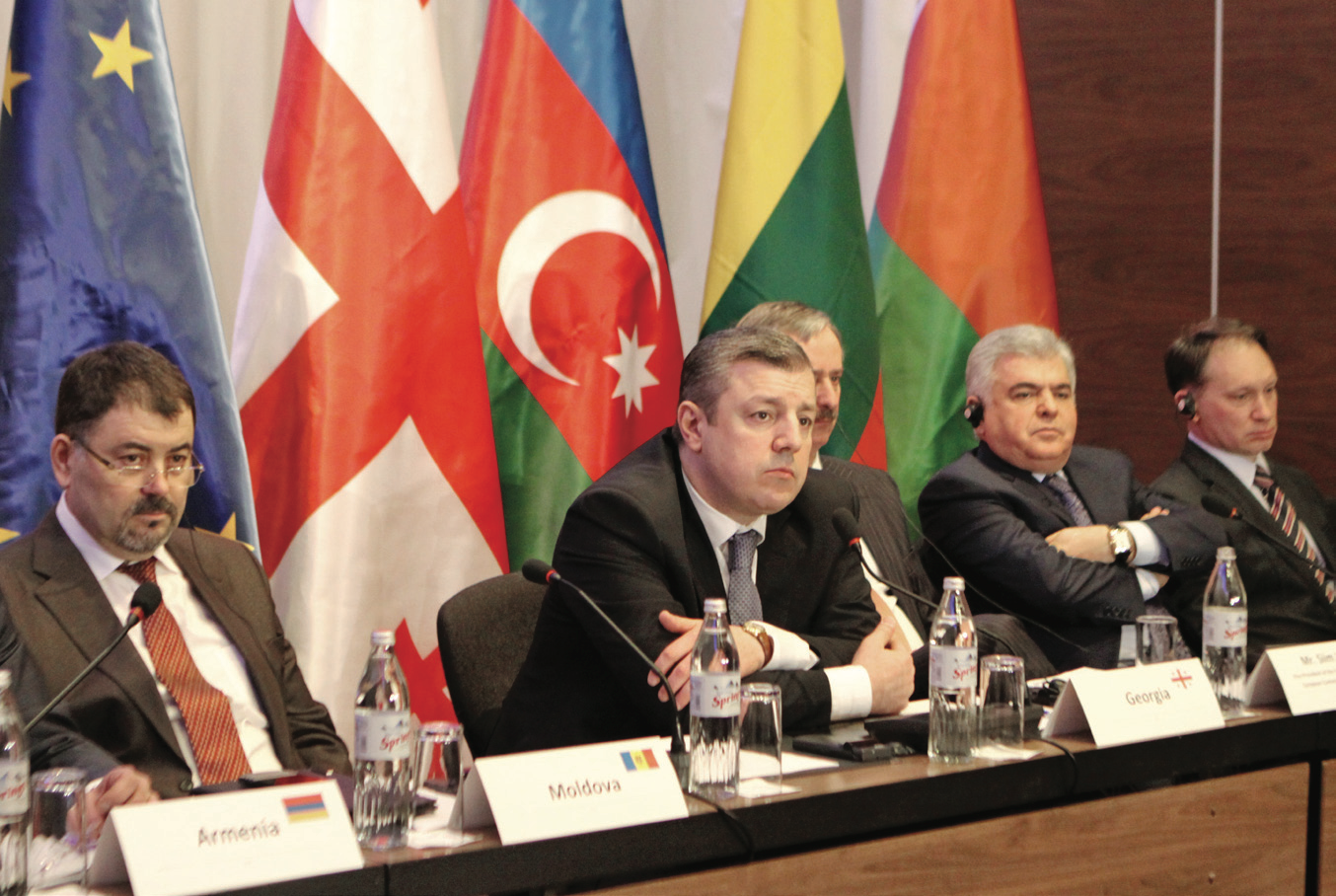
Caspian Energy (CE): How would you evaluate the results of 2013 year? What are the plans for the current year?
George Kvirikashvili, Minister of Economy and Sustainable Development of Georgia: In the light of the events concerning the shift of power in Georgia that happened in the recent two years, which usually influences the economy, the general assessment of the 2013 results can be considered rather positive and optimistic.
Despite some slowdown in the rates of economic upturn in the three quarters of 2013, the positive trend of growth has been observed already since the fourth quarter of the last year. According to the preliminary results, the real growth in November and December exceeded 8%, which is going to reach 3.1% at year-end.
There is also a positive growth in the amounts of direct foreign investments. In the third quarter, 2013, the growth comprised 20% vs. the similar period of the previous year.
Georgia’s foreign trade also features the growth trend. In 2013 the growth of export reached 22% in comparison with the last year, while the total trade turnover grew by 6%.
The trade turnover in the business sector grew by 24% in IIIQ 2013 vs. IQ 2013 and the production output increased by 27%. Besides, in IIIQ 2013 employment in the business sector grew by over 2,000 employees.
In addition, it is noteworthy that Georgia ranked the eighth in Doing Business 2014 (vs. the 9th position in 2013). It once more proves that the business doing environment in our country is favourable. At that, the Government of Georgia stays strongly committed to improving the business doing environment and raising the competitiveness of the Georgian production sector as well.
All the mentioned trends enable to state that the 2013 year was positive and optimistic. So, we hope that 2014 year will show even much better results.
With regard to the plans for the 2014 year:
Since our economic policy is based on the principles of the free market economy, we are planning to work hard to: ensure free competition, protect the rights of private property, and continue improving the investment and business environment of the country; to raise competitiveness of the Georgian economy; to support business, in particular small and medium-size businesses and startups, including improved access to funding; to develop innovations; to develop and deepen international trade relations, which in turn will foster a growth of export; to promote integration of the transport systems of Georgia into regional and international transport systems, etc.
At that, maintaining macroeconomic stability is the key factor for sustainable development of the country.
CE: Which global events of the 2013 year strongly influenced the Georgian economy?
George Kvirikashvili: As you know, in recent years the world economy has been featuring both a slowdown of the economic growth (recession in many countries) and a decrease in direct foreign investments. In 2012 vs. the previous year global direct foreign investments decreased by 18%. The decline comprised 31.6% in the developed countries, 41.7% in Europe and 6.5% in the Commonwealth of Independent States. The United Nations Conference on Trade and Development forecasted no change in the trend for 2013.
It is also noteworthy that the economic upturn was not positive in 2013. The total GDP of the European Region fell by 0.4%, while the GDP growth of the Commonwealth of Independent States made only 2%.
Since these countries are our major trade and economic partners, it is natural that the trends in those countries have certain influence on the Georgian economy.
CE: Could you please outline future plans on integration into the European economy?
George Kvirikashvili: The European integration is the important strategic aim of the home and foreign policy of our country.
Last year Georgia finalised the talks with the European Union on the Association Agreement and Deep and Comprehensive Free-Trade Agreement as its inescapable part. The Government of Georgia sees this agreement an important step towards the European integration.
The Deep and Comprehensive Free-Trade Agreement with the EU considerably differs from customary free trade agreements. It envisages liberalisation of both trade in commodities and trade in services, including the gradual rapprochement of the Georgian legislation in the field of trade to the relevant EU legislation, which is particularly important.
We are applying all efforts to sign the Association Agreement with the EU as soon as possible and stay committed to continuing reforms that the country needs to implement for the maximum use of new possibilities of integration into the extensive European market and raising the investment attractiveness of the country.
CE: Which sectors of Georgian economy are nowadays the key ones in the GDP structure of the country?
George Kvirikashvili: The largest shares in country’s GDP for 9 months of 2013 belong to the following sectors: production sector (17.1%), trade (17.1%), transport and communications (11.1%), agriculture (9.7%) and construction (6.1%).
During the period a considerable increase fell to agriculture (9.0%), financial intermediation (7.6%), real estate, rent and services (6.3%), production and trade (per 4.5% each), hotels and restaurants (3.1%).
CE: How much has the implementation of the Baku-Tbilisi-Kars project progressed in Georgia? Which challenges do you face in the process of its implementation?
George Kvirikashvili: Within the framework of the project we perform construction, rehabilitation and upgrade of the 180-km Marabda-Kartsakhi railroad line: the first section Marabda-Akhalkalaki (153 km) will undergo rehabilitation and upgrade and the works on the second section Akhalkalaki-Kartsakhi - frontier of Turkey (27 km) include construction of a new railroad line, including a railroad tunnel.
By now, the most part of works has been already completed (over 1/3). Testing on the railroad line is scheduled for late 2014.
All operations are performed in line with the existing work schedule and we hope to finalise the project in 2015 as scheduled.
The project is strategic not only for Georgia, but also for the Republic of Azerbaijan and the Republic of Turkey. The main railroad line will connect Europe and Asia, thus facilitating transportation of cargoes and passengers in both directions. The first phase envisages freight traffic in the amount of 5 million tons with subsequent expansion of the mentioned indicator. This project will also help to attract additional transit cargo flows, raise the competitiveness of the TRACECA transport corridor, foster creation of new jobs and give a new impulse to a further development of the economic cooperation in the region.
CE: What could you say about development of the investment cooperation with Azerbaijan?
George Kvirikashvili: Azerbaijan is one of the important strategic partners of Georgia. Azerbaijan has been also leading among the major trade partners in recent years and is now the second largest trade partner of Georgia.
The trade turnover between Georgia and Azerbaijan increasingly grows from year to year. For instance, in 2013 the trade turnover grew by 7% and amounted to approximately $1.35 bn.
The investment cooperation between our countries is also developing very actively. In 1997-2012 the total amount of Azerbaijan investments into the Georgian economy made approximately $620 mln. According to the data for 2012, the amount of investments reached $59 mln. Investments were channeled to such sectors as energy, processing industry, financial sector, transport, healthcare, real estate, etc.
CE: Could you please speak about plans on development of cooperation with Russia, Kazakhstan and Turkmenistan?
George Kvirikashvili: Russia, Kazakhstan and Turkmenistan are certainly interesting economic partners for Georgia.
Since 2013, when Georgian agricultural goods entered the Russian market, the trade turnover with Russia has increased by 50% and amounted to $780 mln. Being among the ten largest trade partners of Georgia, during only one year Russia has changed from the sixth position to the fourth one.
Fruitful cooperation with such dynamically developing countries as Kazakhstan and Turkmenistan, which certainly feature the huge economic potential and rich resources, is also important for Georgia. We lay special emphasis on development of long-term cooperation with these countries, both in bilateral and multilateral formats. For instance, in case with Kazakhstan we find prospective to cooperate within the ТRАСECА project and some other regional projects. No less important is to deepen cooperation in the field of investments because nowadays we have the positive examples of placement of Kazakh investments into the Georgian economy. As a result, we are now working on a number of interesting projects. With regard to Turkmenistan, we find cooperation in the energy sector the most promising.
CE: What do you think about a probable rebirth of Georgia-Ukraine-Azerbaijan-Moldova economic alliance?
George Kvirikashvili: Georgia continues active cooperation within the Organization for Democracy and Economic Development - GUAM. We believe this alliance could promote further regional cooperation and development. This organisation has the potential to foster a further development of regional projects in such fields as trade, tourism, transport, etc.
CE: Could you please tell about the development of the Georgian economy with regard to innovations?
George Kvirikashvili: The Government of Georgia is now preparing on a long-term strategy on development of innovations and technologies in the country ‘Innovative Georgia 2020’. The strategy will highlight key priorities of the innovative development of Georgia. The Technology and Innovation Agency of Georgia was set up to achieve concrete objectives. The agency will promote commercialization of knowledge, development and export-oriented high techs and innovations, and also facilitate more efficient use of innovations and technologies in the economic sectors of Georgia and development of infrastructure facilitating creation of an innovative ecosystem.
Thank you for the interview