


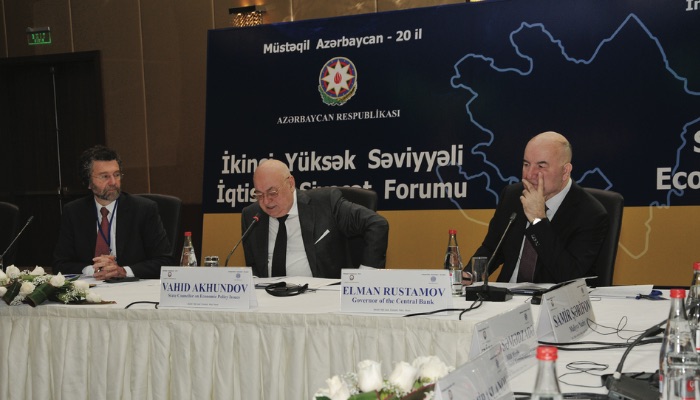
Caspian Energy (CE): Will the CBA continue rigid monetary policy in order to maintain the national currency stability?
Elman Rustamov, Chairman, Central Bank of Azerbaijan: Like in previous years, the key near-term priority of the Central Bank of Azerbaijan will be to maintain macroeconomic and financial stability with a view to support diversification of economy. To that end the Central Bank is going to try to keep a single-digit level of inflation, provide financial stability of the banking sector and stay committed to deepening the financial intermediation.
It is difficult to foresee now whether the Bank will follow rigid or soft monetary policy in the future. Depending on a macroeconomic situation in the mid-term outlook as well as next year, the Central Bank will be able to use different options of monetary policy. The Central Bank has worked out adequate scenarios of reaction at different courses of events. In case of a risk of abundant increase in prices of forecast indicators, the Central Bank will certainly embark on anti-inflationary measures. In case of demand inflation, the Bank can take into use the “monetary restrictions policy”, while if import inflation occurs the Bank will apply appreciation of the exchange rate. In case of significant deviation of actual inflation from target figures as a result of weakened aggregate demand or a possible threat of economic growth in non-oil sectors, the monetary policy can be softened.
CE: What macroeconomic figures in Azerbaijan would you suggest for 2014 and the coming years?
Elman Rustamov: According to the forecasts of the Government of Azerbaijan, the Central Bank and international financial organizations, in 2014 and the mid-term run the economic situation in the country will feature macroeconomic stability and sustainable growth along with intensified processes of diversification.
For example, as specified in the primary forecasts of the Ministry of Economy and Industry, in 2014 the growth of economy in the country is expected to comprise 5.2%, including the growth of the non-oil sector at 10%.
Supported by the economic growth, the positions of Azerbaijan in external markets will continue strengthening. The current account surplus is expected to promote growth of strategic currency reserves of Azerbaijan in coming years.
According to official forecasts of the Government, the average annual inflation in 2014 is to comprise 3.5%. The forecasts of the Central Bank also prove that next year inflation will maintain on a low level if no external shocks take place in the food market. Stabilization of inflation-related expectations this year will be one of the factors to hamper any growth of prices. The ongoing reduction of growth rates of money stock will help keeping headline and core inflation on the minimum level in the mid-term run. In October inflation for the last 12 months comprised 2.6%, and core inflation did not exceed 1.1%.
As far as prices and tariffs regulated by the state are concerned, there is no official decision regarding their escalation in 2014. In general, the share of goods and services with prices regulated by the state do not exceed 15% in the consumer basket. It means that a 1-percent rise in these prices and tariffs can directly affect inflation by only 0.1%. At that, the core inflation does not change. Indirect effects on inflation of state-regulated prices and tariffs depend on their share in prime cost of produced consumer goods and services.
A low level of inflation next year will foster a growth of real household income, help preserve favourable conditions of international competitiveness of the non-oil export and also boost investment activity and financial stability.
CE: Is it possible to say now that the background of the eurozone does not represent any threat to the banking system of Azerbaijan? Which measures should be applied to promote its sustainable development?
Elman Rustamov: It would be wrong to ignore the current situation in the eurozone against the background of processes of integration into the global financial system. The process of rebalancing between main economic hubs is flowing slowly and painfully for the whole global economy. As to Azerbaijan, in general the national economy has showed the high level of resistance and successfully come through bad consequences of the global economic crisis. Azerbaijan did it despite a significant decrease in global prices for main export goods during the peak of the crisis, which led to a fall in external financial flows into economy. However, tremendous financial reserves of the country accumulated in recent years, their efficient use and coordinated endeavours of the Government and the Central Bank have enabled to balance in a flexible way and boost a dynamic development of the main areas of economic growth.
In general, I would like to emphasize that in the previous period we have accumulated the extensive experience in operating our banking sector against the background of global turbulence. Considering our previous experience I would like to say that currently the main base for financial stability is to ensure a balanced lamellar growth of the banking sector. It, in turn, drives a necessity for banks to follow an optimum baseline between the level of profitability and readiness to accept risk.
In the near-term outlook sustainable development of the banking sector will depend on the ability of banks and their shareholders to generate capital. In this context, it is necessary to highlight formation of a new configuration of the global banking system after implementation of Bazel-3 recommendations, which along with qualitative improvement requires a significant absolute growth of banks capitalization.
In addition, I would like to stress that not all unambiguously depends on the banking sector. The measures aimed at stepping up protection of rights and enhancement of financial awareness of consumers of financial services can play the significant role. I believe it is obvious that a literate and protected consumer is associated with a stable and healthy growth of the banking sector.
CE: To what degree are new Bazel-3 based standards applicable in present conditions? Which Bazel-3 based standards are not applicable in Azerbaijan?
Elman Rustamov: The global financial crisis as well as shortcomings revealed in the financial regulation system had predetermined the necessity for improving the quality of control and risk management in the banking sector.
In this context the Bazel committee for banking control has developed methodological recommendations in the field of banking regulation – Bazel-3. The main purpose of this document is aimed at increasing requirements for the bank capital, suggestion of new instruments on macroprudential oversight as well as introduction of new regulatory requirements for liquidity.
As far as the Central Bank is concerned, we have already started implementation of certain elements of Bazel-3 that are the most important for our banking sector. Thus, since March 2011 we have been applying the main protection tool (leverage coefficient) introduced by the Bazel committee. This same instrument is a practicable mechanism for minimizing risks associated with the excessive growth of bank assets. The main components of the regulatory capital were revised to stable.
Apart from this, the CBA assessed the possibility of application of liquidity ratios offered by Bazel-3. The first indicator - the liquidity coverage ratio is practically identical to the current liquidity that is applied at the moment. It is the most perfect tool and planned to be applied as a regulation in the future.
Implementation of the second indicator, net stable financing indicator (long-term liquidity indicator), still remains a subject for discussion in the international arena. Its application at this stage may lead to the loss of one of the bank’s classical functions aimed at transformation of attracted funds into long-term assets. Considering the negative aspects of this indicator’s impact on the financial stability and policy of the long-term financing of the economic growth, the CBA decided to postpone the usage of this coefficient in a normative order. However, the CBA will apply it as an indicative norm.
CE: How well does the Central Bank manage to deal with the supervisory role? Do you find the number of financial institutions and banking structures adequate to present rates of the economic development of the country?
Elman Rustamov: First of all, I would like to note that there is no such concept as an optimal number of financial institutions for a certain country applied in the theory and international practice. In this regard, we still attach bigger importance to the financial welfare and sustainability of the financial institutions rather than their quantity.
Considering these two important factors, it is necessary for the banking system to continue performing its main function that would be financial intermediation. On the other hand, banks have to satisfy the growing requirements of the business caused by the increase of the economy and requirements of the real sector. In this context it is necessary to encourage the process of consolidation of the capital base of the banks, expansion of the investment potential as well as the growth of quality of the corporate management.
CE: What changes will the banking system face in terms of institutional development?
Elman Rustamov: Institutional development of the banking sector will considerably depend on running global economic processes. Institutional development of the banking sector is under focused attention of the regulator. CBA is currently undertaking measures for introduction of the new philosophy of corporate management, assets evaluation and risks management. I assume that the abovementioned measures will lead to the qualitative improvement of the institutional development of the sector.
The CBA will also undertake measures for strengthening the market discipline, creating equal conditions for all market participants, improving the system of electronic payments, stimulating migration of modern banking technologies into the national banking sector and strengthening infrastructure of non-banking credit organizations.
CE: What is necessary to promote development of the commercial banks? It is planned to enlarge presence of global financial giants in the local market?
Elman Rustamov: I assume that the rates of development of the banking sector and the processes occurring in the economy often have mutual influence. Nowadays the banking sector is the accelerator of the dynamically developing economy of Azerbaijan. Thus, the average annual growth rate of the banking sector totaled 14% over the past 5 years. The sector demonstrated stable growth rates even during the crisis period.
As far as the foreign capital is concerned, I would like to note that 22 out of 43 commercial banks are foreign-invested banks. Apart from this, 4 representative offices of foreign banks (Commerzebank, City Bank (Turkey), Rosselhozbank, Societe Generalle) are operating in Azerbaijan.
We have repeatedly stated that there are no restrictions for participation of the foreign capital in our banking sector and the CBA is interested in operation of the “brand” banks in our market. The participation of these banks promotes competitiveness and corporate management in the banks, as well as application of new technologies, that finally leads to the improvement of the quality of banking services and products.
Subsidiaries of such banks as VTB Bank (Russia), UNiCredit (Turkey, Italy) are operating within our banking sector.
CE: What measures are planned to be introduced within the framework of the financial stability policy of the Central Bank?
Elman Rustamov: Azerbaijan’s banking sector is the engine of the whole financial system of the country and significant source of financing of the real sector of the economy.
In spite of the global financial crisis, the banking sector of Azerbaijan has been developing successfully and demonstrating high level of sustainability.
The main infrastructure had been created during the pre-crisis period to maintain the financial stability including preventive anti-crisis measures. Thus, as early as the pre-crisis period the CBA activated a dialogue with the banking community in order to motivate banks toward restrained behavior as well as improvement of the risk and corporate management systems. Besides, requirements for the quality of assets and mortgage security of credits were toughened. The reserve asset ratio was increased.
Coordinated actions of the CBA had a positive impact during the aggravation of the financial crisis. Within the framework of the anti-crisis measures the banking sector gained considerable volume of liquidity; appropriate changes were made in the legal framework in order to provide the CBA with additional instruments aimed at maintenance of the financial stability; a five-fold growth of the size of the deposit liable for insurance is also aimed at protection of a high amount of depositors, and it stimulated an additional flow of deposits into the banking system.
The Central Bank’s further activities will focus on ensuring stability of the banking system, undertaking measures provided in the long-term Development Concept “Azerbaijan – 2020, future outlooks”. Special importance will be attached to measures aimed at increase of quality of the banking operations, ensuring of sustainability of credit organization and improvement of the banking supervision.
In order to improve banking supervision and regulation the Central Bank of Azerbaijan will continue the work aimed at the growth of the quality of the banking capital and assets, limitation of risk including the rate of their exposure, growth of the accuracy of accounting records and reports of credit organizations.
Provision of the financial stability proposes:
- to pay high attention to timely identification and assessment of system risks in the banking sector and other segments of financial markets;
- promotion of transparent operation of credit organizations;
- to unify measures of the banking regulation and supervision with the requirements of Bazel-3;
- to develop risk-oriented approaches, considering on the best foreign practices, during the supervision;
- to improve the bank risk management systems (use of stress-testing for evaluation of the bank sustainability and vulnerability);
- to apply a differentiated approach taking the system value, risk profile and level as well as transparency of credit organizations into consideration;
- to develop supervision on consolidated basis;
- to strengthen analytical and technical potential of the CBA (forecasting and evaluating banking risks on basis of dynamic stochastic equilibrium, to improve macro stress-testing, etc.).
CE: What could you tell about changes that the Central Bank is going to introduce in the mortgage market for the revival of the real-estate market lending?
Elman Rustamov: In an effort to improve the system of the mortgage lending the Central Bank has developed a new strategy envisaging comprehensive approach for system improvement, regulation over demand and supply in the real estate market, broader access of the population to mortgage credits, creation of new mechanisms and services as well as attraction of local and external investors along with the usage of state funds.
Considering international experience and local specifics the strategy is to focus on 4 main directions.
The first direction is aimed at expansion and facilitation of the social mortgage mechanism. Reduction of the interest rates on mortgage lending as well as the initial payment sum is the first to be carried out in this regard. Taking into account the international practice including that of Turkey and Kazakhstan, it is offered to create a mechanism of social construction, increase building of the economic class apartments by the state and bring them to conformity with the conditions of the social mortgage in order to spend funds more rationally and meet the demand maximally. Based on this mechanism, the construction is to be financed by state funds and profits received from apartments’ customers. Ready and fully repaired apartments are sold to the citizens’ priority category on basis of financial leasing and in an order of precession.
The second direction of the strategy envisages financing facilities at the expense of personal savings of the citizens. In this case we have applied the experience of the German construction-savings banks. In our opinion, existence of the alternative system in the mortgage market will increase the population’s opportunities to save funds for making primary payments on mortgage credits as well as stimulate citizens to accumulate savings for buying apartments. This experience was successfully applied in Kazakhstan and Eastern Europe.
Besides, the strategy provides a stage-by-stage switch to a market mechanism in order to liberalize, expand crediting and provision of new services on basis of market conditions, to reduce the dependence of the mortgage crediting on state funds and develop a mechanism of stable financing.
The final direction is to improve the existing legal and institutional mechanism. In order to be able to implement the above-mentioned proposals this direction is mainly associated with the improvement of normative documents, adoption of new procedures and creation of the corresponding infrastructure including the creation of the mechanism to guarantee mortgage credits.
The mentioned strategy is currently under discussion. We hope that after adoption and approval of the given strategy our citizens will obtain broad opportunities in the field of housing provision.
Thank you for the interview