


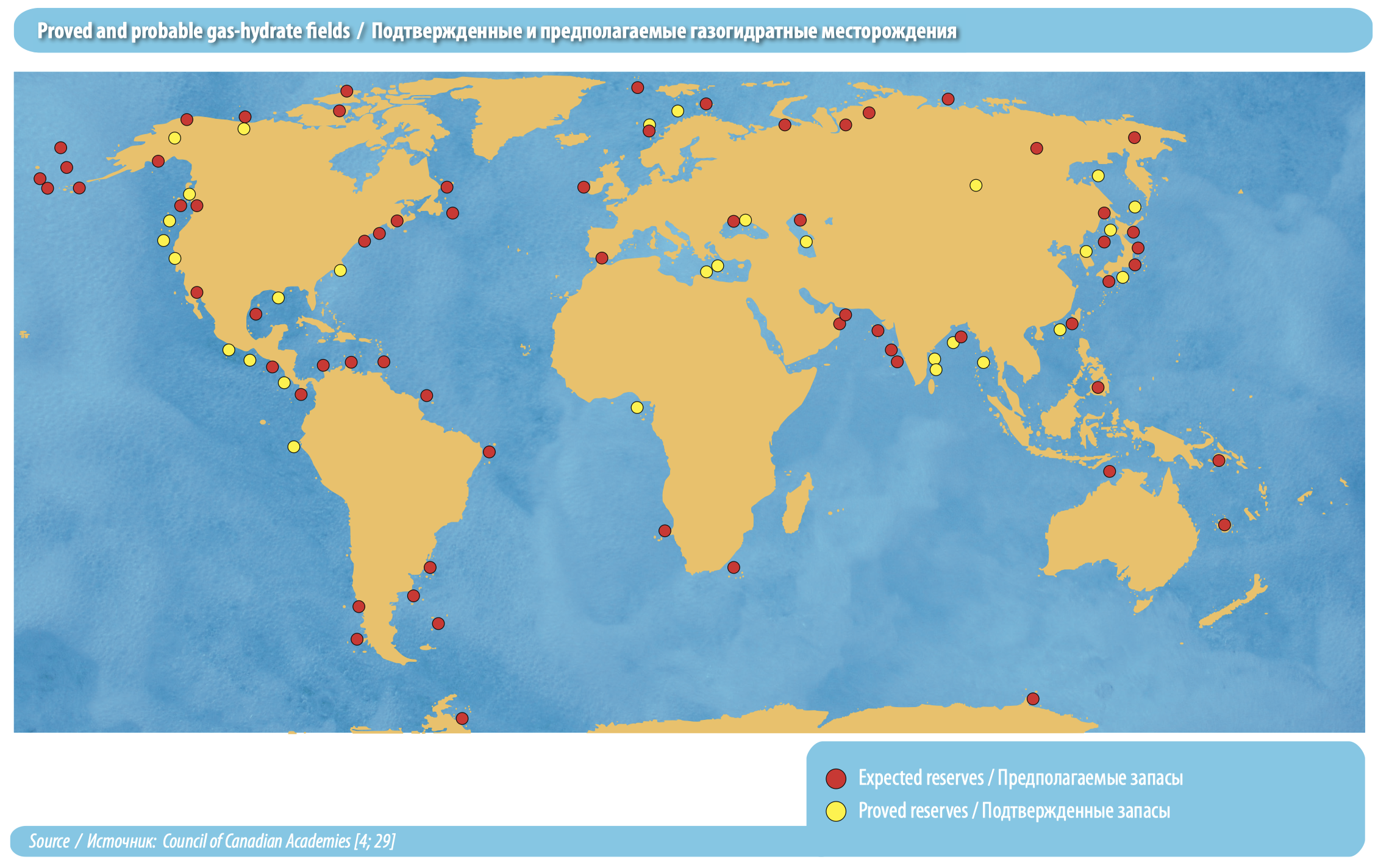
Despite considerable emission of methane into the atmosphere, natural gas has been found the most environmentally friendly energy resource. Gas hydrate deposits are one of its unconventional types. It is highly effective energy resource consisting of solid crystalline compounds of low-molecular gases (mainly methane) with water. Externally they remind snow or spongy ice. The hydrates lie deep in the seas and oceans (over 500m) in conditions of either high pressure or low temperature. The depth where the gas hydrates lie on the offshore bed ranges between 500-1500m. The depth of the occurrence in the Arctic zone reaches 200-1000m. About 164—180 cubic meters of natural gas are produced out of one cubic meter of hydrates. By content of energy (thermal value), gas hydrates are comparable with bituminous oil and oil-bearing sands.
According to geologists, global resources of crystalline hydrates lying on the sea-beds and permafrost zones (onshore) may reach 250 trillion cubic meters. This energy reserve exceeds all explored global oil, coal and gas reserves twice as much.
Hydrates were for the first time produced in laboratory conditions by the British scientists of the 19th century. No one assumed their existence in natural conditions then. Later, technogenic gas-hydrates which occasionally blocked the natural gas flow were revealed in gas pipelines in 1930s. Development of the Messoyakh field (West Siberia) commenced in 1960s enabled to discover natural gas hydrates. In 1970s they were found in the samples taken from the well on the north slope of Alaska and the Caspian Sea bed. As the result of researches held in 1980s, gas hydrates were considered as new and potentially broad source of methane.
Broad-scale programs on discovery and development of gas hydrates have been carried out in the world since the end of the past century until the present time. Among the companies-pioneers of this industry noteworthy are the Japanese national corporation of oil, gas and metals JOGMEC, Japex, Japan drilling, Norwegian university of Bergen, Conoco (Malik-Canada field, north slope of Alaska, the coast of the Japanese peninsula Azhumi), Chevron (exploration of geology of occurrence of gas hydrates in the Mexican gulf).
Big investments mainly in the Asian-Pacific region, rapid promotion of new technologies, encouraging results of their use in different parts of the world provide ground to assume that the gas industry is on the threshold of new revolutionary changes similar to the shale gas revolution in North America. It is proved by experimental data obtained in Japan and China last year as well.
In summer of the past year the government of Japan commenced the first broad-scale exploration of assumed methane hydrate fields on the bed of the Japanese Sea. Within the framework of the governmental program the special exploration vessel will hold exploration by operations near the Noto peninsula (Isikava prefecture) and the area of Sado island (Niigata prefecture, the western part of the central island Honshu).
Performance of exploration work has been assigned to specialists of the national institute of advanced industrial sciences of Japan and the University of Maydzi. This campaign is to last for about 3 years.
About 1 bln Yen ($105.6 mln) was appropriated by the state budget of Japan in 2013 for exploration in this area. There are plans to conduct exploration (till 2015) on fields located by the coast of Simane, Akita, Yamagata and Hokkaido prefectures.
By the mid of March the Japanese specialists had performed trial production of methane-hydrates on the field located 80km to the south from the Azhumi peninsula (the Pacific coast of the Honshu island). During the experiment, they managed to recover over 13,000 cubic meters of gas out of the produced resource.
The reserves of the field, according to the estimations of experts, correspond to the volumes of gas consumption in Japan for the last 14 years. Commercial production of gas is expected to be launched in the coming five years.
The Ministry of Land and Natural Resources of the People’s Republic of China announced that from June till September 2013 the Chinese marine geologists for the first time received examples of gas hydrates with high degree of purity (gas hydrates) in the water area near Guangxi. Besides, the drilling showed presence of considerable controlled reserves. The Zhen’min’ Zhibao newspaper reports about it with reference to the site of the Chinese government.
The Deputy Director of the Geological Exploration Division of the Ministry of Land and Natural Resources of the People’s Republic of China, Che Changbo said the discovered examples of gas hydrates are remarkable for four main characteristics. In particular, they feature shallow superficial bedding, big thickness, diversity and high purity.
As a result of drilling of 23 wells, the area of controlled gas hydrate distribution covers 55 km2. In the future gas hydrates can be converted into natural gas. Controlled reserves make 100-150 trillion cubic meters, this figure is equal to the especially vast scales of conventional natural gas.
The Ministry of Energy of the Russian Federation thinks that a revolution in the global energy market will be made not by production of shale gas, but through development of gas hydrates.
“There are such changes, which are considered to be revolutionary. They can lead to a change of energy balances. For example, the accident on Fukushima has become an unexpected factor. I believe that the next case able to change the system is development of gas hydrates”, RF Minister of Energy Alexander Novak said this in the interview to Russia 24 TV channel.
“The reserves of gas hydrates are more than two times higher vs. the total reserves of shale gas and conventional natural gas. Currently it seems inefficient to explore and develop gas hydrates. However, technologies will be available in the long-term outlook and the prime cost of their production is going to be competitive”, the minister said.
As far as in 2012 the US Department of Energy extended funds on 14 research projects to work out and improve practices of commercial gas production from crystalline hydrates. The total sum of grants comprised $5.59 million.
The US Department of Energy said the objective of the subsidized works was to take the project, which was successfully completed in the beginning of the year on the northern slope of Alaska, out of the experimental stage. The experiment has showed good prospects of receiving of a sustainable flow of gas from hydrate formations.
The special place among world gas hydrates belongs to deep-water fields of the Azerbaijan sector of the Caspian where large non-conventional reserves of free natural gas were discovered through the last decade.
The Caspian – XXI century’s unique treasury
Commercial development of the energy resource of the XXI century is just starting nowadays in the Caspian. The contract of the XXI century, envisaging the full development of Shah Deniz field with 1 trillion cubic metres of recoverable gas reserves, was signed with foreign investors on December 17, 2013 under the leadership of President of Azerbaijan Ilham Aliyev. In total, the Azerbaijan sector of the Caspian Sea has over 2.5 trillion tons of discovered recoverable gas reserves. The corresponding infrastructure, namely the Trans-Anatolian Natural Gas Pipeline (TANAP) and Trans-Adriatic Pipeline (TAP), is under construction now and will be commissioned in the coming two years. However, a much larger volume of non-conventional gas can lie under free gas layers as well as hard rocks and sandstone of deep-water fields of the Azerbaijan shelf. It is proved by the researches of the Azerbaijan scientists, who have been conducting exploration of Caspian gas hydrates for the last 42 years.
Their results enabled to suggest theoretically and experimentally that the unique and world’s only intracontinental sea contains much more riches than can be expected. Soft climatic conditions of the ice free Caspian along with the developed extraction and transportation infrastructure can turn the Caspian Sea into a natural environmentally friendly area for exploration and subsequent commercial production of gas hydrates.
Deep-water areas of both the Caspian Sea and the Black Sea feature numerous examples caused by natural conditions release of methane with fish and sea grass rowing nearby.
A “methane fountain” can be playing for several days, months, or “work” periodically, calming down one day and breaking out to the water surface the other day. Such phenomenon is called mud volcanoes: gas rising to the surface rises masses of ground soil, stones, waters and sometimes gases even ignite.
In the Caspian Sea mud volcanoes near Baku sometimes blazed so impressively, that people by mistake thought it were nuclear explosions.
Up to five hundred million cubic meters of gas can be thrown out during one eruption.
In total, there are 344 mud volcanoes in the territory of Azerbaijan. Of these, 133 are located in the Azerbaijan sector of the Caspian Sea.
According to the data of the Azerbaijan scientists, the first discovery and systematic research study of submarine gas hydrates in craters of offshore mud volcanoes was performed in 1979. During expeditions in the Caspian performed on the research ships of the Academy of Sciences of Azerbaijan in 1986 and1988, hydrates in craters of mud volcanoes were for the first time in the world mapped and surveyed on the three areas called Buzdag, Elm and Abikha (Ginsburg, Gramberg, Guliyev, Huseynov and others. “Submarine mud volcanic type of accumulation of gas hydrates”). Research works on gas hydrates in the Caspian Sea were resumed 10 years later, when the consortium of companies working in Azerbaijan described more than 10 gas hydrates occurrences in the Caspian shelf of Azerbaijan. Then the results of those surveys were not available for scientists of the republic and were not published in the professional literature.
However, in 2000 the scientists of the University of South Carolina (USA) published the information about discovery of geophysical facts testifying the presence of high-capacity gas hydrates concentrated in the layers of Absheron field. It turned obvious that the Caspian Sea is a large gas hydrate province of the world class. The approximate calculations showed that the total reserves of gas in gas hydrate formations can make several tens of trillions cubic metres of gas. If the scientists are true in their suggestions, gas hydrate resources in the Caspian can fully cover the gas demand of Azerbaijan and neighbouring countries for several centuries, runs the scientific works of the Azerbaijan specialists. So, attraction of new technologies will enable to produce much more gas that today planned from Absheron field (350 bcm of recoverable reserves) now developed by the consortium led by French Total. Moreover, the existing technologies already allow producing methane from gas hydrates lying under free gas formations through reduction of pressure in the hydrate-rich layer with the help of selection of certain volumes of free gas biologically. Such technology is now recognized as the most cost-effective and productive. Taking into consideration that the large-scale development of Absheron will start after 2020, the growth rates of development of technologies of non-conventional methane enable to suggest that by that time a number of countries will have launched commercial development of methane hydrates.
That is why the second in this century “gas revolution” (after the shale revolution in the USA) is likely to happen in the Caspian. And Azerbaijan, with its century-long traditions of oil and gas production, which is actively developing its gas production now, like no other should be ready for any new technological challenges.