


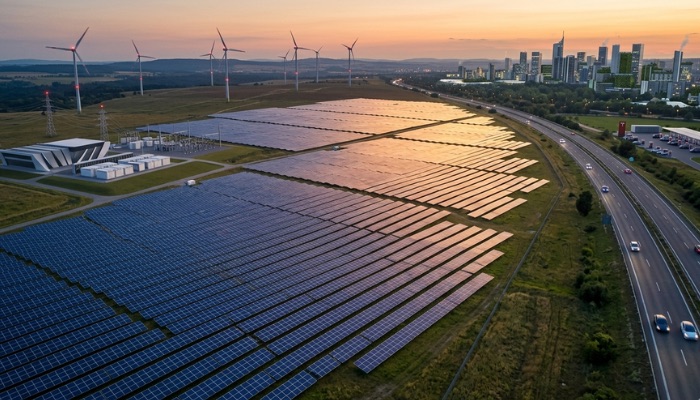
It is not a secret any more that the global energy map starts rapidly changing. The understanding of the global climate change all over the world mainly stimulated this process. The fight for oil sources and various consequences of its use had been observed throughout the 20th century (various embargoes, sanctions, price crises, military conflicts, global environmental impacts, climate change and man-caused catastrophes) while today the weight of fight for the energy security shifts to the innovative centers, high-tech geological survey campaigns, laboratories, tubes and brains of scientists, engineers and entrepreneurs. The gross of the mankind is convinced of facing the dangerous line.
Universal commercial production of such mineral products as coal and oil, that are nothing else than the result of rich flora and fauna of the far past, certainly provide the mankind all the blessings of the civilization. However, they surreptitiously are pushing the mankind to the background of the natural evolution, posing threat to the humans’ existence as well as the whole ecosystem. Therefore, the era of environmentally hazardous energy resources is moving toward its end. At first growth rates, and then consumption, will start falling in fact. Besides, this trend that to all appearances is going to start in 2014 will gain an irreversible character. Its signs are clearly shown by the example of the two leading world energy (China) and oil (USA) absorbers that are also leading polluters of atmosphere respectively.
China
According to the forecast of the US Energy Information Department, China will keep increasing energy efficiency that certainly leads to slowdown of oil consumption growth.
According to the information of the Chinese National Company for Development and Reforms engaged in centralized planning in the country, the total energy consumption in China will have grown by 3.2% compared to the figures of the past year. Meanwhile, the demand for oil is to grow by 1.8% (up to 510 mln tons) compared to the figures of the past year, the forecast says.
This year China will consume 0.71% of coal equivalent of energy for production of every 10,000 Yuan of GDP. It means decline of energy-output ratio by 3.9% compared to the past year and a 12% decline vs the figures of 2010.
According to the forecast, this year the total volume of non-fossil fuel consumption will grow up to 10.7% of total energy consumption. The authors of the forecast noted that alternative energy (wind and solar energy) and hydro-power engineering will be developed in China this year.
The government of China plans to install solar panels with the capacity of 35 GW by 2015, says the website of Greenpeace.
According to the information of the Bloomberg agency, solar panels with total capacity of 12 GW were installed in People’s Republic of China last year. The Chinese Renewable Energy Industries Association provides the similar figure of 10.7 GW. It is higher than the capacity of panels installed in any other country within a year. Apart from this, it is an internal Chinese record –the capacity of solar panels launched in China in previous years is lower than the capacity of those installed in 2013 alone.
Germany commissioned only 3.3 GW solar capacities last year.
According to the forecasts of Deutsche Bank, the entire market of solar energy will grow by 46 GW in 2014. China, Japan and USA will be the key markets. In 2013 this type of energy competed on 19 markets without the support of subsidies. The grid parity markets will be more in 2014, the analysts of the bank note.
The calculations of the Skolkovo Business School Energy Center of show that even the partial fulfillment of tasks assigned within the framework of the energy plan of Barack Obama and the European program “20-20-20” will lead to the stagnation of oil-gas demand in USA and Europe. The same trend is observed in the Asian countries that are the members of the OECD (mainly in Japan and South Korea). The demand is falling due to the decline of power consuming industry, growth of energy efficiency standards and ongoing economic stagnation. Consumption of oil products in Japan had been decreasing for several years in row long before the crisis. According to the Russian experts, the developing countries are compensating this energy consumption decline with interest. However, the stoppage of demand growth on the most solvent and matured markets will not only change the directions of supply of energy resources but also accelerate reconsideration of the rules and forms of international trade: for instance, it is unlikely that India will be able to purchase on basis of the same conditions that Germany does.
Meanwhile, the rate of nuclear energy in the global consumption of primary energy fell from almost 8% in 2000 down to 4.5% in 2013 and keeps declining.
USA
The network of Supercharger stations now covers the section of the New York – Los Angeles road, Eastern and Western coasts and Texas (covering about 80% of the US population), Teslauto portal writes.
The 2015 plans are to cover 98% of the population. Meanwhile, 14 stations are under construction in Europe. Asia is the next in turn. Construction of first stations is likely to start this year, the portal notes.
In January of this year the European Commission presented a new policy framework for climate protection and EU energy development till 2030 aimed at reduction of greenhouse gases by 40% compared to the rates of 1990.
“A 40% reduction of greenhouse gases by 2030 is an ambitious goal and the most efficient step on the way toward the economy with lower emission of CO2”, head of the European Commission Jose Manuel Barroso said at the press conference held in Brussels.
Apart from this, a new policy assigns the EU countries to raise the component of the renewable energy sources up to minimum 27%. Achievement of this goal guarantees stability to investors, stimulates employment in environmentally friendly activities and supports our energy security”, Barroso clarified.
According to the European Commissioner for Energy Gunther Oettinger, he will do his best to ensure sale of energy at affordable prices. “Considering ambitions on buying energy resources for the lowest price, a 2030 policy framework sets a much higher level of tasks aimed at climate change combating”, Oettinger noted.
Christina Figeres, Executive Secretary of the UN Framework Convention on Climate Change (UNFCCC), called business leaders to accelerate “greening” of their investments - to invest funds into the development of renewable energy resources and growth of the green economy.
Participating in this forum were hundreds of leaders of corporations, financial and investment companies with the total “weight” of over $20 trillion.
The UN representative drew attention of investors to the fact that pensions, insurances and family savings of billions of people are directly associated with the long-term security and stability of investment funds.
Addressing the press conference, the UN representative reminded that investments to the amount of $36 trillion would have to be made globally in environmentally friendly energy sources by 2050 for achieving the goal aimed at prevention of the global temperature growth within 2 degrees Centigrade. It means that $1 trillion per year will be necessary on average for development of environmentally clean energy sector in coming 36 years.
Investment banking giant Goldman Sachs declared that renewable energy sources sector is one of the most attractive markets. The fund of its reserve investing totals $40 bln of already made and scheduled investments.
Goldman Sachs is not the first bank which raises the issue of financing of the renewable energy sources sector or even “sustainable” investments. But it is one of the first banks that invested into this sector.
Apart from consulting and fund-rising commitments, in 2012 it assumed obligations to invest $40 bln into the renewable energy sources and made a number of big investments into the share capital which usually is the source of main income for such investment banks as Goldman Sachs.
«Goldman Sachs finds this market incredibly promising». In one of the recent interviews, Stuart Bernshtein who heads the department of clean technologies and renewable energy sources of the Investment-Banking group said that the bank is oriented at long term investments. He also expressed his confidence that renewable energy sources would soon become the most important component of global GDP growth.
Variety and high economic profitability of clean energy sources such as energy efficiency, wind power, solar generation, energy of waves, high and low tides, geothermal sources and many others have much higher share in energy consumption of both leading and developing economies of the world. Oil consumption rates within energy intensive economies will start falling. The growth of oil consumption rate will start slowing down in coming 5 years (this trend will be observed clearly after 2020 when shale oil production starts declining in the USA). All of it will cause energy security of countries-leaders of this segment of the energy market for a century to come as well as a corresponding de-globalization of the world energy market. Mega-cost investment upstream projects along with large connection export systems will yield positions to the global competition for efficient energy intensive environmentally clean technologies, resources and innovative ways of their industrial production and commercial realization. The priority has been laid on so called transitional and environmentally clean energy resource as natural gas in order to mitigate various economic, social and political consequences of such grandiose race. Production technologies of this resource are developed intensively.