


We are cautiously optimistic for 2014
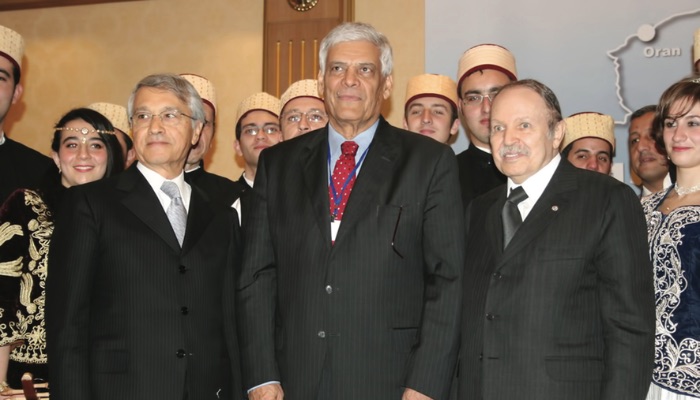
HE Abdalla Salem El-Badri was appointed OPEC Secretary General on 1 January 2007. He began his oil industry career with Esso Standard (now ExxonMobil) in 1965 after studies in Accounting, Business Administration, Finance and Management in the United States and Libya. In 1977, he became a member of the Board of Directors of Libya’s Umm Al-Jawaby Oil Company, moving on to become Chairman of the Waha Oil Company (a joint venture company between the Libyan National Oil Company, Conoco, Amerada Hess and Marathon Oil) in 1980. In 1983, he became Chairman of the Libyan National Oil Company, before being made Minister of Petroleum in 1990. His ministerial career continued with his appointment as Minister of Energy, Oil and Electricity (1993-2000) and Deputy Prime Minister (2000-2004), before he returned to the chairmanship of the Libyan National Oil Company (2004-2006).
During the latter half of 1994, he was both President and Secretary General of OPEC, and again served as its president in 1996 and 1997. He has been a frequent speaker at numerous international industry events. In 2013 he was awarded The Abdullah Bin Hamad Al-Attiyah International Energy Award for the Lifetime Achievement for the Contribution to the Advancement of OPEC.
Caspian Energy (CE): Your Excellency, OPEC has been operating for 53 years and has grown in prominence over this period. What will be the role of OPEC in the coming decade? Which global factors will help, and which of them will hinder the further growth of the OPEC’s influence in the global market?
Abdalla Salem El-Badri, OPEC Secretary General: It is important we look to the past when thinking about OPEC in the coming decade. From when OPEC was founded in 1960 its overall goal has been market stability. It is not only the best type of market for OPEC, but for all stakeholders. And this will continue to be the Organization’s goal on a daily, weekly, monthly and yearly basis. We will continually review the market looking for movements and trends as we seek a stable market, with a balance between supply and demand. Market stability remains central to everything we do.
In the second part to your question you use the term “influence”. Here, let me reiterate that the only influence we look to achieve is in terms of market stability. So I think it is better to look at this part of your question from the perspective of the uncertainties, challenges and opportunities for the oil industry in general.
On the demand side, the global economic situation continues to be the main worry. It is important that the world returns to sustainable and healthy economic growth rates.
We do see a higher economic growth rate in 2014, compared to 2013, but it is important this is maintained. The industry needs to continually monitor the emergence and expansion of the ‘paper oil’ markets, specifically regarding excessive speculation and extreme price volatility.There are the ongoing UN climate change negotiations with their possible impact on the energy sector still unclear. There are energy policies, which need to be feasible, predictable and sustainable. For producers, it is critical to have a better understanding of demand side developments, particularly policies that discriminate against oil. If not, it can lead to investment uncertainty, and in turn, future market instability. There is the impact of rising industry costs. And there are also advancements in technology, that are enabling us the industry to continually push the boundaries of what is possible and extending the reach of the industry.
This is not an exhaustive list, but underlines some of the uncertainties, challenges and opportunities for the industry in the years ahead.
CE: Will the role, that OPEC is playing in price setting at the oil market, change in near future?
Abdalla Salem El-Badri: Let me stress that OPEC does not set prices. We do not have a price target. We believe the oil price should be based on market supply and demand fundamentals. Our goal at OPEC is for market stability, something I covered in detail in my response to your first question. This is essential for an efficiently functioning market.
In terms of prices, they need to be at a level that allows investors to invest for the future benefit of producers and consumers and producers to receive a fair income for their resources, and at the same time, at a level that does not impede the global economic recovery.
CE: Do you think oil price levels continue to be driven by speculators?
Abdalla Salem El-Badri: In 2013, we have generally witnessed prices move in the $100-$110 range; a range that is acceptable to producers and consumers alike. However, it is important that we continually look to mitigate extreme volatility and excessive speculation.
Let me take you back to 2008. In mid-2008, crude prices reached a peak of 147 dollars a barrel, before sinking to a low of around 30 dollars in December of the same year. This is clearly not conducive to the effective functioning of the market, particularly given the long-term nature of investments in our industry.
I am sure everyone here can appreciate that we cannot avoid speculation and volatility altogether. It is part of the market. But it is vital we do not see a return to what the market saw in 2008. The goal, for both producers and consumers, must be a stable price.
CE: Which factors will ensure the growth of demand for oil worldwide in 2014? Is OPEC concerned about the slowdown in China’s economic growth?
Abdalla Salem El-Badri: In OPEC’s latest Monthly Oil Market Report we see global oil demand growth of 1 million barrels a day in 2014, slightly higher than this year. And it is clear the main driver of growth remains non-OECD countries, which are projected to increase demand by 1.2 million barrels a day, compared to an expected decline of 200,000 barrels a day in the OECD region.
In terms of factors, obviously the central one is the economy. It is clearly essential that the world sees a return to balanced and sustainable. Overall, we are cautiously optimistic for 2014, although there are evidently mixed messages among regions.
In terms of China, while the country’s economic growth for 2013 has slipped from a predicted 8 per cent at the start of the year, to 7.6 per cent today, the numbers are still clearly positive. We hope that this slowdown is just a short-term issue, and not a long-term trend.
CE: Do you think climate change and worsening ecological conditions are grounds for setting possible regulation over global oil demand or limiting its production? What kind of solution would you offer for this global problem?
Abdalla Salem El-Badri: Climate change is a threat to sustainable development and concerns all of us.The United Nations Framework Convention on Climate Change is the foundation of global efforts to mitigate and adapt to climate change. Its principles and provisions should remain the cornerstone of climate change negotiations, in particular the principles of common but differentiated responsibilities and of equity, and with economic development and poverty eradication the overriding priorities of developing countries.
OPEC Member Countries are doubly vulnerable: to the effects of climate change, and to the adverse impacts of response measures.
We believe that it is important that the world is committed to reaching a comprehensive, balanced outcome to the negotiations based on a full consensus. This outcome should be ‘win-win’ in nature and recognize the diverse interests of all Parties.
Let me also stress that OPEC Member Countries are making huge efforts to protect the environment, such as through gas flaring reduction, supplying cleaner petroleum products, investing in carbon capture and storage, developing hybrid solar-natural gas power stations and solar desalination units. They also invest in research and development for cleaner energy.
CE: Is the growing percentage of natural gas in the global energy mix a risk to OPEC’s importance? Or is beneficial to many OPEC Member Countries with significant gas reserves?
Abdalla Salem El-Badri: In OPEC, we recognize the expanding role of gas. In our most recent World Oil Outlook we anticipate that gas will increase its share of the energy mix from around 22% in 2010 to close to 26% in 2035. However, its overall share will still lag that of oil, which will still contribute over 26% to the energy mix in 2035.
So what does this mean for OPEC? We believe that oil will see significant expansion and remain central to the global energy mix. In terms of barrels a day, oil demand will increase by almost 20 million barrels a day by 2035. Thus, it will evidently remain central to Member Country economies.
From the gas perspective, yes our Member Countries have significant gas reserves. And they will decide on how to develop these.
Let me add here that OPEC welcomes the efficient and sustainable development of all energies and energy technologies.
CE: Compared to OPEC, Azerbaijan and other countries of the Caspian region are the newcomers (as independent producers) in the global market. How do you evaluate the energy potential of the Caspian region? Do you think OPEC has to expand cooperation with Azerbaijan, Kazakhstan and Turkmenistan?
Abdalla Salem El-Badri: There is no doubt that the Caspian region has significant energy potential. In fact, it is already a major player in the oil and gas markets.
Given that we live in an increasingly interdependent world, I am an advocate of continually evolving collaboration among producers, and between producers and consumers. There is much we can learn from each other in terms of the challenges and opportunities we may face in the years ahead. Let me say that at OPEC, we are always ready to talk.
In fact, OPEC has long recognized the importance of dialogue and cooperation with producers, as well as with other stakeholders. For example, OPEC continues to maintain a strong and positive relationship with the European Union. Its cooperation with the International Energy Agency also goes back many years and has advanced considerably. OPEC has also been proud to have played an active part in the formation of the International Energy Forum, which was founded as a platform to foster informal dialogue between producers and consumers. Additionally, OPEC has expanded dialogue with Russia; our most recent meeting took place in October this year. And this past decade we have also seen dialogue with a number of other international organizations, such as the World Bank, the International Monetary Fund and the World Trade Organization.
Thank you for the interview