


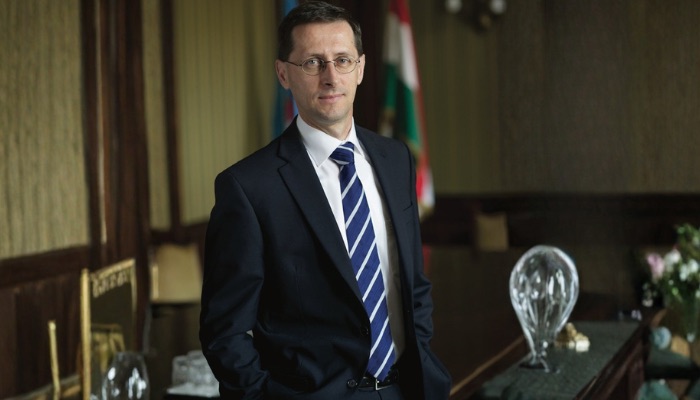
Caspian Energy (CE): Mr. Varga, could you, please, tell which measures does the Government of Hungary take to get out of the crisis that recently overwhelmed the entire EU space? Do you consider the measures taken by the European Commission enough?
Mihály Varga, Minister for National Economy of Hungary: Over the past decade, closing the economic gap with the West has come to a standstill for Hungary: the country was no longer keeping pace with the more highly developed part of Europe. The pace of potential long-term economic growth has slowed down, general government debt-to-GDP ratio increased and the country was becoming more and more vulnerable. The Government which took office at the end of May 2010 had to achieve a rapid trend reversal in four key fields in order to stabilize the country’s economy and put it on a growth path leading to convergence:
(1) halting and reversing a high and rising government debt trend;
(2) reducing the high external debt level severely aggravating the country’s financial vulnerability;
(3) achieving a trend reversal in employment;
(4) reversing the trend of deteriorating competitiveness and a dramatic slowdown in potential, long-term economic growth.
Over the past three years, the obligation to achieve results in these fields has determined the Government’s economic policy priorities. The achievements Hungary has so far accomplished show that efforts aimed at restoring fiscal and financial balance, reducing the level of government debt and rebalancing labour market supply and demand have managed to deliver the expected positive results. Recently, along with the auspicious change in fiscal indicators, several other positive developments have indicated the improving confidence of foreign investors. The balance of the state budget could be corrected despite an inauspicious external environment. During the country’s fiscal consolidation, carried out in a global financial crisis, some unconventional economic policy instruments had to be utilized, as broader burden-sharing and thus the more active engagement of certain sectors in taxation became a priority. However, some positive signs have already appeared: one of these is that Hungary has already exited the Excessive Deficit Procedure and consequently got off the list of the most vulnerable countries.
CE: Dou you support introduction of a tax on financial transaction?
Mihály Varga: As of 1 January 2014, the EU plans to introduce a financial transaction tax within the framework of an agreement concluded by 11 member states with a top rate of 0.1 percent for shares and 0.01 percent for derivatives. Currently, the Government of Hungary does not consider joining the enhanced cooperation procedure, but appreciates its completion. As the proposal may have effects which reach across borders, Hungary is of the opinion that the directive recommendation must not impair the tax sovereignty of countries outside the enhanced cooperation.
CE: What are your expectations on the G8 Summit? Do you expect making global economic decisions?
Mihály Varga: The Government places emphasis on observing G8 and G20 summits and similar events, which may play a key role in the future of the global economy. Hungary can influence the EU’s standpoint presented at these summits via EU institutions. The Government is looking forward to news of the upcoming, 39th G8 summit held in the United Kingdom.
CE: Which measures are taken to promote the growth of the national economy of Hungary?
Mihály Varga: In 2012, Hungary’s GDP decreased by 1.7 percent. The economic contraction had several triggers, among them various one-off factors. The European recession due to a protracted debt crisis dented external demand, which in turn undermined Hungarian exports that increased only by 2 percent for the year. Subdued export growth and diminishing domestic demand also resulted in stagnating imports. However, Hungary’s economy is expected to resume growth in 2013. The drivers of this growth are anticipated to come from a correction of one-off impacts which caused contraction in 2012. Agriculture, for example, provided average weather conditions prevail, may significantly contribute to higher output – after a poor performance in 2012 due to unfavourable weather conditions. On the other hand, a pickup in external demand – even if domestic demand remains flat – is expected to result in export growth. As a third factor, fiscal processes in 2013 – while the Government continues to be committed to achieving a fiscal deficit of 2.7 percent of GDP – will also stimulate growth, due to the basis effect resulting from a low deficit of 2 percent of GDP in 2012. As the fourth factor, the lending schemes announced by the Eximbank and the National Bank of Hungary (MNB) will also boost growth. The Eximbank scheme will contribute to economic expansion via export subsidies, while that of the MNB will add to growth by fostering investment. With its loans of preferential rates, the Funding for Growth Scheme is aimed at those growth-oriented SMEs of viable business models which usually face rigid lending conditions but for which bank financing is indispensable. EU funds, as the fifth factor, may also significantly invigorate investment activities. Moreover, the Government believes that Hungary will remain a crucial destination for capital investment, which will be underpinned by better competitiveness enhanced by Government measures: as the flat-rate personal income tax system was introduced, the share of taxes on labour – which had been too high from a regional perspective -- has decreased and brought down the costs of skilled labour force, too. Lower tax liabilities of SMEs are another competitive edge.
As of 2014, along with the anticipated acceleration of growth, it will be a more balanced, structural expansion: on the one hand, the upswing in external demand will boost the volume of exports, while domestic demand will also increasingly bolster the economic upturn. This latter factor will also benefit from higher real incomes at households, the scaling-down of their adjustments, the loosening of their financial rigour and lower interest rates, all of which will prop up consumption. Besides lower interest rates which will lift lending, investment growth will also be assisted by improving company balance sheets.
CE: Which branches of economy are the key ones in the GDP of Hungary?
Mihály Varga: Output at the manufacturing sector, one of Hungarian economic growth engines, in 2012 was below the level it had reached the year before. The contraction was caused by the severe, 18 percent year-on-year decrease of the second most significant sub sector, the manufacturing of computers, electronic and optical products. This contraction has not been the consequence of weaker Hungarian competitiveness, but of the loss of global market share for certain electronic goods producers (i.e. Mobile phones of Nokia and Blackberry). As a result, several Hungarian facilities which manufacture and assemble electronic products have cut output capacities and curbed production.
However, as of 2013, no sizable layoffs are expected in the electronics sector, and thus this segment will no longer exert such negative effect. As a consequence of the manufacturing sector’s gradual recovery, new motor vehicle output capacities will also increase (engine production of GM in Szentgotthárd, Mercedes in Kecskemét, Suzuki in Esztergom and Audi in Győr).
As a knock-down effect, successful car industry investment projects in Hungary are expected to attract further large-scale job-creating investments in the coming years, especially as motor vehicle suppliers come or relocate to Hungary. These expectations are confirmed by data compiled by the Hungarian Investment and Trade Agency (HITA) which indicate that investors have recently showed interest in motor vehicle project opportunities.
After January and February, industrial output was again up (by 0.4 percent, month/month) in March this year. Signs of a trend reversal are appearing also in other sectors, for example, construction sector growth has been positive since November 2012. On the basis of statistics, this segment registered year-on-year growth of 4.2 percent of GDP in the first quarter of 2013, which was lifted by volume growth of 9.9 percent in March.
CE: When does Hungary plan to join the eurozone? Which obstacles do stand on its way?
Mihály Varga: The introduction of the Euro is on the one hand an obligation for Hungary, but it is also a guarantee for faster and more calculable growth. When Hungary joined the EU, it undertook to fulfill the requirements for the introduction of the Euro and provided the conditions are met, the Euro will be adopted. The introduction of the Euro helps establish a more successful economy with a higher growth potential, but it also provides several opportunities and favourable changes with regard to the economy, society and international relations. The adoption of the Euro will lessen the country’s vulnerability, improve its international image and make business environment safer and more predictable. The financial integration based on the free flow of capital within the EU also justifies the introduction of the Euro, especially for countries with a large share of foreign currency debt.
In light of the latest European developments, however, the introduction of the Euro is no panacea for all ills. The advantages stemming from it can only exploit to the full, if these are also underpinned by a consistent economy policy which takes fully into consideration the country’s long-term economic interests. The negative consequences of the financial crisis have dealt the most severe blow to countries with a less disciplined economic policy within the Euro-zone. To what extent these advantages can be utilized also depends on the level of integration into the EU’s economy. Hungary had already been well integrated into the EU economy by the time its formal accession was completed. The highly diversified economic structure, highly developed inter-company relations and the high share of manufacturing exports all ensure that Hungary’s business processes are in tune with the economies of the bloc’s other countries. Provided these characteristics are given, the country can realize advantages provided by the bloc to the largest possible extent in case the country’s macro-economic conditions are stable and structural circumstances enable favourable competitiveness.
CE: How attractive is the Hungarian economy in terms of investments? Which projects are planned for implementation in Hungary?
Mihály Varga: In 2013, several favourable developments are expected in the Hungarian economy, which will also have an auspicious effect in investment. In the second half of the year, the economy is expected to expand year-on-year, and as of 2014, GDP growth is expected to accelerate. Several factors will contribute to the trend reversal, each of which will be positive regarding the perception of Hungary, also from the aspect of investors:
- In the second half of the year, due to enhanced lending and faster disbursement of EU funds investment may pick up;
- Due to the inflation rate, which hit a 40-year record low, real wages are increasing which results in consumption growth;
- Parallel to diminishing inflation, the base rate has also dropped to a record low, which will invigorate lending;
- External and internal balances are secured, and the level of debt continues to decrease both in the public and the private sectors. Accelerating growth coupled with improving external vulnerabilities imply that the economy will expand in a sustainable manner, so enterprises can also make their plans in a predictable macro-economic environment;
- Cost-efficiency is also anticipated to improve, as thanks to Government measures, labour supply is more favourable which dampens wage increases, while employment growth is assisted by several tax incentives as these cut tax liabilities on labour.
In a 2013 survey, similar to the previous year’s study, Hungarian company executive officers underlined skilled labour and reliable infrastructure as the most outstanding economic factors, but cost-efficient production has also been mentioned among these. In comparison to the previous year, however, the number of managers who singled out competitive taxation (especially in the field of taxes on labour) and business-friendly environment (due to red tape cuts) as the most attractive factors.
CE: What could you say about the development of cooperation with the Caspian Sea countries?
Mihály Varga: Hungary’s foreign economic strategy focuses on extending and diversifying external trade relations, as Hungary has an open economy, and effective and flexible adjustment to global economic changes requires the broadening of Eastern relations – parallel to the active role Hungary plays in the European-Atlantic community – which the Government calls the policy of “Opening to the East”.
Under the “Opening to the East” concept, Hungary considers the improvement of cooperation with the Commonwealth of Independent States a key priority, in the field of economy and culture alike. The Government aims to establish opportunities beyond trade relations, which may serve as long-term partnerships. The Government intends to act as partner in implementing Government-funded economic development and diversification programmes via up-to-date technologies, knowledge and unexploited production capacities of Hungarian enterprises.
The Government believes the following fields have great potentials with regard to the development of economic relations: agriculture and food industry, energy industry, construction and engineering, environmental protection and water management, infrastructure- and public utility services, urban planning, tourism and pharmaceuticals industry.
The improvement of relations regarding the energy sector has been a key priority; the Government expects that the countries of the Caspian region will be crucial for establishing energy stability for Hungary and the EU.
Over the past couple of years, a consistent policy and high-level political visits have reinvigorated bilateral relations in the region, but current trade and investment cooperation is far below its potential.
Economic partnership by inter-governmental commissions provides a framework for identifying new cooperation options with Russia, Azerbaijan and Kazakhstan, while setting up a similar commission is under way with Turkmenistan.
Russia has been a leading trade partner not only in the Caspian region and in the Commonwealth of Independent States, but also globally: in 2012 the country was Hungary’s the third largest trading partner, while it was the number one outside the EU.
Russia has been a pivotal strategic partner also from the aspect of energy, as bilateral trade relations are traditionally based on energy imports. With respect to enhancing development, improving relations between the two countries enjoys priority (mutual visits by high-profile delegations, Hungarian-Russian Inter-Governmental Economic Committee, extensive Hungarian foreign trade representation in Russia (Moscow, St Petersburg, Yekaterinburg, Rostov-on-Don), Government Commissioner for Hungarian-Russian relations). In April this year, a new trade office was also opened in Moscow.
As far as Kazakhstan is concerned, in May 2013 a new Hungarian trade office was opened in Astana, a common Business Committee was set up, several joint ventures were established and MOL Nyrt has also expanded its production facilities.
Over the past couple of years, several high-level political and professional delegations paid respective visits, a Hungarian trade representation was last year opened in Baku and various common company projects were launched. A direct flight between Baku and Budapest will add another impetus to relationships.
The Government also regards Turkmenistan as a potential partner, and supports the establishment of proper diplomatic relations and the determination of partnership guidelines on the basis of mutual interests.
With regard to Iran, international sanctions currently in place unfortunately several limit opportunities which would be worth exploiting, and therefore the Government aims to stimulate cooperation on the level of trade of chambers.
CE: How is the fulfillment of the Maastricht criteria going on?
Mihály Varga: One of the most crucial tasks for the Government is to help generate sustainable and stable economic growth after fiscal stability has been achieved. These are the preconditions for the introduction of the Euro in Hungary.
The Maastricht convergence criteria on the state budget will soon be met, as Hungary is expected to exit the Excessive Deficit Procedure in June. This proves that Hungary has forced the state deficit below 3 percent and the general government debt-to-GDP ratio was put on a declining path. The inflation rate is expected to be about 3 percent in 2013 (it was 1.7 percent in April 2013), which level is close to the reference figure of 2.7 percent recorded in April 2013. The Forint/Euro exchange rate oscillated in a band of +/-15 percent, but as Hungary does not belong to the ERMII exchange rate mechanism, the criteria with regard to exchange rate was not fulfilled. Great improvement has also been achieved regarding the fulfilment of criteria for long-term yields, as these were around 5-5.5 percent in the first half of 2013, which is also close to the April 2013 reference figure of 5.5 percent.
At the same time, as several euro-zone countries have lately demonstrated, meeting the Maastricht criteria is not sufficient in itself for the full utilization of advantages which a common currency provides. In order to prepare well for entering the Euro-zone, the Government does not only focus on fiscal balance, but it also places emphasis on improving competitiveness and potential growth via implementing structural reforms. The middle-term structural reform programme published in March 2011 aims to transform expenditures in a growth-friendly manner. In the introduction of these, it had to be taken into account that several steps had already been taken which several member states are just about to contemplate now. The Hungarian reform programme brought about the largest changes in the following fields: employment and labour market, pension benefits, public transport, tertiary education, healthcare and state and local government financing.
Thank you for the interview