


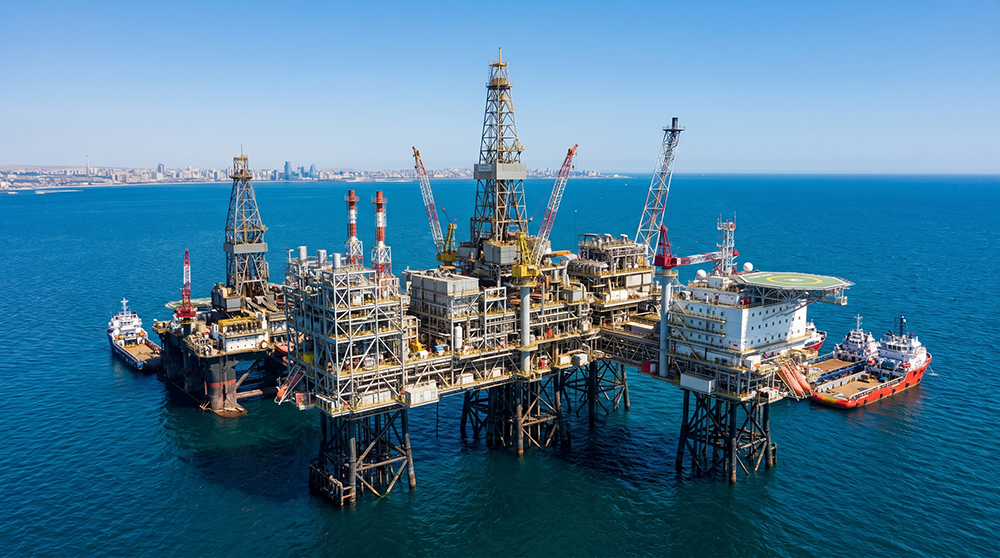
Gas reserves at the "Gunashli" field alone can be estimated in the range of 4–6 trillion cubic feet (113–168 billion cubic meters), while a precise assessment for the "Azeri" section has not yet been conducted and the process is in its initial stage, bp's Executive Vice President for Production and Operations, Gordon Birrell, told reporters on the sidelines of Baku Energy Week. Gordon Birrell emphasized that this new gas potential is of key importance for the further development of the ACG block.
According to him, the Azeri-Chirag-Gunashli (ACG) block of fields is one of the largest oil fields in the world, and more than 4 billion barrels of oil have been produced here since it went into operation.
"Gas reserves are concentrated in two main parts of the block—the 'Gunashli' and 'Azeri' sections—and uncertainty regarding the exact volumes of resources still remains in both directions. The main purpose of drilling the first production well is to collect dynamic subsurface data and reduce this uncertainty," he reported.
Despite the lack of refined data from the exploration results, bp—the operator of the Azeri-Chirag-Gunashli project—announced this week on behalf of the ACG joint venture partners (SOCAR, MOL, INPEX, ExxonMobil, TPAO, and ONGC Videsh) the start of non-associated gas (NAG) production from the ACG field in the Azerbaijani sector of the Caspian Sea.
The first NAG well, drilled from the existing West Chirag platform, provides critical reservoir and gas inflow data in addition to ensuring early production, which allows for evaluating the resource base and making decisions on the future full-scale development of the gas field. NAG production activities at the ACG field are being carried out on the first production well, which was drilled last year into the Pereryv suite, as well as the Upper Kirmaky and Lower Kirmaky suites.
The development of ACG is being conducted in accordance with the amendments made on September 20, 2024, to the existing Production Sharing Agreement (PSA) for the ACG fields. This addendum is valid until the end of the existing ACG PSA term in 2049. Over the next 23 years, subject to exploration and appraisal of the NAG fields, there is potential for investing billions of dollars into the full-scale development of NAG resources within the ACG field.
The participation shares of the ACG partners in the NAG project are the same as in the existing ACG PSA: bp as operator (30.37%), SOCAR (35.3%), MOL (9.57%), INPEX (9.31%), ExxonMobil (6.79%), TPAO (5.73%), and ONGC Videsh (2.92%).
ABSHERON PROJECT
The "Absheron" project involves drilling new wells, constructing a 140-kilometer subsea pipeline, and implementing solutions for multiphase transportation of gas and condensate, the Head of the TotalEnergies Representation in Azerbaijan, Emmanuel de Guillebon, stated during a panel discussion held as part of Baku Energy Week.
According to him, within the second phase of the Absheron field development, it is planned to drill three new wells with an expected production of about 40,000 barrels of oil equivalent per day from each well, with approximately 30% accounted for by condensate and 70% by gas. He reported that the project will involve building a subsea pipeline about 140 km long, which will provide a direct connection from the wells to onshore facilities without using production platforms. He noted that the initial production level for the project will be around 120,000 barrels of oil equivalent per day, taking into account the existing early development phase of the field.
During Baku Energy Week, held in Baku from June 1 to 3, an agreement was also signed for the long-term supply of gas from the Absheron field to Türkiye. The document was signed between SOCAR, TotalEnergies, XRG, and BOTAŞ during a meeting in Baku. In particular, the parties reviewed the progress of work on the full-scale development project of the Absheron gas condensate field.
Notably, the Absheron field is located on the Caspian Sea shelf, approximately 100 km southeast of Baku and 25 km northeast of the Shah Deniz field. The area of the structure is about 270 square kilometers, and its gas reserves are estimated at 350–400 billion cubic meters of recoverable reserves.
Production at Absheron began in July 2023 as part of the early development stage under the operatorship of JOCAP, utilizing a single deepwater well.
SOCAR, TotalEnergies, and XRG have agreed on the concept for the second phase of the field development, which envisages subsea production followed by transportation to shore. The wells will be drilled at a water depth of about 500 meters, and their total length will exceed 7,000 meters, making them some of the deepest in the Caspian Sea.
At its peak, the second phase of development can provide production of up to 12.7 million cubic meters of gas per day (about 4.5 billion cubic meters per year) and 37,000 barrels of condensate per day. The start of production is expected in late 2028 or early 2029.
KARABAKH PROJECT
Dan Sparks, bp's Vice President for Exploration for Azerbaijan, Georgia, and Türkiye, said during a panel discussion held as part of Baku Energy Week that the implementation of projects in the Caspian basin not only ensures production and infrastructure development but also shapes long-term technological and industrial capabilities, including the development of fabrication yards and human capital.
D. Sparks noted that the "Karabakh" project involves creating the world's second complex for the production of subsea bundles in the Caspian region. He explained that such modules allow for the integration of multiple pipeline lines and communications into a single unit, which can be transported and installed without the need for specialized pipelay vessels.
"The development of technological capabilities in the region continues, including the application of new seismic methods that have become a significant factor for the industry in the Caspian basin," he said.
In particular, he mentioned obtaining new seismic data for the Shah Deniz field and conducting its processing, noting that even after 30 years of operations, the study of the field continues using new data processing technologies.
bp's Regional President for Azerbaijan, Georgia, and Türkiye, Gio Cristofoli, noted during Baku Energy Week that "engineering work is currently underway, and a final investment decision is expected by the middle of next year. We aim to develop 'Karabakh' as a satellite field. This will allow us to utilize existing infrastructure in the Caspian region to develop new fields, marking an important milestone," Cristofoli stated.
Notably, the Karabakh contract area is located 120 km east of Baku, at water depths of 150–200 meters, near the Azeri-Chirag-Gunashli and Ashrafi-Dan Ulduzu-Aypara contract areas.
According to data from the Ministry of Energy of Azerbaijan, the initially estimated geological reserves of the field exceed 60 million tons of oil.
Recently, bp completed an Ocean Bottom Node (OBN) subsea seismic survey at the Karabakh field. The work started in December 2025 and was completed in mid-March 2026.
Caspian Projects
SOCAR is considering options to accelerate exploration work in Azerbaijan, Arzu Javadova, Vice President of SOCAR, stated during a panel discussion held as part of Baku Energy Week.
According to her, projects undergo selection based on specific criteria, considering which ones can be implemented independently and which require involving partners to share risks and costs. She also emphasized that the company has strengthened its work on forming a team of specialists in geosciences and underground research, introducing new tools, and data analysis.
"Within the framework of the current strategy, exploration work is being conducted in three main directions: onshore, in the waters of the Middle Caspian, and in the South Caspian. At the same time, promising zones are identified onshore, including Shamakhi-Gobustan, Yevlakh-Aghjabadi, and others," she said.
The Vice President of the company emphasized that in the offshore part of the Caspian, deeper horizons are being considered, including the pre-productive series, and a number of projects are already at the drill-ready stage.
Perhaps the single project that earned special attention from the audience of Baku Energy Week due to its unparalleled multiplier effect on all spheres of life, as well as the economy of Azerbaijan and regional countries, is the long-running project—Azeri-Chirag-Gunashli (ACG). Implemented since September 20, 1994, the ACG project has turned into a strategic oil and gas infrastructure project, Babek Huseynov, Vice President of SOCAR, stated at a panel discussion on the second day of Baku Energy Week.
Despite the fact that the main challenges facing the upstream sector (production and development) of the oil and gas industry are changing, the relevance of ACG is driven by the discovery of new gas reserves and global market conditions.
"Previously, the main source of oil and gas production was the discovery of new fields, the development of new regions, and the implementation of large, especially offshore projects; today, the key issue is not just new discoveries. The main task is to extract more value from existing fields, effectively utilize available infrastructure, and accelerate these processes," the expert noted.
Babek Huseynov emphasized that even a mere 1 percent increase in the recovery factor at operating fields can make a significant contribution to meeting energy demand for many years. In this context, the Vice President of SOCAR cited the Azeri-Chirag-Gunashli (ACG) project and an important phase related to the production of non-associated gas from ACG as examples.
"Over the past 30 years, ACG has been known as one of the largest oil fields in the world. However, today we view this project not merely as an oil field. ACG is now a strategic energy infrastructure project with both oil and gas potential. Significant volumes of resources lie beneath the project's reservoir, and the development programs implemented in partnership with bp inspire us tremendously," he added.
Babek Huseynov stated that in the development of the Absheron gas condensate field, which occupies an important place in Azerbaijan's energy sector, key priorities include achieving first gas production faster, increasing the ultimate recovery factor, simplifying project solutions, and maintaining capital discipline.
"It is important that these projects are economically efficient both for our partners and for Azerbaijan. Therefore, they must be implemented on the basis of simplicity, speed, and financial discipline," he noted.
The SOCAR representative also stated that the development of the Karabakh field demonstrates a different model of development. According to him, the project is being implemented using the capabilities of existing infrastructure, an approach known as the "infrastructure-led development" model.
"The Karabakh project utilizes flexible subsea tie-back solutions. Integration into existing infrastructure reduces project execution timelines and allows for a faster start to production. This infrastructure is one of the most valuable assets of Azerbaijan's energy sector," Babek Huseynov emphasized.
American company ExxonMobil is exploring opportunities to develop hydrocarbon resources using unconventional methods in Azerbaijan and is assessing prospects for applying technologies in the country that previously allowed the United States to become a global leader in oil and gas production, John Ardill, Vice President of Global Exploration at ExxonMobil, stated at the "Exploration and Production — New Horizons" session during the Baku Energy Forum. He recalled that thanks to the introduction of horizontal drilling and hydraulic fracturing technologies, the United States has been able to significantly increase hydrocarbon production over the past two decades and become the largest producer of oil and gas in the world.
According to the ExxonMobil representative, "when bringing these technologies to international markets, we consider three key factors: a suitable geological structure, commercial attractiveness, and a solid partnership model," Ardill emphasized.
Thanks to modern technologies, the recovery factor at oil fields can exceed 50%, and at gas fields—70%. The Vice President emphasized that the process that began in the US in the 1980s–1990s with the development of horizontal drilling and hydraulic fracturing technologies subsequently spread to other basins as well. ExxonMobil assumed a strategic position in this direction about 20 years ago and has since been gradually increasing investments in this field.
John Ardill emphasized that production in the Permian Basin currently stands at about 1.6 million barrels per day, and there are plans to bring this figure to 1.8 million barrels in the near future. "This experience shows that with the acceleration of technological development, the timelines for occurring changes are also shortening. If previously such a transformation took 20 years, it can now happen in 5–10 years," he noted.
The company representative also pointed out that deepwater projects are another example of this trend, and regions such as Guyana are setting new records, outperforming Angola. He added that increasing the recovery factor can significantly extend the lifespan of fields and influences company strategies at an international level.
Baku-Tbilisi-Ceyhan (BTC) Pipeline
The Baku-Tbilisi-Ceyhan (BTC) pipeline will be handed over to the management of SOCAR, bp's Regional President for Azerbaijan, Georgia, and Türkiye, Gio Cristofoli, told reporters at the Baku Energy Forum.
According to him, the deadline for fulfilling the contractual obligation for this process is set for July 1, and the company is fully adhering to this schedule. He emphasized that this is not about bp exiting the asset, but rather about fulfilling contractual commitments.
"In order for SOCAR to act as the operator, extensive preparatory work was carried out. The company possesses the necessary experience and capabilities for effective pipeline management," he noted. According to him, short-term fluctuations in oil prices do not affect the company's investment decisions.
Back in December 2025, bp stated that discussions were being held with relevant authorities for the timely planning of necessary measures to transfer operatorship of the Baku-Supsa and Baku-Tbilisi-Ceyhan pipelines.
Notably, the Baku-Tbilisi-Ceyhan (BTC) oil pipeline transports oil from the Azeri-Chirag-Gunashli (ACG) field and condensate from the Shah Deniz field through the territories of Azerbaijan, Georgia, and Türkiye. It connects the Sangachal terminal on the shores of the Caspian Sea with the Ceyhan marine terminal on the Turkish Mediterranean. In addition, the transportation of oil from Turkmenistan and Kazakhstan continues through this pipeline. The pipeline, commissioned in June 2006, was built by the Baku-Tbilisi-Ceyhan Pipeline Company (BTC Co.), operated by bp.
The shareholders of BTC Co. are: bp (30.10%), SOCAR (32.97%), MOL (8.90%), TPAO (6.53%), Eni (5.00%), TotalEnergies (5.00%), ITOCHU (3.40%), ONGC Videsh (3.10%), ExxonMobil (2.50%), and INPEX (2.50%).
RENEWABLE ENERGY
Azerbaijan and the United States have concluded a framework agreement on the extraction and supply of rare earth metals. The document was signed by Mikayil Jabbarov, Minister of Economy of Azerbaijan, and Caleb Orr, US Assistant Secretary of State for Economic Affairs. The document was signed within the framework of Baku Energy Week. A similar agreement was previously concluded between Armenia and the United States during a visit to Yerevan by US Secretary of State Marco Rubio.
Within the framework of Baku Energy Week, the President of SOCAR, Rovshan Najaf, met with the Vice President of ExxonMobil Corporation, John Ardill. During the meeting, the successful development of long-term partnership relations between SOCAR and ExxonMobil Corporation in the energy sector was noted.
A meeting took place between delegations led by Baba Rzayev, Chairman of the Board of OJSC "Azenerji"; Nabi Aytzhanov, Chairman of the Board of JSC "Kazakhstan Electricity Grid Operating Company" (KEGOC); and Feruz Kurbanov, Deputy Chairman of the Board of JSC "National Electric Grids of Uzbekistan." During the meeting, an exchange of views took place on the current state and prospects for the development of energy cooperation between Azerbaijan, Kazakhstan, and Uzbekistan.
At the same time, during the meeting, where issues concerning the implementation of new technologies and the integration of renewable energy sources into the power grid were discussed, an exchange of experience was conducted regarding the recently launched Battery Energy Storage Systems (BESS) in Azerbaijan, which feature a capacity of 250 MW and a storage capacity of 500 MWh.