


"Many of our oil contracts have been successfully implemented for years, and not a single paragraph, clause, or even a single word has been or will be changed in the adopted decisions and contracts. This is a crucial factor for attracting foreign investors to our country because Azerbaijan is a reliable state," declared President Ilham Aliyev in the summer of 2025 at the official opening ceremony of the Khizi-Absheron wind power plant. "Our word is as valuable and legally binding as our signature."
Therefore, the development of renewable energy sources in Azerbaijan is carried out within the framework of large-scale projects implemented by foreign investors. Hundreds of millions of dollars have already been invested in these projects. Currently, three more projects are underway—two solar and one wind power plant. Azerbaijan has also held its first competitive auction for the construction of a 100 MW solar power plant, with the support of the European Bank for Reconstruction and Development.
In 2025, Azerbaijan's total installed electricity generation capacity reached 9,732.5 MW, an increase of 1,317 MW (15.6%) compared to the same period last year. The capacity of power plants operating on renewable energy sources, including hydroelectric power plants, is 1,829.6 MW, which is approximately 18.8 percent of the total installed capacity. Since the commissioning of the 230 MW Garadagh Solar Power Plant, solar electricity production has increased nearly tenfold. During this period, the plant's generation of 1 billion kWh confirms it is operating at full capacity. These figures are reflected in an article by Energy Minister Parviz Shahbazov, dedicated to Power Engineers' Day on October 20, titled "Azerbaijan is becoming a regional energy hub."
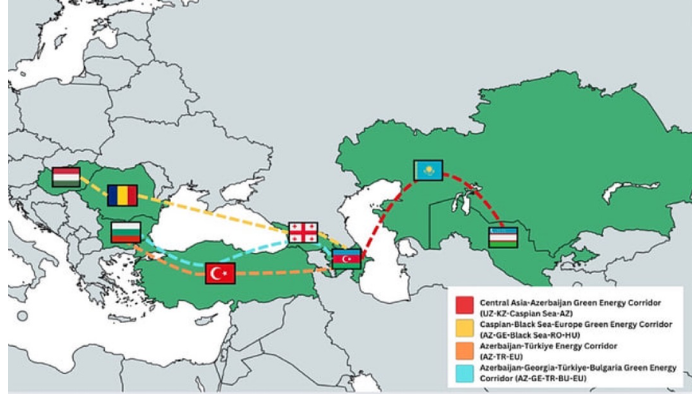
Simultaneously, as noted by the minister, necessary work is underway in preparation for the phased start of exporting 4 GW out of a planned 6 GW+ starting in 2032 through the "Caspian–Black Sea–Europe Green Energy Corridor." The current status of the "Azerbaijan–Türkiye–Europe," "Central Asia–Azerbaijan Green Energy Corridor," and "Azerbaijan–Georgia–Türkiye–Bulgaria Green Energy Corridor" projects is also highlighted. It is noted that various corridors and interconnectors will be interconnected in the future, allowing Azerbaijan to take a leading position in the export and transit of renewable energy across a vast territory from Central Asia to Europe. To implement the project based on the "Agreement on Strategic Partnership between the governments of the Republic of Azerbaijan, the Republic of Kazakhstan, and the Republic of Uzbekistan in the field of green energy development and transmission," the "Green Corridor Alliance"—a Joint Venture—has been created, and a feasibility study is being developed with the support of the ADB and the Asian Infrastructure Investment Bank.
Interestingly, such projects are being initiated with increasing frequency; for instance, the German government has officially announced its support for the "Atlantic Power" project, which aims to transport renewable energy from Morocco to Germany via a 4,800-kilometer subsea cable.
This project is viewed as a strategic step toward strengthening the energy partnership between Morocco and Europe and revives former ambitions for continental power integration following the failure of similar projects over the last two decades, as reported by the Moroccan website "Al-Amq."
The "Atlantic Power" project is based on the construction of solar and wind power plants in Morocco with a total capacity of up to 15 gigawatts, which will allow for the export of approximately 26 terawatt-hours of electricity per year—equivalent to about 5% of Germany's total electricity consumption.
Electricity will be transmitted via a high-voltage subsea cable laid along the European coast through Portugal, France, Belgium, and the Netherlands before reaching Germany. For this purpose, a battery-based energy storage system will be used, providing over 20 hours a day of continuous clean electricity supply, which will increase grid flexibility and its ability to meet peak loads. Estimates suggest the investments required for the project's implementation will range from 30 to 40 billion euros, making it one of the largest renewable energy projects in Europe in terms of both cost and strategic impact. Despite its cumbersome nature from a commercial standpoint, geographic integrity and complementarity will ultimately be able to reduce production costs on a long-term basis, offset the investments made, and lead the projects to a high degree of profitability.