


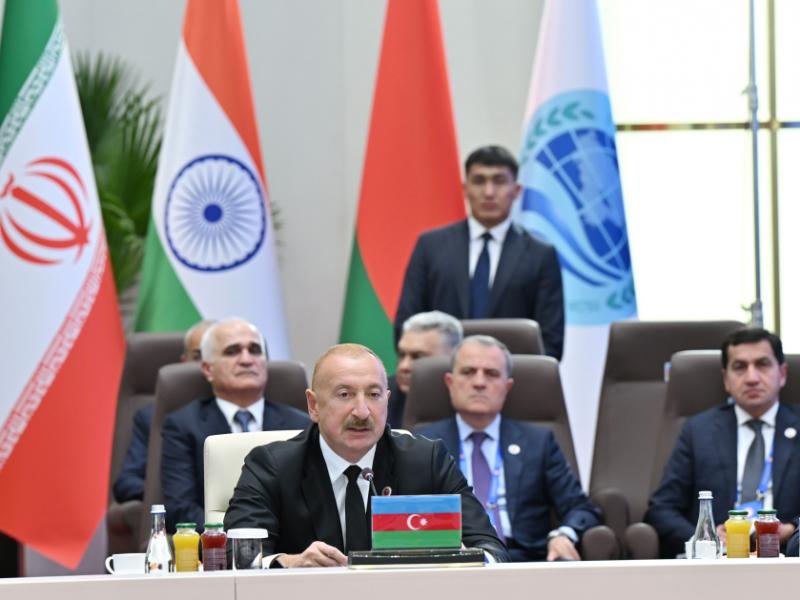
President of Azerbaijan Ilham Aliyev’s visits this summer to Kyrgyzstan and Uzbekistan were dedicated to establishing and developing Azerbaijan’s strategic relations with the countries of Central Asia. During the state visit of the President of Azerbaijan to Kyrgyzstan on July 31, following talks between Sadyr Japarov and Ilham Aliyev, a Treaty on Allied Relations between the two countries was signed, along with decisions of the Interstate Council. Among the signed documents were an Agreement on International Road Transport, roadmaps for cooperation in the energy sector for 2026–2027, a roadmap for the implementation of the Cooperation Programme for 2024–2029, and other documents.
On August 23, the 3rd meeting of the Supreme Interstate Council of Azerbaijan and Uzbekistan was held in Tashkent, with the participation of President of the Republic of Azerbaijan Ilham Aliyev and President of the Republic of Uzbekistan Shavkat Mirziyoyev. President of Uzbekistan Shavkat Mirziyoyev and President of Azerbaijan Ilham Aliyev signed a Treaty on Eternal Friendship. At the 3rd meeting of the Supreme Interstate Council of Azerbaijan and Uzbekistan, President Ilham Aliyev spoke about the Zangazur Corridor. As AZERTAC reports, noting that work on the implementation of the Zangazur Corridor is actively continuing, the head of state emphasized that the project would be completed next year in the main part of Azerbaijan. President Ilham Aliyev also noted that relevant work had begun in the Nakhchivan Autonomous Republic. It was also noted that Azerbaijan is restoring and modernizing a section of the existing railway from Baku to the Armenian border, with a length of approximately 400 kilometers. The Nakhchivan section of the railway is approximately 200 kilometers long. This line will become an important branch of the Middle Corridor.
And already on September 1, meetings in the “SCO Plus” format were held in Bishkek, the capital of the Kyrgyz Republic. The main outcome of the SCO summit in Bishkek, held from August 31 to September 1, 2026, was the signing of 28 official documents and the adoption of the Bishkek Declaration marking the 25th anniversary of the organization. The meeting of leaders in the “SCO+” format took place against the backdrop of discussions on Eurasian security, economic partnership, and strengthening the organization’s role in the global architecture. The SCO leaders also discussed regional and transport projects during bilateral talks. Within the framework of the SCO, the presidents of Azerbaijan and Armenia discussed the next practical steps for implementing the Trump Initiative for International Peace and Prosperity (TRIPP), one of the key outcomes of the Washington Peace Summit, and noted the importance of projects to develop transport infrastructure along the TRIPP routes.
As a result, Azerbaijan is currently supplying petroleum products to Armenia and ensuring the transit of goods from third countries. Together with Armenia, work is underway to increase the volume of bilateral trade, expand its range, and establish new land transport links.
Island of stability
On July 21, President of the Republic of Azerbaijan Ilham Aliyev held an expanded meeting in Berlin with President of the Federal Republic of Germany Frank-Walter Steinmeier. Frank-Walter Steinmeier described Azerbaijan and Germany as an island of stability against the backdrop of events taking place in the world and the region. The President of Germany particularly noted Azerbaijan’s role in ensuring Europe’s energy security.
Touching upon Azerbaijan’s role in Europe’s energy security, President Ilham Aliyev stated that the country already exports gas to Germany and Austria.
On July 20, President of the Republic of Azerbaijan Ilham Aliyev met in Berlin with Michael Harms, Chairman of the German Eastern Business Association.
According to AZERTAC, the meeting highlighted the growing interest of Azerbaijani and German businessmen and companies in joint activities, and ways to institutionalize such cooperation were also discussed.
The parties exchanged views on the existing potential of traditional and alternative energy sources, transport infrastructure, transport and logistics, including opportunities for cooperation within the framework of the Middle Corridor.
On July 1, President of the Republic of Azerbaijan Ilham Aliyev held an expanded meeting in Berlin with President of the European Commission Ursula von der Leyen. Ursula von der Leyen stated that the European Union was ready to provide comprehensive support for the peace process between Azerbaijan and Armenia.
The meeting highlighted Azerbaijan’s important role in establishing regional connectivity between Central Asia and Europe, as well as the successful cooperation between our country and the European Union in the field of energy.
Regarding Azerbaijan’s role in Europe’s energy security, it was noted with satisfaction that Azerbaijan is a reliable partner, particularly given the increase in the volume of gas exports to the European Union since 2022.
Integrating the Caspian and Black sea regions opens up good opportunities - Serdar Berdimuhamedov
On June 22, President of the Republic of Azerbaijan Ilham Aliyev and President of Turkmenistan Serdar Berdimuhamedov signed a joint declaration. Emphasizing that issues of the global agenda — transport and energy security — are currently on the agenda, the head of the Azerbaijani state stated that, in this regard, Azerbaijan and Turkmenistan play a very important role not only in the region but also on a global scale, both at the national level and within the framework of joint initiatives, and that this role will continue to grow in the future.Azerbaijan’s Minister of Foreign Affairs Jeyhun Bayramov and Deputy Chairman of the Cabinet of Ministers of Turkmenistan and Minister of Foreign Affairs Rashid Meredov exchanged the “Cooperation Programme between the Ministry of Foreign Affairs of the Republic of Azerbaijan and the Ministry of Foreign Affairs of Turkmenistan for 2026–2029.” A number of other documents were also signed.
During his visit to Baku, the President of Turkmenistan touched upon cooperation in the Caspian Sea region and alsoemphasized the importance of joint activities by the two countries in the areas of security, the economy, ecology, and environmental protection. In this regard, he noted that Turkmenistan had initiated a high-level meeting on issues related to the Caspian Sea and expressed hope for Azerbaijan’s support in promoting the Caspian Environmental Initiative.
Serdar Berdimuhamedov emphasized the importance of cooperation on the international stage, as well as within the framework of the United Nations, the Organisation for Economic Co-operation and Development, the Organisation of Islamic Cooperation, the Organization of Turkic States, and the Commonwealth of Independent States. The high-ranking guest highly appreciated Azerbaijan’s support for Turkmenistan’s neutral foreign policy and international initiatives put forward in the interests of peace and sustainable development. At the same time, he noted that Turkmenistan also supports Azerbaijan’s important international initiatives and stated that this tradition would continue in the future.
Considering the transport and transit sector one of the strategic areas of cooperation, Serdar Berdimuhamedov noted that the advantageous geographical position of Turkmenistan and Azerbaijan creates significant advantages for the development of international transport corridors. In this regard, he proposed intensifying the activities of the Turkmenistan-Azerbaijan Commission on Transport, Transit and Logistics.
Considering the Afghanistan–Turkmenistan–Azerbaijan–Georgia–Türkiye transport corridor an example of successful cooperation, Serdar Berdimuhamedov emphasized that the two countries also support the initiative to establish a Caspian–Black Sea transport corridor along the Turkmenistan–Azerbaijan–Georgia–Romania route. The high-ranking guest noted that bringing the Caspian and Black Sea regions together opens up good opportunities for developing economic, trade, and investment cooperation.
The President of Turkmenistan also emphasized the broad opportunities for developing cooperation in the oil and gas, chemical, textile, and other sectors.