


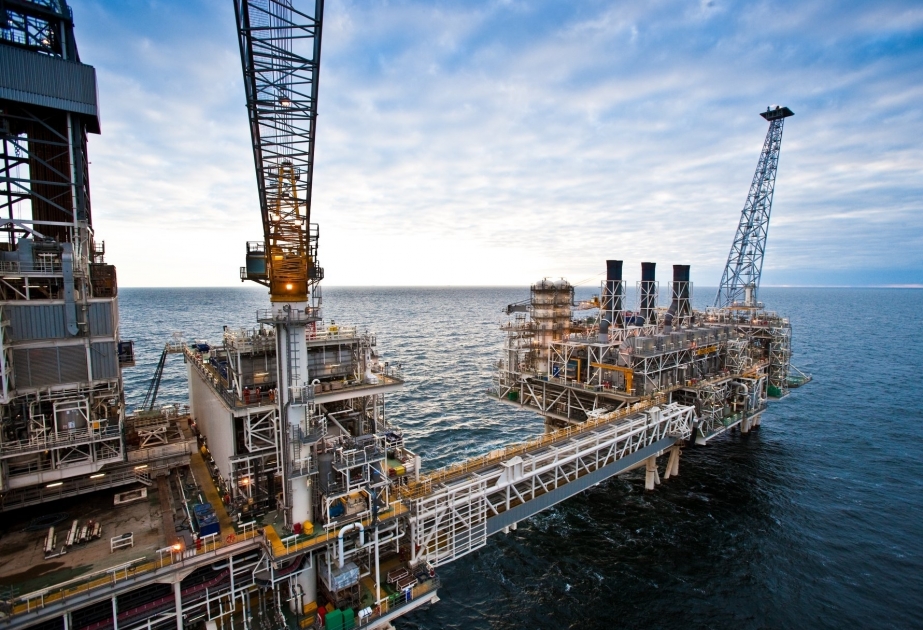
The first oil from the Azeri-Chirag-Gunashli field reached the Ceyhan marine terminal in Türkiye on May 28, 2006. On June 14, the first tanker, the British Hawthorn, carrying 600,000 barrels of oil, left the port of Ceyhan for the global market. In 2006, about 7.1 million tonnes of Azerbaijani oil were transported through the main export pipeline, the Baku-Tbilisi-Ceyhan (BTC) pipeline named after Heydar Aliyev. From its launch in mid-2006 through the end of 2008, the pipeline carried a total of about 70 million tonnes of oil.
In 2025, the total volume of oil transported through the Baku-Tbilisi-Ceyhan (BTC) main export pipeline amounted to 36.306 million tonnes, down 7.8% from the previous year and 6% from the pipeline’s peak throughput recorded in 2010.
Oil exports through the Baku-Tbilisi-Ceyhan (BTC) pipeline totaled 14.8 million tonnes in January–July 2026, down 8.1% from the same period in 2025.
Key figures for 2026
Total volume for the first seven months: 14.8 million tonnes, compared with 16.1 million tonnes a year earlier.
Azerbaijan’s share: 76.8% of the total volume transported, with the remainder consisting of transit oil.
Transit oil: From January through July, the volume of transit oil transported amounted to 2.618 million tonnes.
Kazakhstan’s plans: Astana plans to increase shipments of its oil through the BTC pipeline to 2.2 million tonnes for the year, with the possibility of raising the volume to 2.5–3 million tonnes.
The maximum volume of oil transported through the Baku-Tbilisi-Ceyhan (BTC) main export pipeline was recorded in 2010, when throughput reached 38.4 million tonnes. This means that 16 years after reaching its peak throughput, oil exports through the BTC pipeline have declined by 6%. Since the Baku-Tbilisi-Ceyhan (BTC) pipeline began operations in June 2006, it has transported more than 630 million tonnes of crude oil and condensate, equivalent to more than 4.7 billion barrels.
In 2006, the average price of Azeri Light crude was approximately $60–65 per barrel, fluctuating throughout the year from around $55 to more than $75 per barrel.
Today, according to the Azerbaijan State News Agency (AZERTAC), a barrel of Azeri Light is priced at $91.51.
The lowest price for Azeri Light was recorded on April 21, 2020, at $15.81 per barrel. This came amid the COVID-19 pandemic, a sharp decline in global demand for energy, and a price shock in the oil market. The highest price was recorded in July 2008, at $149.66 per barrel. In the first half of 2008, global energy prices rose sharply amid strong worldwide demand, before falling dramatically in the autumn as the global financial crisis began.
Having successfully weathered all the price highs and lows of 2006–2026, Azeri Light has seen its market value rise, as has demand for the ACG project itself. This is despite the fact that investment in the global oil industry continues to decline for the third consecutive year, amid shifting markets and energy companies’ efforts to strengthen supply security. Investment in the development of the Azeri, Chirag and Gunashli fields is increasing.
In 2006, planned investment in the development of the Azeri-Chirag-Gunashli (ACG) block of fields stood at approximately $1.8 billion. At the time, $500 million was earmarked for the Azeri project (Phase 1 and Phase 2), while $1.3 billion was planned for Phase 3, the development of the deepwater section of the Gunashli field.
Today, investments by the participants in the Azeri-Chirag-Gunashli (ACG) project exceeded $1 billion in the first half of 2026, reaching approximately $1.001 billion, up from $817 million in the same period of 2025. According to bp, the increase in investment made it possible to maintain oil production at last year’s level. From January through June, 59 million barrels of oil—approximately 8 million tonnes—were produced at ACG, with average daily production ranging from 323,000 to 327,000 barrels. Daily oil production in Azerbaijan stood at 440,000 barrels in July. A year earlier, in July 2025, daily oil production in Azerbaijan was approximately 470,000 barrels per day, according to an S&P Global review.
Total spending (investment) by bp and its partners in the Azeri-Chirag-Gunashli (ACG) block of fields amounted to $1.852 billion in 2025, essentially the same figure in nominal terms as 20 years ago. This underscores the project’s strong market relevance and the enduring value of its infrastructure, which remains in use today despite the natural depletion of the reservoirs and emerging trends in the global energy market. Since 1994, oil production in Azerbaijan has been carried out primarily under the agreement for the development of the Azeri-Chirag-Gunashli (ACG) block of fields. The State Oil Company of the Republic of Azerbaijan (SOCAR) holds a 35.3% share in the contract. In September, bp, the operator of the Azeri-Chirag-Gunashli (ACG) development project, plans to begin producing deep-lying oil. According to Gordon Birrell, bp’s executive vice president for production and operations, ACG is a field of unique scale and complexity, with free gas reservoirs located both above and below the oil-bearing formations.
According to Birrell, the Azeri-Chirag-Gunashli (ACG) block is one of the largest oil fields in the world, and more than 4 billion barrels of oil have been produced there since it began operations.
During a recent visit to Baku, bp executive Meg O’Neill discussed the development of non-associated gas at the Azeri-Chirag-Gunashli (ACG) field, as well as the next stage of development of the Shah Deniz field—the Shah Deniz Compression project. The talks also covered the progress of the offshore Karabakh and Ashrafi-Dan Ulduzu-Aypara (ADUA) oil and gas projects, as well as the construction of the Shafag solar power plant and the electrification of the Sangachal terminal.