


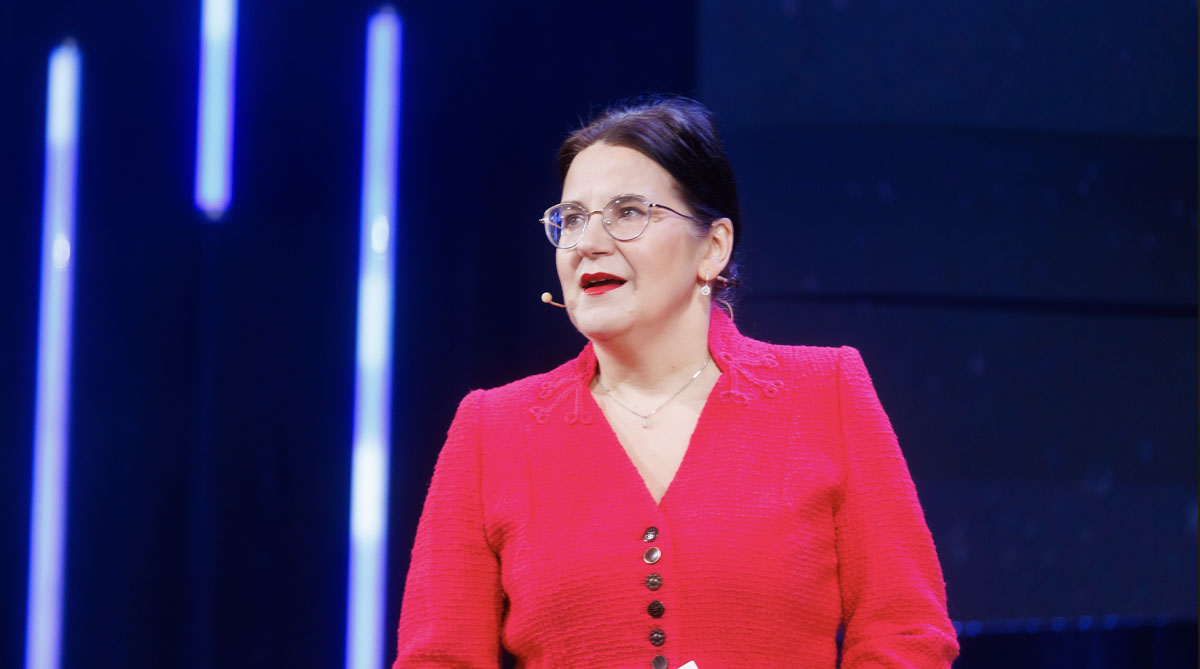
Caspian Energy (CE): As Estonia transitions toward ‘invisible’ proactive government services, how is your Ministry utilizing Artificial Intelligence to further personalize the e-state experience for citizens and businesses?
Liisa-Ly Pakosta, Minister of Justice and Digital Affairs of the Republic of Estonia: Our goal is to shift from a reactive state to a proactive, or ‘invisible,’ state. Citizens shouldn’t have to seek out the government; instead, the government should be there the moment a person needs assistance—whether it’s the birth of a child, starting a company, or retiring. Artificial Intelligence plays a critical role in achieving this. We are developing a national network of virtual assistants called Bürokratt. It is not just a chatbot, but an interoperable ecosystem that allows people to access public services via voice commands or chat from a single point of entry. AI helps us analyze data (while strictly maintaining privacy) to offer services proactively—for example, automatically paying family benefits without an application. Our vision is that bureaucracy should be left to machines, so people can focus on the joy of living.
CE: With the implementation of the EU AI Act, how is Estonia evolving its legal framework to remain a global ‘sandbox’ for tech innovation while maintaining the highest standards of data security and ethics?
Liisa-Ly Pakosta: Estonia has always believed that technological innovation and a strong legal framework must go hand in hand. The EU AI Act provides the necessary framework to build trust, but we must be careful not to over-regulate or stifle innovation. Estonia’s approach is to create regulatory sandboxes. These are secure environments where companies, in cooperation with the state, can test new AI solutions using real data but under controlled conditions. Our message to the world is simple: Estonia is the best place to test boundary-pushing digital solutions. Our small size and digital agility allow us to quickly adapt laws to support development while ensuring data security.
CE: Looking toward 2030, which specific ICT innovations do you believe will have the most transformative impact on how the public sector operates and interacts with the private digital economy?
Liisa-Ly Pakosta: By 2030, we foresee the biggest breakthrough in the real-time economy and data-driven decision-making. This means transitioning from documents to data. For entrepreneurs, reporting to the state (e.g., taxes) will happen automatically in the background, fully integrated into their business software. Another major direction is cross-border interoperability. Digital wallets and data exchange must not be confined by national borders. Thirdly, I see great potential in personalized medicine, where the symbiosis of AI and genetic data allows us to prevent diseases more precisely than ever before. The public sector will become a platform upon which the private sector can build new value-creating services.
CE: Estonia is a global benchmark for digital governance; how does your Ministry facilitate the exchange of experience in digital transformation with partners in the EU, the Caspian region, and Central Asia to help them build their own digital ecosystems?
Liisa-Ly Pakosta: The success story of Estonia’s digital state is not a secret we keep to ourselves—it is an open-source mindset. We have shared our underlying technologies (such as the X-Road) and experiences with many countries, including those in the Caspian region and Central Asia, with whom we have had long-standing and fruitful cooperation. Our Ministry works closely with organizations like the e-Governance Academy (eGA) and the Estonian Centre for International Development (ESTDEV) to provide strategic advice and technical support. We believe that a digital society makes countries more transparent and resilient. Our goal is to assist partners in building digital ecosystems that suit their specific needs, offering both our lessons learned—what to do and what to avoid—and proven technological solutions.
Thank you for the interview.