


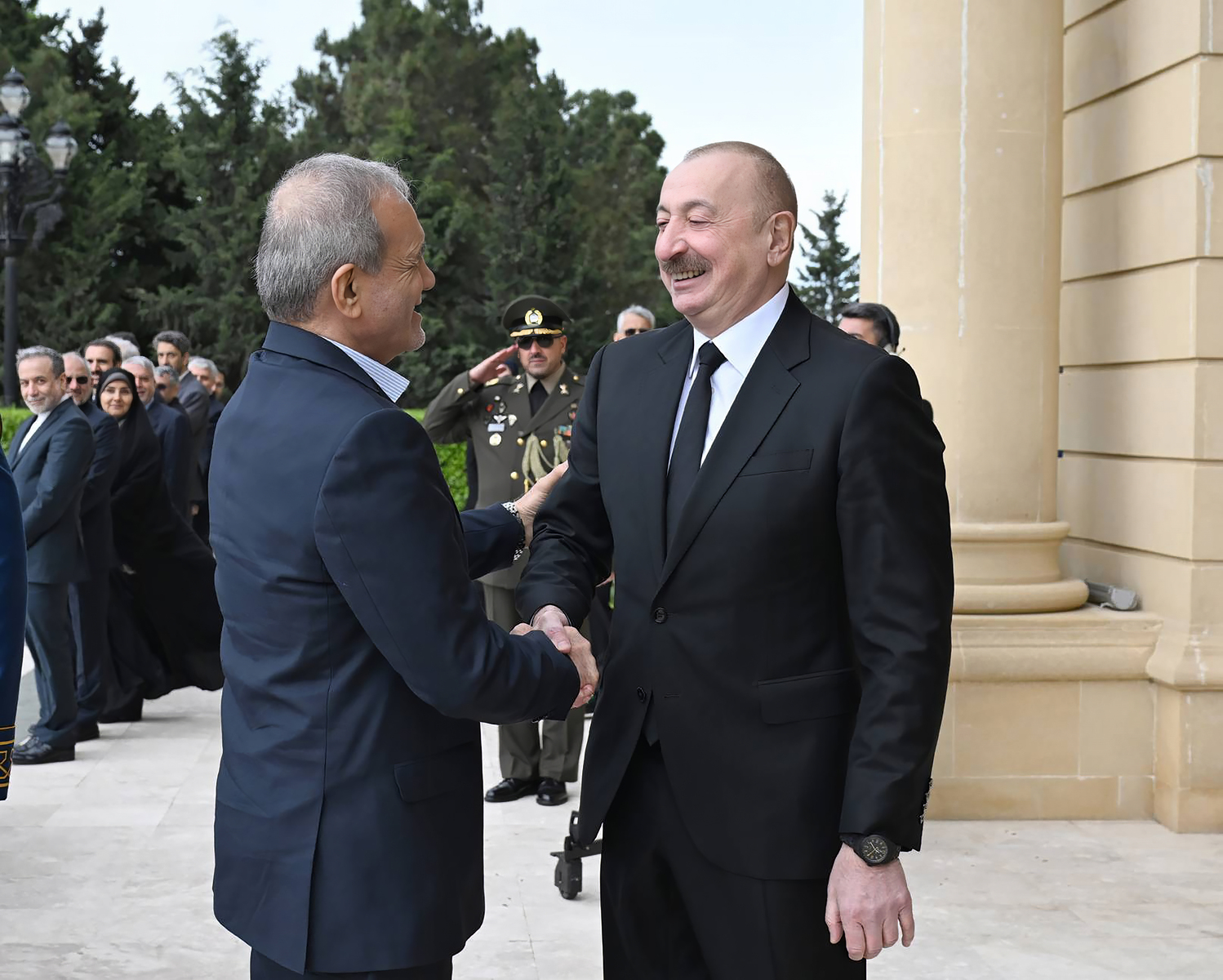
The key focus of Iranian President Masoud Pezeshkian’s April 28 visit to Baku - his first official trip to the Azerbaijani capital as head of state - was to build cooperation in industry, trade, and joint investment. According to Masoud Pezeshkian, the next phase of cooperation will involve BRICS, the Shanghai Cooperation Organization, and the countries of Eurasia.
“We are doing everything possible to help resolve the issue of restoring the Zangezur Corridor. Specifically, we are preparing a route to Iran for Azerbaijani citizens so they can reach the Nakhchivan region through Iran. Work on constructing road and rail infrastructure is progressing rapidly. We have reached an agreement, and God willing, there will be no obstacles in establishing transport links between Azerbaijan and Nakhchivan,” the head of state stated. “We are paying special attention to connecting Astara with Astara, as well as Astara with Rasht, and our agenda also includes the construction of a railway line.”
During the visit, seven strategic documents were signed, including the following:
• A Memorandum of Understanding on transport, aimed at developing rail links between the two countries.
• An Agreement on Cultural Exchange for the period 2025–2028, providing for joint cultural events and delegation exchanges.
• A Memorandum of Cooperation in the media sector, aimed at strengthening information exchange between the two countries.
These documents reflect the parties’ commitment to deepening cooperation in key areas.
Cooperation between Tehran and Baku is of significant importance for the entire region. The development of bilateral relations contributes to strengthening stability, fostering economic growth, and improving the well-being of the peoples of both countries. Therefore, special attention was given to the project for the construction of the Rasht-Astara railway, which is part of the International North-South Transport Corridor.
This project is designed to improve logistics connections between Iran, Azerbaijan, and Russia, as well as to promote trade development in the region.
The parties discussed opportunities for joint development of energy projects, including:
• Advancing hydropower development on the Araz River, specifically the operation of the Giz Galasy hydro facility, which was commissioned in May 2024.
• Cooperation in the oil and gas sector, including joint development of fields in the Caspian Sea.
These initiatives are aimed at ensuring energy security and sustainable development for both countries.
It is important to highlight the potential for developing the promising Araz, Alov, and Sharg blocks. Following the resolution of the Caspian Sea’s legal status, this issue has gained new relevance, although it has not yet been formally addressed at the official level.
Until July 2001, the Azerbaijani side intended to develop the Araz-Alov-Sharg block under a 25-year contract signed with the international consortium led by BP. However, the project was suspended at the insistence of the Iranian side. Also, the issue of developing the Caspian deepwater structures “Lerik Deniz,” “Janub” or D-43, and “Zardob” or D-41 remains unresolved. According to exploration data, the field with gas reserves may contain 50 trillion cubic feet (over 1.4 trillion cubic meters) of gas and approximately 10 billion barrels of oil.
Therefore, the oil and gas sector, particularly these fields which require a high-tech approach and modern deepwater drilling technologies (with depths exceeding 1,000 meters), as well as the preservation of the Caspian Sea and its biological resources, remains one of the key areas in the economic relations between the two neighboring countries.