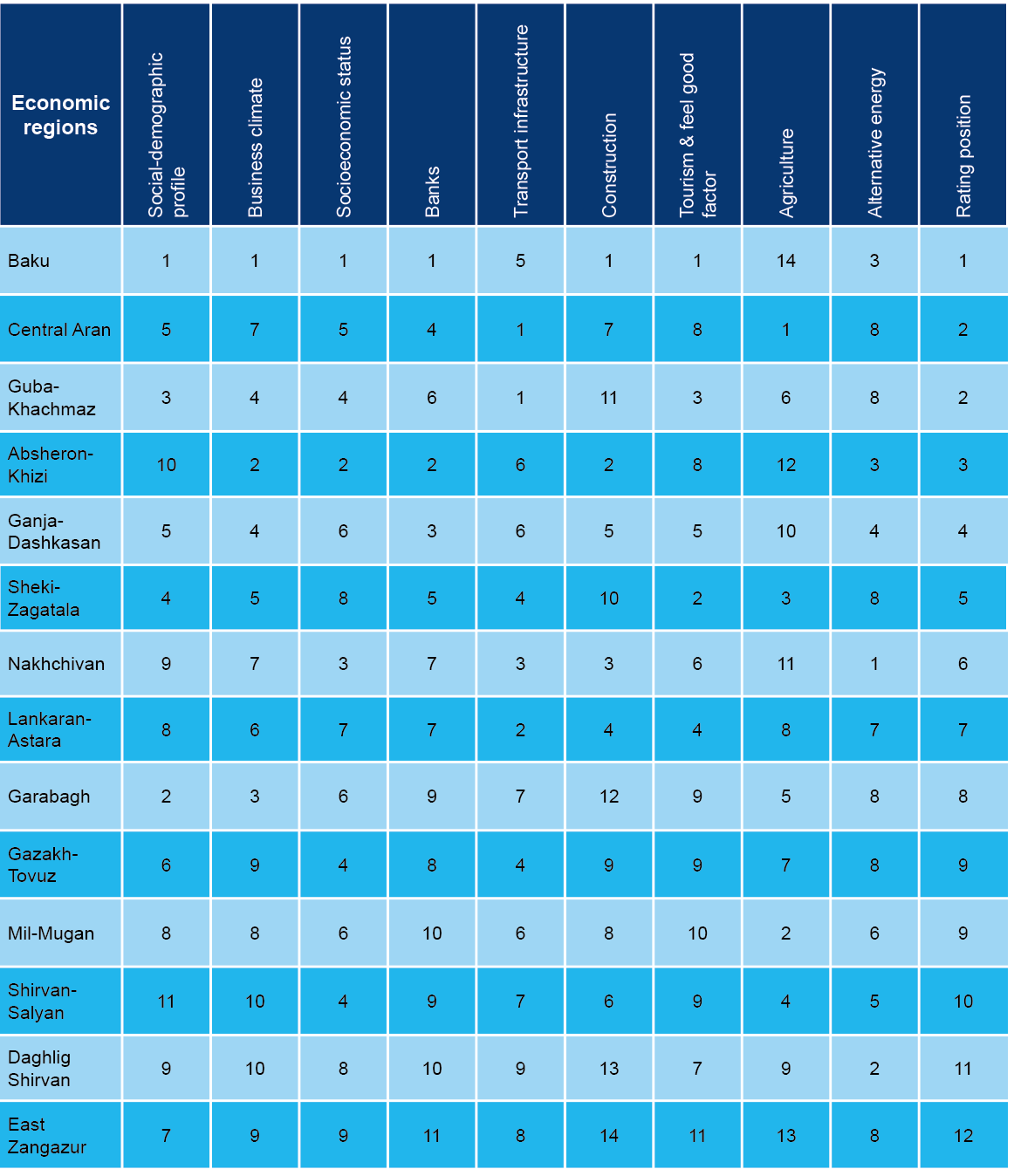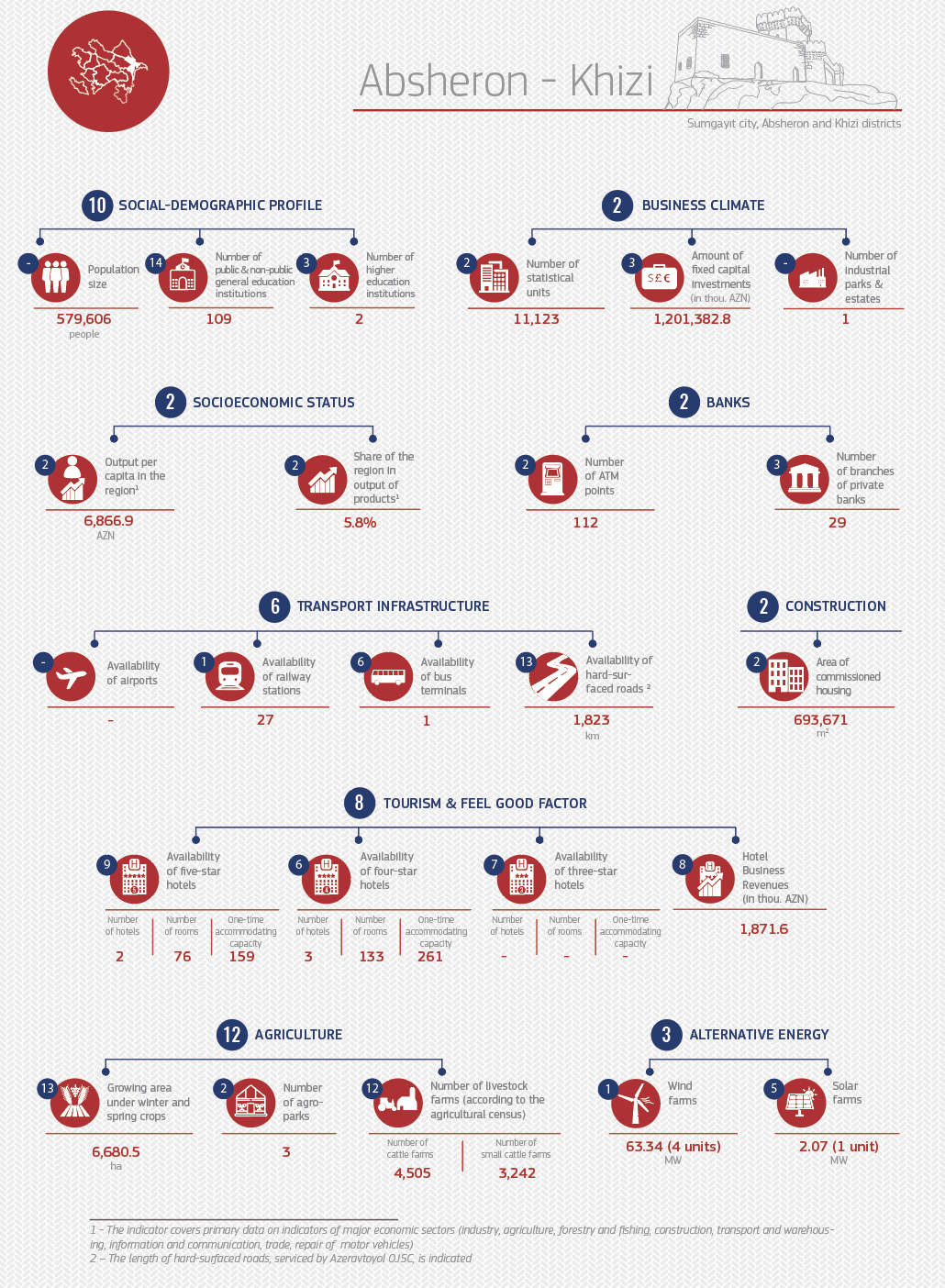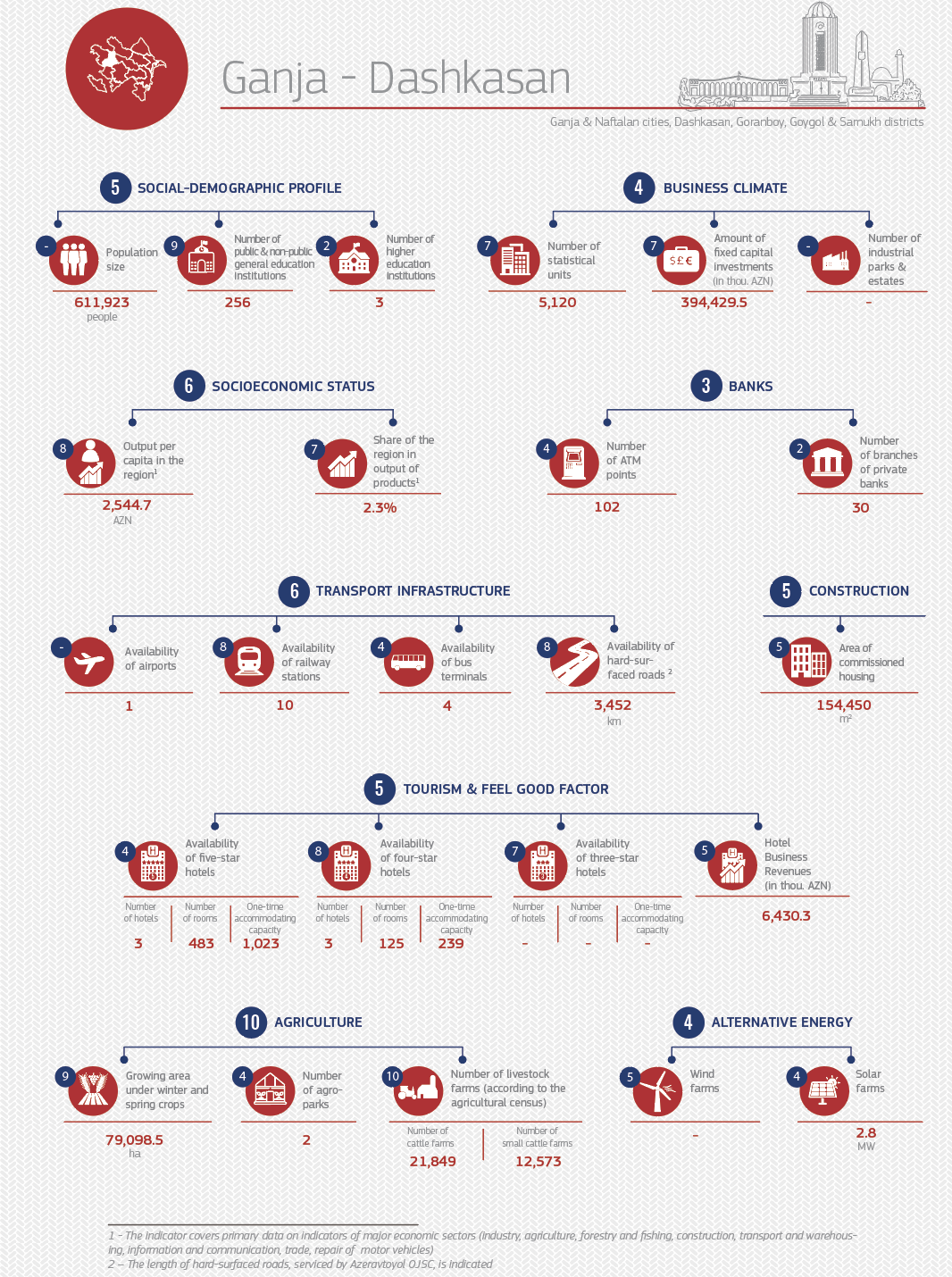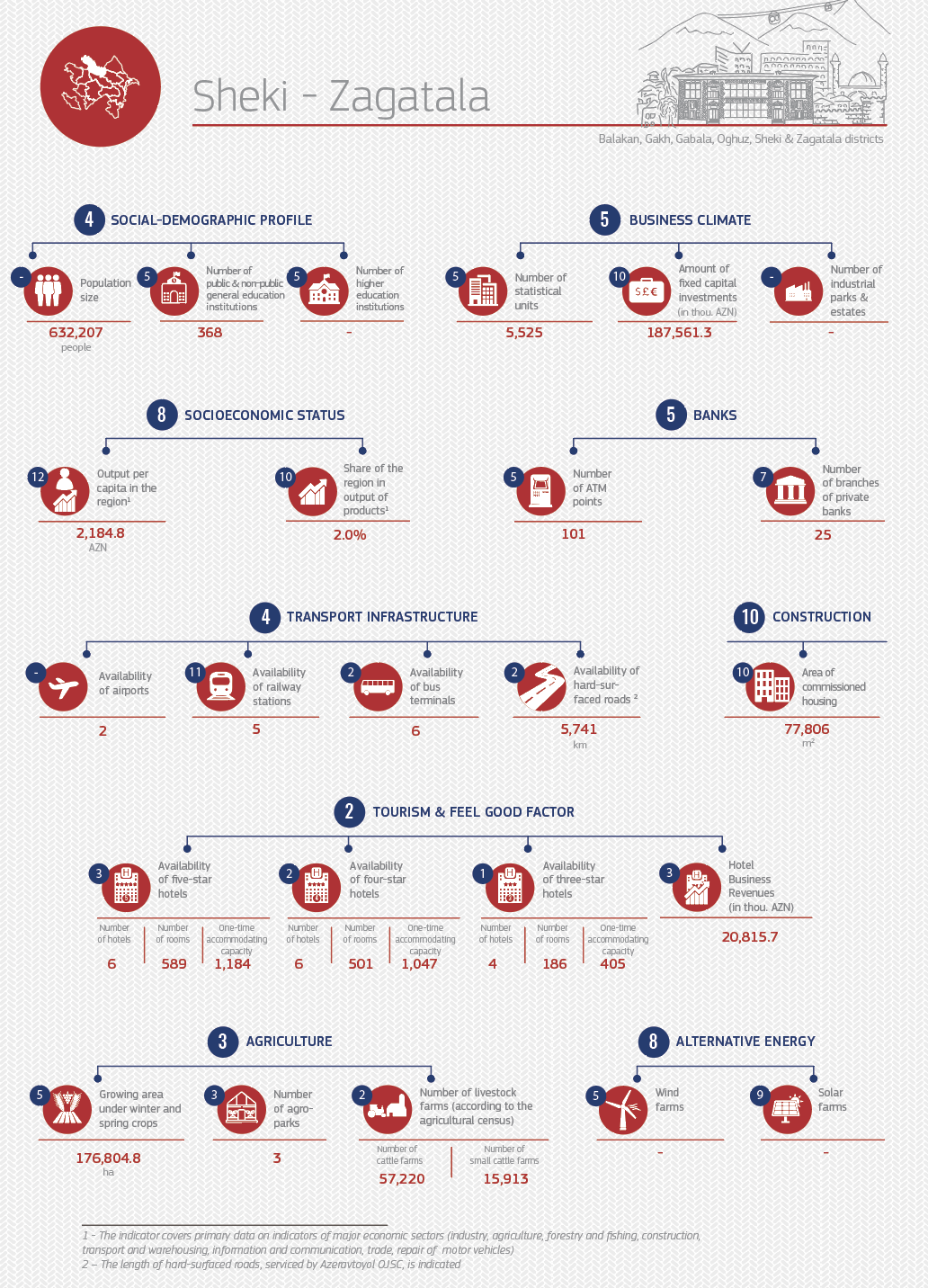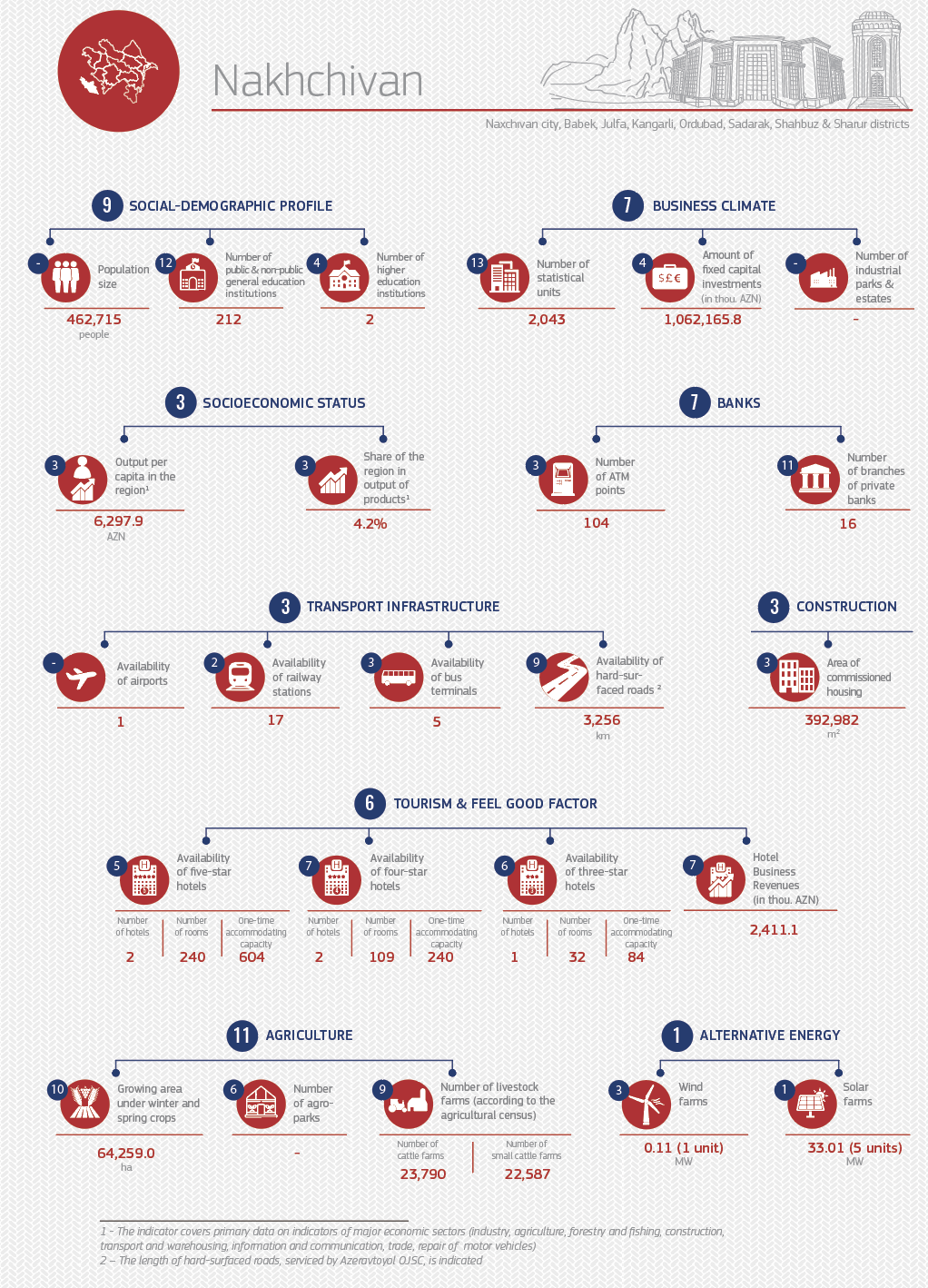


The rating of 14 regions is conditionally divided into 9 indicators. Among them are the social-demographic profile (based on the demographic indicators of each region and the number of general education and higher educational institutions), socioeconomic status (based on the total output per capita, percentage share of the economic regions in total output of products, number of branches of banks and ATM points showing the level of financial services provided to the population), business climate (focused on the number of statistical units, amount of fixed capital investments, number of industrial parks and industrial estates). Considered were also transport infrastructure indicators (number of airports, railway and bus stations, length of hard-surfaced roads), feel-good factor, hospitality and service indicators, which is a favorable basis for the development of the tourism sector (number of different category hotels), as well as an agricultural sector (number of agroparks, growing areas, cattle and small cattle farms). All these indicators are closely interrelated and the result of development of one or another of the fourteen regions.
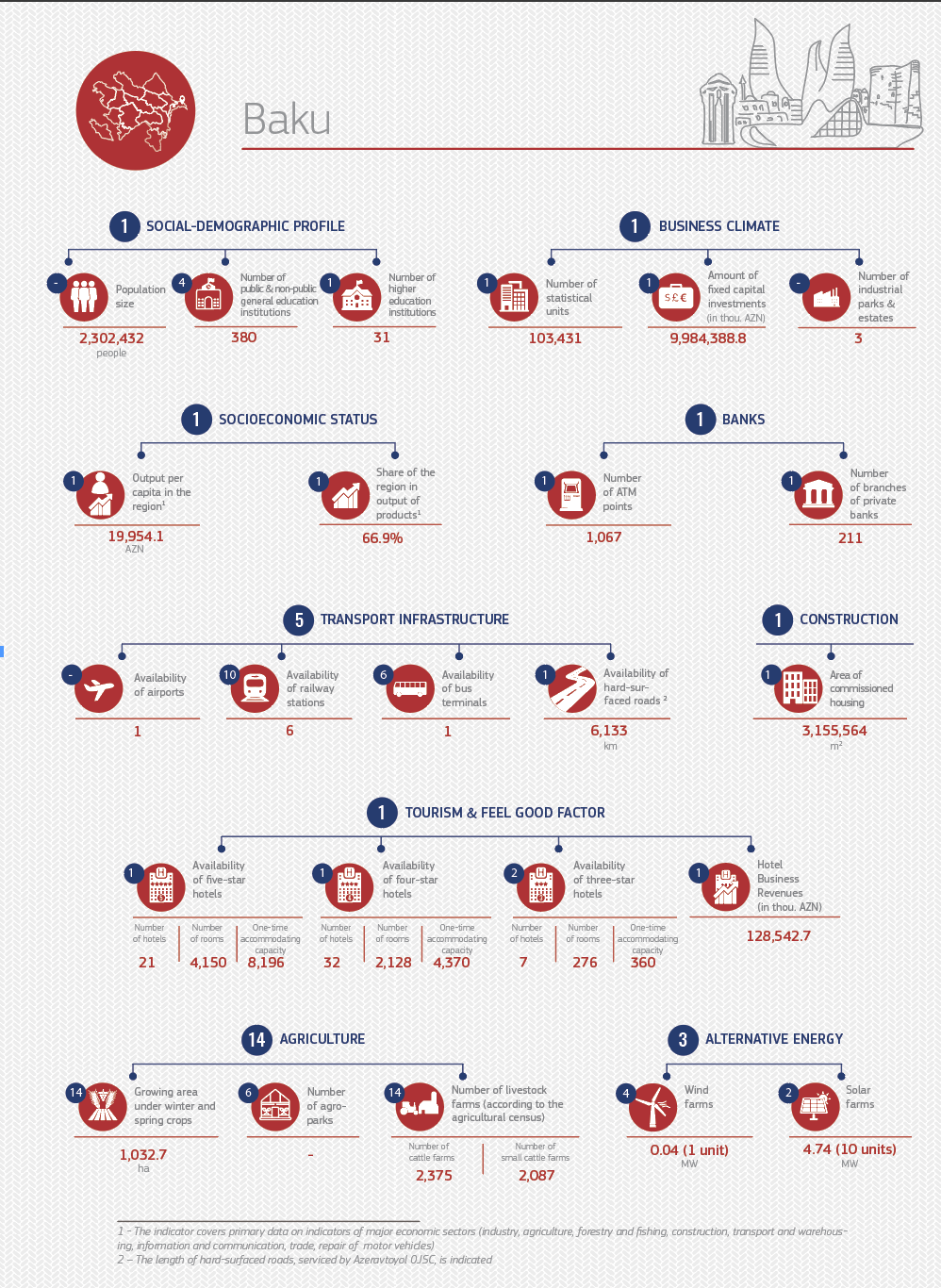
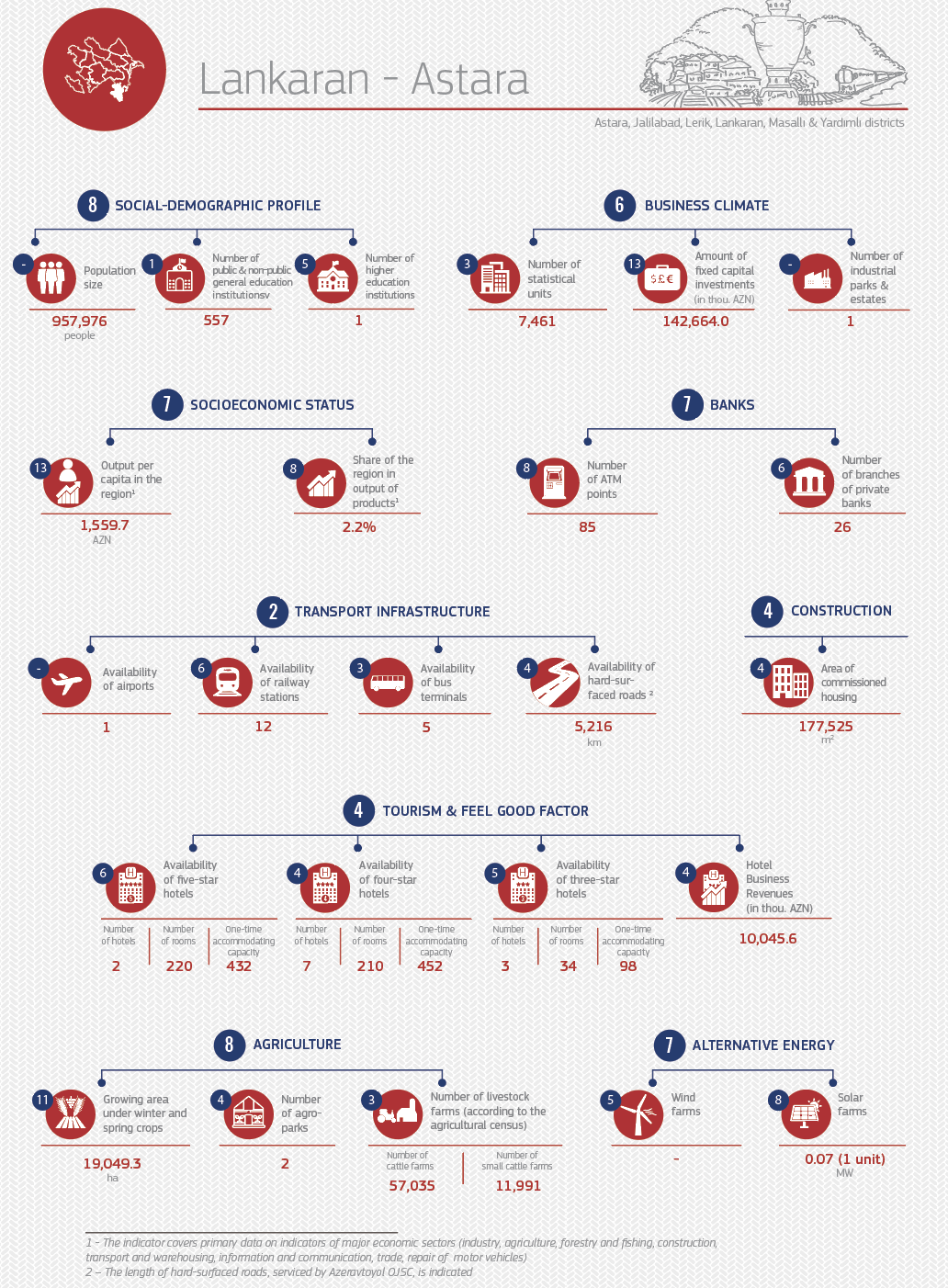
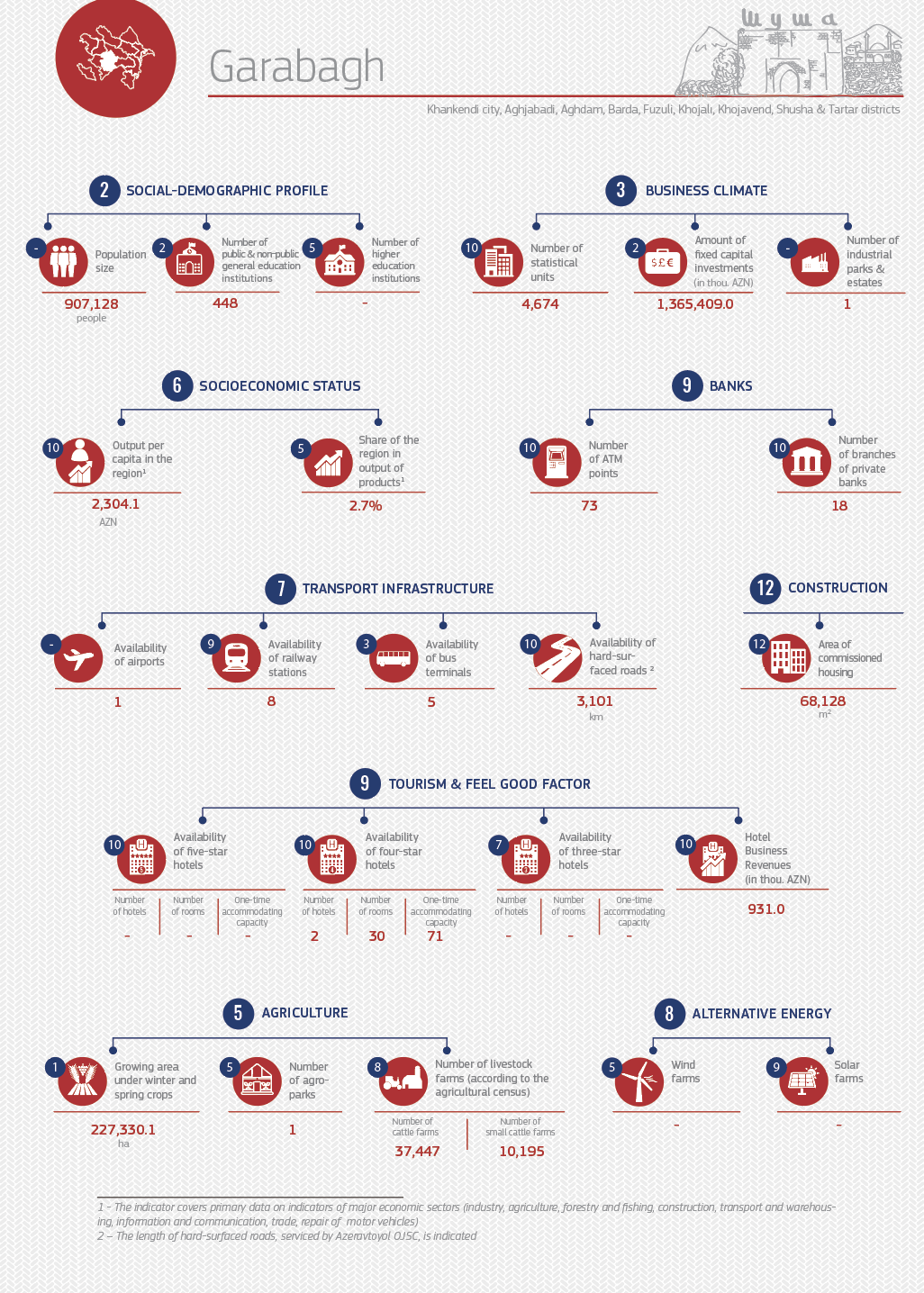
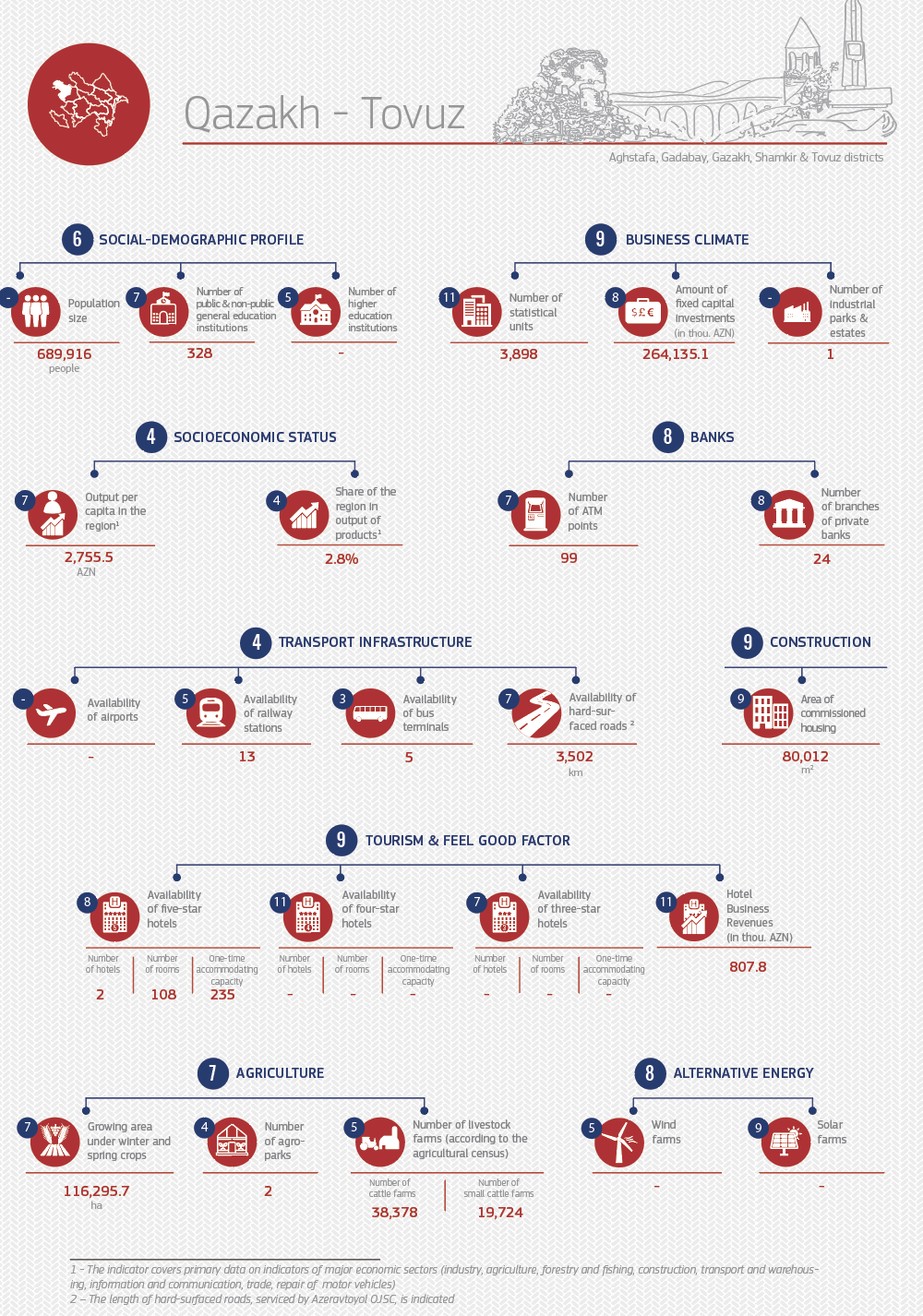
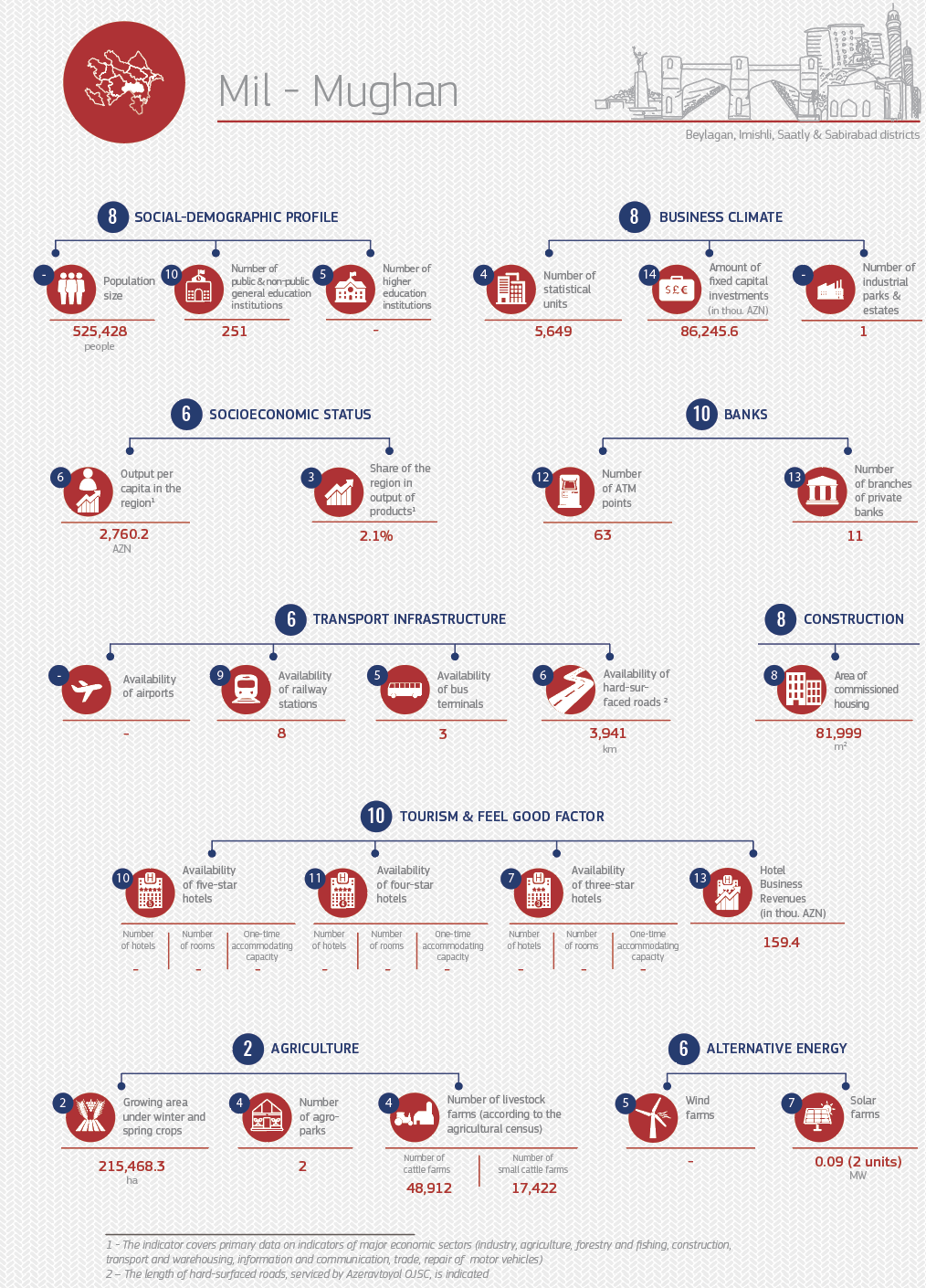
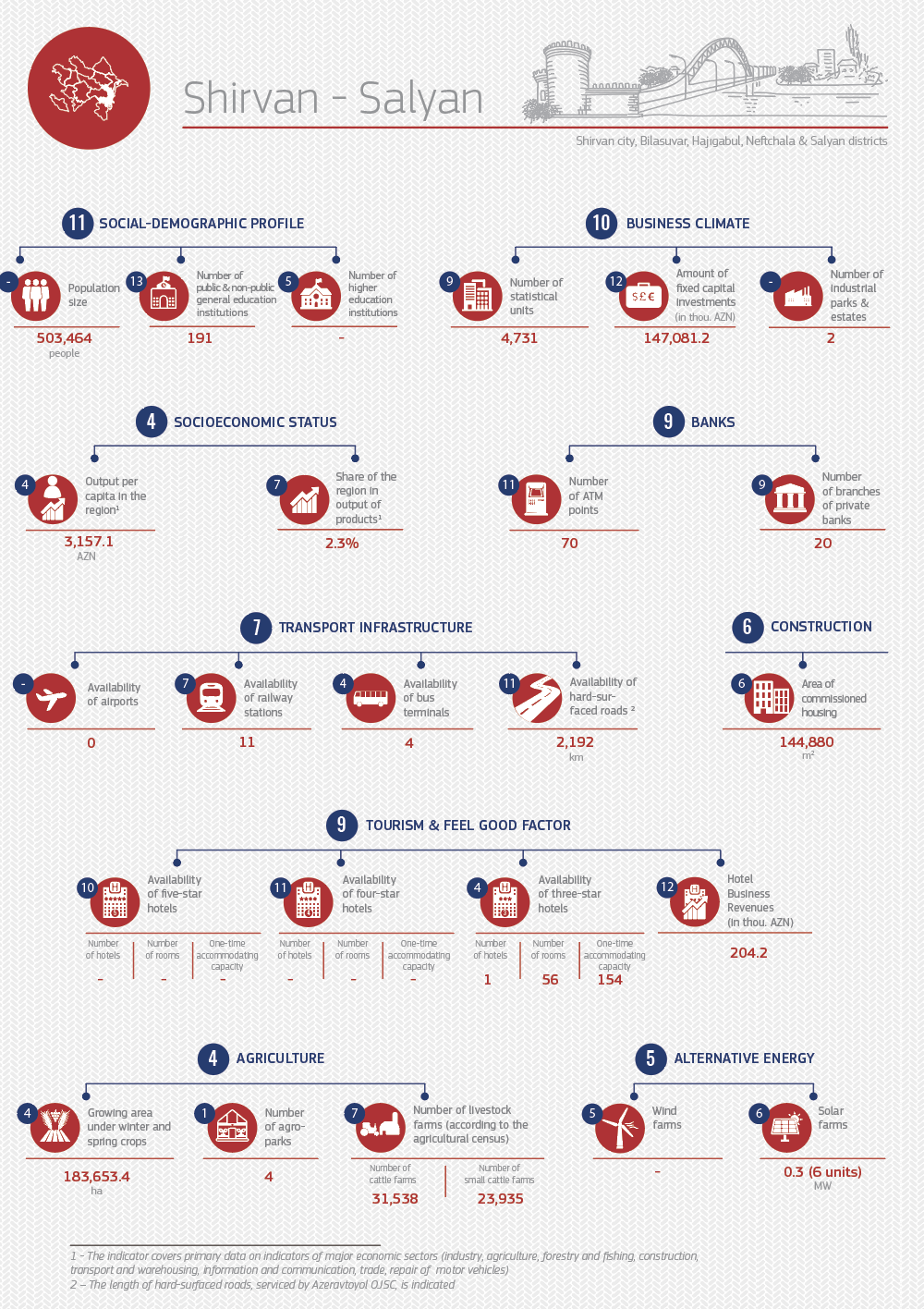
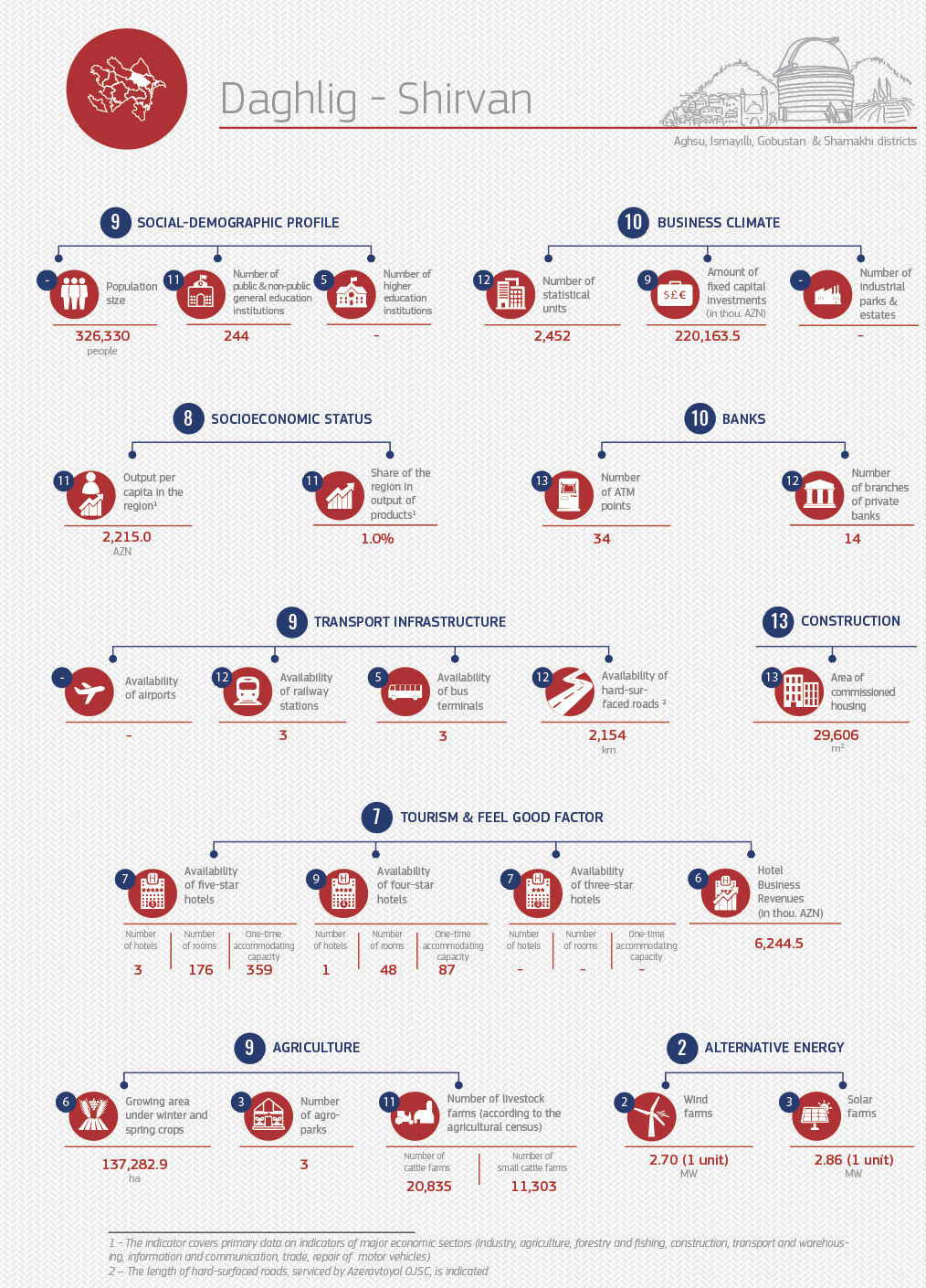
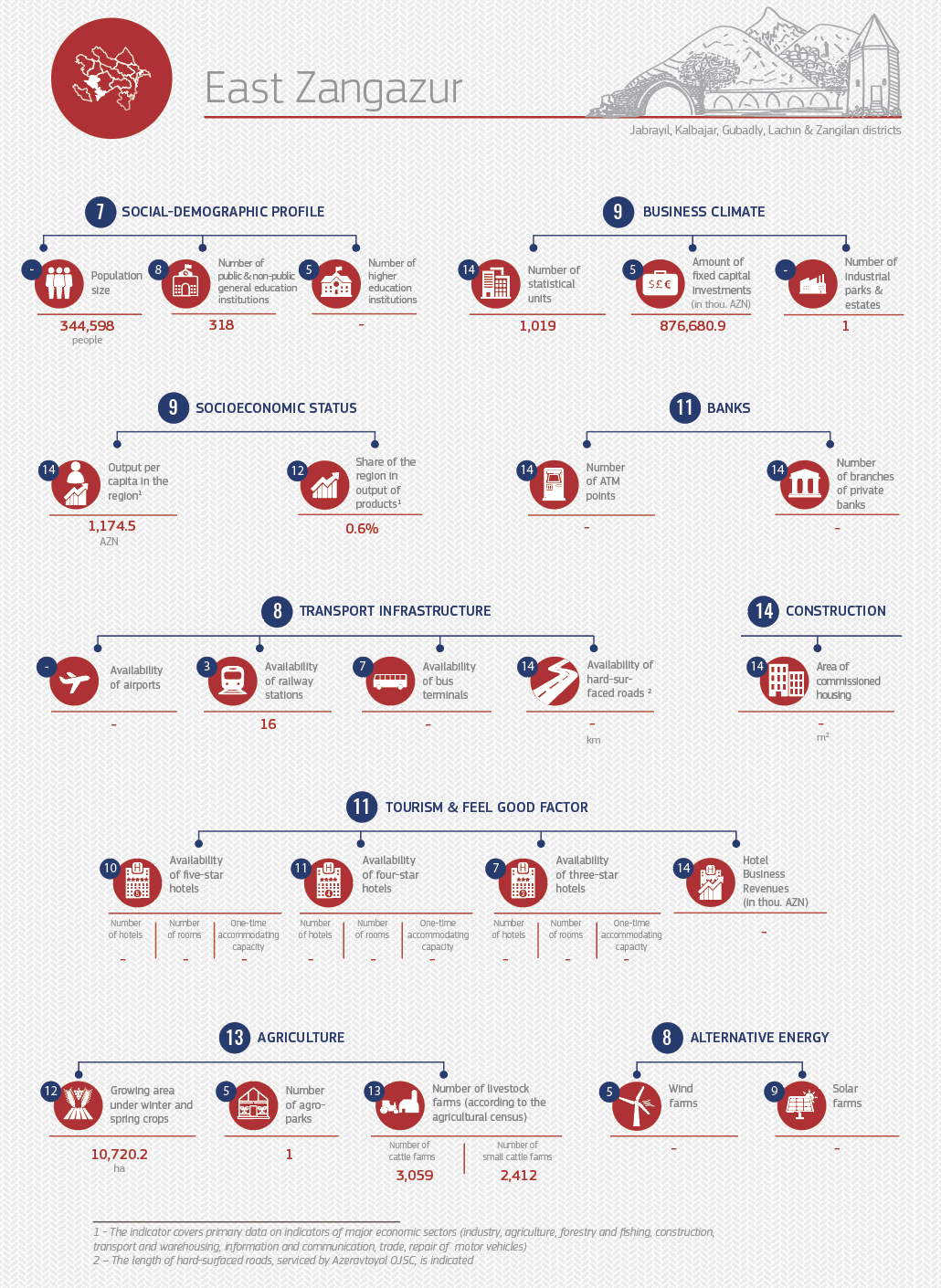
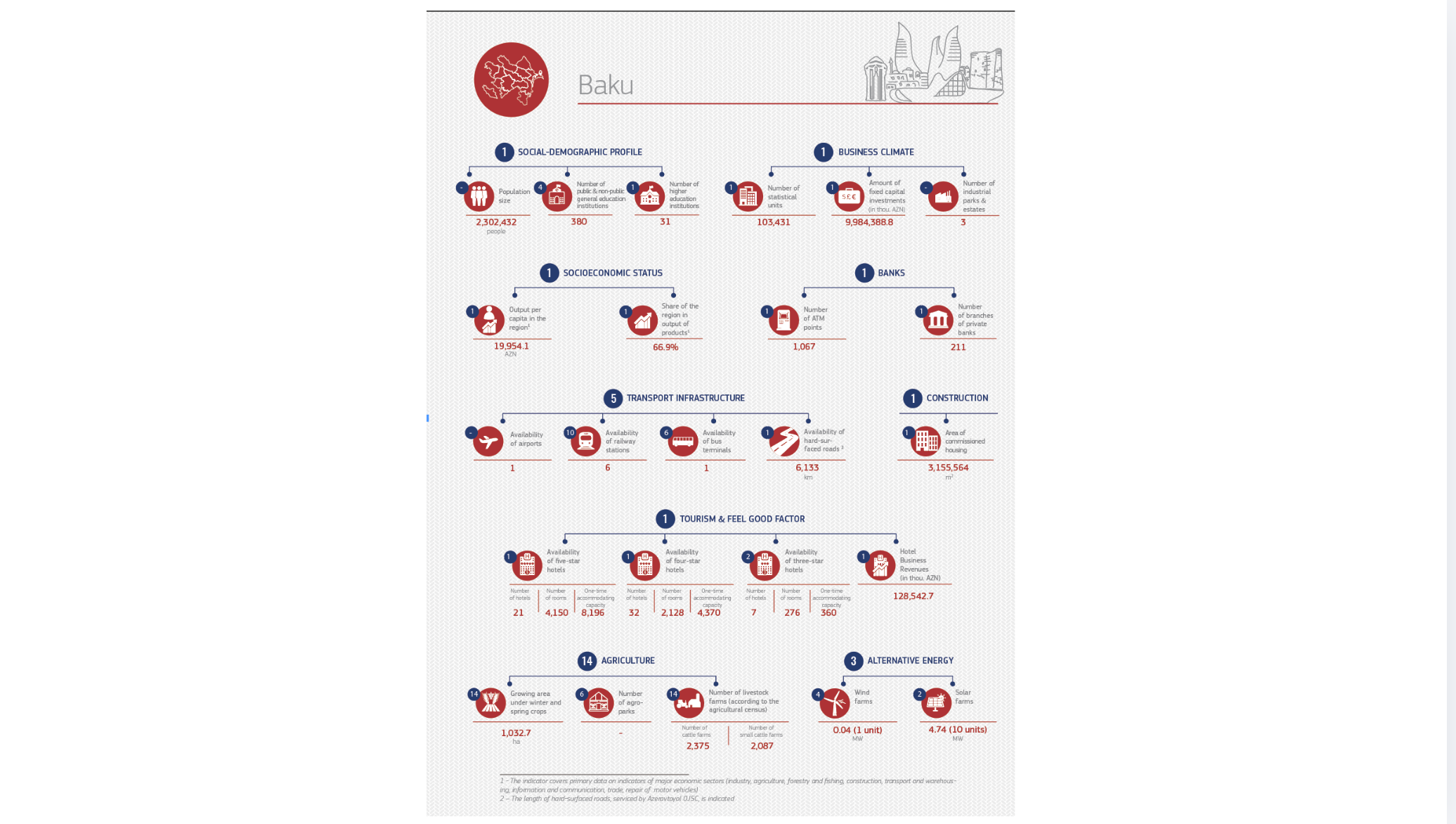
Azerbaijan’s most densely populated regions are, of course, Baku (2 million 302 thousand 432 citizens), Lankaran-Astara (957,956 people) and Garabagh (907,128 people) followed by Central Aran (742,475), Gazakh-Tovuz (689,916), Sheki-Zagatala (632,207) comes on the 6th position, Ganja-Dashkasan comes seven (611,923 people), then Absheron-Khizi (579,606), Guba-Khachmaz (561,182) is the 9th, Mil-Mugan (525,428 people) is on the 10th place, Shirvan-Salyan (503,464) on the 11th, the 12th is the Nakhchivan Autonomous Republic (462,715) and the 13th is East Zangezur (344,598). The most scarcely populated region is Daghlig Shirvan (326,330 people).
The studies have shown that, except Baku, not always the most populous region shows development results similar to those of the country’s capital. 31 out of 40 higher educational institutions of Azerbaijan (HEI) are in Baku, 3 in Ganja-Dashkesan (the 7th most-populous region), two each in the Nakhchivan (the 12th most populous region) and Absheron-Khizi economic regions (comes 8 in terms of the demographic indicator). The largest number of general education institutions (schools) is seen in the Lankaran-Astara economic region (557), Garabagh (448) and Guba-Khachmaz (417). Baku takes only the 4th place (380 units). In total, there are 4,431 schools operating in the country.
The most favorable socioeconomic status indicators in all terms are seen in Baku. Among the economic regions Absheron-Khizi (6,866.9 AZN per capita, this is not the most densely populated region taking the 8th position on this indicator) accounts for the highest volume of total output per capita. Then comes Nakhchivan (6,297.9 AZN, the twelfth most populous region) on the third place after Baku (19,954.1 AZN), Shirvan-Salyan is the fourth (3,157.1 AZN) by a significant margin, and the lowest figure has been registered in East Zangazur (1,174.5 AZN) coming on the 14th place - this is almost 15 times lower than the figure of Baku and several times less than that of Nakhchivan. The total output of products per capita in the Absheron-Khizi and Nakhchivan regions, prevailing in terms of the population size, is three times lower than in Baku.
The largest number of bank branches is in Baku - 211 units, Ganja-Dashkasan - 30 branches and Absheron-Khizi – 29. Central Aran is coming fourth with 27 branches. Together with the GDP indicator, the Absheron-Khizi region, according to the rating data, has the most favorable socio-economic climate. As in previous years, there is still a protracted uneven development of the banking sector relative to the capital of the republic, which in turn can be cited as the result of the low share of the economic regions in the output of products relative to Baku (66.9%). Then follow already mentioned Absheron-Khizi (5.8%) and Nakhchivan (4.2%). Coming on the fourth place with a much lower indicator is Gazakh-Tovuz (2.8). East Zangazur (0.6) has the lowest output indictors, which also resonates with its lowest GDP figure.
Socio-economic indicators of the rating fit and arise from the current business climate where Baku certainly prevails in terms of the number of statistical units and the size of fixed capital investments (103,431 units, fixed capital investments make 9,984,388.8 AZN). In terms of the number of statistical units, Absheron-Xizi (11,123 units) and Lankaran-Astara (7,461) are right behind Baku. The fourth economic region is Mil-Mugan (5,649) followed by Sheki-Zagatala (5,525). The lowest number of units is fixed in Nakhchivan (2,043) coming the 13th in the rating, and East Zangazur (1,019) taking the 14th position.
The Garabagh economic region has the highest volume of fixed capital investments (1, 365, 409.0 thou. AZN) with an almost sevenfold margin from Baku which is decreasing. Coming next is Absheron-Xizi (1, 201, 382.8 thou. AZN). The lowest investment indicator (86, 245.6 thou. AZN) is registered in the Mil-Mugan economic region. Despite the low number of statistical units in Nakhchivan and East-Zangezur, these regions can boast of a relatively high volume of fixed capital investments and by this indicator take the 4th and 5th places respectively. Fixed capital investments in Nakhchivan and East Zangazur reach 1,062, 165.8 thou. AZN and 876, 680.9 thou. AZN, respectively. This is respectively 9.4 and 11.38 times lower than the size of investments fixed in Baku. Despite the relatively numerous units, the lowest volume of fixed capital investments in the rating is seen in the Lankaran-Astara region (142,664.0 thou. AZN). This is 70 times lower than in Baku.
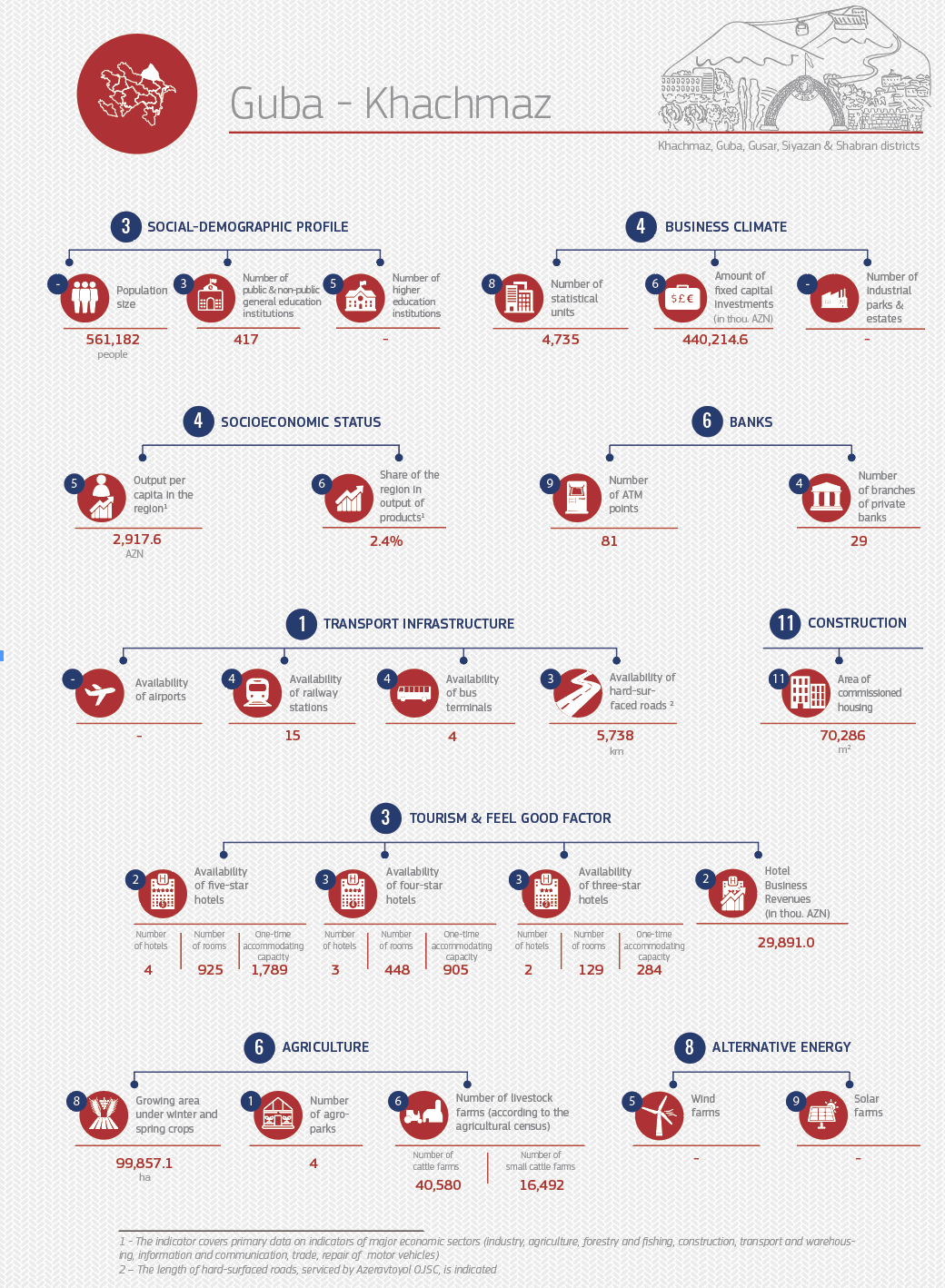
Infrastructure development indicators are closely linked with the number of airports. There is a total of 7 airports in Azerbaijan. The largest one is in Baku and two more in Sheki-Zagatala. Absheron-Khizi has the longest railway track consisting of 27 stations, followed by Nakhchivan with 17 stations. Apart from Baku (6,133km), there is a large length of hard-surfaced roads in Sheki-Zagatala (5,741km) and Guba-Khachmaz (5,738km). Lankaran-Astara (5,216km) is coming fourth.
The number of five-star hotels operating in the hospitality sector of Azerbaijan reaches up to 45. 21 of them are in Baku, 6 in Sheki-Zagatala, 4 in Guba-Khachmaz and 3 each in Ganja-Dashkesan and Daghlig Shirvan. 32 out of all 63 four-star hotels operating in Azerbaijan are in Baku, leaving units to the regions – 7 units in Lenkaran-Astara, 6 in Sheki-Zagatala, 4 in Central (Merkezi) Aran, and 3 each in Guba-Khachmaz, Ganja-Dashkesan Absheron-Khizi. Three-star hotels operate in Baku - 7 units, 4 in Sheki-Zagatala, 3 in Lankaran and one in Nakhchivan. Mil-Mugan is the only economic region where no hotel operates and there is only one three-star hotel in Shirvan-Salyan. Despite the predominantly high population size after Baku, there is only one four-star hotel operating in Garabagh and Central Aran.
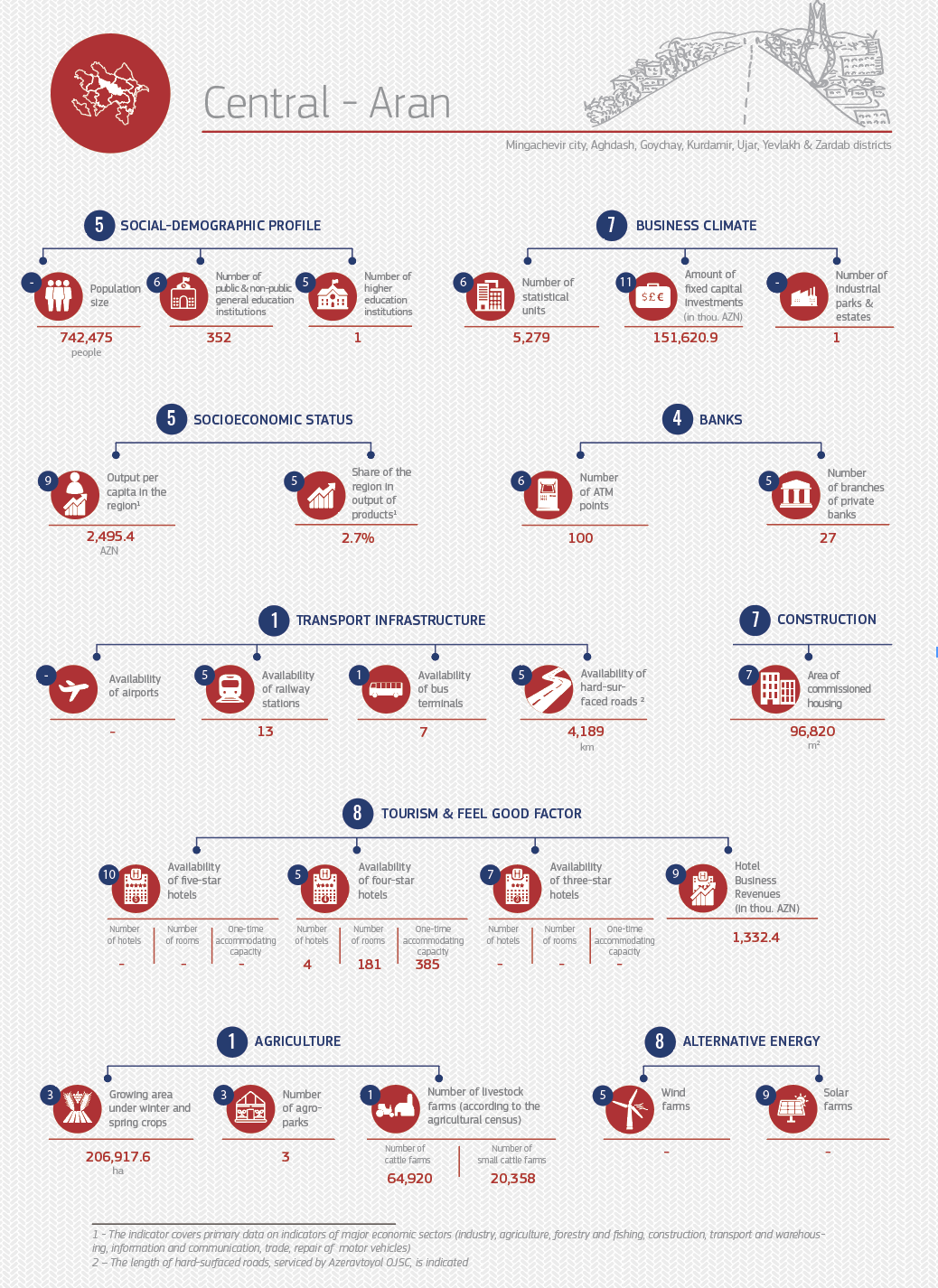
The agro-industrial sector is developed fairly even across the regions of the country. Thus, there are 4 agroparks operating both in the Guba-Khachmaz and Shirvan-Salyan economic zones. With three in each, agroparks operate in Absheron-Khizi, Daghlig (Mountainous) Shirvan, Sheki-Zagatala and Central Aran. Two agroparks also operate in each of the following economic regions – Gazakh-Tovuz, Ganja-Dashkesan, Mil-Mugan and Lankaran-Astara. One agropark operates in the East Zangazur region and one in Garabagh. The largest sown areas are located in Garabagh – 227,330.1 hectares, Mil-Mugan economic zone – 215,468.3 hectares and in the Central (Merkezi) Aran – 206,917.6 hectares. Baku, which accounts for 1,032.7 hectares, comes last in this rating. Cattle-breeding farms are strongly developing in Central Aran, Shirvan-Salyan and Nakhchivan.
The largest number of ATM points is in Baku (1,067 points) followed by Absheron-Khizi in the second position (112 points). Coming third is Nakhchivan with 104 ATM points, the fourth is Ganja-Dashkasan with 102 points and the fifth is Sheki-Zagatala with 101 points. Central Aran goes on the sixth position with 100 atm points, Gazakh-Tovuz has 99 points (7), Lankaran-Astara has 85 points (8), Guba-Khachmaz - 81 points (9), Garabagh - 73 points (10), Shirvan-Salyan - 70 points (11), Mill-Mugan – 63 points (12), Daghlig Shirvan – 34 points (13) and the 14th place belongs to East Zangazur where no such bank infrastructure is available.
As for the hotel business, the highest financial turnover of hotels was registered in Baku - 61.3% (128,542.7 thou. AZN). The capital is also leading in terms of the number of rooms sold, with 63% of income for 2021 (79,829.6 thou. AZN).
Following after Baku is the Guba-Khachmaz economic region with 29,891.0 thou. AZN - 14% of the total annual income of all hotels in Azerbaijan. Guba-Khachmaz also takes lead among the regions in terms of the total cost of sold rooms, accounting for 13%.
Coming next is the Sheki-Zagatala economic region with 9.92% of income gained from hotel business in 2021. In terms of the sold rooms this region accounts for 8.83% - 20, 815.7 thou. AZN.
The rating of 14 regions is conditionally divided into 9 indicators. Among them are the social-demographic profile (based on the demographic indicators of each region and the number of general education and higher educational institutions), socioeconomic status (based on the total output per capita, percentage share of the economic regions in total output of products, number of branches of banks and ATM points showing the level of financial services provided to the population), business climate (focused on the number of statistical units, amount of fixed capital investments, number of industrial parks and industrial estates). Considered were also transport infrastructure indicators (number of airports, bus and railway stations, length of hard-surfaced roads), feel-good factor, hospitality and service indicators, which is a favorable basis for the development of the tourism sector (number of different category hotels), as well as an agricultural sector (number of agroparks, growing areas, large and small cattle farms). All these indicators are closely interrelated and the result of development of one or another of the fourteen regions.
Azerbaijan’s most densely populated regions are certainly Baku (2 million 302 thousand 432 citizens), Lankaran-Astara (957,956 people) and Garabagh (907,128 people) followed by Central Aran (742,475), Gazakh-Tovuz (689,916), Sheki-Zagatala (632,207) comes on the 6th position, Ganja-Dashkasan comes seventh (611,923 people), then Absheron-Khizi (579,606), Guba-Khachmaz (561,182) is the 9th, Mil-Mugan (525,428 people) is on the 10th place, Shirvan-Salyan (503,464) on the 11th, the 12th is the Nakhchivan Autonomous Republic (462,715) and the 13th is East Zangezur (344,598). The most scarcely populated region is Daghlig Shirvan (326,330 people).The studies have shown that, except Baku, not always the most populous region shows development results similar to those of the country’s capital. 31 out of 40 higher educational institutions of Azerbaijan (HEI) are in Baku, 3 in Ganja-Dashkasan (the 7th most-populous region), two each in the Nakhchivan (the 12th most populous region) and Absheron-Khizi economic regions (coming 8th in terms of the demographic indicator). The largest number of general education institutions (schools) is seen in the Lankaran-Astara economic region (557), Garabagh (448) and Guba-Khachmaz (417). Baku takes only the 4th place (380 units). In total, there are 4,431 schools operating in the country.
The most favorable socioeconomic status indicators in all terms are seen in Baku. Among the economic regions Absheron-Khizi (6,866.9 AZN per capita, this is not the most densely populated region taking the 8th position on this indicator) accounts for the highest volume of total output per capita. Then comes Nakhchivan (6,297.9 AZN, the twelfth most populous region) on the third place after Baku (19,954.1 AZN), Shirvan-Salyan is the fourth (3,157.1 AZN) by a significant margin, and the lowest figure has been registered in East Zangazur (1,174.5 AZN) - this is almost 15 times lower than the figure of Baku and several times less than that of Nakhchivan. The total output of products per capita in the Absheron-Khizi and Nakhchivan regions, prevailing in terms of the population size, is three times lower than in Baku.
The largest number of bank branches is in Baku - 211 units, Ganja-Dashkasan - 30 branches and Absheron-Khizi – 29. Central Aran is coming fourth with 27 branches. Together with the GDP indicator, the Absheron-Khizi region, according to the rating data, has the most favorable socio-economic climate. As in previous years, there is still a protracted uneven development of the banking sector relative to the capital of the republic, which in turn can be cited as the result of the low share of the economic regions in the output of products relative to Baku (66.9%). Then follow already mentioned Absheron-Khizi (5.8%) and Nakhchivan (4.2%). Coming on the fourth place with a much lower indicator is Gazakh-Tovuz (2.8%). East Zangazur (0.6%) has the lowest output indicators, which also resonates with its lowest GDP figure.
Socio-economic indicators of the rating are consistent and proceed from the current business climate where Baku certainly prevails in terms of the number of statistical units and the size of fixed capital investments (9,981 out of total 12,223 statistical units across the country, fixed capital investments make 9,984,388,800 AZN). In terms of the number of statistical units, Absheron-Khizi (11,123 units) and Lankaran-Astara (7,461) are right behind Baku. The fourth economic region is Mil-Mugan (5,649) followed by Sheki-Zagatala (5,525). The lowest number of units is fixed in Nakhchivan (2,043) coming the 13th in the rating, and East Zangazur (1,019) taking the 14th position.
The Garabagh economic region has the highest volume of fixed capital investments (1,365,409,000 AZN) with an almost sevenfold margin from Baku which is decreasing. Coming next is Absheron-Khizi (1,201,382,800 AZN). The lowest investment indicator (86,245,600 AZN) is registered in the Mil-Mugan economic region. Despite the low number of statistical units in Nakhchivan and East Zangazur, these regions can boast of a relatively high volume of fixed capital investments and by this indicator take the 4th and 5th places respectively. Fixed capital investments in Nakhchivan and East Zangazur reach 1,062,165,800 AZN and 876,680,900 AZN, respectively. This is respectively 9.4 and 11.38 times lower than the size of investments fixed in Baku. Despite the relatively numerous units, the lowest volume of fixed capital investments in the rating is seen in the Lankaran-Astara region (142,664,000 AZN). This is 70 times lower than in Baku.
Infrastructure development indicators are closely linked with the number of airports. There is a total of 7 airports in Azerbaijan. The largest one is in Baku and two more in Sheki-Zagatala. Absheron-Khizi has the longest railway track consisting of 27 stations, followed by Nakhchivan with 17 stations. Apart from Baku (6,133 km), there is a large length of hard-surfaced roads in Sheki-Zagatala (5,741 km) and Guba-Khachmaz (5,738 km). Lankaran-Astara (5,216 km) is coming fourth.
The number of five-star hotels operating in the hospitality sector of Azerbaijan reaches up to 45. 21 of them are in Baku, 6 in Sheki-Zagatala, 4 in Guba-Khachmaz and 3 each in Ganja-Dashkasan and Daghlig Shirvan. 32 out of all 63 three-star hotels operating in Azerbaijan are in Baku, leaving units to the regions – 7 units in Lankaran-Astara, 6 in Sheki-Zagatala, 4 in Central Aran, and 3 each in Guba-Khachmaz, Ganja-Dashkasan and Absheron-Khizi. Three-star hotels also operate in Baku - 7 units, 4 in Sheki-Zagatala, 3 in Lankaran and one in Nakhchivan. Mil-Mugan is the only economic region where no hotel operates and there is only one three-star hotel in Shirvan-Salyan. Despite the predominantly high population size after Baku, there is only one four-star hotel operating in Karabakh and Central Aran.
The agro-industrial sector is developed fairly evenly across the regions of the country. Thus, there are 4 agroparks operating both in the Guba-Khachmaz and Shirvan-Salyan economic zones. With three in each, agroparks operate in Absheron-Khizi, Daghlig (Mountainous) Shirvan, Sheki-Zagatala and Central Aran. Two agroparks also operate in each of the following economic regions – Gazakh-Tovuz, Ganja-Dashkasan, Mil-Mugan and Lankaran-Astara. One agropark operates in the East Zangazur region and one in Garabagh. The largest sown areas are located in Garabagh – 227,330.1 hectares, Mil-Mugan economic zone – 215,468.3 hectares and in the Central Aran – 206,917.6 hectares. Baku which accounts for 1,032.7 hectares is coming last in this rating. Cattle-breeding farms are strongly developing in Central Aran, Shirvan-Salyan and Nakhchivan.
The largest number of ATM points is in Baku (1,067 points) followed by Absheron-Khizi on the second position (112 points). Coming third is Nakhchivan with 104 ATM points, fourth is Ganja-Dashkasan with 102 points and the fifth is Sheki-Zagatala with 101 points. Central Aran goes on the sixth position with 100 ATM points, Gazakh-Tovuz has 99 points (7th), Lankaran-Astara has 85 points (8th), Guba-Khachmaz - 81 points (9th), Garabagh - 73 points (10th), Shirvan-Salyan - 70 points (11th), Mill-Mugan – 63 points (12th), Daghlig Shirvan – 34 points (13th) and the 14th place belongs to East Zangazur where no such bank infrastructure is available.As for the hotel business, the highest financial turnover of hotels was registered in Baku - 61.3% (128,542.7 AZN). The capital is also leading in terms of the number of rooms sold, with 63% of income for 2021 (79,829.6 AZN).
Following after Baku is the Guba-Khachmaz economic region with 29,891 AZN - 14% of the total annual income of all hotels in Azerbaijan. Guba-Khachmaz also takes lead among the regions in terms of the total cost of sold rooms, accounting for 13%.
Coming next is the Sheki-Zagatala economic region with 9.92% of income gained from hotel business in 2021. In terms of the sold rooms this region accounts for 8.83% - 20,815.7 AZN.
Accounting for 4.79% (10,045.6 AZN), Lankaran-Astara is coming on the 4th place with a large margin from the previous economic region. In terms of the gross amount of rooms sold, this southernmost region of Azerbaijan is also on the fourth place with 4.05% (5,073.5 AZN).
Ganja-Dashkasan takes the 5th place (3% - 6,430.3 AZN). The indicator on sold rooms makes 3.42% - 4,282.1 AZN.
The 6th position belongs to Daghlig (Mountainous) Shirvan (2.97% - 6,244.5 AZN). The second indicator makes 2.23% - 2,792.3 AZN.
Nakhchivan takes the 7th position in terms of hotel business income – 2,411.1 AZN.
Absheron-Khizi is the 8th – 1,871.6 AZN. Central Aran is the 9th with 1,332.4 AZN, followed by Garabagh (931 AZN), Gazakh-Tovuz (807.8 AZN). Shirvan-Salyan (204.2 AZN) goes on the 12th position and Mil-Mugan (159.4 AZN) is coming on the 13th position in terms of the hotel business income.
East Zangazur has no hotel network as the development and restoration work is underway there after its liberation from occupation.Azerbaijan’s alternative energy sector is in its active development phase and consistently monitored by the country's leadership. Azerbaijan has 9 out of 12 climate zones within its territory. Therefore, if they are effectively applied in accordance with high technologies, Azerbaijan by using alternative sources can get electricity export opportunities comparable in contribution to the energy security with the existing Baku-Tbilisi-Ceyhan oil pipeline and the Southern Gas Corridor, which are owned by a consortium of foreign companies led by British bp plc. Besides, the low (relative to the EU) population density will make it possible to use empty areas for high-export potential alternative energy projects with minimal losses for crop areas and without a negative impact on flora and fauna.
To date, the capacity of all alternative energy facilities (wind, solar, bio-installations) totals 149.92 MW (100%), of which wind turbines account for 66.15 MW (44.3%), solar generators for 45.92 MW (30.8%) and bio-installations for 37.7 MW (25.3%).
Wind turbines are geographically distributed in the vicinity of the Baku region and in the Nakhchivan region. Thus, operating in the Absheron-Khizi economic region are 4 wind farms with a total capacity of 63.34 MW, a 2.7 MW capacity wind turbine in Daghlig (Mountainous) Shirvan and also a 0.11 MW station in Nakhchivan.
Solar generation facilities produce a total of 45.92 MW, of which 33.01 MW fall to the share of 5 installations in Nakhchivan, a total of 4.74 MW comes from 10 solar plants operating in Baku, 2.86 MW from one plant in Daghlig (Mountainous) Shirvan, 2.8 MW from a plant in Ganja-Dashkasan and 2.07 MW from a plant operating in the Absheron-Khizi economic region. 6 plants are operating in the Shirvan-Salyan economic region (0.3 MW) and two in Mil-Mugan (0.09 MW).
Bio-plants with the capacity of 37.7 MW are operating in Baku (37 MW) and Daghlig (Mountainous) Shirvan (0.70 MW).
According to the results of the study, wind turbines account for the large share of generated alternative energy - 44.3%.
According to the final results of the 14-point assessment, Guba-Khachmaz and Central Aran regions share the second place after Baku. Coming next on the third position by a small margin is Absheron-Khizi, Ganja-Dashkasan comes fourth, the fifth place is taken by Sheki-Zagatala, the sixth by Nakhchivan, seventh - Lenkaran-Astara, eighth - Garabagh, ninth - Gazakh-Tovuz and Mil-Mugan, the tenth place is taken by Shirvan Salyan, the eleventh by Daghlig Shirvan, and the twelfth by East Zangazur.