


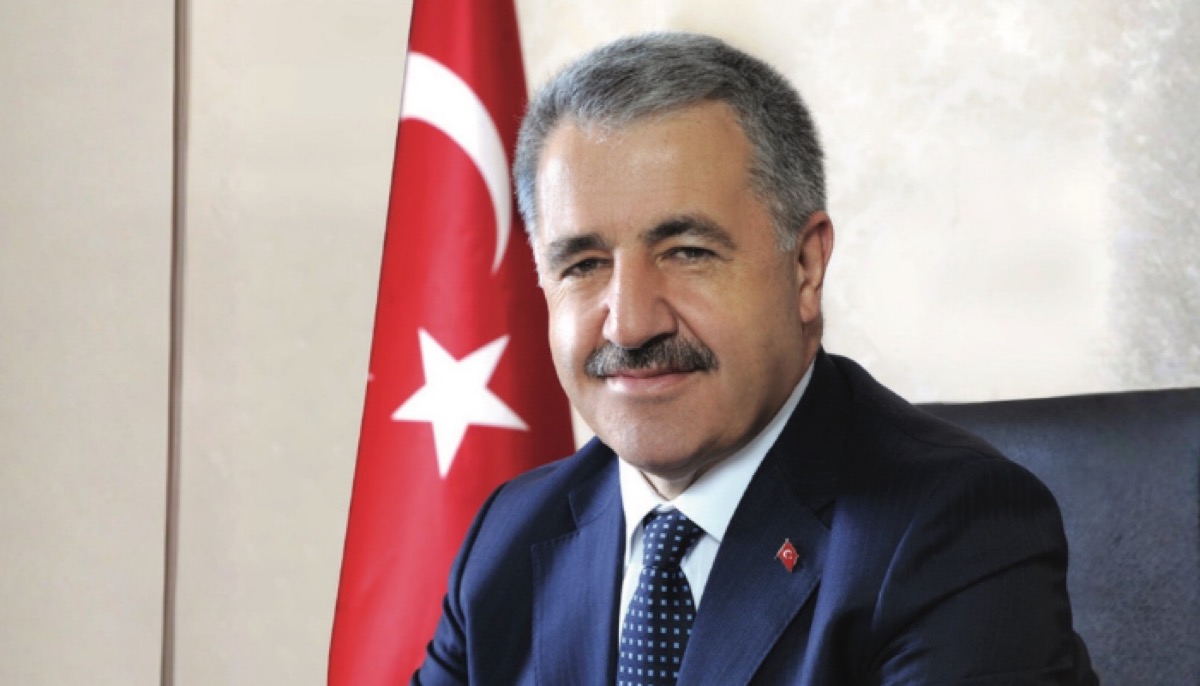
One of the important advantages of the Trans-Caspian Middle Corridor is the possibility of access to the countries of the Mediterranean and North Africa
Caspian Energy (CE): Mr. Arslan, could you please tell about the plans on operation of the Baku-Tbilisi-Kars transport corridor?
Ahmet Arslan, Minister of Transport, Maritime Affairs and Communications of the Republic of Turkey: As you can see from the map, the Baku-Tbilisi-Kars railway project enables to reach the Great Britain, France, Belgium, Germany, Austria, Hungary, Serbia, Bulgaria, Turkey, Georgia, Azerbaijan, Kazakhstan, Turkmenistan and China.
This project is the result of joint efforts and decisions of Turkey, Azerbaijan and Georgia. With the commissioning of the 829km Baku-Kars railway, the construction of one of the main sections of the Trans-Caspian Middle Corridor was completed.
Works on the project were commenced on May 4, 2008 after the approval of the construction site. The ground-breaking ceremony for the railway was held in Kars on July 24, 2008 and was attended by the heads of state of Turkey, Georgia and Azerbaijan. The rail road is 829 km long, including 504 km in Azerbaijan, 246 km in Georgia and 79 km in Turkey. The entire Turkish section is a newly built line. In Georgia, the 29km section of the line is a newly built line, 155 km of the line have been reconstructed, and the 62km section of the line is the old section. The railways stretching via Azerbaijan and Georgia meet the standards of the Soviet times, having the 1,520mm track gauge. The railways of Turkey comply with the IRIS standards (International Railway Industry Standards), so their track gauge is 1,435 mm. For this reason, the bogie exchange station was built at the Akhalkalaki station in Georgia to implement the break-of-gauge. After commissioning the line is expected to handle 1 million passengers and 6.5 million tonnes of cargo. By late 2034 the railroad capability will reach 3 million passengers and 17 million tonnes of cargo. In the longer term, we plan to increase the capacity to 50 million tonnes.
This line has a tremendous potential for freight transportation. The travel time for cargo transportation from China to the EU countries along the southern and northern corridors, including sea transport, is approximately 45-62 days. If the same cargo is transported to the EU countries along the middle corridor, then the travel time will be only 12-15 days. Our target market covers all countries along the historic Silk Road. The Baku-Tbilisi-Kars project’s key objective is to create a new energy corridor in the region. We intend to supply petrochemical products of Azerbaijan throughout the world by means of this line. At the same time we believe that a large part of Turkey’s current trade with the CIS countries (Turkmenistan, Uzbekistan and Kazakhstan) will be shifted to this line.
Please login or subscribe to read the full article.
Login / Subscribe