


After the country gained an independence, solution of the environmental problems became one of the priorities of the state policy. The attention given to the environmental issues was increased. Execution of the new environmental protection projects was commenced.
One of the major tasks, facing SOCAR, is to solve the ecological problems which aroused as a result of the offshore and onshore oil-gas operations, as well as terminate the pollution.
Therefore, both the requirements of the country’s legislation and issues, coming out of the international conventions which Azerbaijan joined, are successfully met.
SOCAR’s achievements in the field of ecology over the last year
Considering the interest of such oil-gas companies as BP, TOTAL E&P Abşeron B.V. and others, operating in our country, in using the SOCAR-owned “Wastes Center”, the operations on the expansion of the center have been completed. Thus, 2 (two) VacuDry units (Vacuum-Distillation), produced in Germany and designed for drilling mu processing, were installed in the center within the framework of the project. Besides, an office building and other support facilities were opened and launched on September 23, 2016. The solemn opening ceremony was attended by the management of SOCAR and BP, as well as other authorized persons. As a result of the project implementation, 100 people got a permanent work. The commissioning of these facilities made it possible to process drilling mud which emerge in the course of the drilling operations, utilize chemical reagents contained in the drilling mud, as well as ensure the substantial reduction of the volume of wastes.
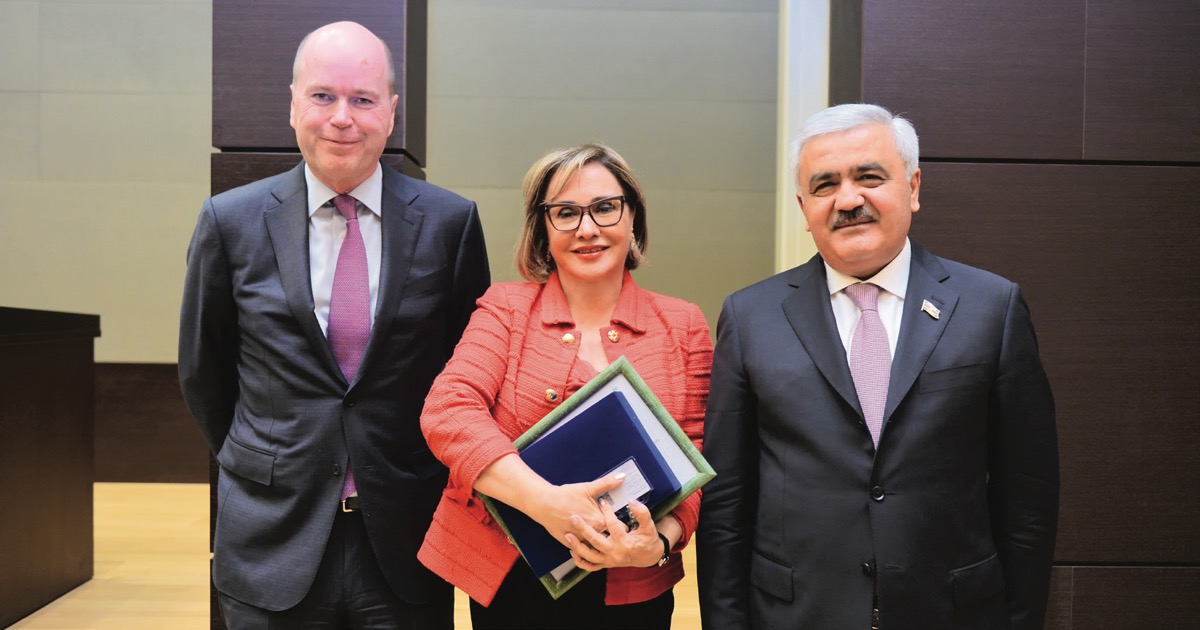
Apart from this, an event about the History of the Azerbaijani oil and large ecological projects implemented by SOCAR, was held in SOCAR TOWER on May 26, 2017 on the occasion of the World Environment Day. A video clip about the history of the Azerbaijani oil was shown in the course of the event. SOCAR’s Vice President for Environment Issues Rafiga Huseynzade received the highest award from BP Azerbaijan for the success gained within the framework of the project on reduction of the flared-gas at Azeri-Chirag-deepwater Guneshli fields, which is implemented jointly by SOCAR and BP, as well as with the support of the World Bank.
Climate change impact mitigation
Funded by the Global Ecological Fund (GEF) and the UN Development Program, SOCAR together with the local representative office of the United Nations Development Program have worked out a project of the Nationally Appropriate Mitigations Actions aimed at lowering the CO2 emission in the field of fuel consumption of Azerbaijan. The project consists of the three following components:
• Increase of the energy efficient buildings;
• Shift to the alternative fuel in the transport field;
• Collection of associated gas from wells and its supply to consumers.
According to the first component of the project, repair-construction operations were completed at SOCAR’s wastes management center and Gala Ecological Park in order to raise the energy efficiency of buildings. The similar operations are still ongoing in Azerkimya PU. 4 wind turbines were installed at the Wastes Management Center within the framework of the project. Apart from this, additional solar panels are planned to be installed in the mentioned Center and Gala Ecological Park.
1 (one) Toyota RAV 4x4 Hybrid and 3 (three) Toyota Auris Hybrid vehicles were purchased within the framework of the second component entitled “Consideration of possibilities of the energy efficient transport in the transport sector of SOCAR, innovative technologies on use of zero-carbon fuel and eco-effective driving practice”.
Control-measurement operations were performed in 63 wells of Zagli-Zeyva field (operated by Siyazanneft OGPD) to determine the potential of wells. This work was carried out within the framework of the third component of the project “Associated gas collection from the wells and its supply to consumers”. The operations in this direction are ongoing.
Intermediate waters management
Broad-scale operations were continued from year to date in order to ensure efficient management over intermediate waters which emerge in the course of production at operation sites of SOCAR. In this regard, engineering survey work was carried out to install plants on intermediate water treatment, which comes out of the oil-gas wells, and to inject these waters, cleaned in accordance with relevant requirements, back into the underground horizons.
A plant produced by the UK company FLS and designed for treatment of intermediate waters from oil and sand, has been commissioned since July of this year at the enlarged Oil Gathering Point #2A of Neft Dashlari OGPD. The maximum daily capacity of the plant makes 4,400 cubic meters.
The plant consists of a two-phase separator, hydrocyclone sand and oil separators. After separation from oil and sand, intermediate waters are injected back into the disposal wells while the sand collected in the separator is used at production facilities of OGPD.
Soil clean-up
Broad-scale survey work is currently underway at the area of wells in order to group the contaminated soils according to the pollution rate, as well as choose and apply a relevant treatment technology. Over the period under review SOCAR’s operating companies and joint ventures rehabilitated 39.7 hectares of lands contaminated with oil and oil products.
Ecological monitoring
Since September 2016 SOCAR’s ecological department has held 45 environmental monitoring operations in onshore enterprises and organizations of SOCAR, while the specialists of the ecological department, assigned to the company’s enterprises, carried out a total of 440 environmental monitoring operations on onshore and offshore fields in accordance with SOCAR’s order #17 dated February 13, 2013. 782 samples taken during the ecological monitoring underwent chemical testing according to 4,321 parameters in the Department’s Laboratory for Comprehensive Research. Moreover, in order to ensure the laboratory’s participation in international projects implemented in the region, and expand cooperation with international companies, the laboratory regularly takes part in inter-laboratory testing arranged by lots of local and foreign companies to prove the quality of laboratory tests. Among such companies noteworthy are WEPAL, FAPAS and LGC.
Wastes management
Wastes management is one of the main areas in the field of the environmental protection. To meet the obligations assumed within the framework of the United Nations Stockholm Convention, the work on stock-taking of polychlorinated entities regulated by the convention was continued this year. The stock-taking of the electric equipment of SOCAR, JVs and OCs, operated by polychlorinated oil, was carried out. Samples of oil were taken to determine the polychlorbiphenyl entities. Their testing in accordance with appropriate parameters was carried out at the Laboratory for Comprehensive Research of the Ecological Department.
Apart from this, from September 2016 until the present day, 63,211.7 tonnes out of 63,476.1 tonnes of wastes emerged in the departments and enterprises of SOCAR were delivered for intended purposes. SOCAR’s Garadagh Wastes Center received 7,564 tonnes of drilling mud and 275 tonnes of hard production wastes. Besides, 24,753 tonnes of oil mud emerged in the course of production at Heydar Aliyev oil refinery underwent treatment at Alfa-Laval unit of Ekol MX CJSC while 408 tonnes of acid sludge obtained during the oil purification at site#19 were regenerated.
Greenery planting
SOCAR planted 64,327 types of trees and brushwoods at the recultivated area in order to ensure environmental safety and maintain an ecological balance. Agrotechnical treatment over trees and brushwoods planted in previous years was organized.
Ecological propaganda and educational work
According to the SOCAR’s plan of actions on ecological propaganda and educational campaign, educational work on the subjects of “Global problems of the modern ecology”, “Rational use of water”, “Man and the environment. Ecological culture ”, “Environmental legislation”, “Environmental policy”, “Waste management plan”, “Potential risks of environmental pollution during the drilling”, “Oil degradation classification” and other topics was carried out in the departments and enterprises.
Besides, due to SOCAR’s engagement in the “Earth Hour” campaign held by the World Wildlife Fund (WWF), facade lighting of buildings located at non-production sites of SOCAR was cut by 1 (one) hour on March 25, 2017 in order to save power.
Along with it, according to the cooperation agreement signed between the Baku City Education Department of the Ministry of Education of the Azerbaijan Republic and SOCAR’s Ecology Department, a “Green school” project was implemented over the period under review. Besides, ecological monthly magazines were published. The green school project shall create new green areas in the schools of Baku city. Participation of schoolchildren in creation of green zones within the framework of this project plays an important role in developing an ecological culture among the young generation.