


“Baku is the greatest oil center in the world. If oil is a queen, then Baku is her throne “(Near East magazine, 1918). Baku is faithful to traditions, but the throne will be taken in the coming decades by a new king – natural gas, not the queen, which is progressively gaining positions in the world energy balance (read “Global changes demand efforts – majors”)
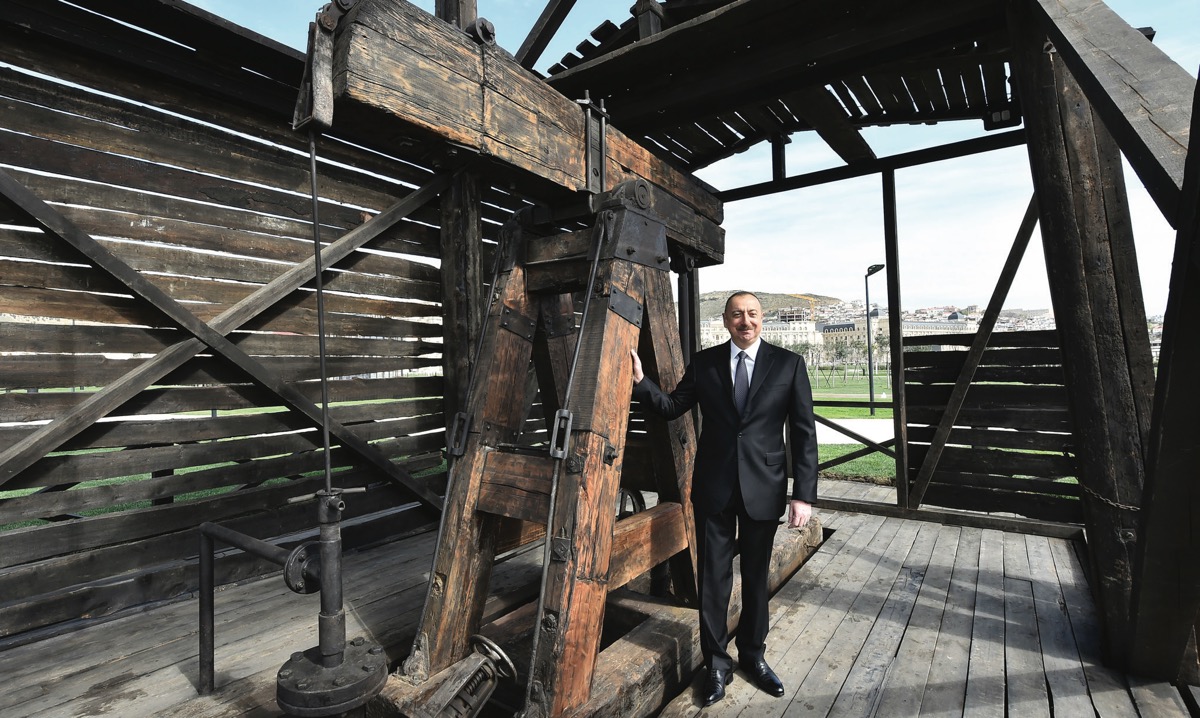
“Today, Azerbaijan has its say in the world as an oil and gas country,” Azerbaijan’s President Ilham Aliyev said while viewing the reconstructed well, the world`s first oil well drilled industrially in Bibiheybat field in 1846.
Addressing the ceremony of commissioning of the new flagship vessel “Khankendi”, the Head of State of Azerbaijan announced the signing of the new contract on development of the Azeri-Chirag-Guneshli block of fields. “We will extend our work on this field till 2050. It once again shows that Azerbaijan possesses very big oil reserves”, the President emphasized.
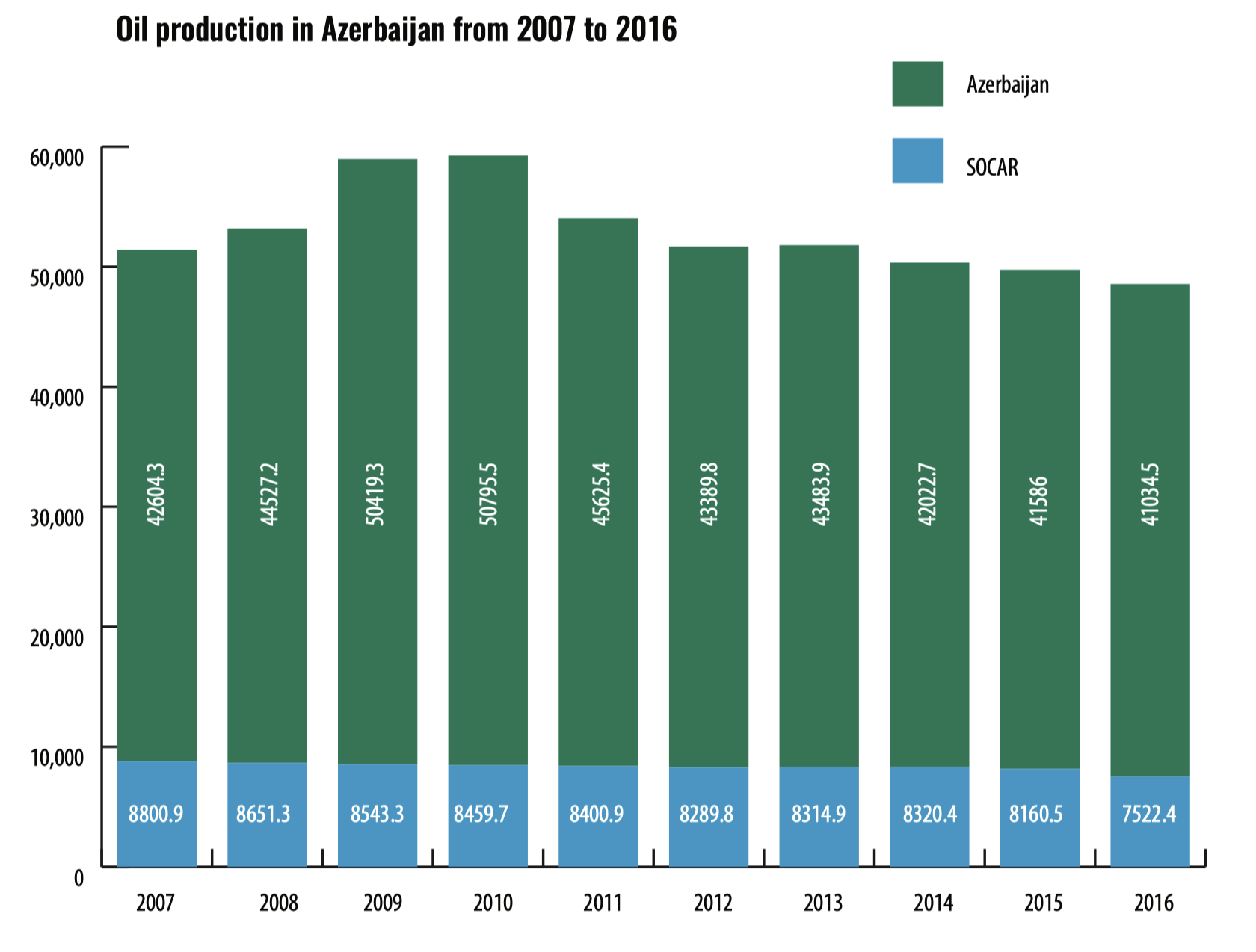
“Azerbaijan is the motherland of oil. That is where the oil industry has started from and after the lapse of about 200 years we shall celebrate the production of the 2 billionth tonne of oil this year”, President highlighted. According to him, “oil is our natural wealth, great legacy of our people, and using it we develop our country.
Over 95% of the first upstream project in the Caspian Sea has already been completed in Azerbaijan. For the European market this project will be a quite new diversified source of intracontinental gas extracted at Shah Deniz (1.3 trillion cubic meters of recoverable natural gas reserves) located in the Azeri sector of the Caspian Sea. According to the plan, the first volumes of the second phase gas will be produced in 2018.
Operating and capital expenditures of SCP project totaled about $14mln and $413mln in the first half of 2017. The average daily carrying capacity of SCP totaled about 21.4 mln cubic meters in the first half of 2017.
At present, gas production at Shah Field is carried out within the framework of the first phase of development of the field, which costs $4.1bln. About 10 bcm per year is produced within the framework of Shah Deniz Stage 1.
The final investment decision (FID) on Shah Deniz Stage II was signed on December 17, 2013. The project entails construction of two platforms, drilling of 26 subwater wells, construction of 500km long subwater pipelines at a depth of 550m, expansion of the Sangachal terminal, expansion of the South Caucasus Pipeline through Azerbaijan and Georgia, and construction of the Trans Anatolian Gas Pipeline and the Trans Adriatic Pipeline.
Annual production volume within Stage II will make 16 bcm per year. 10 bcm of this volume will flow to Europe while 6bcm to Turkey. Gas will start flowing to Europe early in 2020.
The contract on development of Shah Deniz field was signed in Baku on June 4, 1996 and ratified by Milli Majlis on October 17 of the same year. Parties to Shah Deniz project are BP (operator, 28.8%), Petronas (15.5%), SOCAR (16.7%), LUKOIL (10%), NICO (10%), Total (10%) and TPAO (19%).
SGC project is estimated at $45-48 bln.
There used to be a revolutionary upheaval in 1917 which collapsed Azerbaijan’s oil industry. It took the industry long to recover subsequently and produce the first offshore oil in 1949. But the 1991 saw the oil industry in ruins again.
Azerbaijan headed by All-National Leader Heydar Aliyev became a master of its resources only after signing of the Contract of the Century with 13 international companies, coming from 7 countries, on September 20, 1994. Thus, squeezed from the north and south by two of the world’s richest oil and gas storages, and located thousands of kilometers from the free market, Azerbaijan found its niche in it within a short space of time and the meantime developed good-neighborly relations with all its partners.
The country became the first in the current history, which managed to model its own formula for long-term energy security. And the signing of the Contract of the Century became an initial point of the international cooperation in the Caspian basin, as well as integration of regional economies into the global economy.
After the Baku khanate joined Russia in 1806, the government started getting revenues from the khanate oil wells and began providing them for lease.
The ways of oil production and utilization were primitive, so the population extracted oil mainly from land wells.
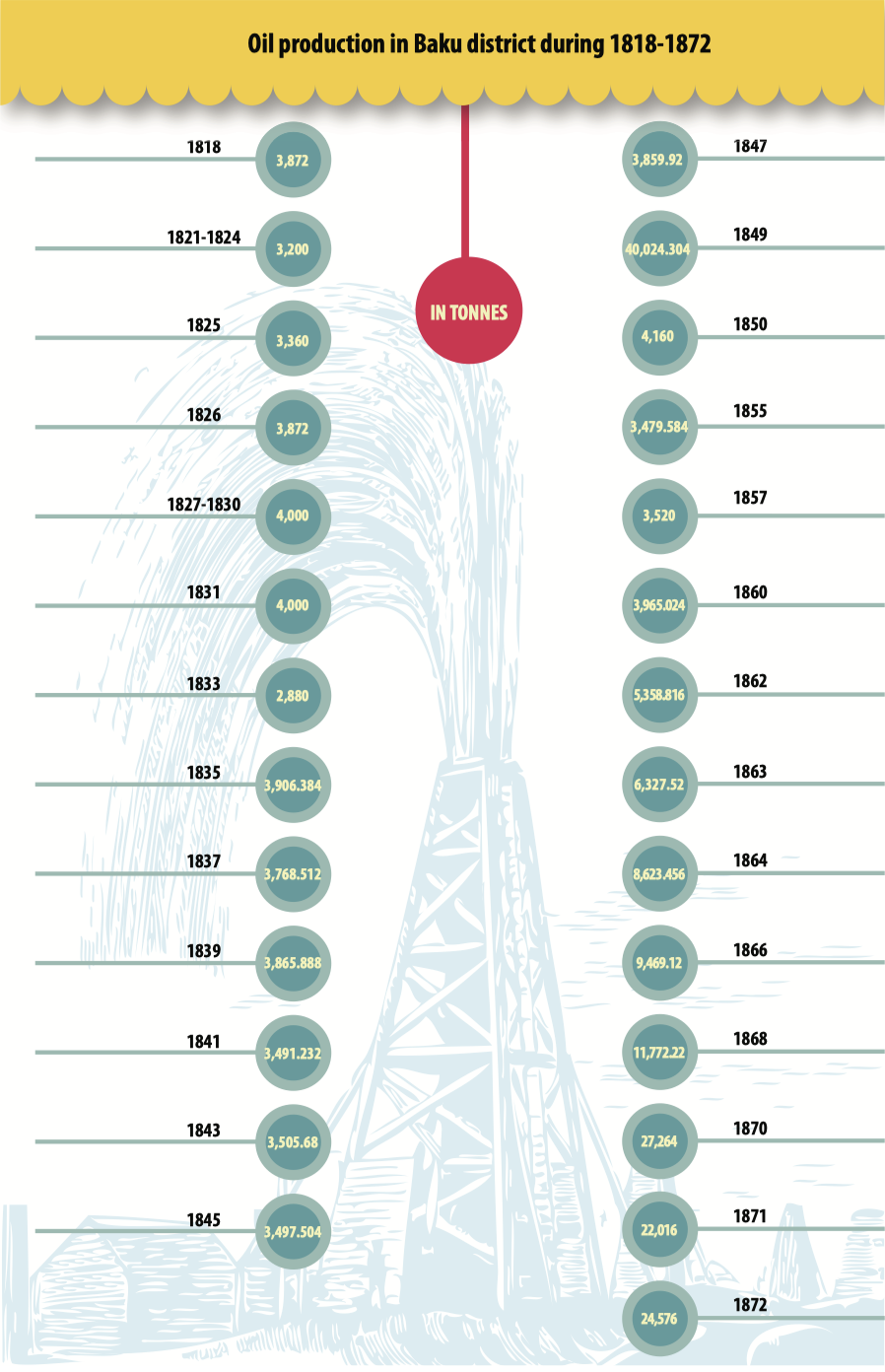
Among the Europeans Eichwald was the first to provide in 1825 a full description of oil production in Baku in his work “Reise auf dem Caspischen Meere und Caucasus” where he brightly presented the eternal flames and the fire worshippers’ cult originating from India. Rod-tool drilling of wells started in the 40s of the 18th century while production was carried out by means of bailers. Bibiheybat was the field where the world’s first oil well was drilled in 1844, which is 11 years earlier than in Pennsylvania (USA). Entrepreneur Mirzoyev launched the first drilling rig derrick and the second one a year later.
1877 is considered a year when the Baku oil industry got on the firm ground. There were 126 separate firms and entrepreneurs in 1879, producing oil at an area comprising 411 dessiatines (measure of land = 10,900 sq. metres or 2.7 acres).
There were three ways of major sources of national local investments in the period of the oil industry birth in Azerbaijan: trade, industry, as well as investments of the military and public officers. Trade capital in the new industry was represented by M.Nagiyev, A. Mantashev, H.Z.Tagiyev, industrial capital was represented by V.Kokerev, P.Gubin and Mirzoyev, as well as a number of public officers. Concentration of production and the capital was also carried out by means of establishment of stock companies.
Baku oil society, the first Joint-Stock Company, was established in 1874. That was the year when the Nobel brothers showed up in Baku first. They rented oil-bearing areas and bought a small kerosene plant in 1875.
When it comes to the historical sequence of penetration of the big foreign capital into the Baku oil industry, the French capital is noteworthy first and then the British capital. A well-known Paris banker Rothschild, who came to Baku in 1883, set himself a task to engage mainly in credit-loan operations and oil trade. Rothschild’s initial capital which made 1.5mln rubles in 1883 increased to 6 mln in 1895 and up to 10mln rubles in 1913. The Company which had a great capital and experience in credit-trade operations developed its business and had a strong influence over the national entrepreneurs. Despite the fact that the French capital was used in trade-credit operations, Rothschild also owned many oil sources: in Balakhany, Sabunchu, Ramany, kerosene and oil plants in Keshla.
In 1903 Baku district had 12 British communities with the capital worth 60mln rubles. The British capital was spent mainly on acquisition of existing enterprises of local entrepreneurs.
Due to the long lasting flow of low profits in 1912-13, the Rothschild branch of the French capital yielded the oil interests it had in Azerbaijan to B.Deterding’s British-Dutch Corporation Royal Dutch Shell. In return, the Rothschilds gained a big package of shares of Shell (20%).
Since then the British capital ranked high in the oil industry of Azerbaijan.
In 1911 the fields owned by the British companies accounted for 11% of total amount of gross oil production in the country.
Early in the 20th century the stock capital in the Baku oil industry reached 165.3mln rubles. One third of this sum fell to the share of the British capital.
Certain processes ran in the oil industry of Baku early in the 20th century. In part, today one can see their consequences at abandoned onshore oil fields.
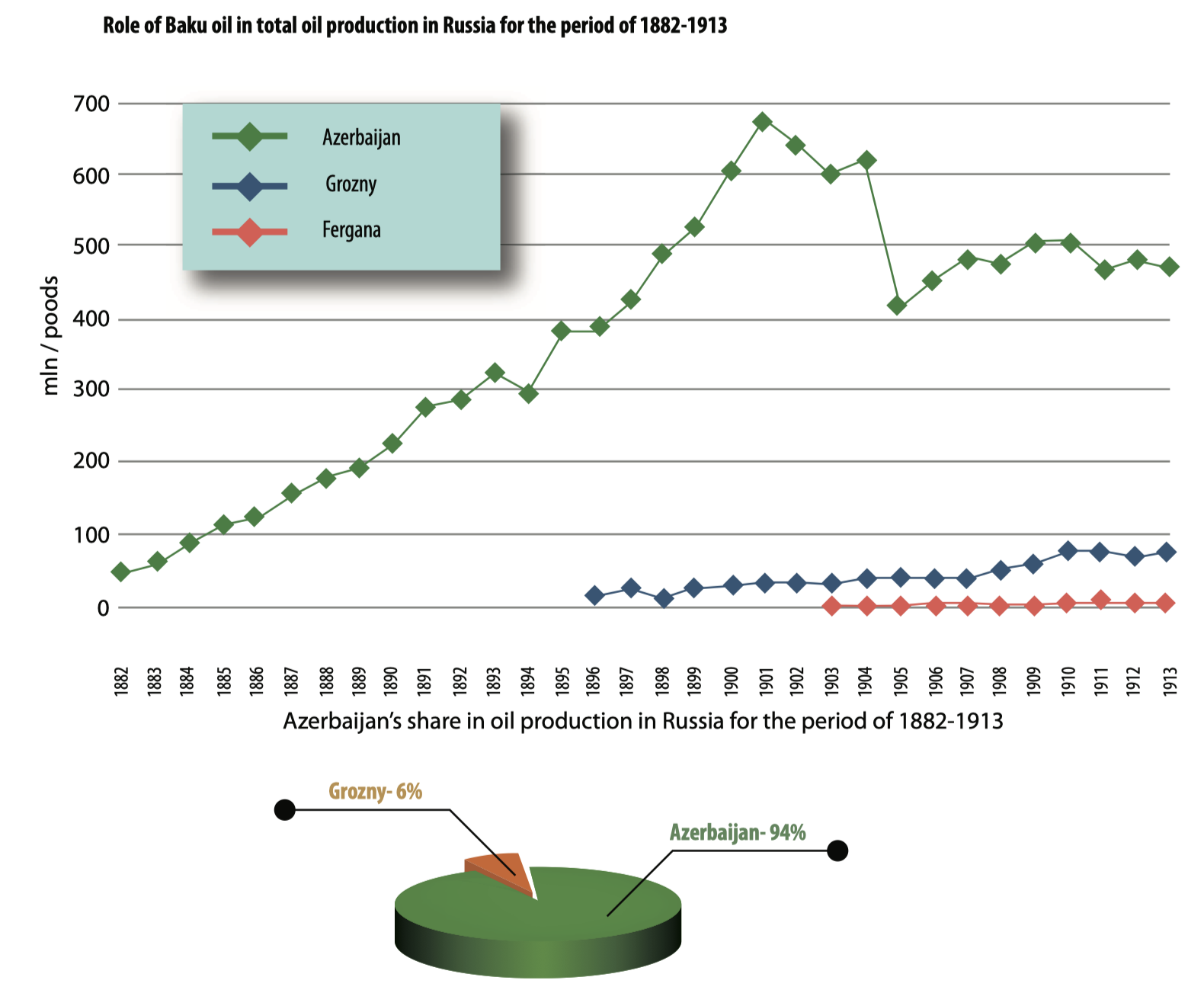
In the beginning of the last century the output on the Absheron Peninsula stood at 10 million tonnes of oil per year, accounting for half of the global oil production. By that time the oil industry was in depression which reached its top during the period of the revolution. Though, as early as 1940 the Republic supplied 71.5% of the USSR’s oil. The crisis lasted right until the recovery of the economy after the Second World War when the offshore oil industry gained impulse towards the development following the extraction of first offshore oil in 1949.
In 70-80s big oil deposits were explored and discovered by Azerbaijani scientists and oil-industry workers in Kazakhstan and West Siberia. That substantially lowered Baku’s role as an oil source but raised its significance as the center of oil refining and production of the oil equipment. Azerbaijan’s share in total volume of CIS fell down to 2.62% by 1993 as the oil fields developed in West Siberia and the Urals. However, the volume of oil production which reduced stably did not affect the interest of west businessmen in Azerbaijan’s subsoil resources. Discovery of new offshore oil fields promoted it to a certain degree and stimulated offshore production. At present over 80% of the total oil production falls to the share of offshore fields. Besides, the major part of reserves lying in the Caspian shelf of Azerbaijan still remains unexplored. According to optimal estimates, it contains over 2 bln tonnes of oil equivalent and about 3 trillion cubic meters of gas.