


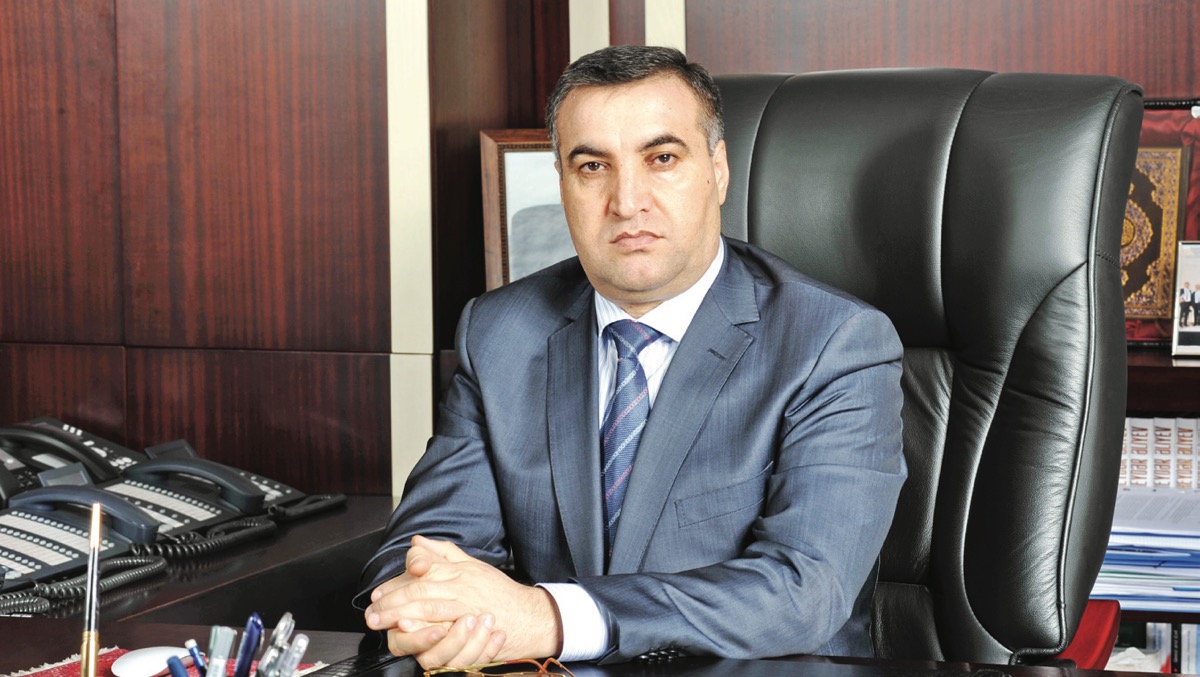
Caspian Energy (CE): Mr. Iskenderov, how would you evaluate the possibilities to increase the oil production in Azerbaijan?
Dashgin Iskenderov, General Director of SOCAR Azneft PU: Currently Azneft Production Union is operating 29 oil and gas fields. Most of the fields have reached the final stages of development, however despite this fact they still have a great potential. With the aim of boosting the output in these fields the work is currently underway to explore the layers, which are not involved in the development, or poorly explored and halted areas, and to bring them into use. At the same time there are many promising structures, where exploration work is conducted for further implementation of exploration drilling.
Predicting of new oil and gas fields is also in process. So, besides seismic, gravimetric, and magnetometric prospecting methods of geophysical exploration, which are conducted to determine areas of exploration drilling, the complex geophysical exploration is also implemented for the purpose of performing a direct exploration work.
At the same time some works are planned for 2016-2019 to increase the oil production. It includes drilling of 20 oil wells and 10 gas wells from the platform No 7 at the shallow water part of the Gunashli field, drilling of new wells from the fixed platforms No 6, 12, 18 and 122 on the Bulla-Deniz field, engineering and drilling of a wildcat well No 1 in 2017-2018 to determine prospects of the Babak field, as well as construction of a new platform and drilling of new wells on the Sangachal-Duvany-Khara-Zira field in 2018.
CE: Which works is Azneft PU implementing to increase the output at the shallow water part of the Gunashli field?
Dashgin Iskenderov: Geological operations are currently underway within the existing well stock to increase the oil production in the shallow water part of the Gunashli field.
At the same time the platform No 7 was built and commissioned at the field. The wells drilled from this platform will help to create conditions for stabilization and growth of the output. One of the planned measures for boosting the output is to increase water injection into wells.
CE: Could you please tell about the plans on development of the Umid field?
Dashgin Iskenderov: Expected reserves of the Umid field comprise 200 billion cubic meters of gas and 30-40 million tonnes of condensate. These resources open up the broad opportunities for sales of Azerbaijan gas to the world markets for decades to come. At the same time the experience gained at the Umid field creates safe conditions for work in other fields. Thus, geological studies confirm the presence of the Babak field near the Umid field. Its reserves are approximately twice as much as those of Umid field’s. The expected reserves of the Babak field are estimated at 400 billion cubic metres of gas.
Currently, there are 2 operated wells at the Umid field. More than 1 billion cubic metres of gas and 160 million tonnes of condensate have been produced since the start of development of the Umid field. Drilling of the production well No 14 with a projected depth of 6,500 metres is currently at the finishing stage. High expectations are placed on the drilling of this well which depth has already reached 6,200 metres.
For the purpose of full-scale operation four jackets are to be installed at the field. Engineering work currently continues on 19 production wells that will be drilled from these jackets, and information obtained from drilling of a new well and drilling results will be very important for implementation of future activities.
CE: Could you please tell about the oil production performance and perspective plans?
Dashgin Iskenderov: The Action Plan of Azneft PU for 2016-2018 has been worked out with the purpose to stabilize and increase the oil and gas production, and the works are performed to implement the assigned tasks.
The Action Plan for stabilization and growth of oil production envisages implementation of works on geological exploration, discovery of new fields, expansion of infrastructure possibilities in the fields, and therefore provides for construction of new jackets, introduction of new technologies. For us these are the main objectives for today.
In 2016-2018 Azneft PU is expected to produce 19.2 million tonnes of oil and 17 billion 375 million cubic meters of gas (in 2016, production will comprise 6.3 million tonnes of oil and 5 billion 595 million cubic meters of gas; 6.4 million tonnes of oil and 5 billion 800 million cubic meters of gas in 2017; 6.5 million tonnes of oil and 5 billion 980 million cubic meters of gas in 2018).
The production will be increased at the expense of 18 new jackets to be constructed by 2018. Their daily production will comprise 2,260 tonnes of oil and 11 million cubic metres of gas.
At the same time it is planned to ensure an increase and stabilisation of production by expanding exploration drilling until 2018. According to the plans, 248 new oil and gas wells will be drilled and commissioned. A daily output from new wells is forecasted to comprise 770,000 tonnes of oil and 975 million cubic metres of gas.
The conducted exploration work resulted in commencing a large-scale development of the Bulla-Deniz field. Drilling on the two jackets of this field is currently underway. The plans for the years to come envisage construction of 4 additional jackets, and the well plan has been developed. In addition, work on a new project for development of the Sangachal-Duvany-Khara-Zira field is currently underway. According to the project, it is planned to drill additional 40 wells.
Our priority areas are to increase production and boost drilling at the perspective onshore fields.
CE: What kind of response measures does the PU undertake for optimization in conditions of lower oil prices?
Dashgin Iskenderov: The project was worked out to increase efficiency of operations and optimise costs of Azneft PU. Its implementation started in 2013. The project continued and ended in 2015. The continued implementation of the project has positively affected the activities of Azneft PU. The project for improved efficiency of operations and cost optimization helped to reduce costs and increase profits of Azneft PU. This project featured not only economic benefits. It also created conditions for the effective organization in such areas as occupational safety and health, environment, transport, human resources, etc. The ongoing introduction of numerous processes within this project is important not only from the perspective of today’s reality. It will have a sustained positive effect in the future.
CE: Which brand-new methods are used to keep production at the old onshore fields?
Dashgin Iskenderov: The technological progress has played a major role in the process of transition of oil production in Azerbaijan from the primary stage up to the large-scale development stage.
Azneft PU is successfully introducing the most advanced innovations in the oil production process. New machines, technology and equipment, which are now being deployed in construction and installation works, development of fields and their operation, exert their positive effects.
In recent years Azneft PU has carried out considerable work in the field of introduction of new equipment and technologies and accordingly achieved positive results.
In particular, testing of a new integrated system with the use of local feedstock, which blocks water and sand inflows, at the well No 1047 of Absheronneft Oil and Gas Production Union has enabled to reduce water production from 7 down to 1 tonnes and raise oil production from 1 to 1.2 tonnes.
Testing has been conducted at the Bulla Deniz field operated by the Nariman Narimanov OGPU to improve the efficiency of transportation of complex rheology oil through the underwater pipeline between QYM-2 and QYM-1 points. As a result, pressure in the pipeline decreased, and permeability of the flow increased. The gas-dynamic separator has been tested at the Nariman Narimanov OGPU. It resulted in gas cooling by 24 degrees and removal of water vapor from gas.
At the same time, the program of effective development of Buzovna-Mashtaga, Gala and Lokbatan-Puta Gushkhana fields is being prepared through new drilling and the following science-research operations. A complex approach is required in development of all the three fields in order to increase residual volumes of oil and gas resources. Meanwhile, expansion of modern stimulation techniques is envisaged.
CE: What offshore sites do you hope will be able to replace the resource potential?
Dashgin Iskenderov: The geological surveys show that oil reserves of Azerbaijan comprise 2-3 billion tonnes, gas reserves - 1.5-2.0 trillion cubic meters, and oil shale - 400-450 million tonnes. These resources are not inexhaustible. Relevant scientific, technical and organisational measures are currently underway to recover the residual reserves, and comprehensive measures are being taken to ensure a widespread introduction of innovative projects.
In addition, the potential of the Absheron and Umid fields, deepwater gas reserves of the Azeri-Chyrag-Gunashli fields, quite promising structures Shafag-Asiman, Babak, Zafar-Mashal and others will be used in full scale.
At the same time it is necessary to highlight the rapid development of the shallow water part of the Gunashli field in the Azerbaijan sector of the Caspian Sea, the discovery and development of the promising of the Goshadash, Bulla-Deniz, SDXZ + Alat-Deniz, Chilov and Gurgan-Deniz fields, as well as implementation of exploration work on shallow water areas (with the water depth of up to 20 metres) and onshore areas of the Mesozoic period. In addition, the use of modern technologies is expected to increase the oil output of the existing fields and optimise the development of the irrational fields.