


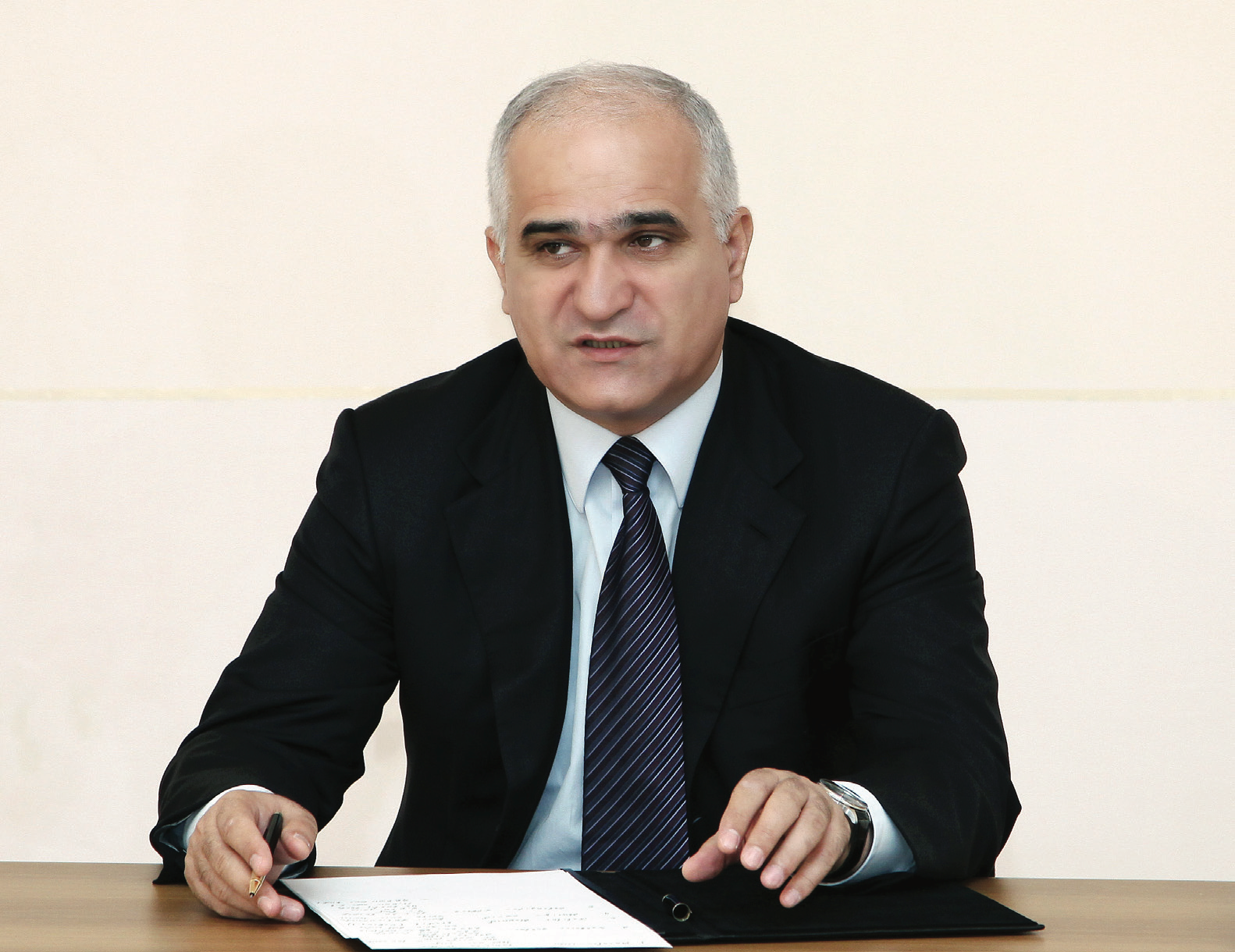
Caspian Energy (CE): Mr. Mustafayev, in his speeches President of Azerbaijan Ilham Aliyev has emphasized for many times that we should forget about the fact that we possess oil and gas and develop our economy taking this factor into consideration. What kind of work is the Ministry of Economy currently performing in this direction?
Shahin Mustafayev, Minister of Economy of the Republic of Azerbaijan: Diversification of economy and development of the non-oil sector are the priority areas of the socio-economic policy of the President of the Republic of Azerbaijan.
Despite the difficult political and economic processes currently taking place around the globe and across the region, as well as a multiple decline in crude oil prices on the global markets, the Azerbaijan's economy shows resilience to the negative external influences and continues developing at the expense of the non-oil sector.
I would like to highlight that in the period of high oil prices the main goal of the economic policy was to reduce dependence on the oil factor and boost development of the non-oil sector. If in 2009 the share of the non-oil sector in GDP comprised 47%, in 2014 this figure increased up to 61.3% and 69.3% in 2015. Apparently, in recent years GDP has been growing mainly due to the non-oil sector.
The non-oil sector is also leading in terms of attraction of investments. Only in the past year $20 billion was invested ino the Azerbaijan’s economy. Of this, $10.2 billion accounts for the share of the non-oil sector.
In the future, the role of the non-oil sector in the development of the Azerbaijan's economy will continue to grow. Lots of directions are currently developing according to the Development Concept “Azerbaijan 2020: Look into the Future” to achieve the set goals by 2020. First of all, the work is being carried out to implement the projects for improvement of infrastructure and ensuring reconstruction of the municipal sector. These measures, in turn, are of particular importance in enabling the activities of entrepreneurs and attracting investment. As a result, investment in the non-oil sector increases, new businesses open and the number of jobs grows.
From the view point of the non-oil sector development, the matters regarding the support of the economic reforms, in particular the development of entrepreneurship, are under special control of the state. The decisions related to the development of entrepreneurship that President Ilham Aliyev made within the framework of the package of economic reforms are of strategic nature in terms of sustainable development of the economy. This is the start of a new era of business development. For example, inspections carried out at business entities have been frozen for 2 years, and the number of areas that require licensing has been significantly reduced. Customs procedures have been simplified and Boards of Appeal have been established. Also, measures have been implemented to encourage investment.
At the same time according to the Decree of the President, in order to boost the development of entrepreneurship and create favorable conditions the areas of activities that require obtaining state licenses have been narrowed notably, while remaining licenses have been made perpetual. Official fees for obtaining licenses have been reduced by 2 times and 4 times in the regions, and licensing procedures have been simplified as well.
One of the priority areas of the policy of economy diversification is the socio-economic development of the regions. The state programs on the socio-economic development of the regions, which have been successfully implemented since 2004, play an important role in the development of the local economy and at the same time play a crucial role in creation of new firms and jobs in the regions, improving the quality of infrastructure services and public utility services, expansion of business activities, as well as improvement of the business environment and investment climate. The regions are developing along with the capital, and possibilities for investment in the regions are expanding.
The support is given to in creation of modern companies in the non-oil industry, since these firms are very important for development of the non-oil sector. Continued efforts are taken to organise industrial parks and districts.
About 270 industrial companies were set up in 2015 only, and construction of a number of industrial facilities is in process. At present, relevant work is carried out in the Sumgayit Chemical Industrial Park, as well as in the Balakhani, Garadagh and Mingachevir industrial parks, Pirallahi and Mingachevir high-tech parks, and Neftchala industrial district.
It should be noted that construction of the Neftchala industrial district has been already completed, and the relevant work on installing necessary equipment is currently underway in the industrial quarter. The industrial district is significant in terms of the development of small and medium-sized businesses. Works on 8 projects are now in process in the industrial quarter. In August 2016, the Neftchala industrial district hosted the groundbreaking ceremony for a joint Azerbaijani-Iranian car manufacturing plant. The plant is a joint project of the Azerbaijan company AzEuroCar and the Iranian company Iran Khodro. The total project cost is $22.5 million manats.
6 residents have been registered in the industrial quarter, and 3 of them are to start working before the end of this year. Implementation of project will result in opening of more than 500 new jobs.
Through the Sumgait Chemical Industrial Park was created within a short period of time, to date 9 companies have received the status of a resident. The volume of investments attracted under projects of these residents will exceed $1.1 billion, and over 2,000 new jobs are to be created.
In the Balakhani Industrial Park, which is the first industrial park in the region in the field of waste recycling and is of paramount importance in the development of “green business” of the country, there are 5 registered residents in the area of recycling of used motor oil, tires, plastic utensils and printed graphic arts products. Total investment comprises 23 million manats, and implementation of projects will enable to open 300 new jobs.
As for the Garadagh Industrial Park, the investment into this part has totalled $470 million, which will enable to increase the number of permanent jobs up to 2,000. The Baku Shipyard, which is the resident of the Garadagh Industrial Park, has completed the order worth $40 million and is currently implementing the projects for underwater construction and construction of 3 passenger ships.
The Mingachevir Industrial Park will operate in the field of textile industry and organizational activities are currently continued to ensure the operation of the park. Unnecessary facilities around the park have been already demolished, and preparations for the start of construction work have been finalised. This year on September 21 President of Azerbaijan Ilham Aliyev attended the groundbreaking ceremony for the Mingachevir Industrial Park. Nine factories will be established within the industrial park to manufacture fabrics, clothes, carpets and other light industry products. According to preliminary estimates, more than $200 million will be invested in the Mingachevir Industrial Park, and more than 5,500 new jobs will be opened there.
At present time, according to the Order of the Head of State, the work on establishing the Pirallahi Industrial Park is underway now. To create the park is important in terms of production of pharmaceutical products, reducing the country's dependence on imports and promotion of domestic production in this area. It stands to mention that in the framework of two projects for pharmaceuticals manufacturing the investment at the first stage will comprise up to $90 million, and up to 300 new jobs will be opened as a result. The project will be implemented jointly with the Russian and Iranian companies. Construction of facilities will start before the end of the year.
Currently, according to the relevant Order of the Head of State of Azerbaijan, with the purpose to ensure sustainable economic development and boost competitiveness, strengthen the Azerbaijan’s positions in the fields of logistics and transport, create an extensive transport infrastructure in the Alyat settlement of the Garadagh district covering the territory of the new Baku International Sea Trade Port works are being conducted to create a special economic zone similar to a free trade zone.
Recently the Ministry of Economy of the Republic of Azerbaijan and DP World group of companies (Dubai Port World is one of the world's largest port operators) have signed the agreement for the provision of consulting services for establishing a free trade area (FTA) in the Alyat settlement. Moreover, at present possibilities are being sought for establishing industrial parks and districts in other regions taking into account the local potential.
It should be noted that provision of soft loans, tax incentives and subsidies to the agricultural sector, rendering of agricultural leasing services and support of the state have contributed to the growth of food production and boosted the self-sufficiency level. Nowadays, the active support of the state enables to continue efforts aimed at building large modern farms, logistics centers and agroparks.
Efficient use of the potential of transport corridors passing through Azerbaijan will enable to increase the share of this sector in the non-oil sector in the future, and transit cargo transportation will play an important role in ensuring the country's sustainable development. To this end, the Coordination Council for Transit Cargo Transportation of the Republic of Azerbaijan was established, and works were implemented to introduce a single, flexible and transparent tariff policy at railway, marine transport, areas of transit cargo transportation with the use of terminals and ports, enabling the border crossing procedures and transportation processes as well as relations between the government agencies working in this area. Also the efforts for development of the North-South international transport corridor were fostered. Construction of a bridge over the Astara River and 8.3 km of a railroad in Azerbaijan, which are going to be the backbone parts of the International North-South Transport Corridor, will be completed by the end of 2016. The launch of satellites into orbit in recent years, organisation of operation of high technology parks, expanded coverage of electronic services has helped to increase the share of the rapidly growing ICT sector in the non-oil sector.
Measures have been taken globally to raise awareness of the tourism potential of the country. The up-to-date infrastructure has been created in this area, and various types of tourism are being developed. As a result, the number of tourists visiting our country increased and, respectively, revenues from this sector have been growing. Attracting domestic and foreign investment in the tourism sector, the improved quality of services and international sporting and cultural events hosted in our country provide an additional incentive for the development of tourism.
In the near future the completed works will increase the share of the non-oil sector in the total GDP and the dependence on the oil factor will be reduced to a minimum.
CE: At the current stage particular attention is paid to the development of agriculture. What measures are being taken in the direction of import substitution?
Shahin Mustafayev: In recent years logistics centers have been created in the country. Horticultural businesses and vineyards, modern poultry and livestock farms, production and processing companies that manufacture competitive and export-oriented products are developing at a fast pace. All of them are the important elements in the development of the agricultural sector. At the same time they cover the needs of the country in a variety of food and other industrial products at the expense of domestic production. They increase the export potential and contribute to reducing the dependence on imports, and in general, ensure food security. As a result, the level of self-sufficiency on the main types of food products has increased notably.
Considering importance of food security, in 20 areas covering more than 44,000 hectares works at many of these farms have been finalised. The performance at these farms is twice as high as the average performance across Azerbaijan.
It stands to mention that the works on the first phase of establishing agroparks in the Shamkir and Khachmaz regions are at the finishing stage. The first stage of establishing the agropark in the Khachmaz region has been completed. Recently, President Ilham Aliyev has attended the opening of the Yalama Agropark in Khachmaz, which was established on the basis of Yalama State Dairy and Pedigree Cattle Breeding Agricultural Production Enterprise. 20 million manats were invested in the establishment of the agropark, which occupied a total area of 523 hectares. Creation of such agroparks will play an important role in the growth of export volumes and expansion of the export geography, creation of national brands, growth of innovative capacity of farmers, broad introduction of intensive methods, achieving high productivity and creation of a single system in the field of agriculture, training of specialized personnel in the field of agriculture and opening of new jobs. Currently the possibility of creating large farms and agroparks in other regions is under consideration.
Relevant activities are implemented according to the instructions of the Head of State to boost the development of traditional industries, including cotton production, cocoon production, tobacco growing, viticulture and tea growing. Thus, farmers involved in development of cotton production and tobacco growing will enjoy necessary conditions for obtaining soft loans and a wider use of agricultural leasing services. The purchase price for cotton and tobacco has been also increased for farmers.
Also, it stands to mention that with the aim of boosting the cotton production up to now the National Fund for Entrepreneurship Support under the Ministry of Economy has extended 61.7 million manats as loans to 370 entrepreneurs, and about 250 entrepreneurs received more than 3 million manats as concessionary loans as of September 2016.
At the same time, according to the relevant instructions of the Head of State, the deliberate attention is paid to development of tobacco growing industry. Therefore, to ensure growth of this industry up to date about 50 entrepreneurs have received 1.7 million manats. Over the last period of 2016 30 farmers received 220,000 manats as soft loans.
In general, regular meetings are being held with producers and processors of agricultural products. Their problems and proposals are being studied and measures are being taken to address the raised issues and proposals.
CE: What measures have been introduced, and which ones are still planned for implementation to improve the investment climate?
Shahin Mustafayev: Favorable conditions have been created in Azerbaijan for local and foreign investors. First of all, it should be noted that the favourable legal regime for investors is in place in the country. The Government of Azerbaijan signed the treaties for the avoidance of double taxation with 51 countries, and agreements on the promotion and mutual protection of investments with 48 countries. Along with this, continued efforts are being made to improve the legal framework.
It should be noted that the business setting up procedure has been completely simplified in Azerbaijan. Since 1 January 2008, registration of business entities has been performed according to the “one-stop-shop” principle.
Agricultural producers are exempt from all taxes, except land tax, which encourages the development of the non-oil sector and at the same time increases the interest of entrepreneurs to the area.
In recent years the ongoing economic reforms have made a significant contribution to improving the business and investment climate in the country, which is especially important for expansion of business activities. The Decree of the President dated 20 April 2016 approved the “Guidelines for issuing an investment promotion document”, areas of economic activities of implemented investment, a minimum amount related to a volume of an investment project and an administrative territorial unit where a project will be implemented. The investment promotion document enables to take advantage of the benefits envisaged in the Tax Code and the Law “On Customs Tariffs”. An entrepreneur, who receives the investment promotion document for a period of 7 years, shall be released from the payment of import duty, 50% of income tax and profit tax, property tax and land tax, as well as from the payment of VAT on imported equipment and technological equipment. This creates favorable conditions for increased investment in the non-oil sector, opening new jobs and, ultimately, makes the important contribution to the development of entrepreneurship.
As part of the economic reforms, 58 investment promotion documents have been presented to entrepreneurs. Implementation of different projects will enable attraction of more than half a billion dollars as investment into the country’s economy. It is worth noting that projects covering different areas of the non-oil sector will be implemented in the seven economic regions across the country. More than 4,000 jobs will be opened under implemented projects.
The introduction of the “Build, operate, deliver” model (BOD) in accordance with the Law “On the implementation of investment projects on the basis of special funding related to construction and infrastructure projects” creates the wide opportunities for entrepreneurs and is important in terms of attracting investment in the domestic economy. An investor, who is involved in implementation of projects according to the BOD model, is exempt from state taxes and fees.
The document “Guidelines for Use of the “Green Corridor” and other access systems for the transportation of goods and vehicles across the customs border”, which was approved by the head of state on May 21, 2016, promote the introduction of a more flexible and transparent customs clearance (documentation), enable the development of “official-to-entrepreneur” relations in line with the principles of modern management, which ultimately will contribute to the growth of non-oil exports, expand the area of foreign trade and boost the possibilities for Azerbaijan products to enter new markets.
CE: How much investment is currently contributed to the Azerbaijan economy?
Shahin Mustafayev: The political and economic stability in Azerbaijan, rich natural resources and ample transit possibilities, the factor of active partner and main contractor of large regional and international projects, economic reforms, which in recent years have been particularly implemented in the field of entrepreneurship, the ongoing comprehensive measures taken to change and improve the business and investment climate have created the best conditions for investments into the national economy.
I would like to mention that the share of domestic investment in the total volume of investments has grown notably in recent years. Over the past 10 years $189.3 billion have been contributed to the Azerbaijan economy as investment. Of this, $105 billion accounted for domestic and $84.3 billion for foreign investment.
Today, around 7,000 foreign investment companies are operating in different sectors of the Azerbaijan’s economy. Foreign companies are also involved in the projects implemented in Azerbaijan as contractors. The geography of foreign investment is constantly expanding. The top five foreign countries investing in Azerbaijan include the UK, the USA, Japan, Norway and Turkey. Such countries as Turkey, the UK, the USA, the Netherlands and the United Arab Emirates are among the top five countries that contribute the largest investment in the non-oil sector of the national economy.
Thus, local and foreign business people, who take advantage of the favorable business environment and conditions created in Azerbaijan through the ongoing reforms, have the opportunity to invest in various sectors of economy, especially in agriculture, manufacturing industry, food production and processing, tourism, information and communication technologies (ICT), alternative energy, production of building materials, machine building, metallurgy, etc.
It should be stated that the development of the Azerbaijan’s economy contributes to the growth of the country’s financial capacity and creates great conditions for investment in foreign countries. Globally, today Azerbaijan is a reliable partner and a country that exports investment. The list of such countries, where Azerbaijan heavily invests, includes Turkey, Georgia, Ukraine, Romania, Moldova and other countries. In foreign countries public and private companies of Azerbaijan are actively involved in projects in the fields of petrochemicals, logistics, infrastructure, etc.
CE: What other measures are being taken to improve competitiveness of the Azerbaijan economy in the world markets?
Shahin Mustafayev: One of the important directions of the economic development strategy is to increase the growth of competitiveness of production of the non-oil sector and expand exports. Every year many activities are conducted in this area. In 2015, Azpromo organised more than 260 events in Azerbaijan and foreign countries. During the events attended by both local and foreign entrepreneurs the investment opportunities of the country were presented, products made in Azerbaijan were promoted, and export agreements were signed with foreign partners.
The recent decisions related to investment promotion and encouragement of exports of the non-oil sector products have boosted the development of entrepreneurship, attraction of foreign investments into the national economy and provided a powerful impetus to the development of both regions and the non-oil sector.
Also, certificates of origin are issued to entrepreneurs within a day in order to further simplify the export procedure. Previously, these certificates were issued within three days.
The first logistic center of Azerbaijan has been commissioned for entrepreneurs in Aktau with the aim to expand possibilities for local products to expand into new markets. The logistics center provides entrepreneurs, especially exporters, with a number of possibilities and benefits. Construction of another center of this type is planned in the city of Yekaterinburg, the Russian Federation. The possibility of creating similar logistics centers in other countries with the potential export market is being studied at the moment, and efforts are made to create an export database.
At the same time work is underway to amend legislation in order to promote exports, including provision of a chargeback, promotion of the “Made in Azerbaijan” brand name in foreign markets, ensuring funds from the state budget to cover a part of costs, which are paid by local companies to obtain export-related certificates and patents in foreign countries, as well as expenditure on export-related projects and R&D programs, provision of additional subsidized loans to enable export-oriented productions.
As a result of performed work a significant increase in interest from entrepreneurs to export has been seen in recent years. Besides traditional markets, local entrepreneurs are showing great interest in the markets of such countries as Kuwait, Qatar, Saudi Arabia, Ethiopia, South Africa, the United Arab Emirates, Japan, China, Eastern European countries. At the same time they take part in the prestigious international exhibitions. Fruit juices, especially pomegranate juice, alcoholic beverages, tea and other products under the brand name “Made in Azerbaijan” are sold in many countries, including the US and Europe.
Undoubtedly, the performed activities, production support and provision of competitive products will make a significant contribution to import substitution. There are manufacturing facilities for production and processing of agricultural products, construction materials, transformers, steel structures and so on operating in the country. Their products are sold not only in the domestic market, but also go for export to other countries.
CE: Which projects are considered first for the purpose of a financial support for products with the high added value?
Shahin Mustafayev: In order to strengthen the financial support for prioritised projects of the non-oil sector, including the real economy, approximately 32,000 entrepreneurs have received soft loans in the amount of 1.9 billion manats through the National Fund for Entrepreneurship Support (NFES). The extended loans enabled to create over 145,000 new jobs.
Logistics centers, “green markets”, agro parks, thoroughbred large-horned livestock farms and greenhouses, large farms and intensive gardening farms, farms for slaughtering and meat processing, production of mixed feed and grain, fruit and vegetable processing, production of construction materials and other industrial enterprises are being established in the real sector of economy in 2016 at the expense of soft government loans for the purpose to ensure a growth of manufacturing of the non-oil products, financing of investment projects. At the same time financing of investment projects is in place to ensure the development of poultry farming, as well as to boost a growth of small business development.
At the same time, the proposals to establish up to 250 different manufacturing, processing and infrastructure enterprises in the regions worth in total AZN 2.4 billion manats have been worked out according to the instructions of the Head of State. Currently, the work is underway to encourage the implementation of these projects. Most of these enterprises will be created at the expense of capital owners. In addition, soft loans can be obtained for a certain part of these projects. Implementation of these projects will be of particular importance from point of import substitution, increasing exports and providing the population with high-quality local products.
Thank you for the interview