


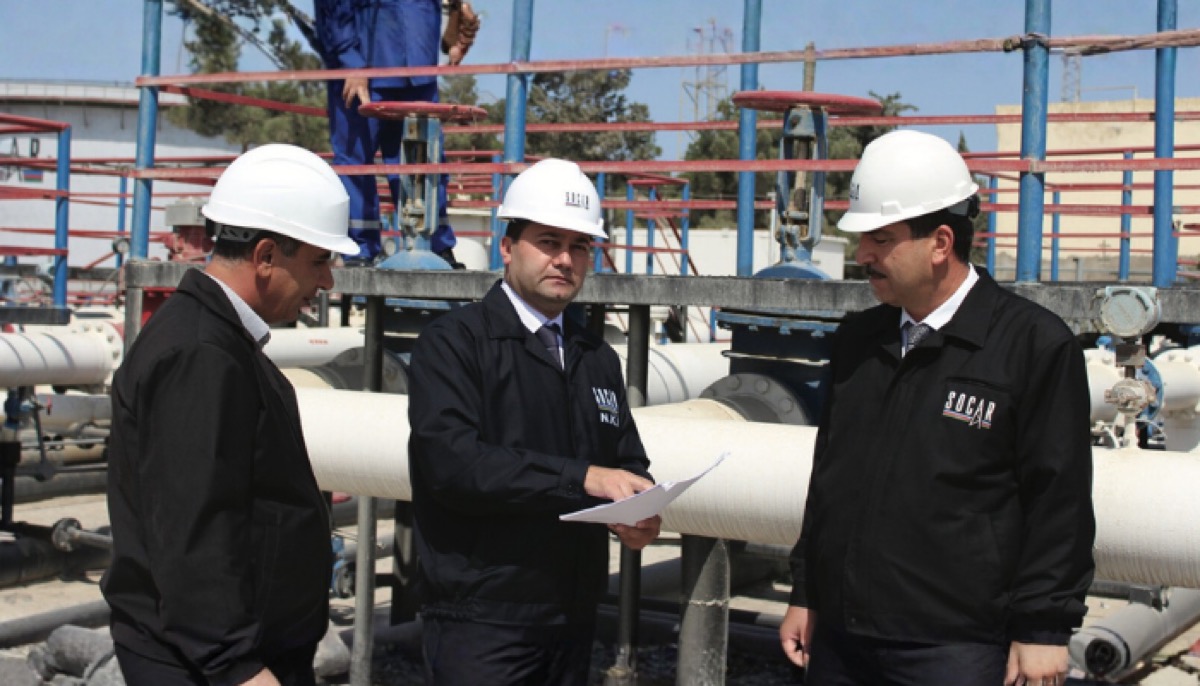
The global changes occurred in the world political life late in the 20th century let many countries, including Azerbaijan, gain independence. Azerbaijan, with extensive natural resources as well as favorable geographic location, has managed to draw the attention of the global community since the very first days of the independence.
Azerbaijan’s oil strategy, a national security component, has already gained corresponding positions globally, all this sets new tasks in the field of oil transportation. A new oil strategy, laid by All-National leader Heydar Aliyev, attaches particular importance to oil transportation system.
The requirements for quantitative and qualitative export of Azerbaijani energy resources to the world markets have been considerably increased.
Oil Pipelines Department has turned into a large specialized organization engaged in transportation of Azerbaijani sorts of oil to Baku oil refineries and the Russian Federation.
There are Dubendi production subdivision, Absheron production subdivision, Garadagh production subdivision and Export production subdivision operating within the Oil Pipelines Department, an entity of the State Oil Company of Azerbaijan Republic (SOCAR).
The Department is mainly involved in management and control over transportation and reception of oil from SOCAR’s oil-gas production unions, joint ventures as well as over its storage, transportation and further delivery to consumers.
The history of the north route began in 1983 when a 601km long Grozniy-Baku oil pipeline 720mm in diameter was built to transport west-Siberian oil to Baku Oil Refineries. The Department deals in the maintenance of this pipeline’s section located in Azerbaijan.
After signing of the EPSA (Exploration & Production Sharing Agreement) for the Azeri-Chirag-Guneshli fields on September 20, 1994, a decision to extend Grozniy-Baku oil pipeline till the Russian port of Novorossiysk was made to provide transportation of “early oil” extracted from these fields.
Therefore, a work on construction of the new section till the Russian port of Novorossiysk and reconstruction of the old pipeline was carried out in accordance with the agreement “On the operating rules and potential transportation capacity of the pipeline” signed between the State Oil Company of Azerbaijan Republic, Azerbaijan International Operation Company (AIOC) and contractors.
At the same time, to transport oil in the north direction a new 57km long line 530mm in diameter was built from the Sangachal terminal and linked to the Baku-Novorossiysk oil pipeline. AIOC performed oil transportation in the north direction in 1996-2008, which has been successfully carried by the Oil Pipelines Department since 2008. Since February 2014 oil has been exported from the Sumgayit oil custody transfer point in the direction of Sangachal terminal from where it flows into the Baku-Tbilisi-Ceyhan pipeline system.
The Oil Pipelines Department is currently operating different diameter oil pipelines with a total length of 629.188km, 12 oil transportation sections, 2 oil custody transfer stations, an oil transshipment point, 66 power transformers, 27 power substations, overhead transmission lines with a total length of 61.944km, cable power lines with a total length of 116.68km, different types of pumps and 14 tanks farms with a total capacity of 479,900 cubic meters.
In 2014, the Oil Pipelines Department received 8284.7 thou tonnes of oil and transferred 8279.6 thou tonnes. Besides, 6731.6 thou tonnes were supplied to the oil refineries via pipelines, 1548.0 thou tonnes were transported for export.
There are 4 berths capable of transshipping 20 mln tonnes per year and an operating bridge, designed for servicing watch, tug and fire boats, to receive oil delivered by tankers from Caspian countries and infill tanks at Dubendi production subdivision. Every bridge is capable of hosting tankers from either sides of the berth. The berths possess the most advanced equipment for pumping oil from tankers into tanks.
To store different sorts of oil and oil products, Dubendi production subdivision has 55 tanks in 10 tank farms with a total capacity of 347,900 cubic meters.Tanks with floating roofs were built and launched here in order to maximally lower natural losses of light fractions. Steam heaters, designed for lowering viscosity and making oil flow along pipelines less resistant, have been installed in the tanks in order to heat paraffin oil freezing at low temperature in autumn-winter season.
There is a chemical analysis laboratory, equipped with modern devices, operating on the oil transportation section of the Oil Pipelines Department, which controls the conformity of products with standards.
Automatic control system is being deployed at oil transportation sections and measurement points of the Oil Pipelines Department in order to control oil transportation via the major pipelines. This system provides remote in-process control over transportation, rate of commercial oil in tank farms, operational parameters of injection pumps, temperature and pressure in oil pipelines and valves.
The control over transportation of export oil along the north export pipelines is carried out by means of the automated control system.
Specialists of the Oil Pipelines Department have been introducing full automation of the control system in order to facilitate the work of employees performing oil transportation operations.
Regular diagnostic work is carried out on major oil pipelines with the purpose to raise efficiency of transportation system and prevent possible accidents. Special facilities are used to inspect technical condition of pipelines, integrity of insulation. Regular-preventive operations are underway. Different diameter pipelines with a total length of 17km were replaced during capital repair held in 2014.
The work on supply of modern equipment and provision of cathode protection of major oil pipelines is underway. Major importance is attached to operation of oil tanks. Thus, cleaning of bottom settlings is carried out on regular basis. The measures are taken to protect tanks from external and internal erosion.
The Oil Pipelines Department devotes a serious attention to security of major and industrial oil pipelines. A fire, explosion or other accidents can occur on major oil pipelines at any time of the day. To ensure timely prevention and handling of consequences, trainings aimed at enhancement of professional qualification are regularly held with participation of people engaged in this sphere and working for Special State Guard Service, Ministry of Emergency Situations, local executive bodies, law-enforcement bodies, ambulance stations and other agencies. All possible scenarios of events are considered during trainings.
One of such important areas of modern life as ecology has also been in the center of attention of the Oil Pipelines department. Noteworthy are advanced measures taken for ensuring environmental protection and ecological safety. Monitoring of oil transportation sections and area along the pipelines, early prediction of every possible accidents, and technical control over the equipment allows preparing an action plan and ensuring its timely fulfillment.
Over 3,860 trees and bushes were planted on the area of structural units of the Oil Pipelines Department and the agrotechnical service is provided regularly.
The employees of the Oil Pipelines Department have been enjoying all conditions for comfortable work and rest. A number of measures will be undertaken to strengthen the production process. Corresponding projects are under implementation at present.
The staff of the Oil Pipelines Department will continue working successfully, promoting the implementation of the oil strategy of Azerbaijan.