


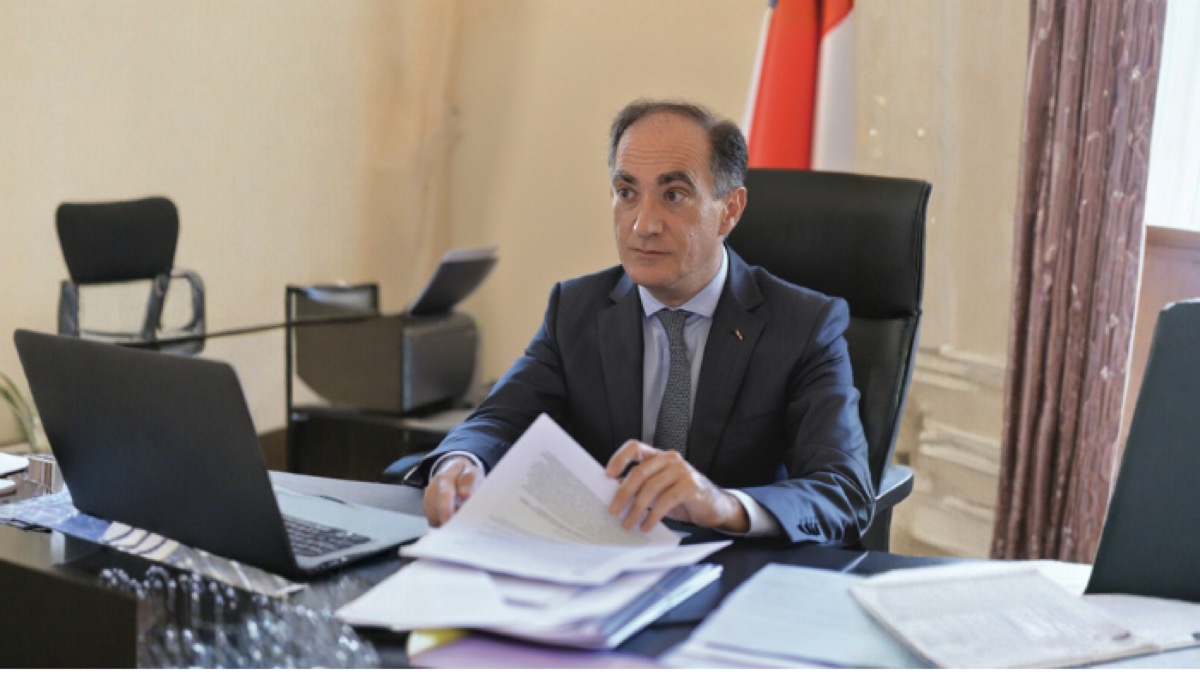
Caspian Energy (CE): Mr. Castellini, how would you assess the current level of economic and financial stability of Monaco and France in general?
Jean Castellini, Minister of Finance and Economy of the Principality of Monaco: Starting from 2012, the state budget has been once again closed with surplus after several years of deficit. The initial 2015 budget is no exception from the rule and also features a significant return to growth, since for the first time in 20 years it has been composed with surplus.
Actually, owing to His Serene Highness Prince Albert II (Prince of Monaco), who drew up a plan for his Government, Monaco has pursued a thrifty budget policy for the past 3 years.
It should be emphasized that this goal can be achieved without sacrificing investments, in particular real estate, which is necessary for the financial attractiveness of the country and well-being of its people nowadays and in the future as well, and even through forbidding cuts in the budget on some key sectors such as security, education, healthcare and social sphere so as to preserve the socio-economic model of Monaco.
At the same time, the measures taken to improve attractiveness of the state have enabled to increase revenues, even hit the historical record several times and for the first time pass the symbolic level of 1 billion euros in 2014.
So, I believe that the current level of economic and financial stability of Monaco is quite satisfactory. Moreover, it should be noted that Monaco has no debt and the state contingency fund is in excellent condition. It has grown over the past few years as a result of the aforementioned positive budget items and the profits from contributed investment.
CE: What was the impact of the eurozone crisis on the economy of Monaco?
Jean Castellini: Like other countries, Monaco has not escaped the effects of the eurozone crisis, but to a lesser degree as it usually happens in the Principality during crises. So, in 2009 the figures were not very positive, but starting from 2010 Monaco was living through a gradual development, which, as I have already said above, led to cash surplus from 2012.
CE: Which investment projects will Monaco implement in 2015?
Jean Castellini: 2015 is going to be especially ambitious year in terms of investments to be made. It is to bring completion of the ‘la Tour Odéon’ project, a start of construction of a new hospital centre ‘Princesse Grace’, continuation of works on a cascade tunnel, reconstruction of the ‘Hôtel de Paris’ hotel and ‘Sporting d’Hiver’ building and, in particular, signing of a contract for future expansion of l’Anse du Portier.
CE: Southern Europe is traditionally a region that shakes economic and financial stability of Europe. Monaco stands apart in this regard. What is the Monaco’s secret of stability? How applicable is it for other southern EU countries, like Greece, that do not want to ‘tighten the purse strings’?
Jean Castellini: The economic and financial stability of Monaco is associated with several key moments. Of these, the key factor is political stability embodied by His Serene Highness Prince Albert II from the 700-year-old dynasty. The law-governed state, legal security, inviolability of property and people, diversified economy, quality of life, education and cultural diversity - all this makes Monaco an attractive state for families and entrepreneurs, who live and work in Monaco, they are consumers in the country and invest in it.
This unique socio-economic system seems to be quite difficult to be transferred to other countries. However, Monaco has never had the intention to be a model or to give lessons, but only wanted to have the specificity of this model, which makes the country different from the rest of the world, recognized.
CE: How will the drop in oil prices affect attractiveness of the economy of Monaco?
Jean Castellini: It is difficult to answer this question to the extent that if we have criteria for a gradual increase in oil prices, which affect our economy, the decline in its volume is unprecedented and we have no experience or criteria for comparison to predict the development of the situation.
CE: Banks seem to be the most sensitive sector of the economic policy. Will Monaco reform this sector like most EU member states?
Jean Castellini: The Government has no plans to reform the banking sector. It is necessary to understand that the situation in Monaco differs because Monegasque banks as such do not exist. All financial institutions resided in Monaco are branch banks of the large international banks, mostly European.
However, without considering this as reforms, it is necessary to emphasize that Monaco is committed to abiding by the international changes in laws and regulations against money laundering, which are aimed at tax transparency. As a result, financial institutions resided in Monaco continuously improve their activities to meet emerging requirements.
CE: Will banking confidentiality be preserved in Monaco?
Jean Castellini: Banking confidentiality is intended to protect confidentiality of a legal entity. The situation is still not favourable in some countries and people want to keep their personal data protected.
However, Monaco is not willing to keep confidentiality used as a tool for tax evasion. Money received from tax fraud is not welcomed and will never be welcomed in Monaco.
Thank you for the interview