


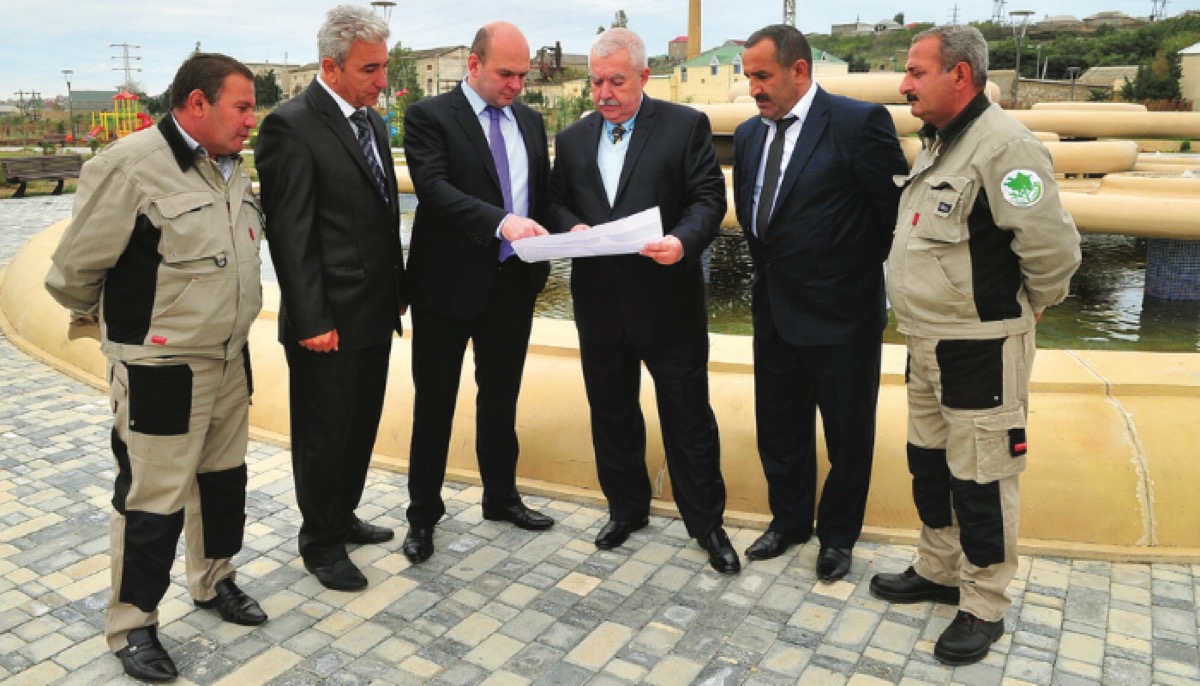
ECOLAND LLC has completed rehabilitation work on purification of soils and grounds of the former Baku iodine and Neftchala iodine-bromine plants, contaminated with natural radionuclides, oil, oil products and other hazardous elements. This work was carried out in tight cooperation with specialists of the International Atomic Energy Agency (IAEA).
At present it is becoming absolutely obvious that the environmental problems are gaining paramount importance. Today, every person realizes their environmental responsibility for the development and prosperity of the future generations. Numerous legislative acts and normative documents adopted by the government of the republic of Azerbaijan as well as numerous conventions aimed at strengthening of cooperation to preserve, recover, protect sound condition and integrity of ecosystems just confirm the thesis of necessity for more attentive addressing of the environmental problems.
One of the by-products associated with oil production and based on low-cost secondary raw materials, was the launch of iodine and bromine production by filtrating formation waters, coming along with produced oil, via activated carbon. However, not only chemical compounds but also natural isotopes 226Ra, 228Ra and products of their degradation contained abundantly in formation waters were absorbed at activated carbon when using this technique. Absorption and accumulation of decay products emerging from the wastes of iodine production led to the creation of artificial source of external gamma radiation.
Such situation also emerged at the area of former Baku iodine (Ramany and Surakhany production sites) and Neftchala iodine-bromine plants founded in 30s of the 20th century. Initially, both plants produced iodine out of secondary raw materials – associated formation waters of territorial oil producing enterprises. After discovery of iodine-bromine formation waters in Neftchala, the plant underwent reconstruction whereafter production of bromine, in addition to iodine, was launched there as well. In the meantime, no essential changes were introduced in the production process which still was based on their absorption at activated carbon.
Production at Neftchala iodine-bromine plant (production at Baku iodine plant had been stopped long before in 1994 by the order of the Sanitation and Epidemiological Service) was stopped only in 2004 after construction of new Azeri-Yod LLC plant by applying environment protection technologies. As a result, Surakhany, Sabunchu and Neftchala districts altogether inherited about 50 ha of polluted and good-for-nothing lands which also caused radiation poisoning of population close to the abandoned areas.
The rehabilitation of the abovementioned areas was assigned to the Ministry of Emergency Situations by the order of President of the Republic of Azerbaijan Ilham Aliyev. A number of structural subdivisions of the Ministry of Emergency Situations were engaged in these projects: Crisis Management Center, State Agency for Control over Construction Safety, State Agency for Regulation of Nuclear and Radiological Activity, Specialized Integrated Plant Isotope and State Design-Engineering Institute Azərinşaatlayihə. ECOLAND LLC which possesses a “Special license for performance of operations on use of radioactive wastes” was appointed the project operator”. “BM-Nəqliyyat” LLC and “Benkos İnşaat” LLC were involved as the subscontractors.
The work started from assessment of the initial state of the areas of the plant and involved the scientists and specialists of sectoral institutes of the National Academy of Sciences. Field research work and laboratory analysis on detection of qualitative and quantitative parameters of contamination were also carried out.
The equivalent doze of gamma-rays reached 6.5 mcSv/h here. The content of oil and oil products in soils (ground) totaled up to 11%.
The project realized under closer cooperation with IAEA was launched in January 2012 and completed in September 2014. Over this period the specialists and experts of IAEA visited Azerbaijan repeatedly, discussed technical conditions of fulfillment of operations with local specialists, watched over the progress of cleaning work, conducted inspection and expert evaluation of cleaned and recovered areas.
The IAEA experts highly evaluated the work that the Ministry of Emergency Situations of the Republic of Azerbaijan and its structural subdivisions performed for cleaning the areas of former Baku iodine and Neftchala iodine-bromine plants. It is, perhaps, the only completed large-scale project implemented jointly with IAEA in Azerbaijan.
Despite the world practice already featured the experience of cleaning the area of the iodine plant in Turkmenistan, where all the work starting from projection and financing right up to the fulfillment was carried out by international organizations, in our case it is the forces and sources of the republic that did the whole work, including projection, financing and performance of operations.
Over the period under review, a total of 378.5 thousand cubic meters of production wastes, construction and domestic garbage including about 340.0 thousand cubic meters of hazardous production wastes (processed activated carbon enriched by natural radionuclides and soil (grounds) contaminated with activated carbon, oil/oil products and construction garbage) has been removed from the areas and utilized.
All hazardous wastes were taken out and buried at a special polygon built directly under the special integrated plant Isotope. As the result of performed operations, about 45 ha of cleaned lands of Surakhany and Neftchala regions were fully rehabilitated and put into the economic turnover. An “ECOLAND” park occupying over 6.0 ha was set at the area of Sabunchu district.
Ministry of Emergency Situations of Azerbaijan has adopted and implements a policy in the field of industrial security, health and environment safety. The priority tasks of this policy is to ensure safe working conditions of workers, health safety of the working personnel and population residing in the areas of activity, as well as to preserve the environment. Integrated health and environment safety system is successfully operating in accordance with requirements of the international standards ISO 9000, ISO 14000 and OHSAS 18000. All of it is aimed at elimination and minimization of any possible negative consequences and related risks.
Relevant workplace conveniences and sanitation conditions were created for workers engaged in rehabilitation work. Necessary measures were undertaken for preventing the radioactive poisoning of the workers. Before going to the worksite, every employee was provided with an individual dosimeter which parameters were put into a special register and regularly controlled. All workers were supplied with special clothes and individual safety equipment.
Radiological measurement was regularly carried out within the framework of the production control. All technical facilities leaving the production sites underwent treatment in order to prevent fall of contaminating substances, stuck to the car bodies and wheels, into the highways. Radiological measurement had also been carried out over the transport facilities before they drive into the highway. Cleaned areas regularly underwent environmental monitoring which continue even today, especially in the area where the wastes were buried.