


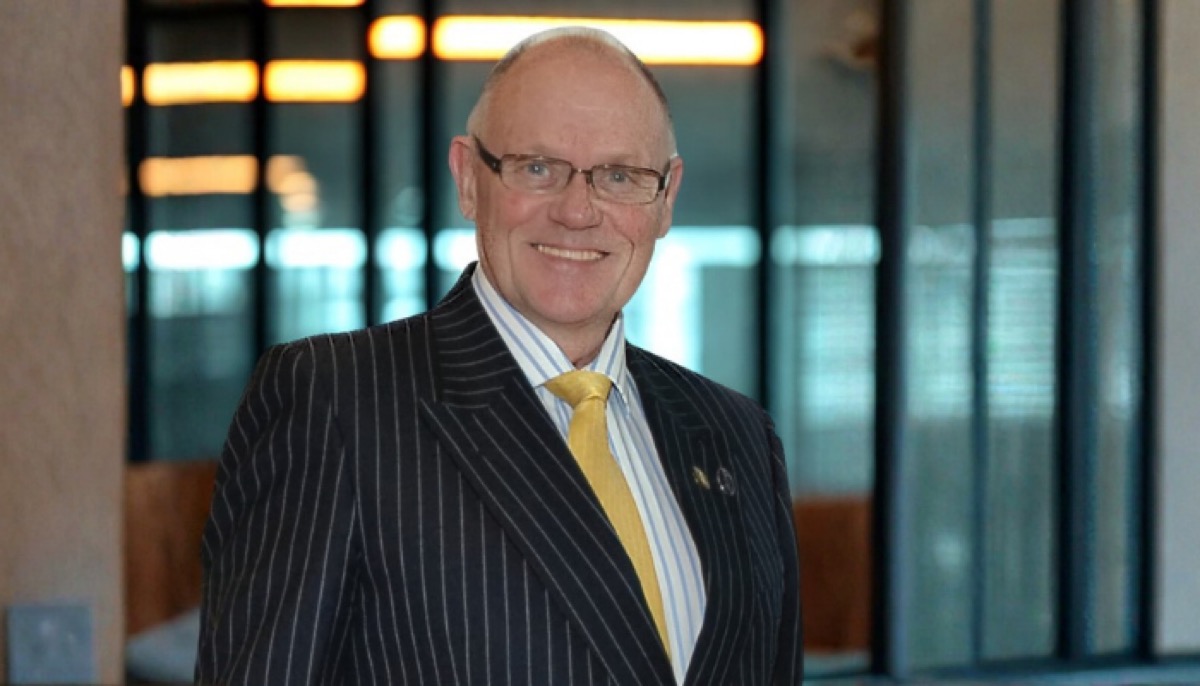
Caspian Energy (CE): Could you please tell us about the results of the activity carried out in the first half of the year?
Christopher Mott, General Manager, SOCAR-Fugro LLC: During this period we finished providing offshore support services to the Chirag Oil Project (COP), and we have started carrying out topographic survey, environmental and geotechnical services on the Sumgayit Chemical Industrial Park.
Our activities on the COP project involved providing services on the pipelay barge, the diving support vessel, the construction support vessel and some of the general support vessels that helped the pipelay barge to lay anchors for duration of the project. We supplied surveyors and engineers. We supplied remotely operated vehicles and ROV personnel. Our services enabled the pipelines to be placed on the seabed in the right place. We enabled the pipelines to be installed without damaging the existing pipelines. We created records of exactly how they were installed on the seabed. A baseline statement of the condition of the newly installed pipelines was created so that when they are inspected in future there will be some existing information that can be used to compare the current condition with the original condition. The client was pleased to recognize FUGRO Caspian's excellent safety achievement on the COP Project. After completing the project, we received a certificate of gratitude from McDermott for doing an accident-free work through these years. “During the tenure of the project, FUGRO Caspian demonstrated outstanding safety performance by attaining Zero injuries to personnel with 172,133 man-hours expended”. Diving Support Vessel Tofig Ismaylov, Pipeline Lay-Barge Israfil Huseynov and Construction Support Vessel Topaz Arrow were employed on this project.
On the Sumgayit Chemical Industrial Park (SCIP) we are providing geotechnical services and soil sampling services to find out what the soils are like on site so that the heavy structures that will be built there can have their foundations designed correctly. Also, because it is a Brownfield site, we are also surveying to determine if the site is contaminated, and if it is, where the contamination is, and the levels at which it is present. At the end of this process we will be in a position to assist in making the site safe for the construction of the new developments, to ensure the safety of people creating the developments, and once the developments are complete, to ensure the safety of the people who will work there.
While we are determining the levels of contamination at SCIP, the people who are doing this work are potentially exposed to contamination. The people working on site expressed concerns that they may be exposed to invisible pollution, for example small amounts of asbestos in the air. Immediately we arranged for a specialist group to visit the site to carry out air quality tests. The results were analyzed immediately. The analysis showed that there was no significant air pollution on site. A local company was engaged in to carry out this work. This is an example of SOCAR-Fugro working with the local supply network to bring the appropriate services to the projects that we are carrying out. As a result of the employees’ raising concern we took immediate action and demonstrated to our employees’ satisfaction that they were safe. We brought in extra procedures to make doubly sure that their safety was assured. These procedures included damping the dust, stopping operations that created dust, issuing additional Personal Protective Equipment and requiring more conservative work practices to reduce personal exposure to potential hazards.
There are several stages that we go through when performing any project. On receipt of a request from a client we prepare for the project. HSE related documents are created on basis of the project including risk assessment work. Hazards that can arise during the performance of operations are considered and assessed. Measures are undertaken in order to keep everything under control throughout the whole process of work. All this documentation is then submitted to the client for approval. The appropriate instructions and documents are provided to managers of sites to ensure that all measures are observed. Audit and inspection work is also carried out in order to make sure that all operations are being performed in accordance with required procedures and standards. This is our usual routine of preparation work.
We are implementing a project together with BP on the ship Svetlomor-2. A local environmental company is also engaged in this work to conduct environmental monitoring on the seabed around fixed platforms at the Azeri-Chirag-Guneshli and Shah Deniz fields. This work is carried out by the order of BP. We supply equipment and personnel to perform these operations, ensuring that the seabed samples are obtained from the correct sample locations. We provide cable hoists, frames and generators that enable the sampling equipment to be lowered down to the seabed. A baseline study was done several years ago. Every year a repeat survey is done and the results of each survey are compared with the baseline study to see how seabed conditions are changing with time and as a result of activities in the oil and gas fields. The samples which are obtained from the seabed are taken to laboratories where they are analyzed. The results of the analysis are compared with the results from previous years.
CE: What could you say about plans for the short-term perspective? What work are you currently involved in?
Christopher Mott: In the short term our objectives are to retain current contracts and secure new contracts for the joint-venture.
CE: Has the company introduced any new technology for performing these operations?
Christopher Mott: The way we are inspecting the pipelines using dual multibeam echo sounders was developed by us here in Azerbaijan. It is world class leading edge technology. Now that we have established efficient data acquisition procedures, we are turning our attention to process the data efficiently. We are using our research and development group which is based in Europe to look into ways that we can process the data faster without losing any of the accuracy.
CE: What is the difference between Fugro and other similar companies?
Christopher Mott: The Fugro Group is the largest independent survey organization in the world. SOCAR-Fugro has access to the services that Fugro supplies. The Group can provide technologies to SOCAR-Fugro that no other organization in the world can offer. We continue to employ Azeri personnel in all capacities. We are able to provide opportunities for those Azeri employees to work internationally and gain international experience. As SOCAR-Fugro is a JV between SOCAR and the Fugro organization, we can allocate our employees to other Fugro operating companies. We provide training to our people in the UK and we have Azeri employees currently working in the North Sea as well as Azeris working in the Middle East.
CE: Could you call any event or any big project that contributed to the development of the Company on a global scale?
Christopher Mott: I am aware of a big survey contract to map a large part of the Red Sea that Fugro has won in Saudi Arabia which is very resource hungry. It is this project which has provided an opportunity for some of our personnel to go and work in the Middle East.
The Australian Transport Safety Bureau (ATSB) has awarded Fugro a contract that will see the deployment of its specialist vessel, equipment and expertise in the underwater search for the missing Malaysia Airlines flight 370 (MH370).
Using its advanced survey vessel, the Fugro Equator, fitted with state-of-the art multibeam echo sounder equipment, Fugro will conduct a bathymetric survey of the search area. The seabed data obtained will assist in the production of maps of the seabed offshore Western Australia. This area is relatively uncharted and the maps will assist in planning subsequent stages of the MH370 search. The Fugro Equator began its operation in mid-June.