


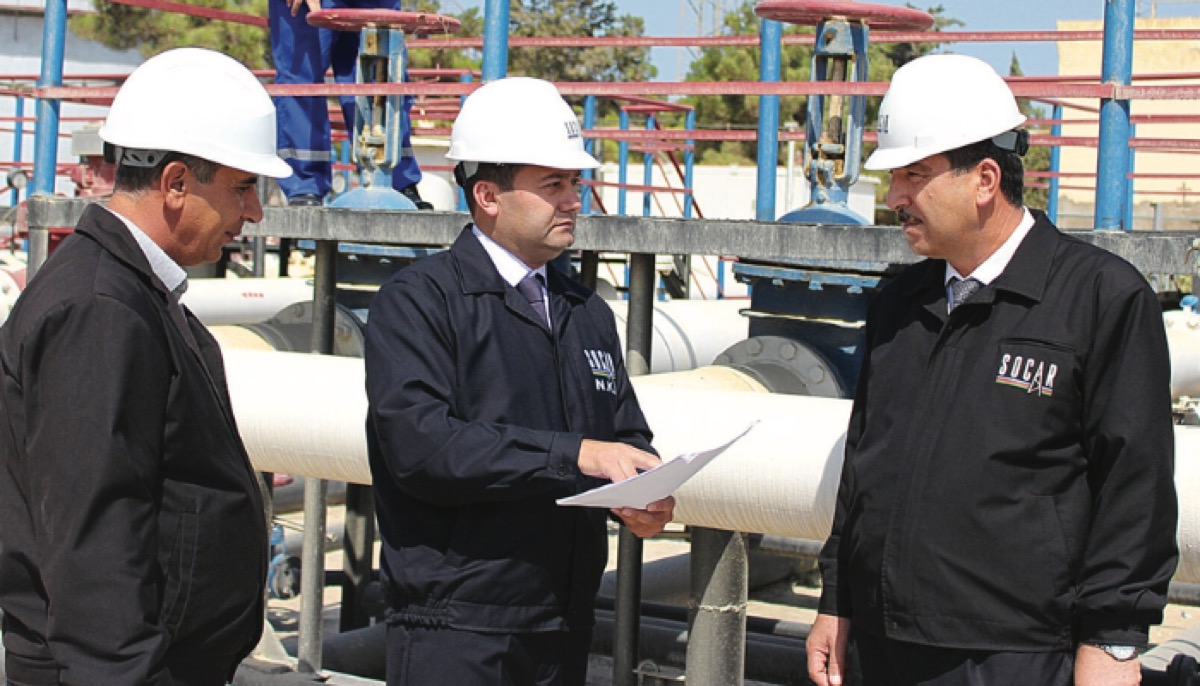
The global changes that occurred at the end of the XX century in the global political life, gave the chance to many countries, including Azerbaijan, to gain independence. With its rich natural resources and favourable geographic position, Azerbaijan was able to draw attention of the global community from the first years of independence.
Azerbaijan’s oil strategy, as an element of national security, has already gained corresponding positions globally, and this in its turn poses new tasks in the sphere of oil transportation. In the new oil strategy, founded by National Leader Heydar Aliyev, the oil transport system has a special value.
The requirements to quantitative and high quality export of Azerbaijan energy resources to the world markets have considerably increased.
At present, the Oil Pipelines Department has developed into the large and specialized organization to ensure transportation of Azerbaijan oil to Baku oil refineries as well as to the Russian Federation.
As a structural unit of the State Oil Company of the Republic of Azerbaijan (SOCAR), the Oil Pipeline Department incorporates Dubandi Production Department, Absheron Production Department, Garadagh Production Department and Export Production Department.
The main activity of the Department is to operate and control oil transport and intake from oil and gas production departments of SOCAR and joint ventures, and to ensure storage, transport and delivery to consumers.
The history of the northern route dates back to the year of 1983, when the Grozny-Baku oil pipeline with the diameter of 720mm and the length of 601km was constructed to transport oil from Western Siberia to Baku oil refineries. The Department serves the section of this pipeline in the territory of Azerbaijan.
The signing of the agreement on exploration, development and production sharing for Azeri-Chirag-Gunashli fields on September 20, 1994 was followed by a decision to expand the Grozny-Baku oil pipeline towards the Russian port of Novorossiysk in order to transport “early oil” from these fields. Therefore, construction of a new section till the Russian port of Novorossiysk and repair of the old oil pipeline were performed in line with the agreement “On operating procedures and potential transportation capability of the pipeline” signed on February 16, 1996 between the State Oil Company of the Republic of Azerbaijan, the Azerbaijan International Operating Company (AIOC) and contractors.
At the same time a new 530mm section with the length of 57km was constructed and connected to the Baku-Novorossiysk oil pipeline to transport oil from the Sangachal terminal northwards. AIOC performed oil transport operations in the northern direction in 1996-2008, while since 2008 the Oil Pipelines Department has been successfully engaged in export operations. Since February 2014 oil export has been also performed from the Sumgait oil custody transfer point to the Sangachal terminal and then via the Baku-Tbilisi-Ceyhan pipeline.
At present the Oil Pipelines Department operates 629,148 km of trunk oil pipelines of different diameter, 12 oil transport sections, 2 oil custody transfer sections, oil transfer section, 66 power transformers, 8 power stations, 82,445km of overhead lines, 105,625km of cable lines, different pump units and 14 crude oil tank farms with the total capacity of 479,900 cubic metres.
In 2013 the Oil Pipelines Department received 8,270.8 thousand tonnes of oil and transferred 8,281.2 thousand tonnes, of them 6,530.6 thousand tonnes were sent to the oil refineries and 1,750.6 thousand tonnes were exported.
4 quays with the total cargo transshipment capacity of 20 mln tonnes per annum along with a bridge for serving log, towing and fire boats are operated to receive oil supplied by tankers from the Caspian states and fill storage tanks at the Dubandi Production Department. Each bridge, in turn, is able to receive tankers from the two sides of the quay. The quays have the brand-new equipment to inject oil from tankers into reservoirs.
The Dubandi Production Department possesses 55 reservoirs in 10 crude oil tank farms with the total capacity of 347.9 thousand cubic metres to store different sorts of oil and oil products. Breathing tanks have been constructed and commissioned there to reduce maximally natural losses of light oil fractions. The tanks are equipped with steam heaters to heat light crude oil sorts with a low freezing point in the autumn-winter season. These heaters reduce viscosity and accordingly reduce resistance in the process of oil transportation in pipelines.
The Oil Pipelines Department operates the chemical analysis laboratory with the cutting-edge equipment to check compliance to standards at the oil transport section. The automatic control system is being introduced at oil transportation and metering sections of the Oil Pipelines Department to control oil transportation via the trunk oil pipelines. This system enables to exercise remote operational control over the process of transportation, the level of commercial oil in crude oil tank farms, operational parameters of pumps, control over temperature and pressure in oil pipelines and all gate valves.
At present the control over export oil transportation through the Northern export pipeline is carried out by means of the automatic control system.
The specialists of the Oil Pipelines Department are introducing automation of control systems to facilitate labour of employees during oil transportation operations.
Diagnostic work is regularly carried out on the trunk oil pipelines to raise efficiency of the transportation system and prevent probable accidents. Special instruments are used to check the technical condition of the pipelines, integrity of insulation, and regular preventive measures are taken as well. 77km of pipelines of different diameter were replaced during major overhaul operations over the last 3 years.
The work to provide modern equipment and recover the system of electrochemical protection of main oil pipelines from corrosion is now underway. Particular attention is paid to the exploitation of oil reservoirs. So, they are regularly cleaned from bottom sludge and measures are being taken to protect tanks from internal and external corrosion.
The Oil Pipelines Department attaches due importance to activities aimed at securing safety of main and industrial oil pipelines. Thus, a fire, explosion and other accidents can occur on main oil pipelines at any time of the day. Trainings are regularly held with participation of employees of the Special State Protection Service, Ministry of Emergency Situations, local executive authorities, law enforcement agencies, ambulance stations and other agencies in order to ensure timely prevention or elimination of accident consequences. All possible outcomes are considered during trainings.
Ecology, one of the most important spheres of modern life, is also in the focus of attention of the Oil Pipelines Department. Special importance is attached to advanced measures undertaken for securing environmental protection and ecological safety. In general, regular monitoring that is held at oil transportation sections and along the pipeline, early prediction of possible accidents and technical control over the equipment enable to prepare an action plan and secure its proper fulfillment.
Over 3,000 trees and bushes were planted at areas of structural units of the Oil Pipelines Department and appropriate agro-technical services provided.
Employees of the Oil Pipelines Department enjoy all conditions for comfort work and rest. A number of activities were prepared for strengthening the production potential. Corresponding projects are underway in this regard.
The personnel of the Oil Pipelines Department will keep working successfully, promoting the implementation of the oil strategy of Azerbaijan.