


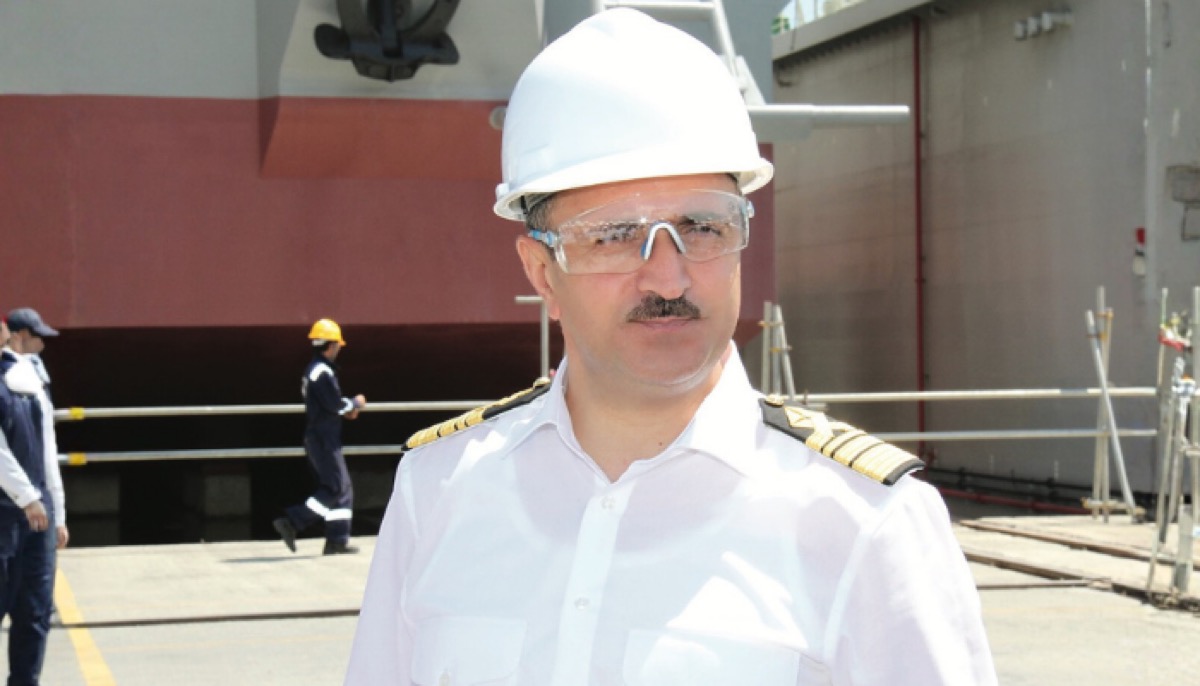
Caspian Energy (CE): Mr. Valiyev, the 20th anniversary of the Contract of the Century is just around the corner. How would you evaluate the effect of the Contract of the Century on development of the Azerbaijan Caspian Shipping Company?
Rauf Valiyev, Chairman of Azerbaijan Caspian Shipping Closed Joint-Stock Company: In the last decade of the 20th century Azerbaijan, which just regained its sovereignty, faced a challenge to reinforce its independence through economic successes. The Contract of the Century became a cornerstone of the rapid economic upturn of our country and played a crucial role in making its political independence stronger. However, the path towards signing the Contract of the Century, was not smooth or easy and included very difficult milestones. Suffice it to recall, some states treated zealously the implementation of this great project and made every efforts to suspend implementation of this project. Only incredible courage, strong commitment and wisdom of National Leader Heydar Aliyev helped defend economic and strategic interests of the country in the Caspian Sea and remove all obstacles on the way of natural resources development. The new oil strategy of Azerbaijan, which was implemented due to the unconquerable will of the National Leader and subsequently continued by his worthy successor President of Azerbaijan Ilham Aliyev, opened up new horizons for the Caspian Sea Oil Fleet, which was a part of SOCAR then.
The exploration ships, derrick barges, supply and tug vessels of our fleet undertook a number of important tasks and played one of the key roles in successful implementation of the Contract of the Century. It was the Caspian Sea Oil Fleet that laid underwater pipelines on the basis of the orders of AIOC (Azerbaijan International Operating Company, operator of the Azeri-Chirag-Gunashli PSA) and perfectly fulfilled such difficult operations as transportation of platforms and jackets, diving operations, assembly of offshore facilities and ensuring their safety. It is natural that during that period the special attention was paid to the modernization of the oil fleet.
At present the oil fleet division of Azerbaijan Caspian Shipping Company operates 184 ships with the total deadweight of 77,867 tonnes or 354,719 horsepower (including derrick and pipe-laying barges, supply, diving, survey, passenger vessels, etc.). Our vessels provide a wide range of services for the offshore oil and gas industry, which includes seismic and geological survey, transportation of offshore jackets and construction of piers, drilling of oil and gas wells, renovation of offshore facilities, repair work during operation, firefighting, laying of oil and gas pipelines, delivery of oilmen, transportation of fuels and chemical reagents, underwater engineering and rescue work, etc.
CE: The merits of seamen have incredible role in the successful operation of the historic Silk Road – the Europe-Caucasus-Asia transport corridor – that considerably contributes to the economic development of Azerbaijan, and also the entire region as a whole …
Rauf Valiyev: The historical value and attractiveness of the Great Silk Road, which used to bring the East and the West together for many centuries, has grown again nowadays. In the past Azerbaijan used to be a trade and transport hub of the Silk Road. It was impossible to realize this transport corridor in the period of the former USSR. The first opportunity to restore the Silk Road appeared in the end of 20th century, when the USSR collapsed and the republics of the Caucasus and Central Asia as well as other countries of the former Soviet Union regained independence. Only after the return of the National Leader to the power, our country for the first time supported the TRACECA program of the European Union and the regional cooperation in such spheres as transport, communication, simplification of trade and cargo transportation considerably improved. Important measures were taken to create a base for large investments into the transport infrastructure. The implementation of the TRACECA program accelerated development of Azerbaijan as well as the entire region.
The National Leader, who highly appreciated importance of our country in the restoration of the Silk Road, used to say with pride: “Azerbaijan is in the heart of the Great Silk Road and holds a very important strategic position. This is not because we are in the centre of this route, but because we are located on the coast of the Caspian Sea. After crossing Japan, China and Central Asia, the Silk Road reaches the Caspian sea. There is a ferry crossing between the eastern and western coasts of the Caspian Sea and it belongs to Azerbaijan. Baku is the only large sea port along the Silk Road. This is the reason why Azerbaijan holds a very important position”.
Nowadays, it is obvious that renovation of the Silk Road incredibly contributes to the cooperation and development of the countries involved in the Eurasian transport corridor. This route serves to bring the continents together, and facilitates integration of both economy and culture.
The transport fleet of Azerbaijan Caspian Shipping Company is carrying transport operations on the Caspian Sea crossing of the Silk Road. During 8 months of 2014 we transported 6.1 million tonnes of cargo (from Central Asia to Europe and back).
CE: Once the Caspian and the Caspian Shipping Company used to be interconvertible words. Nowadays every Caspian littoral state has its own shipping company. What difficulties do you face in competing on the Caspian sea freight market?
Rauf Valiyev: Like other countries located on the coastline all over the world, the Caspian littoral countries also intend to have their own strong fleets and we treat their intentions with understanding. Healthy competition always stimulates development in a long-term regardless of the industry. Unfortunately, sometimes such competition turns to be unhealthy in the Caspian sea. Some of our neighbors create favorable conditions for their own shipping companies in such issues as port duties, provision of vessels, application of tariffs, etc. One of the important objectives for Azerbaijan Caspian Shipping Company is to withstand such competition and try to preserve our position in the freight market in the Caspian sea.
Our transport fleet is comprised of 61 vessels, including 33 tankers, 13 ferries and universal bulk carriers. We have recently developed and started implementing long term plan for the transport fleet renewal with support of the state.
CE: Until recently, we have heard about our seamen from different seas. Do you intend to expand geography of operations outside the Caspian sea?
Rauf Valiyev: The Caspian sea is one of the most whimsical seas in the world. Difficulties are faced in cargo transportation and provision of marine transport services due to prevalence of winds almost all over the year. Hence, in terms of experience, our seamen have strong experience and education in order to operate vessels in any part of the world. Five years ago our vessels exit the Black Sea and the Mediterranean Sea because of the world economic crisis. Today the situation in the European freight markets is improving. Although freight market is very competitive and there are lots of difficulties in entering the Black sea and Mediterranean sea freight markets, we will do our best to turn our intentions into reality.
CE: ... and, what are the major goals for the near future?
Rauf Valiyev: Working on our development strategy, we set up the objective to complete organizational and restructuring works of the newly created Azerbaijan Caspian Shipping Closed Joint-Stock Company within 3 years as well as to form a new team, ensure certification of our company according to the international standards, implementation of the best practices, improve the technical condition of the fleet, preserve and strengthen our position in the Caspian Sea.
The plans for the coming years are to resume operations outside the Caspian Sea, which was suspended 5 years ago. Today we are able to enjoy the first achievement in this regard. Recently, we have signed a contract to purchase a bulk carrier. This vessel will be sailing under the tricolor flag of Azerbaijan in the Black Sea, Mediterranean Sea and other seas.
CE: Which concrete works are carried to supplement our fleet with new vessels?
Rauf Valiyev: Like the National Leader, who always considered the fleet to be irreplaceable wealth of the people, President Ilham Aliyev highly appreciates the role of the Shipping Company in the transport sector of the country and keeps development and provision of the fleet with new ships under close control. In this regard, we constantly enjoy the state support. On April 25, 2014 we signed the contract with Baku Shipbuilding Yard for the construction of 3 modern passenger vessels. These vessels will be capable to transport 80 passengers, 50 tonnes of cargo and move at the speed of 20 knots. The new passenger vessels, intended for SOCAR needs, will ensure timely delivery of workers and cargoes to the offshore facilities.
Our oil fleet will shortly take advantage of a new PSV (Platform Supply Vessel) manufactured by Ulstein Bergen in Norway. Another AHTS (Anchor Handling Tug Supply) vessel was purchased with support of the state. This AHTS vessel has bollard pull of approximately 210 horsepower that makes it the most powerful one in its class in the Caspian Sea. She will be involved in operations for the Shah Deniz-2 project.
Also, as I noted before, our transport fleet recently received a bulk carrier to be operating in the Black and Mediterranean seas.
CE: Which difficulties do you face in repair of vessels?
Rauf Valiyev: Naturally, the fleet is profitable if it meets the requirements of international standards and is in good condition. All necessary repair and modernization works are carried at Zykh and Bibiheybat ship-repair yards to ensure high-quality repair of vessels and their timely return into the operations. During the first six months of the year the yards overhauled 23 vessels, performed current repair of 12 and docking of 13 vessels. Despite that fact, the two yards have a tight schedule because of the number of vessels that need repair.
We are working to expand capability of our repair ship-repair yards. A 158 metres long and 36.85 metres wide 8,000 dwt floating dock, constructed by Gorodets Ship Repair and Shipbuilding Corporation (Nizhny Novgorod, the Russian Federation), will be placed into operation in the near future. This will enable us to improve quality and reduce repair duration. There are also certain difficulties in operation of old vessels since manufacturers suspended fabrication of their spare parts.
CE: Do you expect any changes in the freight market in the near future?
Rauf Valiyev: As a logical outcome of the successful policy of the Head of the state, Azerbaijan is gradually developing into a regional transport hub. It is well known that railway transportation of freight via the Caspian Sea through the Europe-Caucasus-Asia transport corridor is carried out by the ferries of Azerbaijan Caspian Shipping Company. Commissioning of the Baku-Tbilisi-Kars railroad and the first phase of the new Baku International Sea Trade Port in Alat will further increase the traffic flow in the corridor. Our transport fleet has a considerable potential and enough vessels to transport increasing volumes in the Caspian sea.
CE: Mr. Valiyev, what are the key factors to ensure success in the freight market: modern fleet, highly-skilled personnel or trust?
Rauf Valiyev: If considered separately, the mentioned factors even all together cannot assure certain success. In cargo transportation, the key factor is availability of cargo. Without freight the other factors do not work in fact. Why? This is because we mainly deal with international freight traffic. Regardless whether we want it or not, global political, economical and financial crises affect operation of the cargo fleet. For example, our vessels regularly sailed to the northern ports of the Islamic Republic of Iran, and the annual volume of freight traffic was 2.5-3 million tonnes. The situation around the IRI, which developed in the last several years, using sanctions against our southern neighbor negatively affected our operations in this direction.
CE: A wise man said that “you shall obey your captain at sea, but obey a cool head in the scheme of things”. Which personal features do matter for promotion at work?
Rauf Valiyev: High competence, professionalism and work ethics.
CE: How much time will it take the Shipping Company to develop into a prosperous modern company?
Rauf Valiyev: The Azerbaijan Caspian Shipping Closed Joint-Stock Company was established to improve efficiency of local and international freight traffic, to reinforce competition and the transit potential of the country and to make the shipping company a mobile international company. This is not just an intention. We have worked out our development strategy, thoroughly studied the freight market and the current condition of our fleet, and set up objectives to achieve our goals. I do believe that the works performed to improve the management structure and enhance efficiency of management mechanisms, the new personnel policy, optimization of the financial and operating performance, introduction of international standards along with creation of the image of a reliable partner among customers will not be unnoticed. We can win time provided that we continue confidently heading to our goal.