


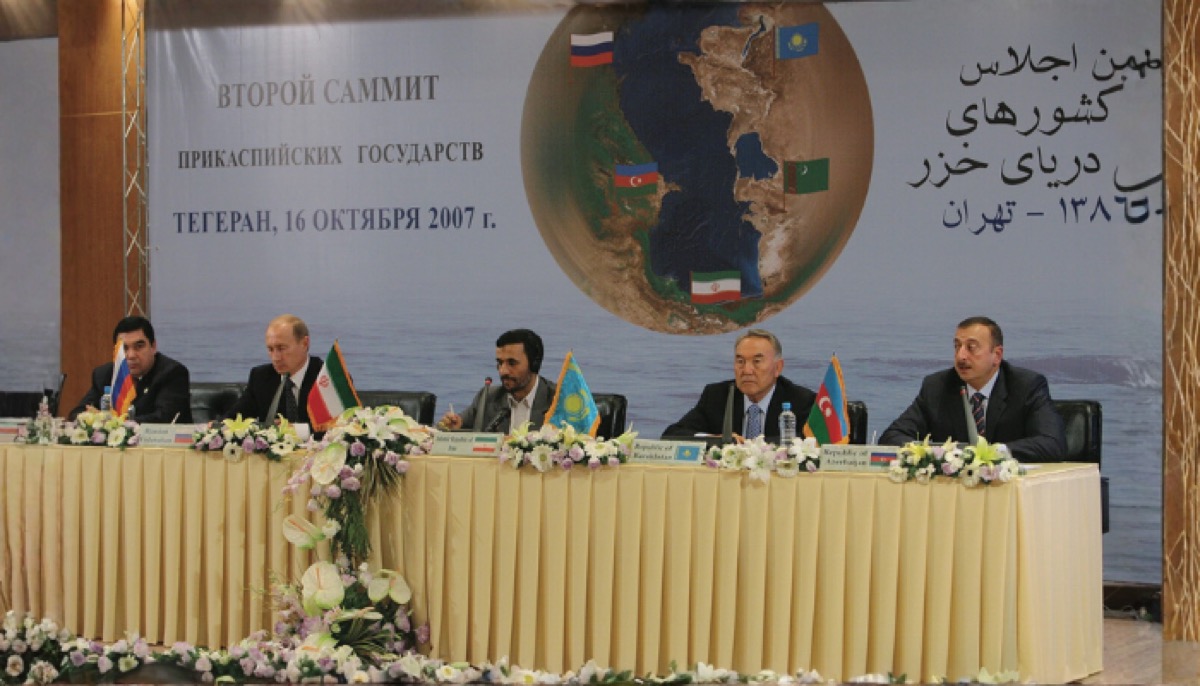
On these days the Russian city of Astrakhan is to host the 4th Caspian summit of the five Caspian states. And if there are no attempts on Caspian leaders’ life expected, just the way it was announced by the Russian media before RF President Vladimir Putin’s visit to Tehran in 2007, no sensations regarding the signing of the General Convention about the Caspian status will probably occur.
The history shows that the Caspian Status problem has become the heritage of agreements of the two and event three past centuries when the enclosed water body was divided first between the Russian Empire and Persia, and later between the USSR and Iran, that satisfied both of those states.
For more than 20 years there have been five sovereign states in the Caspian. However, the mentality of the past still pursues the economic entities of all Caspian states.
In spite of the fact that bilateral relations between all the Caspian states are on a high political level (which is regularly emphasized during bilateral negotiations and different high level events) the five-sided format is demonstrating much lower dynamics. There are plenty reasons for it: a welter of international geopolitical contradictions associated with reasons and sanctions imposed on Russia and Iran, peculiar methods of competition on global gas markets, difference of legislative investment regimes and approaches to attracting international investors, regional priorities of development of Caspian states, turned the status of the Caspian into a “long-playing album” or split-level legal, economic and bio-geological problem.
Development of energy resources is ongoing at different speed in all Caspian sectors, de-facto admitting a sectoral method of division of the water body by a medial line.
In spite of the efforts of diplomats, beyond the Caspian status there remain other practical problems still to be solved : the problem of pipeline connection of the eastern and western shores (for exporting energy resources of Kazakhstan and Turkmenistan to European markets), legal uncertainty of development of large oil field Kapaz-Serdar (Azerbaijan-Turkmenistan), Iran’s approach to development of big gas fields such as Araz, Alov and Sharg located in the Azeri sector of the Caspian Sea is still inadequate to actively developing bilateral relations. Apart from this, since 2006 the difference in internal legislative approaches has been delaying the fulfillment of the agreement between KazMuanyGas and Russian TsentrKaspneftegaz on development of the trans-border structure “Tsentralnaya (RF’s jurisdiction) in the north of the Caspian Sea.
All of it detains creation of the favorable investment background, delays economic, technological and innovative development of the whole Caspian offshore, limiting flows of Caspian energy resources to the world markets though oil-gas contracts in-force. But such situation can last no longer. A stable high corridor of oil prices, strong growth of demand for gas in the Asian-Pacific region, governmental programs on development of own sectors of the Caspian declared by Iran, Turkmenistan, Russia, Kazakhstan, intensified exploration in Azerbaijan will move the process of the Caspian status forward. It is also necessary to search for new forms of real business-cooperation of the 5 Caspian states without creation of any certain supranational structures, through attracting both state and private international as well as Caspian companies on equal and mutually beneficial basis.