


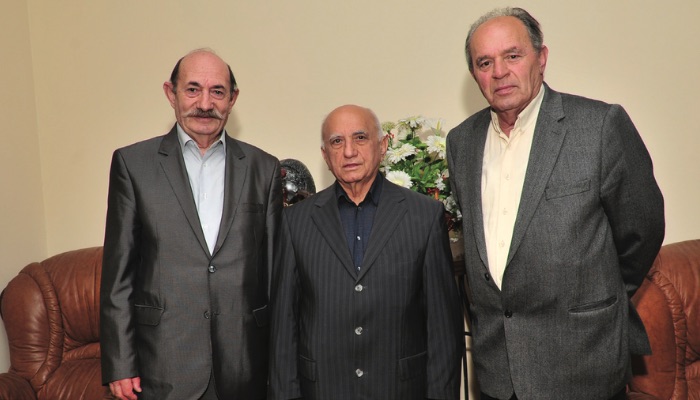
Caspian Energy (CE): Mr. Suleymanov, when at the end of the 19th century slavery was abolished in the USA alongside with serfdom in Russia, Azerbaijan was already producing oil. Drilling of oil wells developed intensively along with oil production growth.
In this regard, would you please tell our journal about the history of creation of the Department for Science-Technical Intelligence of the FCD of KGB USSR, which now is explained as dealing in collection of the information about innovations of technical achievements in the world for former soviet engineering.
Colonel Shamil Suleymanov, Head of the Department for Scientific-Technical Intelligence of the First Chief Directorate, KGB of Azerbaijan SSR: The history of intelligence activities of the mankind has roots stretching back into deep antiquity. The Soviet intelligence has taken its rise from the 20s of the past century. The intelligence in the Committee for State Security was called FCD (First Chief Directorate) in last years of the USSR, i.e. in 90s.
The history of the Department for Science-Technical Intelligence of FCD started in the post-war years. The collection of science-technical information had not been systematized until then. Stalin initiated creation of the department in 40-50s when creation of the nuclear weapon in the USA, tested afterwards in Hiroshima and Nagasaki, became known.
The bomb was created by German nuclear physicist who had emigrated to the USA. Stalin, concerned about the availability of the nuclear weapon in the USA, assigned soviet scientist Kurchatov to resume researches in this area. Meanwhile, he also ordered the MSS (Ministry of State Security) to get materials, concerning the design of the atomic bomb, by all means. This ministry managed to get to sources which provided the USSR with necessary materials. It took the intelligence the period from 1945 to 1947 to fulfill the task. Our intelligence in the USA got an access to the plants producing equipment for industrial centers engaged in creation of the bomb. USSR’s efforts promoted accelerated fulfillment of the assigned task. The Soviet Union tested its first atomic bomb at polygon in Kazakhstan in 1949.
At that period the USSR was close to creation of the hydrogen bomb. These achievements put an end to imbalance observed in the field of nuclear weapon at that period.
The help of MSS turned out quite considerable. This result was an impetus for creation a special unit in the field of intelligence that was called scientific-technical intelligence department operating within FCD of KGB, USSR.
This department also has two other attributes: Directorate “T” and Directorate “X”.
CE: Offshore oil production began at Neft Dashlary (Oil Rocks) field of Azerbaijan in 1949. Was it the first step taken in global offshore oil production or were there also other cases in the field of development of offshore deposits? If you know anything about it, please tell us.
Shamil Suleymanov: Oil in Azerbaijan was initially produced from excavated wells. The churn drill system of wells was adopted later. The operations were initially held in Balakhany. Then the oil production site moved to Bayil where oil beds were lying in the coastal area of the sea. In the 20s of the past century the government of the republic decided to reclaim land from the sea by filling. This operation was performed under the direction of engineer Pototsky. The wells which oil flew from were drilled on the artificial land.
It was a significant event in the history of operation of oil fields since it was considered as the beginning of the offshore oil production.
According to produced geological maps, the probability of discovering big oil deposits at a distance of 120km away from the shore was determined. However, the lack of updated techniques prevented from reaching them. The platform built on several rocks peeping out of water enabled to build a drilling rig and facilities designed for drilling.
Afterwards, this site became a starting point for building a big oil field department Neft Dashlary. This field also has a more romantic name “The Island of 7 ships”.
CE: You were one of the founders of scientific-technical intelligence in KGB of Azerbaijan SSR. Could you please tell about the history of its creation and the benefit the group delivered to oilmen of the Republic over its 30-year existence?
Shamil Suleymanov: The availability of ready, erudite, competent, high-skilled science and technical specialists with scientific degrees enabled us to apply to the Center, i.e. FCD of KGB, USSR with a request to create a line on scientific and technical intelligence in the Intelligence department of KGB of Azerbaijan. Moscow decided to accept our request after consideration. Finally, this line was created in 1963. Three people were appointed for its staff. Two of them were back up.
Only those who had a technical education and knowledge of foreign language worked for this line. The major task was to create a help staff out of young, capable, competent and perspective science workers, who worked for the Academy of Sciences, its scientific institutes and centers, institutions of Ministry of higher and secondary special education as well as for the republican industry institutes. All three units started immediate fulfilling of the task.
Early in 1963 we were informed by the source about construction and testing of semi-submersible drilling rig (SSDR) by the Americans in the Gulf of Mexico. It was a new trial in offshore oil-production. Our republic had a practice of offshore production on Neft Dashlary field. These were piles on which roads were laid. Small platforms for drilling of wells were erected on both the right and left sides of the road. However, we did not have a semisubmersible drilling rig.
Having found out about it, the oilmen of the republic assigned us to gain the necessary information that could be used for creating an own semi-submersible drilling rig.
Our group of three - Efendiyev S.B., Babayev D.I. and I sat for hours thinking over different options that could help us to receive this information. The main option envisaged conduction of talks with leading oilmen of the republic, mainly with academicians-drilling technicians. Finally, a scientist-academician, a drill man by occupation and a friend of Babayev D.I. let us know that he had heard something about it from the American scientist when the latter discussed parameters of the facility with other scientists of his country. He had splendid personal relationship with this American scientist.
We decided to use academician’s resources. For this purpose an academic trip to Texas was arranged for him where he started meeting and communicating with his American friend. As a result, he managed to persuade his friend to visit Baku and ensure him that his stay in the USSR will be held confidential.
According to the program of visit of the American, he was shown all sights of Baku and the republic. He was also taken to Goy-Gol Lake and was fascinated. However, we considered a visit to the Neft Dashalary to be the culmination of our program. A table heaped with dishes and several types of drinks was laid in the captain’s cabin of Baba-zade diesel-powered ship. He preferred cognac “Ganja” and was drinking it in small sips.
An academician and we, three employees, accompanied him during the trip to Neft Dashalary. A ride on the jacket along a wood deck made a deep impression on him. He was enraptured with things he saw. We also visited the grave of Kaverochkin M.P. A tragic death at the working place filled the foreigner with astonishment. The American admired the heroic labor of oilmen but was shocked with the reply to his question hearing that the length of the jacket is reaching 100km.
On the way back to Baku, the American noted in the cabin of Baba-zade diesel driven ship that the construction of such long jacket requires considerable forces and funds.
One of the three employees asked: “Does anything similar exist in the USA?
The foreigner admitted: we have a facility, i.e. semisubmersible drilling rig which performs drilling of wells. This unit is operating in the Gulf of Mexico. This unit is very modern, promising and interesting from the scientific standpoint. It reminds a small town.
Unlike the Neft Dashlary, which is a unique facility, our unit is mechanized, flows in the sea and is capable to move to any point and drill the well at any depth.
“Yes, it would be great to apply it in the Caspian,” – the Academician said.The American agreed and added –Your brave nation could use the floating drilling rig and facilitate the work of oilmen.
The Academician had managed to persuade the American to help oilmen and obtain the design of the semisubmersible drilling rig before seeing the American off Baku.
The American who was pleased with his arrival in Baku and lack of any notes in his passport left the Sheremetyevo airport.
A month later, while attending one of the oil congresses the foreigner passed a full design of the SSDR project called “Mokhol”.
The operation was completed successfully and the document was delivered to Baku. Moscow insisted on sending the scientific-technical information we gained to them. But we rejected their request since our republic had to find an alternative for construction of expensive jacket.
Heydar Aliyev (Nationwide Leader of Azerbaijan) who used to be a Deputy Chairman of KGB of Azerbaijan at that period solved this disputable matter with Moscow. An indoor laboratory was created in accordance with the order of Gipromorneft. The “Mokhol” project was given to the laboratory for studying and creating an own but modified SSDR in order to avoid possible lawsuit that could be brought by the USA and possible detection of the source who passed the information to us.
The first soviet SSDR was constructed in Azerbaijan. The plants for construction of SSDR were built in Astrakhan and Far East in the following years.
It has been a concrete result of fruitful work carried out by the scientific-technical intelligence line of Azerbaijan KGB, which should be considered as a big contribution to the development of the national economy of the USSR by the state security agency in 70s.
Operation of old fields is continued in Azerbaijan. The flow rate of wells operating on these sites was quite inconsiderable, i.e. from 0.2 tons of oil up to 1.5 tons of oil per day. This category of wells belonged to low-yield wells. The cost price of 1 ton of oil extracted from this well was high for the state. But Azerbaijan had to produce it since it contained almost no sulfur and its processing supplied fuel and oil to missile and cosmic facilities. The scientific-technical intelligence line was assigned to help oilmen to gain information that would help them to facilitate oil production growth and reduce tangible expenditures.
Having studied the whole information that we had at our disposal, we ran into a small article – an extract from the newspaper published in the developed European country. It contained brief information about growth of production at old fields. But there was nothing about the way they did it.
We tried to get reliable information. We chose a source who was an oil scientist, doctor of engineering sciences, fluent in English, and had a rich practical experience on operation of oil fields under his belt. We arranged him a business trip to European country that had a bearing upon the article.
While visiting the country, our scientist studied scientific and production processes, visited oil fields and communicated with oilmen. One day he took part in repair of the well and paid attention to an unusual design of operating pipes when they were lifted up. He asked the chief of the crew questions about the design of pipes and was told that one of the four bore-hole pumps operating in the well went out of action and needed to be replaced. However, all the four pumps would have to be replaced. In reply to the question of our scientist why there are four pumps instead of one, the chief of the crew said: oil is collected in the well simultaneously from four layers. Thus, a separate pump designed for every reservoir is lowered into the well. Our scientist understood that he witnessed quite a new technology of oil production. In the evening our scientist visited the chief of the crew in his office and asked him to have a look at materials about the design of pipes operating with pumps. After looking through a pile of materials, the scientist asked permission to take materials to his room where he could view the documents without any haste. The same night the scientist made a copy of all materials.
The KGB of Azerbaijan passed this information to the management of Azneft PU. According to the calculations of specialists, the annual economic effect gained from introduction of obtained scientific-technical information totaled about 430 mln RUB. At that time this sum was full enough for funding not only KGB but also other agencies of the republic for several years.
I mentioned only about two cases that helped to obtain valuable scientific-technical information for motherland. In all, the STI line in Baku had been working hard and regularly delivered our country materials that contributed to progress of science, technologies, economy, defense and space. The country gained projects and information that were ready for realization.
CE: Could not you just buy a unit or design and build a local one?
Shamil Suleymanov: Your question is pertinent and the answer could be as usual, as it is customary to say, yes, of course, but … However, we can not say so because of this ‘but’. We are speaking about the period of 1963-1965 years, when the USA wages a rabid “cold war” against the USSR not only in terms of policy, but also, mainly, the economy by using embargo on know-how. Therefore, a particular importance was attached to obtaining of scientific-technical information. This task was assigned to the Directorate “T” of FCD of KGB USSR.
However, obtained scientific materials, samples of technologies or projects accelerated their manufacture, bringing benefit to the Fatherland. The same happened to the ‘Mokhol’ project. The indoor lab, which delivered the soviet project of SSDR, was established in Baku.
Based on this project, the first in the USSR semi-submersible drilling rig was built in the Karadagh district on the seashore near Baku in the 70s.
The work on construction was carried out under regular control of Heydar Aliyev, the First Secretary of the Central Committee of the Communist Party of Azerbaijan.
Serial release of such facilities was started in the Soviet Union in the second half of the 70s.
CE: Compared with the scope of performed tasks, the group of the scientific and technical intelligence seems very small in number.
Shamil Suleymanov: Yes, you are absolutely right. But, please, do not forget that it was the first group created in the early 60s. The KGB of Azerbaijan did not have this line of intelligence before. But already in the first half of the 80s, this line was employing already almost 15 employees.
CE: Mr. Suleymanov, you have recently published the book “The third oldest”. Could you please tell what it narrates about?
Shamil Suleymanov: The book has been co-written with Mishin V.G., the prominent Russian journalist and writer, the only holder in Azerbaijan of ‘The Big Gold Medal’ of the international PEGAZ contest. The novel is based on the real events that happened in the 1980s in Sweden. The line of the scientific and technical intelligence, which I headed in the Stockholm Residency of the KGB First Chief Directorate, purposefully and consistently carried out a search of sources of information about confidential technical novelties invented and used in work by the “Main Adversary”. The First Chief Directorate analysed all the information, even rumours, about foreign scientific and technical know-how. That is why, when we learnt that the CIA and FBI had a secret mobile device, RV-1500, designed by Japan by the special order of the US intelligence agencies, we were motivated to start organizing scheduled work to detect a location of this device. To that end, we first of all needed a source with real capabilities and perfect personal behaviour, where strong interpersonal skills come first. The search was successful. We chose a source, who was the Norwegian by origin. He understood the task set for him and began to search a required contact. After a while, he contacted the American, who worked at the military base deployed in the north seashore of Sweden. The source learnt that the USA had naval and land bases in this country. The secret of the world’s neutral state was made public. The base had six or seven huge hangars arranged in the dug granite grottoes, namely in natural rocks. It emerged that those grottoes had existed even during the World War II and Hitlerite Germany had used them. That time Sweden had no relation to the war and externally declared neutrality, but provided its territory to the fascist aggressors.
As a result of the long contact with the American, the source managed to receive the catalog and the inventory of the equipment stored in the hangar where that American was the main and the only responsible person. The device RV-1500 was also listed in the catalog. The implementation of a combination of measures enabled allowed the source to convince the American to agree and sell these devices to the Soviet Union. After the long resistance the American through a source handed over 30 units of these devices and received a solid reward in dollars for them.
On the basis of these devices the closed institute of the Military Industrial Complex designed our Soviet device. It was upgraded and tuned to be of a higher class in terms of its technical performance.
Thank you for the interview