


The current 2014 year is a very significant year for us. In September, we will be solemnly celebrating the 20th anniversary of the signing the agreement on development and production share of Azeri, Chirag and Deepwater Gunashli in the Azerbaijan sector of the Caspian developed under the guidance of Nationwide Leader Heydar Aliyev and with participation of President of Azerbaijan Ilham Aliyev, which consequently went down in history as the Contract of the Century.
Caspian Energy Journal that introduced the Contract of the Century, Azerbaijan’s new oil strategy and its brilliant results to the world, is actively involved in the anniversary offering interesting events and Caspian Energy Forum is the first step. The events dedicated to the 20th anniversary of the Contract of the Century will be remarkable even because they are to show a new point of view to the history of the oil industry development in Azerbaijan.
On September 20, 1994, a PSA on development of Azeri-Chirag-Gunashli (deep-water part) was signed between 11 famous oil companies from 7 countries - BP, Statoil, Amoco, TPAO, Itochu, ExxonMobil, Lukoil, Delta, Ramco, McDermott and Hess. This agreement was named the Contract of the Century, thus giving the start to successful implementation of the New Oil Strategy of Azerbaijan.
The Contract of the Century ranges with the major international agreements in terms of the volume of hydrocarbon reserves and investments. I would like to note the two positive aspects of this Contract.
The political significance of this Contract is that it unveiled Azerbaijan as an independent state and a reliable partner, persuaded leading companies of the world of successful operation in this country and urged them to make investments here.
It is no coincidence that 32 more agreements were concluded with foreign companies after signing of this Contract.
Assessing the economic importance of the Contract of the Century, one can see that oil production grew from the lowest figure, fixed in history of Azerbaijan, 9 mln tons in 1997 up to 51 mln tons in 2010. In other words, oil production grew by 5.6 times. The main part of the growth of hydrocarbons production in the Republic falls to the share of ACG and Shah Deniz fields. The monthly production from wells at ACG is about 2.8 mln tons of oil and 1.1 bcm. Since the beginning of development of Azeri-Chirag-Guneshli fields the production has reached 333.6 mln tons of oil and 95.5 bcm of gas.
For 15 years, the participants of ACG project, as well as Azerbaijan have been gaining income from “profit oil”. If the income gained from sale of “profit oil” used to be spent on investment maturity till 1999, starting from December of the same year tankers filled with “profit oil” of Azerbaijan have been delivering crude to foreign markets. A total of 177.2 mln tons of “profit oil” falling to the share of Azerbaijan was sold at the world markets till May 1, 2014. The volume of profit oil is growing year by year. Out of 32.7 mln tons of oil recovered at Azeri-Chirag-Gunehsli fields, 68.8% or 22.5 mln tons were, alone in 2013, profit oil falling to the share of Azerbaijan. Funds gained from sales of “profit oil” are accumulated in the Oil Fund, created by Nationwide Leader Heydar Aliyev, and spent on development of the non-oil sector of the Republic of Azerbaijan as well as improvement of welfare of the people.
If Azerbaijani oil was exported to the world and European markets along the northern route (Baku-Novorossiysk) starting from 1997 and along the Western route (Baku-Supsa) starting from 1999, it was in May 2006 when the major oil pipeline Baku-Tbilisi-Ceyhan joined them.
It is noteworthy that the main export oil pipeline Baku-Tbilisi-Ceyhan, laid along the territory of Azerbaijan, Georgia and Turkey and reaching directly the Mediterranean Sea, is a unique pipeline in order of its importance. Its total length is 1769km. The carrying capacity which may be increased up to 60mln tons in future totals 50 mln tons at present.
A total of 345 mln tons of oil was exported to the world markets as of May 1, 2014, including 244.6 mln tons via the Baku-Tbilisi-Ceyhan oil pipeline, 67.7 mln tons via the Baku-Supsa oil pipeline, 11.2 mln tons via the Baku-Novorossiysk oil pipeline and 20.2 mln tons by the railway.
If the Contract of the Century once again proved to the whole world that Azerbaijan is an oil country, the discovery of giant Shah Deniz field in June 1999 and successful implementation of the Shah Deniz gas project introduced Azerbaijan to the whole world as country which has a potential to export big gas volumes to the world markets as well. The present reserves of Shah Deniz field total 1.2 trillion cubic meters of gas and 240 mln tons of condensate.
In 2013 daily gas production within the framework of Shah Deniz Stage I was planned to be 25.5 mln cubic meters, i.e. annual gas production should have totaled 9.0 bcm. However, a total of 9.8 bcm of gas and 3.1 mln cubic meters of condensate were produced last year at 6 operating wells drilled from Alfa platform. Daily production totaled on average 26.8 mln cubic meters of gas and 8.5 thousand cubic meters of condensate. A total of 51 bcm of gas and 13.3 mln tons of condensate have been produced since the beginning of development of Shah Deniz field.
Participants of the Shah Deniz project created a South-Caspian Pipeline company in 2003 and commissioned the South-Caucasian pipeline (Baku-Tbilisi-Erzurum) in July 2007. This pipeline starts from Sangachal terminal of Baku, crosses via the territories of Azerbaijan, Georgia and reaches the Turkish city of Erzurum where it joins the pipeline system of the BOTAŞ Company (Turkey).
The total length of the pipeline makes 971km. The carrying capacity is 20 bcm. Starting from the date of commissioning until May 1, 2014, a total of 3.9 bcm of gas and 27.4 bcm of gas were supplied to Georgia and Turkey respectively from Shah Deniz field.
Important steps were taken for exporting Azerbaijani gas to the European Union states on basis of the long-term agreements. Selection of the TransAdriatic pipeline (TAP) made by the consortium on June 28, 2013 in Baku for delivery of Shah Deniz II gas to Greece, Italy and consumers of the South-Eastern part of Europe was one of the important events. It is noteworthy that the TAP project will secure supply of over 10 bcm of Azerbaijani gas to the European markets at the initial stage. The following companies are the partners of the TAP project: SOCAR, BP, Statoil, Total, Fluxys, E.ON and Axpo.
Signing of the bilateral document on construction of the Trans Anatolian gas pipeline (TANAP) between Azerbaijan and Turkey is also an important step undertaken in this direction. The length of the TANAP project, which is 56 inches in diameter, will total 1,800km.
The work on implementation of the TANAP project has already been commenced. The commissioning of the pipeline has been fixed for mid of 2018. Its primary carrying capacity will total 16 bcm and reach 23 bcm in 2023 and 31 bcm in 2026. 10bcm and 6 bcm out of 16 bcm, scheduled to be supplied at initial stage, will flow to Europe and Turkey respectively. Thus, the Southern Gas Corridor will have its idea realized fully.
The first stage of Shah Deniz II will involve Azerbaijan, Georgia, Turkey, Albania and Bulgaria. The following stage will cover also Montenegro and Croatia. During the following years it is planned to extend the pipeline in the direction of Romania, Hungary and Austria.
SOCAR will be one of the biggest investors of the 3500km long Southern Gas Corridor, covering the 6 countries - from Azerbaijan to Europe.
As President of the Republic of Azerbaijan Ilham Aliyev said while addressing the ceremony of signing of the final investment decision on Shah Deniz II project at the Heydar Aliyev Center in Baku on December 17, 2013, if the Contract of the Century is a contract of the 20th century, then the Shah Deniz II contract is the contract of the 21st century. This agreement will secure long-term development of Azerbaijan and broad cooperation of states and companies which became participants of this historical project.
Speaking about the Shah Deniz project it is relevant to note that fact that Azerbaijan possesses over 2.5 trillion cubic meters of proven gas reserves.
Here I would like to touch another issue. In the years of independence we mainly performed prospecting-exploration operations together with foreign companies. However, the new gas-condensate field “Umid” discovered in 2010 in the Caspian Sea became the first one revealed in the years of independence at the expense of internal resources of SOCAR.
A fixed platform enabling to drill 6 wells was assembled in 2009 at the north-eastern flank of the Umid field revealed as early as 1953. The depth of the sea, where the platform was installed, reached 58m. The Umid gas condensate field was discovered in November 2010 right after drilling of the first well (with total depth of 6006m) from Umid-1platform.
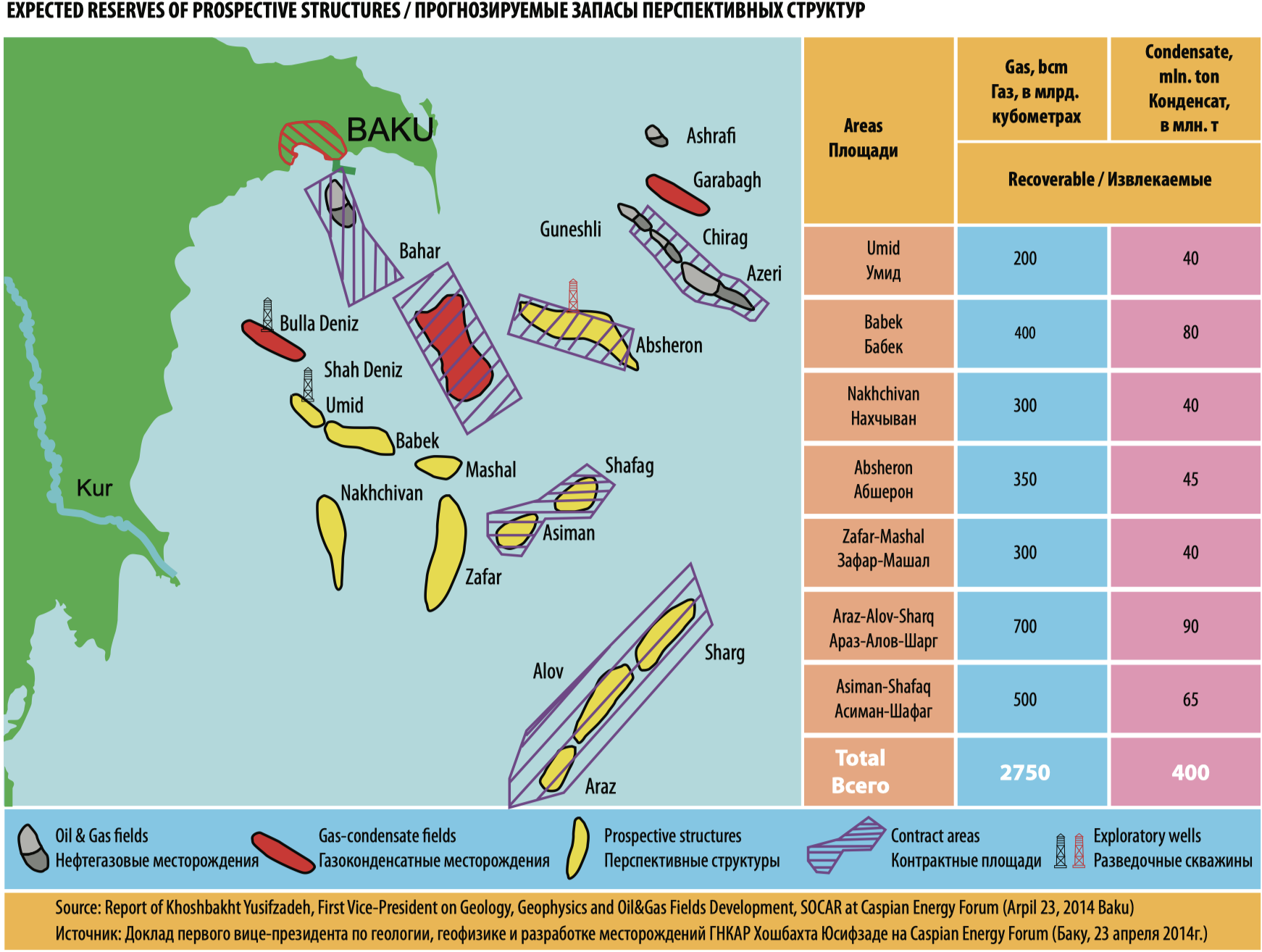
Two wells are currently operating on this field. Up to 345.5 mln cubic meters of gas and 57 thousand tons of condensate have been produced on the field which is currently at initial stage of development. According to primary calculations, hydrocarbon reserves of Umid field total 200 bcm of gas and 40,000 tons of condensate.
Discovery of gas-condensate field Absheron is another success gained over the past years. The Absheron structure which lies at a depth of 350-550m was revealed by Azerbaijani geophysicists as early as 1960. It was prepared for prospect drilling in 1993.
The first agreement “On exploration, development and production sharing at promising structure Absheron” was signed in 1997. The participants of this agreement started drilling the prospect well in the south flank of the field in 2000. Drilling operations were completed in 2001. However, they did not bring any results.
The French company Total, a participant of the first agreement, resumed prospecting-exploration operations at Absheron. As a result, the second agreement “On exploration, development and production sharing at the offshore block Absheron, located in the Azeri sector of the Caspian Sea,” was signed. Afterwards, the French company Gas de France also joined this agreement.
On September 9, 2011 SOCAR and Total announced about discovery of new gas condensate field Absheron in the Azeri sector of the Caspian Sea.
According to primary calculations, hydrocarbon reserves of Absheron field total 350 bcm of gas and 45 mln tons of condensate.
Revealing of Absheron and Umid fields enabled to raise probability of discovery of new oil-gas fields in the Azeri sector of the Caspian Sea. The obtained information raised chances for prospectiveness in such structures as Babek, Nakhchivan, Zafar, Mashal, Asiman and Shafag.
Analyzing the path that Azerbaijan’s oil and gas industry has been through over the past 20 years, I would like to note that a new oil strategy, which took its rise from signing of the Contract of the Century, has become the basis of modernization of economy of Azerbaijan, particularly its industrial and oil sectors. Broad-scale transformation was carried out along with the diversification of industry development. SOCAR is a founder of 36 joint ventures, 6 alliances, numerous subsidiaries in foreign countries and 13 representative offices operating almost in all spheres of industry. SOCAR is successfully representing Azerbaijan in 17 PSAs signed with 25 companies representing 15 countries. Investments worth $51.6 bln were made within the framework of PSAs into oil-gas sector of Azerbaijan through 1995-2013.
Owing to a new oil strategy of Azerbaijan, the State Oil Company turned into a modern company which is capable to implement projects requiring big investments and meeting world standards.
Nowadays, SOCAR is successfully implementing different projects beyond Azerbaijan, especially in such countries as Georgia, Turkey, Kazakhstan, etc. Along with the Trans Adriatic pipeline project noteworthy are the Kulevi terminal, commissioned in Georgia with SOCAR’s investments worth $350 mln, broad network of filling stations and gas distribution stations in this country, purchase of 51% (worth $2bln) of Turkey’s largest petrochemical complex “Petkim” within the framework of the SOCAR-Turkaz/Injaz alliance, construction of the oil refinery Star near the petrochemical complex Petkim in the city of Izmir, etc. According to the opinion of leading rating agencies, SOCAR has been among the largest 50 companies of the world starting from 2009.
Resuming the abovementioned, I would like to note that all successes gained after signing of the Contract of the Century are indisputable and invaluable merit of Nationwide Leader Heydar Aliyev who always addressed oilmen with particular care and regard.
It is our holy duty to perpetuate the name of such vivid person and genius, who was ahead of his time, in the memory of people. A new oil strategy he developed and realized after signing of the Contract of the Century promoted not only development of the economy of Azerbaijan but also countries of Europe and the world.
Nowadays, the fortune of our country is in the hands of such eminent, highly intellectual state and political figure President Ilham Aliyev, the guarantor of the statehood of Azerbaijan. He is an irreplaceable follower of the policy and diplomacy of Nationwide Leader Heydar Aliyev in the international arena. He became a big state and public figure in the period of intense struggle for strengthening political and economic independence of the Republic. President of Azerbaijan protects the interests of the republic like the apple of his eye and relies on the nation in his daily activity. Overall development of the regions is his credo and the program of his creative work. He repeatedly noted that development of regions means the development of the republic, and this process is under strict control of the President of the country.