


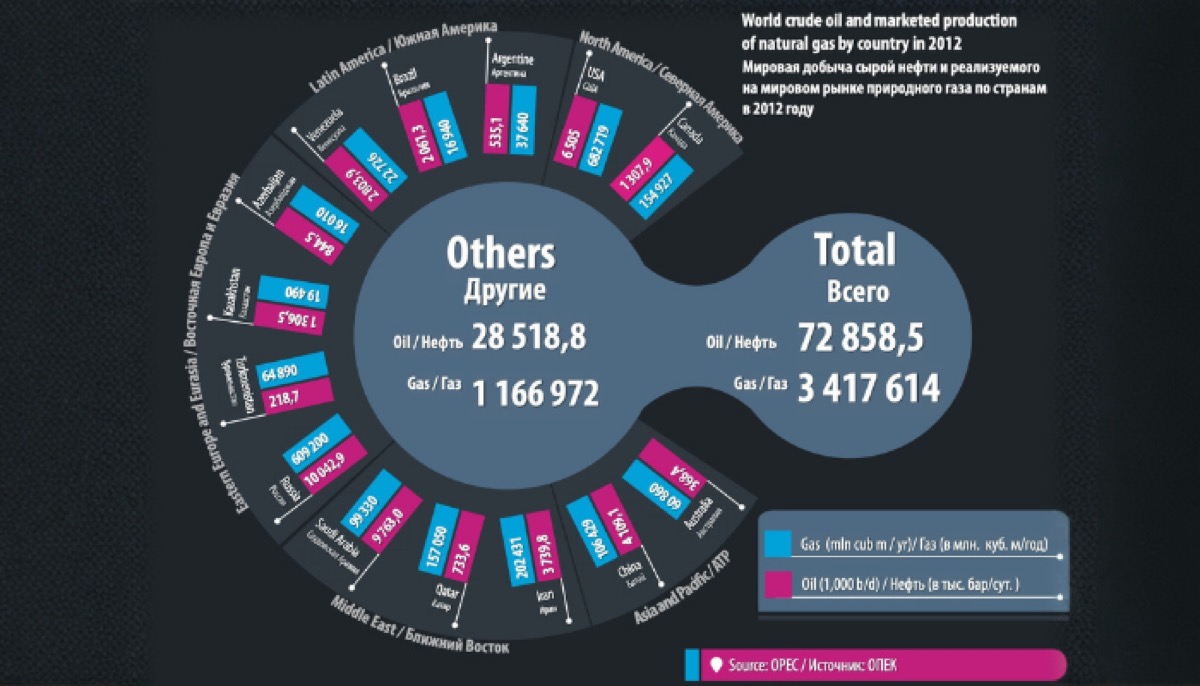
Growing domestic demand in countries producing both conventional and non-conventional energy resources, a resource nationalism, high depletion level of fields, lack of access to new technologies, high political sensitiveness of regions, abounding in hydrocarbons, like Russia and Iran, and finally a low level of investments of national oil-gas companies into prospecting and exploration operations, will lead limiting of supply at traditional markets as early as in coming 5 years. International oil-gas companies still remain major drivers of the market since their technical competence and innovative developments are the factors determining the resource policy of the states - main market participants and owners of hydrocarbon reserves. The price at oil markets will exceed $100 while new efficient technologies, applied in the field of alternative energy supply, try to reduce dependence on conventional energy resources and geopolitical contradictions become stronger. Any change observed in these two factors will pull the price toward different sides from the psychological price barrier set by the market.
Even a probable reaching of the full agreement about the Iranian nuclear program between Iran and 6 UN Security Council member states (Russia, China, Great Britain, France and Germany) will not allow it immediate changing article #81 of the Constitution of the Islamic Republic of Iran, “that strictly forbids any concessions to foreigners…”, which in its turn minimizes chances for other states to sign traditional production sharing agreements. Though the Iranian government has recently been demonstrating certain openness, it offered India in September 2013 to sign a production sharing agreement (PSA) on gas field Farsi within 3 months. Besides, Tehran was ready to receive a 100% payment for this agreement in Indian rupees. It was considered a solitary step taken in the market.
Iran declares about big oil-gas production plans that will also require attraction of foreign technologies and investments. Minister of Industry, Mines and Trade of the Islamic Republic of Iran Mohammed Reza Nematzade said in his interview with Handelsblatt: “In future we would like to play much bigger role in the global gas market. Nowadays, Iran possesses the biggest natural gas reserves in the world. We are working over a large-scale project aimed at construction of the gas pipeline that would deliver “blue fuel” from south of Iran to the north-west (borders of Turkey). From there we could export an energy resource to the Western countries”, the Minister said.
He reminded that Tehran had already signed contracts with the Swiss and Spanish companies as well as with Shell. However, international sanctions hindered their realization.
The USA and the European Union are discussing a possibility of imposing ban on supply of the most advanced technologies and equipment for Russian oil-gas companies, The Financial Times has recently reported. Such ban may be imposed in the USA as a new additional licensing of export, just like the way it has been done in the field of supply of military technologies. Sanctions may bypass existing projects, however, the new ones will undergo additional control or be blocked, the newspaper runs. Sanctions are planned to be imposed in case if the western countries assume that Moscow is trying to frustrate presidential elections in Ukraine.
In order to maintain own oil-gas production in future, countries, possessing state companies, such China, Argentine, Brazil and Russia will aspire to ensure access to discovered reserves and cooperate with international oil companies in order to apply their experience and technologies for increasing the recovery rate at old fields.
For instance, the Chinese government has approved the production sharing contract between Royal Dutch Shell PLC and the Chinese National Petroleum Corporation (CNPC) aimed at development of shale gas reserves of China. Conditions, permitting national oil companies to possess controlling interests in projects in future, have already been included into Chinese PSAs.
Example – signing of contracts within the framework of PSA between CNOOC and Chevron. According to these contracts, the national oil company possesses controlling shares (51%) in any commercial fields discovered in the region while all exploration expenditures shall be covered by a foreign partner.
Growing demand for energy resources in China in terms of ensuring energy security will enable the country to preserve the status of one of the biggest centers of demand, the report of Deloitte says. Demand for natural gas in China is expected to grow by over 300% in coming 20 years. It will exceed the supply growth expected from development of shale gas fields in the country.
Brazilian national oil company (Petrobras), announced late in 2013 about $236.7 bln it is going to invest in coming 5 years into development of large oil-gas fields discovered over the past 10 years. The company will initially need a technical support of foreign companies to implement capital-intensive projects. The country has already softened the conditions of PSA by reducing the size of the minimum interest of NOC from 45% down to 30% and preserving the operatorship for it.
Considering privatization of YPF and growing demand for energy resources, Argentina will broadly use PSAs. The company has recently signed a contract with Chevron and Bridas for exploration and development of shale resources.
Russian national companies Gazprom and Rosneft have been recently making considerable efforts for attraction of foreign companies.
In 2013 Rosneft continued working for strengthening strategic cooperation with foreign partners.
The company signed final agreements with ExxonMobil, Eni and Statoil for cooperation in the shelf of RF.
The partners created a number of operating companies in order to realize joint projects. An agreement for cooperation within the framework of implementation of projects in the Okhotsk Sea shelf has also been signed with Inpex.
Construction of the “Sila Sibiri” (Strength of Siberia) gas pipeline will enable to attract independent gas producers, capable to produce 25 bcm of gas per year, to the development of the field, say the materials of the Ministry of Energy of RF.
The carrying capacity of the gas pipeline is estimated at about 60 bcm of gas per year. “Construction of the “Sila Sibiri” gas pipeline will enable to draw develop not only Kovyktin and Chayadin fields into development, but also those that belong to independent gas producers operating along the pipeline route and are capable to additionally produce up to 25 bcm per year”, say the materials of the ministry.
“Sila Sibiri” is a gas pipeline project from Eastern Siberia to the Far East. The date of commissioning is no earlier than 2019. Russia also plans to provide access to gas export for different players of the market and in this way end up with the monopoly of Gazprom.
Libya will also aspire toward international partnership to reach the pre-crisis production rate. Production volume in Libya possessing the biggest oil reserves in the African continent has reduced almost by 80% since the beginning of rebel against Muammar Kaddafi in 2011. Nowadays, oil supply from the country fell down to 235 thousand barrels per day that is the lowest indicator within OPEC.
Traditional oil-gas producing centers such as Saudi Arabia will preserve previous approach by increasing financial and technological potential of the national Saudi Aramco company. Possessing free volumes of additional oil producing capacities that reach 2 mln barrels per day, Saudi Arabia will keep freely drifting within the framework of export policy of OPEC.
Based on Qatar’s state strategy of development till 2030, the country plans to lower the speed of natural resources development. The government finds the development of hydrocarbons to be a “great expansion” that can lead to exhaustion of natural resources in absence of due control. Meanwhile, the lack of technical knowledge and need for big investments in Qatar LNG production projects will result in limiting of toughening of resource policy measures.
Increase of financing by Asian companies in Kazakhstan will secure flow of investments into those projects that are abandoned by IOC. Thus, the Indian company ONGC Videsh bought out a 8.4% stake of ConocoPhillips in the project on development of the North-Caspian field Kashagan for $5bln. The Chinese energy companies invested in Kazakhstan about $14 bln within the period from 2005 to 2012; in 2009 the export-import bank of China appropriated a credit worth about $10 bln to the state company KazMunayGas.
Last year Iraq signed a preliminary agreement with Iran about construction of the pipeline to provide supply of Iranian gas to power plants in the Iraqi province Basra. The ongoing internal conflicts and big risks associated with acts of terror on export pipelines will limit the speed of exploration and development of huge Iraqi reserves by foreign investors. However, considering the interests of Asian state oil companies, Iraq will preserve the present model of mutual relationship with investors and continue active using of agreements on maintenance service for fields that are under development.
Venezuela is currently supporting PSA in which a 60% share holding belongs to the state company PDVSA and the rest 40% belongs to foreign NOC. Possessing considerable oil reserves of over 200 bln barrels, Venezuela may in future toughen measures for participation of foreign companies in its PSAs. However, it will remain investment-attractive for NOC from Latin America and Asia.
It would be naive to assume that even such countries as the USA, Canada and Australia that are open for investments via concessional form of cooperation (it is more beneficial for an investor than a production sharing agreement since it sets much lower rate of fiscal charges in comparison with other countries) have no notion of resource nationalism. Despite provision of full access to oil-gas resources when signing concessional contracts, USA will remain a big center for oil demand and continue limiting export of crude oil. As far as natural gas is concerned, USA will follow the strategy of exporting part of produced gas as LNG, setting, however, much stricter requirements by introducing export duties or raising license payments. It was in January 2012 when the US Internal Affairs Department offered to increase license payments for mainland fields from 12.5% up to 20%.
However, a decision to adjourn this offer was made as the domestic price for gas resources is much lower than those of foreign markets. Growth of the Mineral Extraction Tax (up to 40% of profits), starting from 2012, for developed mainland oil fields may serve as an example of toughening of the resource regime in Australia. It is not ruled out that this step may be taken at stage of growth of the market interest toward Australian LNG.
Bitumen sands in Canada remain in the center of attention of investors. However, after acquisition of two large Canadian companies by foreign investors (Malaysian Petronas and Chinese CNOOC) as early as 2012, Prime Minister of Canada Stephen Harper said: “The federal government states that the Nexen deal will be the last in the course of acquisition of Canadian oil sands by foreign state companies”.
According to the outcomes of 2013, securities of American companies ConocoPhillips, ExxonMobil, Hess as well as European brands of BP and Total rose in prices more intensive than others. Price decline was fixed in shares of Chinese energy resource producers PetroChina, Sinopec, Brazilian Company Petrobras and Rosneft.
More and more states are nowadays trying to arouse interest of investors by unconventional methods of production of hydrocarbons. According to the information of FT, last year the highest price growth was fixed in shares of those companies which are actively developing shale fields of fuel resources in the USA. In particular, the matter concerns Pioneer Natural Resources, Continental Resources and EOG Resources.
Considerable quotation growth was registered in securities of service companies Halliburton, Baker Hughes, Schlumberger practicing production of hard-to-recover reserves of hydrocarbons.
Considering the cost situation observed in the global oil market in the first half of the year, the similar situation will remain in 2014 as well. International innovation companies will be the most popular with investors while the national companies will aspire to attract investments in order to develop hard-to-recover reserves and ramp up a resource base.