


Strategic vector
According to a new development strategy, the government of Georgia is aspiring to implement an economic policy which will secure sustainable development of the country. The major principle of the strategy of the economic development is to set free operation for the private sector in presence of small, efficient and transparent government. It envisages establishment of the economic order where the private sector is free in its decisions making, the supremacy of ownership rights is protected, and the private sector is main driving force of the economic development.
The strategy clearly defines priorities and problems which have to be solved for achieving long-term, sustainable and inclusive economic growth.
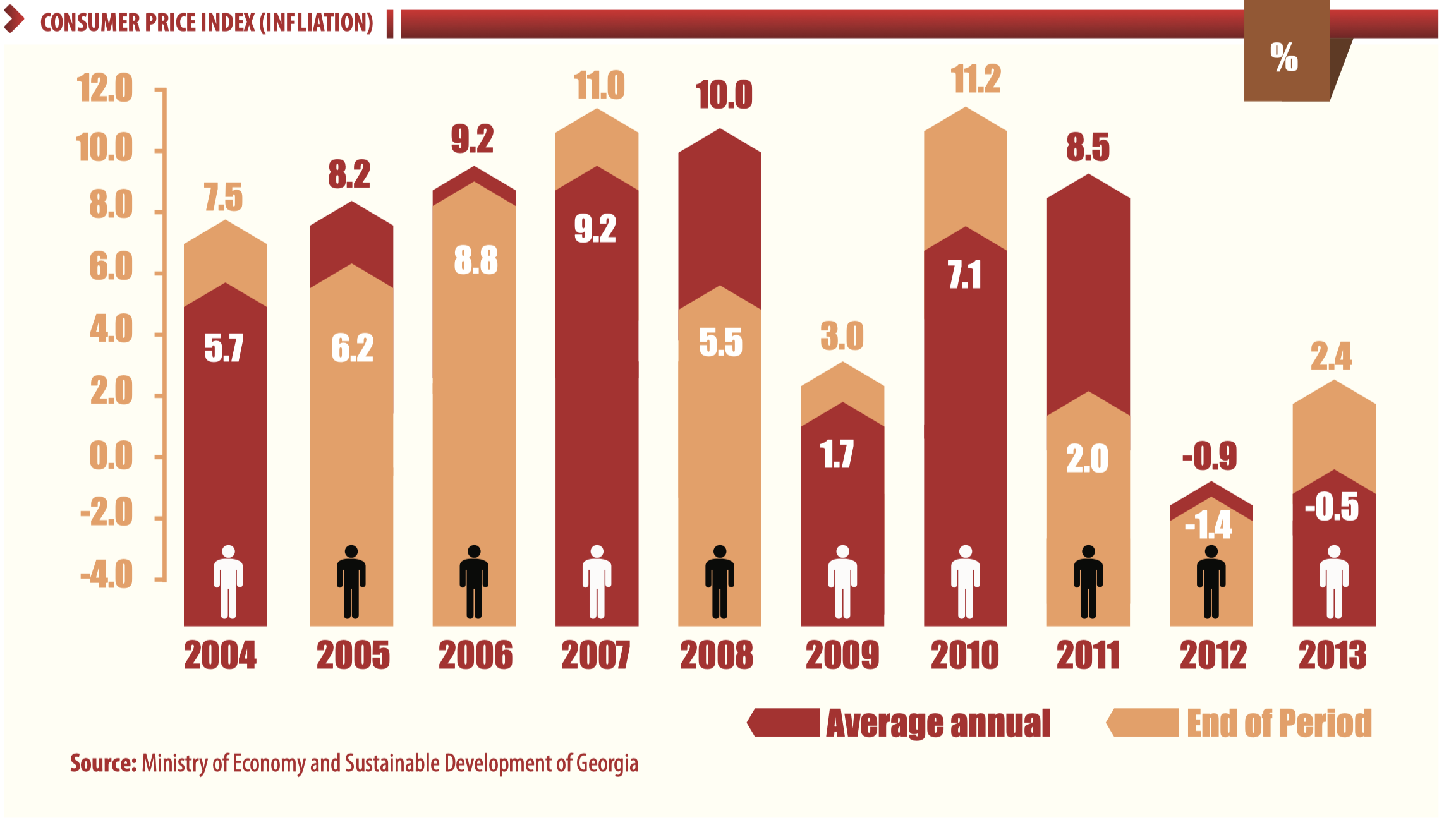
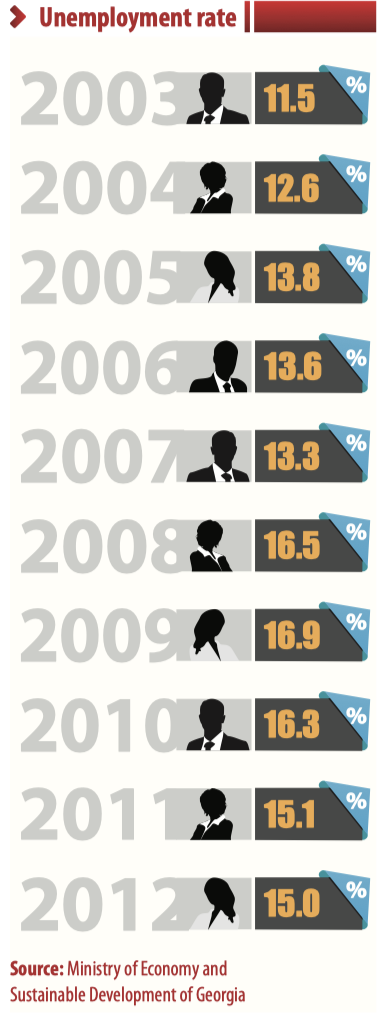
The objective of the “Georgia 2020” strategy of social-economic development of the country is to have the following targets reached by the mentioned year: inflation rate must total 4%; GDP per capita must total 13,000 lari; a state debt in relation to GDP must be below 40%; the unemployment rate shall fall down below 12%; export rate in relation to GDP must total 50%; the rate of taxes in relation to GDP must total 25%.
In Georgian Prime Minister Irakli Garibashvili’s opinion, there are a number of challenges remained within the economy of the country.
According to him, Georgia’s per capita GDP used to hold the 16th position in 2004 and the 115th in 2013 worldwide.
“Our government began implementing structural reforms, and we planned the development of the real economy”, says the head of the new government of Georgia.
The governmental adviser of Georgia Thomas Hammerberg, who noted that the “economy of Georgia is on a hard path of revival and there are a lot of challenges the country is facing”, adheres to the same opinion.
“We should not forget about such important things as the protection of social and economic rights. It is necessary to guarantee high living standards to the population. From the economic standpoint, Georgia is going through a hard economic path, and the government of the country must work very actively in this direction. However, it is noteworthy that the Georgian people may be proud of a good start”, Hammerberg noted.
Economic objectives
According to the forecast of the economic team of the government, the economic growth indicator will have totaled 5% by 2014. In the opinion of the President of the National Bank of Georgia Georgi Kadagidze, it is quite possible to reach a 5% growth of the economy by 2014. “Of course, there are risks that are mainly associated with the geopolitical situation. You are well aware of the events that take place almost in all the neighbor countries, especially in Ukraine. It may have a certain impact on the economy of Georgia. If we rule out external factors, that we are not able to influence, it is quite possible to reach a 5% economic growth from the standpoint of pure economic forecast”, Georgi Kadagidze said.
Minister of Finance of Georgia Nodar Khaduri also finds a forecasted 5% GDP growth of Georgia by 2014 quite realistic. The tendency has changed since October of the past year despite the delay of the economic growth early in 2013. A 4.4%, 8.0% and 8.8% growth were fixed in October, November and December respectively. According to preliminary estimates, the annual economic growth totaled 3.2% through 2013.
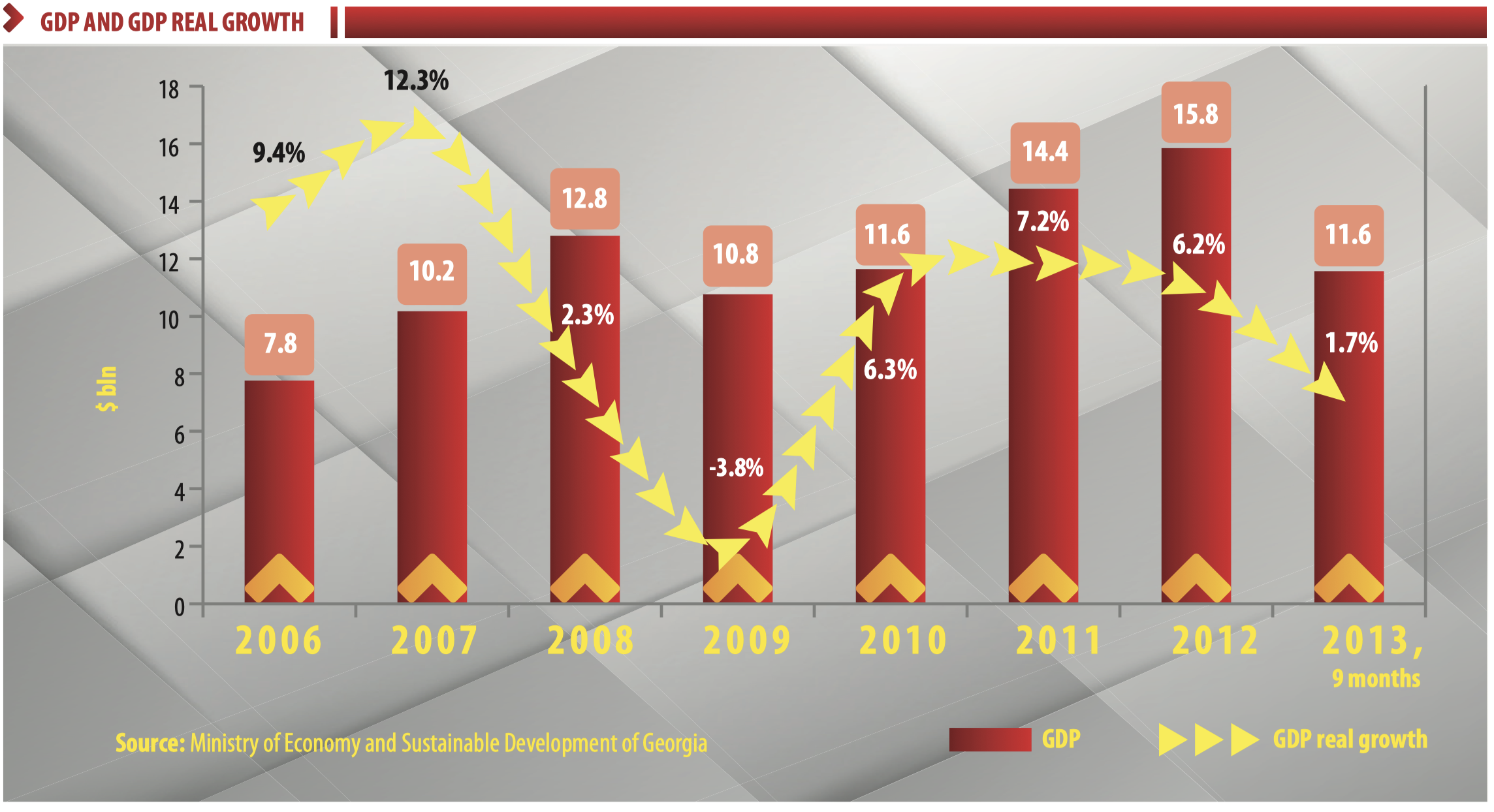
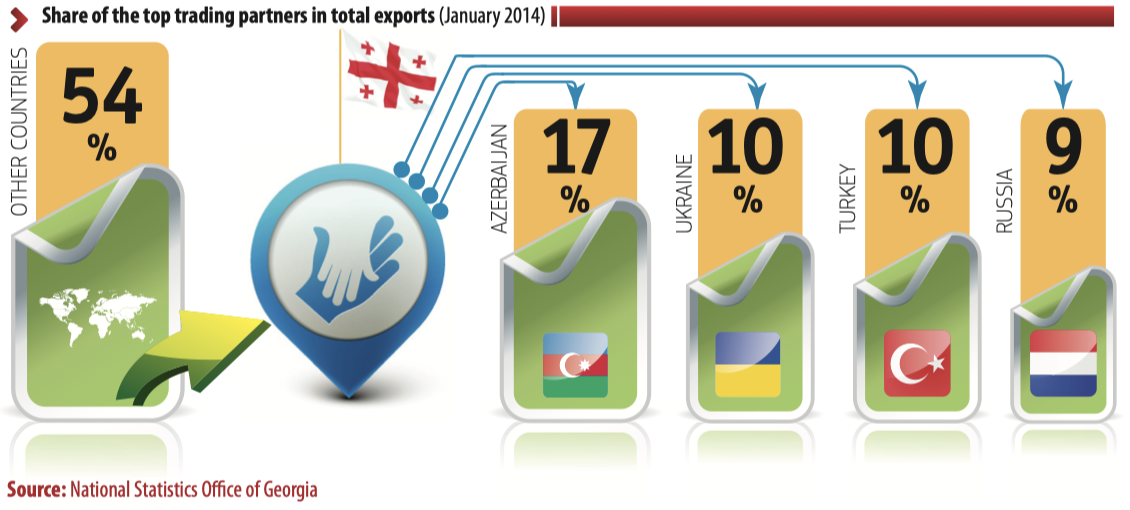
Following the statement of the Minister, the growth trend of the last quarter is still observed and a 7.8% economic growth has been fixed (in January) since the beginning of this year. According to the Minister, an external trade turnover grew by 15% and totaled $761 mln in January 2014 vs the figures from the same period of the last year. Besides, export and import grew by 14% ($224 mln) and 15% ($538 mln) respectively.
“Amid such revival of the growth rate, a 5% GDP growth forecasted for 2014 is absolutely realistic, we may even call it conservative”, the Minister of Finance says.
The Minister of Finance also spoke about the significance of the long-term strategy of social-economic development of the country “Georgia 2020” and has once again emphasized that it is pursuing an inclusive economic growth all over the country. According to the Minister of Finance, it is extremely important that the project stays open and public for everybody until its final approval since even the most critical and sound public opinion is favorable and important for the ministry.
International financial structures
International monetary fund (IMF) also hopes that Georgia’s economic growth will total approx 5% in 2014, chief of the IMF mission Mark Griffiths said. “Together with the Georgian side we discussed the situation of this year and spoke about prospects for 2014. We hope the economic growth to total approx 5% in 2014, that is a prefect indicator”, the chief of the IMF mission said.
According to him, a political stability, improved business environment, reasonable fiscal stimulation, and assistance to foreign investments are necessary for reaching the mentioned goal.
“The government must also undertake measures to eliminate unemployment and create working places so that to contribute to the economic development of the country. The new government has good chances for reaching the goal and we wish to help it in this”, Griffiths said.
In general, the representatives of the International Monetary Fund and the World Bank positively assess measures undertaken by the Georgian government, and state that 2014 will be relatively successful for Georgia in terms of the economic growth. Executive Director of World Bank Frank Heemskerk and Executive Director of IMF Menno Snel made such statement during the meeting held with Georgia’s Prime Minister Irakli Garibashvili late in February.
The World Bank is currently preparing to appropriate Georgia $60 mln for the development of the competitiveness and economic growth. The corresponding agreement was signed by Georgia’s Minister of Finance Nodar Khaduri and Regional Director of the World Bank for South Caucasus Henry Kerali.
“This project is the second part of the three-year plan of measures aimed at strengthening of the competitiveness of Georgia and its economic growth”, the representative of the Ministry of Finance said.
The funds of the WB will be spent on creation of the micro-fiscal environment aimed at stability and growth, on increasing finance management efficiency, and the effectiveness of social protection programs.
Khaduri expressed hope that the WB would keep lending support to Georgia for bringing the economy of the country closer to the American and European economic models.
Georgia is actively working over integration with the European economy. The text of the association agreement between Georgia and EU would be agreed and prepared for signing in near future, Georgia’s Foreign Affairs Minister Maya Panjikidze said after meeting with the European Commissioner for Enlargement and Good Neighborhood Policy Stefan Fule.
“Both Georgia and EU are expressing a desire for signing the document about association as soon as possible. Both parties are carrying out an intensive work over required procedures. A decision about to agree the text of the document on time (approx by the end of March) was made”, Panjikidze said.
“The future association agreement to be signed between EU and Georgia is not a short way for securing full employment, growth of salaries and momentary economic success”, Stefan Fule said when addressing the representatives of the civil community in Tbilisi. “I am confident that this agreement will contribute to the prosperity of Georgia in due time, but it will not come overnight. All those who hope for sooner results will, to all appearances, be disappointed”, the member of the Commission emphasized.
As European Commissioner Stefan Fule said, there are a lot of false myths around the association agreement. “It is not true that there will be a high flow of import from EU to Georgia. It is wrong as the agreement is two-sided, that means both the Georgian and European companies will enjoy opportunities for doing business in the markets of each other. The transition period will protect the Georgian economy from rapid changes. Throughout this period Georgia will uphold opportunities of temporary security mechanisms. There are fears that the association agreement will annihilate the whole sectors of the Georgian economy, but it will not happen. The agreement lets the Georgian economy catch up with the EU in terms of competitiveness and gain benefits from the access to the largest market of the world”, Fule said during the meeting held with the representatives of the non-governmental sector.
“The agreement means investments into the future of Georgia”, Fule said. The signing of the agreement has been scheduled for August 2014.