


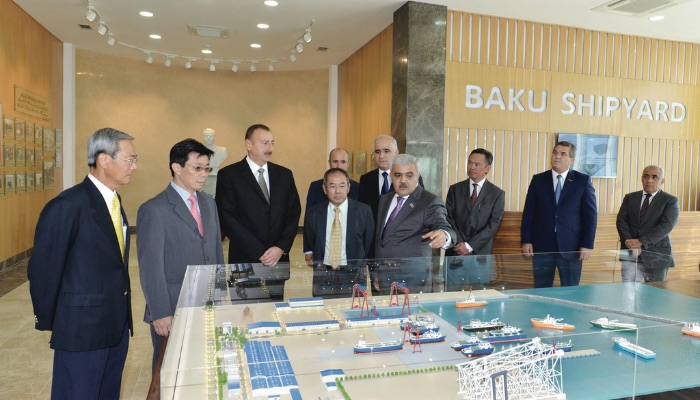
Caspian Energy (CE): What are the real capabilities of the Baku Shipyard?
David Loh, General Manager, Baku Shipyard LLC: The shipyard is designed to accommodate all types or sizes of vessels operating in the Caspian Sea. Basically, we have to facilitate our clients operating in the Caspian Sea. The yard is equipped with latest technology or equipment to enhance productivity and quality work for our clients. Importantly, the reason for setting up the Baku shipyard is to have a shipbuilding and shiprepair yard in Baku. Of course, it is the first time that the Baku shipyard can provide shipbuilding services to the clients operating in the Caspian Sea. In the past, they would bring either old vessels or new built into the Caspian Sea through the Volga-Don canal down to Baku. And of course if they have some restrictions or limitation due to the Volga-Don canal they have to literally chop up the vessel and bring it in smaller parts or components and do the integration or the re-assembly in one of the yards here in Baku before actually putting her into service. So, primarily, this will have a very big change in regards to the clients’ expectation of having boats built here in Baku. Obviously, it reduces a lot of hassles and complications from the owners’ perspective. So, we hope with this new shipyard, we can provide a better solution for the clients here in Azerbaijan and in the Caspian Sea. In addition, to make sure that Baku shipyard can be independently run by locals and of course our duty from Keppel is to provide guidance and training and make them professionally able to run the shipyard in the near future. Of course, it is a process that we have to go through and we have started the process by employing many engineers here from Azerbaijan and send them over to Singapore for training. Minimum training period is 6 months, subject to extension for further enhancement of their skill level. We have so far sent three batches of engineers. Two batches have already returned and are deployed into the fields or in various departments. The training program is primarily focusing on shipbuilding where Keppel will provide all kinds of training program suitably modified to meet the requirements here in Azerbaijan or in the Caspian Sea. Similarly, we will be sending people who need to be professionally trained in ship-repair activities. We hope that Baku Shipyard can soon provide a One-Stop service to our Clients.
CE: What kind of benefits will the Caspian region consumers get from the operation of the shipyard?
David Loh: The ship repair is definitely a complementary business to our core shipbuilding activities which is a very ideal business model for our shipyard especially in the Caspian Sea. So, literally, we can say that it is a one stop-service for our clients. And of course, knowing that business or knowing the marine industry long enough, turn a round time is very important. They need to put the vessel back into service as soon as possible when they have to send the vessel for ship repair or conversion. As far as I am aware, there are many clients operating in the Caspian Sea are very excited about Baku shipyard. They have started to knock on our doors for both ship-building and ship repair projects. In a way, we are very fortunate that we have a good clientele based here in the Caspian Sea that looks forward to collaborate or do some business together with us. It is a big challenge to make sure that the Baku shipyard can accommodate and continue providing such service and make ourselves a preferred choice shipyard for many of the operators here in the Caspian Sea. In fact, I’ve great faith at the potential growth for the offshore and marine sector in Azerbaijan or in the Caspian Sea because of the buoyant upstream activities happening in the Caspian Sea. If they have a good shipyard that can maintain their vessels, that is obviously something very important for many shipowners. This is why I felt that they are very excited with Baku Shipyard and obviously it is also our responsibility to make sure that they are confident in us. Therefore, we have to prove and continue providing expected services to them. In addition, on operational perspective of this shipyard, we have also designed a shipyard to accommodate so called or one of the largest tankers required in the Caspian Sea. We try to name the Caspianmax size vessel or tanker. This is the equivalent to the Panamax size vessel. So, in regards to tonnage it may be 60-70 thousand tons deadweight. So, hopefully, with these kinds of facilities in the Baku shipyard, the clients will be more excited to consider investment in this sort of tankers to provide better service to their upstream clients who are oil majors. So, I think there will be a lot of growth or spin off from Baku shipyard presence. And I strongly believe that the great strategy of Azerbaijan government on industrialization, especially with maritime industry, will succeed. Of course it ultimately creates more employment for the country and eventually, stability becomes a viable proposition for all parties. So, this is how a partnership gets established, and we have to continually strive and get ourselves ready to serve. I also would like to inform that Baku Shipyard will have a steel production output of 25,000 tons annually.
CE: What could you say about forth-coming, underway and realized projects?
David Loh: We were also fortunate that during the yard development we managed to build two different types of vessel: one of course is our own floating dock, which we needed for our ship repair activities and also for new building launching purposes. It was completely constructed in Baku with our people and of course with help from our sister company CSC. We managed to construct such a big floating dock here by ourselves even though we are new but we managed to gather sufficient resources together and had make-shift facilities to construct this vessel. And likewise, we are very fortunate again that we have secured a 50T Bollard Pull ASD tug from SOCAR. This also gives us an opportunity to prematurely test the whole construction system here in Azerbaijan whereby we went through different processes from the design aspects to production engineering, from procurement to installation and eventually commissioning and preparing for sea trial. So, this creates an opportunity for many of our employees whereby they see shipbuilding activities for the first time in Azerbaijan or in Baku, in particular. As I say, we managed to test out many different systems and understand the difficulties of getting construction done here. However, we also managed to find good solution to overcome the difficulties. And importantly, to understand and improve means we are potentially able to reduce the cost structure here in Azerbaijan to be competitive in this industry. And that is why we have enabled to try overcoming all these factors by mechanization which improves or increases productivity of our people. So, as I said this is something that we have to continuously improve and bring our cost down as much as possible so that we can compete aggressively with the international market. So, the clients will not need to bring in their vessels all the way from international waters into the Caspian Sea. So, this is why we are here to make them feel confident and also make their projects more viable. It is a big challenge honestly speaking, but I think we are able to do it with the right people and honestly we are trying to nurture our people, set a right attitude in the work, and it is obviously beneficial for the company and success of Baku shipyard. That is very important, I still believe that this shipyard can last generation after generation if we manage it well and hopefully the growth in the Caspian Sea continues. So, this is how we view the prospects of Baku shipyard.
There are quite a number of projects that we are in discussion now with our clients SOCAR and BP, and of course with their partners involved. Among them, noteworthy are Total and Statoil. These are some of the major operators in the Caspian Sea which we would definitely like to have their confidence in us. And with the latest or the most recent development of Shah Deniz II, we have these great opportunities to provide marine and offshore projects for their needs, which plan to operate in 2017. So within this period, we hope to construct many different types of vessel for their operational requirements. We have been in discussion with them for subsea construction vessel, subsea field support vessel, AHTS, PSV, and of course likewise for many other supporting vessels like crane vessels and crew boats meant for the operation offshore. So, I am glad to say that the start up will be very promising basing on how the development on Shah Deniz 2 is progressing. And I am very sure that this project will spin off and create a lot more opportunities for the marine and offshore industries. And in fact, this spin off has led to our sister company Keppel FELS in Singapore and together with CSC in Baku have contracted a Semi- submersible rig with SOCAR’s CDC. And, this project involves three different parties actually for the construction: one is Keppel FELS from Singapore, the other one is CSC and Baku Shipyard also gets to partake in this prestige project. So that also creates another opportunity for us to continue improving or correcting our processes and procedures as well as testing our major facilities and equipment in the beginning phase. We will be in a better position to execute the potential projects in the pipeline which will easily last for the next five years. And I am sure potentially with projects from other neighboring countries like Kazakhstan and Turkmenistan, it will also give us more opportunities to build them more vessels. As a matter of fact, like I just said, tankers are the one that we are hoping to get if Kazakhstan field gets developed and the ship owner definitely wants bigger tankers to conveniently or economically transport oil from Kazakhstan to the European markets via Baku pipeline. So, we see great opportunities of Baku Shipyard in this respect. Obviously, we have to move very fast and get our people, get these facilities up and running. What is important now, also in order to supplement our business we need to engage in the ship-repair activities so we are pushing very hard to get our shipyard ready, to gather resources, and hopefully we can commission the ship-repair facility by early next year.
CE: What could you tell about the contribution and support of the shareholders?
David Loh: Between SOCAR and Keppel we have been partners for the last 17 years and we understand each other very much and with this very strong relationship, Baku shipyard has been established. On the commercial aspect there could be some differences in view of why this shipyard has been set up. SOCAR is the main shareholder and owns 65% of Baku shipyard. 25% comes from the Azerbaijan Investment Company and the remaining from Keppel. So, the question is why 90% is from Azerbaijan. Honestly, the overall intent is industrialization, nationalization and obviously is to have good business opportunities for Azerbaijan. And of course, we see it very strategic and we also believe in our partners, about how they build a prospect of a shipyard in Azerbaijan. We are given the opportunity to increase our stake to 20% and if we see good potential growth in the Caspian Sea, then it has no doubt that Keppel will increase its stake. So, that is the whole intent about this partnership. Having Keppel means SOCAR can achieve the objective in terms of running a shipyard professionally, and of course serving the clients again professionally. In terms of what we have already gone through, the yard development of the shipyard without SOCAR it would not be as easy as we have achieved, honestly speaking. So, this is the strength of partners in this project. SOCAR has provided a lot of support with regards to the yard development whereby it sped up the whole yard development process. We have built this yard within almost 2 years which is very amazing in local context. Even on international context, it is also very amazing that we have achieved this. So, from Keppel’s side our contribution is to obviously and immediately bring in the right expertise to fast track shipbuilding activities here. There are many other supports from Singapore when it comes to design, engineering, and production processes. So, there will be a lot of virtual support in that respect from Keppel’s side. And with Keppel’s name, we believe it is also helpful in regards to business opportunities in ship repair and ship building, as Keppel’s name is well established in the marine and offshore industry. These are all the benefits from the shareholder’s point of view. As for the Azerbaijan Investment Company, of course, they are a very professional investment company with the government entity. And, I am very sure that they also see a lot of other potential in the Baku shipyard and that is why they put in a 25% stake. On an overall perspective of investors and the shareholders themselves I strongly believe that they have viewed Baku shipyard with the same prospects and with the same direction moving forward.
CE: What could you tell about the HR policy?
David Loh: As a matter of fact, with this intent we have designed a shipyard with an appropriate training center. And we just literally copy and paste with a corporate training facilities in Singapore and brought it over here into the Baku shipyard. So, with that we hope that we can speed up the process of training the locals and eventually lead to more employment with Baku Shipyard. Most importantly, we must expedite in training more engineers to assume more roles and responsibilities.
CE: Which goals and objectives shall the shipyard gain in future?
David Loh: I believe that the shipyard must be ready to quickly serve the clients is the most important goal and objective. Obviously, it is very important for us to have a good start as it enables us, the owners, the operators and people of Azerbaijan realizing the intents and purposes of Baku Shipyard. Most importantly, I would like to hope that with Baku shipyard’s presence and Keppel’s continuing presence here, we will be able to help many other investors interested to come here and set up their marine companies and also better service our shipyard and likewise for the clients. I think that is the ultimate objective about the industrialization.