


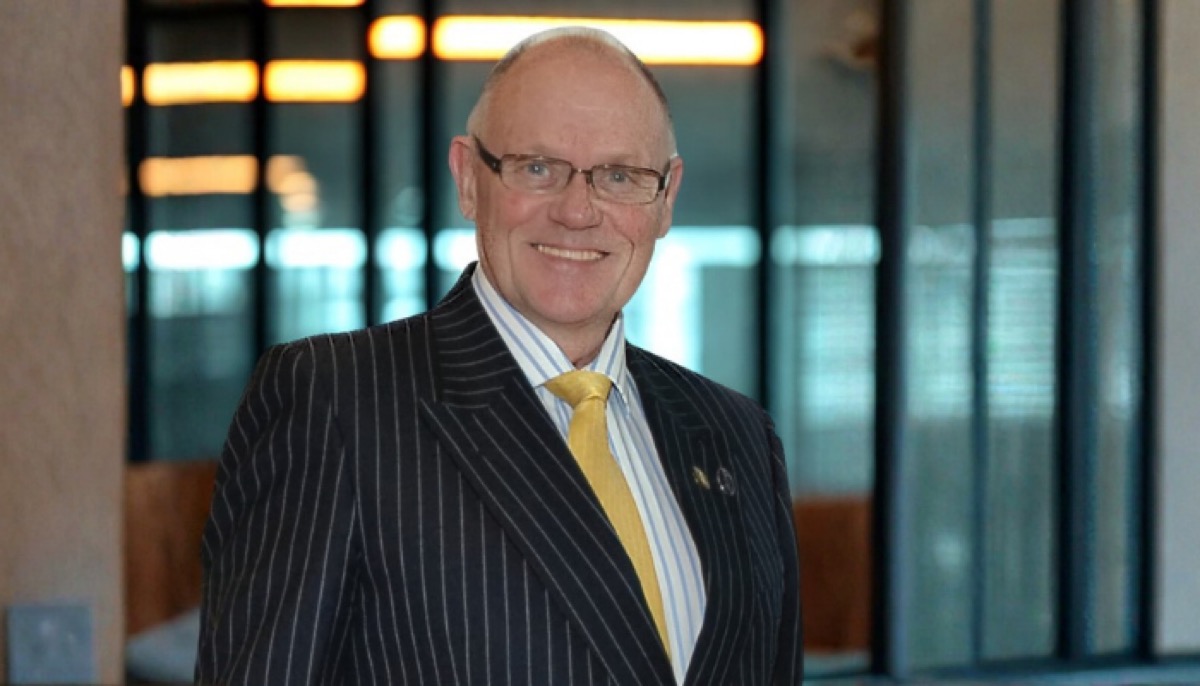
Caspian Energy (CE): What could you tell about the performance results of the company 2013?
Chris Mott, General Manager, Fugro Survey Ltd (Caspian): In general, the results of the company are satisfactory. In an earlier interview you asked me how I thought that the company would perform in 2013 and I explained then that we set a plan for ourselves. I am pleased to be able to report that the company’s performance has been slightly ahead of that plan. We have done better this year, to a small degree, than we thought we would when the year began.
CE: Could you provide detailed information about those projects?
Chris Mott: The results are still confidential, so I can not be specific. But the reason that led us to being ahead of plan is due to the fact that some projects that we thought would not happen did happen in this year. So our activity rate was higher than we were anticipating.
We were pleased to get some onshore survey work this year that we thought would not happen until next year. We have been doing some site investigation work south of Baku for some proposed petrochemical works and, just at the very end of this year, we will be doing some onshore geotechnical work for a new gas terminal.
CE: How does the company manage to preserve competitiveness in the local market?
Chris Mott: We face competition from the local market in everything that we do and our proposition to the local market is the value added aspects of our services. If a client contracts with Fugro, we work very carefully with him to understand what his requirements are from our survey work and how those requirements feed into his business process. We make sure that the information we provide from our surveys enables him to engineer his designs for his infrastructure to be safe and cost effective. Our general premise is that every extra manat spent with Fugro can lead to a 10 manat saving elsewhere in the project (in capital expenditure or operating expenditure). Our challenge is to explain our value proposition to our clients and demonstrate to them how, by contracting with Fugro, their whole business process can be improved. Our focus is always on our clients’ business.
CE: Fugro always surprised with its advanced technologies. What could you tell about innovative technologies the company introduced in 2013 in Azerbaijan and in the Caspian region?
Chris Mott: At the moment we are carrying out a survey in the Caspian Sea to obtain geotechnical soil samples from the seabed. The water depths that we are working in are quite significant. Sometimes greater than 500m. We are deploying a sea-bed drill system that, instead of being operated directly from the surface support ship, is lowered to the seabed and operated in a remotely controlled way from the surface support ship. This drilling system enables small vessels to be used to do significant geotechnical sampling tests in deep water. This is one example of Fugro’s innovative technologies. We are also conducting an AUV (autonomous underwater vehicle) survey in the same part of the sea. We are obtaining very high quality geophysical data that is giving our clients an extremely high resolution image of the seabed and the soils lying beneath it. We are also in discussion with a client for some onshore site investigation work on a brownfield site that has previously been developed, but now it is being redeveloped for a different purpose. It has some ground contamination due to previous industrial activity. We have unique technology that can safely and quickly detect where the contamination is, find out what it consists of, and can map the aerial extent of the contamination.
At the moment we are speaking with our clients about the techniques that we can deploy there and the results that we can provide.
CE: What are the future prospects of the future activity of the company in the Caspian Sea?
Chris Mott: In the medium-term, the prospects are very good. BP is here as an established oil-gas producer, Total is just beginning its oil-gas activities in Azerbaijan. We also understand that there are other international companies such as Statoil and RWE that are at the very start of their activities in Azerbaijan as oil-gas companies. SOCAR underpins the nation`s hydrocarbon production. I can see in the medium-term an increase in the demand for the services that we offer. However next year, I don’t see that many new projects coming to the market, therefore I anticipate that next year will not be as busy as this year.
CE: What could you tell about the evaluation given to the activity of Fugro Company at Chiraq Oil Project?
Chris Mott: We have been providing Construction Support Services on the Chirag Oil Project as well as precise positioning on the surface of the sea and precise positioning on the seabed. We are providing ROVs to assist the pipelay operations and the inspection of the pipelines that have been laid, together with installing physical supports that the pipelines need once laid on the seabed. We have been providing all the subsea survey services that are necessary to connect all the pipelines to each other and to the risers and to other parts of the existing oil-field infrastructure.
CE: Which innovations can the company offer for the oil and non-oil sector, especially in Azerbaijan?
Chris Mott: I have already spoken about our specially developed tools that quickly and safely detect pollution in contaminated soils. This is very important wherever pollution exists. We have advanced geotechnical sampling equipment that can take very high-quality geotechnical samples in any type of land contaminated or not. This increases the speed of our surveys, and increases the quality of the results of the testing of the samples that we get from our survey. We have technologies that are capable of working in all water depths of the Caspian Sea. When companies like BP, SOCAR and Total are exploring for oil-gas and producing it from the deepest waters of the Caspian Sea, our tools and our techniques are as effective in the deep-water as in the shallow water. We are working with our clients to continually refine the services that we offer.
Over the last 12 months, working with one of our clients, we developed a way of inspecting the external condition of pipelines by using a high density acoustic technique which has gained an international interest. We use thousands of acoustic beams per second to create an image of the pipeline and the seabed in a way that is very quick and very accurate.
CE: Is it possible to apply these techniques in the non-oil sector?
Chris Mott: Yes, our services are not restricted to oil-gas. They can be applied to any pipeline for whatever purpose. If the pipeline were carrying water, we can inspect that pipeline exactly in the same way. It does not matter what it contains. Our techniques are totally transferable.
We have a company within the Fugro group that has a unique capability in what is known as a pile testing. All the tall buildings that are being built need very safe foundations. Usually, these foundations are pinned into the ground with piles. The capacity of these piles to support the buildings that will be built on top of them is a very important factor to know. We are capable of doing tests which determine that the capacities of the piles that have been proposed are safe. These same techniques also prevent very costly over-engineering.
CE: Will be it beneficial for construction companies to cooperate with Fugro in this area?
Chris Mott: I refer to an earlier part of this conversation about our focus on our clients’ business and the value of our services to him in the sense that the proper site investigation information applied to his whole business model can save him 10 manat for every extra manat he spends with Fugro. Our challenge is to explain to our clients how that multiple works. Fugro is a company operating in accordance with highest international standards. To provide services within those standards brings with it a cost. We are a public-owned company, so we have a duty in front of the shareholders to operate profitably. The flexibility that we have in our pricing structure is constrained by those factors. We are conscious that the pricing structures in different industries vary. We explain to our clients the difference between cost and value. And we feel that our cost-effectiveness and our value added services are more compelling in the more difficult and more challenging construction areas where we have tall buildings, seismicity etc, where pile capacities are critical or where construction is required on brownfield sites where the ground conditions are challenging because of potential pollution and contamination. These are the areas where the value of Fugro surveys is more apparent than in the more general routine projects.
CE: What importance does the company attach to HR policy?
Chris Mott: Earlier this year, Fugro established a training facility in the UK where trainees attend different courses. There are foundation courses lasting for three months. I intend to put our Azeri national trainees on to those training courses which that is something that I am very excited about.
CE: In which area does Fugro plan to focus its activity on in near future?
Chris Mott: There are two elements to that. First of all, we want to continue onshore and offshore survey work in the oil-gas industry and expand as it expands. We have already spoken today about BP being established, Total becoming established, and Statoil and RWE beginning to become established. This will lead in the future to a sustained demand for the services that Fugro provides. Therefore, we wish to grow in the oil-gas sector.
In the same way, because we have started operating onshore for the oil-gas market on the existing and proposed gas terminals, we have invested significantly in onshore geotechnical equipment which brings quality services and speed of operations to the high end onshore construction market that is occurring in Azerbaijan.
I don’t see 2014 being as active as 2013 was. The COP project is coming to an end. The Shah Deniz II construction activity is not expected to begin until 2015. There will be routine tasks that we will carry out. And some things may happen which at the moment I have no visibility of.
We have the full spectrum of the Fugro group globally behind us and we are willing and happy to bring to Azerbaijan any Fugro service that we don’t have here locally for specific projects. This is one of the strengths of the Fugro Group. The ability to bring in specialist services wherever there is a demand for it.