


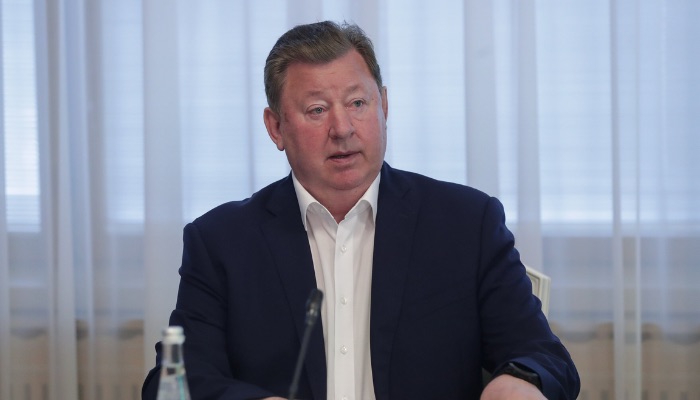
Caspian Energy (CE): Which vital problems is Russia facing today in terms of efficient use of natural resources, including hydrocarbon deposits?
Vladimir Kashin, Chairman of the State Duma Committee for Natural Resources, Subsoil Use and Ecology, the Russian Federation: Problems abound. For instance, the growth of oil reserves seems to be quite favorable at first sight. However, it is not new oil fields that ensure the growth. The increase is the result of either supplementary exploration or inventory revaluation toward the growth of oil recovery index.
The present production is implemented at the expense of reserves explored in 1960-80s. Not a single new oil production area was prepared for operation in Russia over the past 20 years. Irrational use of explored reserves is the main problem of the oil industry. Companies simply skim the cream off the fields and often abandon quite profitable wells.
Oil processing industry has not been developed well enough. Russian oil refineries produce 470 liters of light oil products out of one ton of oil while this indicator reaches about 700 tons worldwide. If the depth of oil processing were increased by 10% in our country, it would enable to save 20 mln tons per year.
The situation in gas industry is not better either. Most of it (almost 60% of explored reserves) consists only of methane and is used for getting energy without preliminary processing. The rest reserves fall to the share of so called “process gas”. Such gas contains different impurities, mainly ethane, propane, butane and other hydrocarbons that are considered to be important petrochemical raw material. Nevertheless, valued components can be taken out of them and processed into a readily-marketable product, juts like the way it is done in the USA.
It is sad that the utilization rate of associated-petroleum gas is tending toward reduction. This indicator reduced from 84% down to 75% over the past three years.
The growth of oil-gas sector efficiency is inconceivable today without innovations in drilling, production, and the increase of oil recovery index. We have to foresee the introduction of advanced production technologies.
It is necessary to overcome a technology lack in Russia. According to different estimates, exhaustion of the equipment that is currently used in the industry reaches from 50 up to 70%.
Noteworthy is also small amount of human resources engaged in geology. The number of specialists has decreased by 5 times since 1980. According to the information of the past years, almost half of the graduates, who majored in geology, now are engaged in different other areas. The deficiency of young university-educated specialists required in this sphere makes about 20,000 people.
Exhausted mineral resources base, unsatisfactory technical condition of enterprises, lack of human resources are only a part of problems we are facing. The Committee has included all these issues into the working plan of the Commission for FEC and environmental security development under the President of RF.
CE: It has been recently announced that big fields are exhausted and oil production will keep falling in the medium-term, do you share this opinion?
Vladimir Kashin: Yes, such scenario seems rather possible. Tendencies of production decline by 1.5% per year on average are already observed clearly in Khanty-Mansiysk region (Yugra), the main production region of the country.
There are almost no big fields left. Therefore, it is necessary to invest heavily in financing of geological exploration.
The expenditures of the federal budget on geological exploration for crude hydrocarbons totaled 12.8 bln RUB in 2012 vs 8.7 bln RUB of 2011. Operations were performed on 148 units. The work on 72 of them was commenced in 2012 and completed on 50 facilities in the same year.
Major amount of costs fell to the share of Eastern Siberia and Yakutia since there was a necessity for increasing the raw material base in the area of operation of Eastern Siberia-Pacific Ocean oil pipeline. Predicted resources of hydrocarbons (6 bln tons of reference fuel) were localized as the result of operations performed onshore and offshore. It is 2 bln tons higher compared with those of 2011.
Despite the positive dynamics of the mentioned figures, it is noteworthy that since 2008 to 2012 the size of the accumulated funding gap within the whole geological exploration of the Russian Federation totaled 111.3 bln RUB compared to the indicators of the “Long-term state program on reproduction of the mineral resources base“.
So it turns out that geological exploration received only half of the funding. Believe me that the consequences will be deplorable soon in case this trend continues. Every year our committee makes amendments into the federal budget of the following year in order to reach the target figures of the state program. We submit these issues to the President of the Russian Federation. However, no understanding has been reached yet.
It is also important to set a more rational use of fields where operation is being performed. A terrible figure was sounded at the meeting of the FEC Commission under the President of RF on February 13, 2013: over 65 mln tons of crude are lost every year during the production process! These are budget losses that comprise about one trillion RUB.
There is a necessity to increase drilling scope by 2.5 in order to ensure high growth of oil reserves. But the license agreements do not let it happen. Nowadays, only the fifth part of licenses contains obligations on conduction of geological exploration. The number of such licenses decreased by one third over the past 10 years. Operations have been practically stopped on poorly explored areas located far from the developed infrastructure.
Efficiency growth in oil-gas sector is inconceivable today without introducing of innovations in drilling, production, and growth of minerals extraction ratio. We have to foresee introduction of advanced production technologies. In case recovery index increases from present 37-38% up to 42% observed worldwide we will be able to produce additional 30 mln tons.
For instance, minerals extraction ratio in the USA grew from 0.33 up to 0.40% in the late 1990s and keeps growing despite the fact that the structure of oil reserves in the USA is much worse than in Russia. Saudi Arabia plans to increase oil recovery index from present 0.50 up to 0.70% in coming 20 years.
CE: Which measures are undertaken for increasing hydrocarbon reserves of the country?
Vladimir Kashin: According to the information of the Federal Agency for Subsoil Use, almost 60% of Russian oil reserves have been explored in the Uralsk federal district. Over half of resources has already been localized there. Therefore, despite a considerably high amount of exhaustion of reserves, this area will remain a major oil producing region of Russia in the foreseeable future.
A total of 26 oil-promising zones, located in non-licensed areas in the Russian Federation, have been marked. 7 of these zones do not need additional exploration at the expense of the federal budget; licensed areas can be singled out and put up for auction. Regional stage work has to be carried out within 14 zones. Another 5 zones are ready for conduction of prospect evaluation work.
These are the very five zones where efforts are to be focused on in 2013. Two of them are located in the south of Western Siberia, one in the Eastern Siberia, one in the Caspian and one covers the area of Yenisei-Khatangsk trough and Gdansk peninsula. According to preliminary calculations, С1+С2 oil category (about 2 bln tons) and С3 category resources (1.7 bln tons) can be predicted to reveal within these 5 zones. It will enable to produce additional 60 mln tons of oil annually.
CE: What kind of legislative initiatives have been recently passed in the field of ecology, what are the plans for future?
Vladimir Kashin: We recently managed to pass an important law which has no equals in the existing legal framework. It aimes at protection of the seas from pollution with oil and oil products, imposes obligations and financial responsibility on operating companies, including full compensation for environmental damage, water bio-resources, health and property of citizens, determines measures envisaging use of technologies and methods of elimination of oil and oil products spillage in the water area, ice, as well as when developing mineral resources in glacial conditions.
In July of this year we also adopted a law about introduction of measures of state regulation over the ozone-depleting substances in the Russian Federation for meeting international obligations. It will certainly reduce the development rate of ozone holes and have a positive impact over the fragile ecosystem of northern latitudes.
Today the Committee has a package of draft bills which, once they are adopted, will have created a new framework for development of the ecological and economic policy of our state as well as help to solve the above mentioned ecological problems. It is a whole set of incentives for business entities to work out and implement technological solutions based on new safety level and efficient use of natural resources.
One of the draft bills concerns improvement of the ecological system regulation and economic encouragement for introduction of the best available technologies. The draft bill envisages time limits and procedure for the industrial enterprises to shift to so-called best available technologies. It has also been based on comprehensive approach to environmental protection regulation. In essence, the draft bill is one of the first steps for harmonization of the Russian environmental legislation with the European one, especially with the European Union Council’s Directive dated September 24, 1996 “On Integrated Pollution Prevention and Control”.
As to the second draft bill (on the rate of wastes and consumption), it aims at recycling of production and consumption wastes as well as at substantial reduction of their disposal. A whole amount of economic and tax preferences is planned to be provided for those who will be engaged in solution of this problem.
Meanwhile, those (oil-gas companies, metallurgists, miners) who cause biggest environmental damage today oppose draft bills and try to prove that they have no funds to be able to shift to advanced technologies. A number of business entities make all efforts for prolonging the process of adoption of bills or having it turned into an emasculated declared dummy. However, we are also working for having both of the draft bills adopted within a short period of time.
CE: What importance does Russia attach to maintenance of ozone layer and what measures are undertaken?
Vladimir Kashin: To ensure system regulation of shift to ozone-safe technologies and reduction of use of ozone-depleting substances in the Russian Federation the State Duma passed (July 3, 2013) a Federal Law “On changes in the Federal Law “On environmental protection” and in certain legislative acts of the Russian Federation”.
Reduction rate (0.4-05% per year) of ozone content in atmosphere of middle latitudes was fixed as early as late in 70s of the past century. Analysis of physicochemical reasons revealed presence of ozone-depleting substances in this process.
Vienna Convention (adopted by the USSR in 1985) for the Ozone Layer Protection and Montreal protocol (adopted by the USSR in 1987) on ozone depleting substances were passed. Based on the mentioned documents, lists of chemical substances depleting the ozone layer and schedules envisaging terms to stop their production and consumption were determined for every country.
This task has already been accomplished in accordance with two lists. But it is also necessary to ensure stoppage of using of substances from the list including different compounds of chlorine and bromine. The following schedules of reduction of these substances have been made up for the Russian Federation, Belarus, Kazakhstan, European countries, USA and many other developed countries: by 35% from 2004, by 75% from 2010, by 90% in 2015. There is only 0.5% left for maintenance of the equipment (created earlier) throughout 2020-2030.
Russia produces only 4 ozone-depleting substances. Imported Halon 141B is not produced in Russia at all. These substances have to be replaced with ozone-safe analogues.
If it is not done, Russia will not be allowed (because of quota exceeding) to import raw materials that enterprises, producing refrigeration technologies and construction materials, need, as the Secretariat of Montreal protocol keeps the global record of production and consumption of ozone-depleting substances. As the result, it may lead to stoppage of operation of a number of city-forming enterprises because of the lack of raw materials. Therefore, Russia has to shift to use of ozone-safe technologies, especially in enterprises which depend on import of such substances. It is exactly what the passed Federal Law proposes.
In general, the Federal law sets a principally new regulation envisaging not only rationing of the final negative impact. It envisages regulation of all life cycle stages of ozone-depleting substances: starting from their production right up to their elimination. The law also prohibits burial of such products without extraction of such substances.
Regulations envisaged by the Federal Law will gain force from January 1, 2014. It will enable to develop and confirm a necessary legislative and regulatory framework as well as create conditions for modernization of enterprises by 2015.
CE: Which measures is Russia undertaking regarding the issue of climate change?
Vladimir Kashin: The Russian Federation’s climate doctrine determining single internal and external state policy on climate change and its consequences was approved by the Russian Federation President’s order No861 dated December 17, 2009.
Research work is held in the following areas in order to realize comprehensive weather and climate research plan in the Russian Federation for assessing and predicting national security threats due to the climate change, for assessing risks and benefits for the economy of the country and its territory, as well as an ability to get adapted to climate change:
Research of modern climate and climate change through the observational data;
Development of global and regional climate modeling as well as future climate change assessment;
Research of climate change consequences for the environment and economic activity carried out on basis of components of natural complex (agriculture and forest management, water resources, etc);
Work in the area of climate application – improvement of methods and technologies of climate service;
Theoretical and experimental researches of technologies on stabilization of climate by means of geo-engineering (including the method of stratospheric aerosols);
Preparation of national inventory reports/ national reports about man-caused emissions and absorption of green house gases in the territory of the Russian Federation in accordance with decisions made by bodies of the UN Framework Convention on Climate Change (UN FCCC) and Kyoto protocol.
Apart from this, the draft of RF President’s decree “On establishment of a target indicator of reduction of emissions” has been developed. The document determines a target figure of reduction (by 2020) of greenhouse gas emission by 15-25% from the figures of 1990s.
Acceptance of this document will confirm (within the framework of climatologic format) the activity which is already carried out in the Russian Federation for increasing energy efficiency of economy in accordance with Russian Federation President’s decree #889 (dated June 4, 2008) “On some measures for the growth of the energy and ecological efficiency growth of the Russian economy” and within the framework of the state program of the Russian federation “Energy saving and growth of energy efficiency till 2020”, approved by the decree (#2446) of the Russian Federation Government on December 27, 2010.
Recognition of the national target on reduction of emissions till 2020 will enable to acknowledge a consecutive course of the Russian policy in reaching the final goal of the UN FCCC, to substantiate possible levels of reduction of greenhouse gas emission when presenting Russian position at negotiations on preparation of the new climate agreement for the period after 2020, to ensure key points for shifting to low-carbon (energy efficient) way of development for national economy during the period till 2020 and further possible prolongation till 2030.
CE: Do you think that Fukushima accident laid new principles for operation of atomic power plants? How will Russia set its perspective plans for increasing the nuclear energy share in this regard?
Vladimir Kashin: Nuclear energy is extremely resistant to such calamities as earthquakes and tsunami. But the events that occurred in US nuclear plant Three Mile Island, Chernobyl and Fukushima shows that there is still probability of severe accidents and sometimes they do happen.
After the Fukushima accident, the world countries did not reject nuclear energy development programs as they had no alternatives for energy generation. Among them we can note Turkey, France, Bulgaria, Belarus, Finland, Czech Republic, USA, Egypt, UAE, Lithuania, Spain, Ukraine, etc.
Meanwhile, four countries, especially Thailand, Israel, Venezuela and Norway declared that they would stop their nuclear energy programs for an uncertain period and would not build nuclear power plants because of the accident occurred in Fukushima-1. Such projects were stopped for certain period in Great Britain, Switzerland, Germany and Japan but no statement about full rejection of nuclear energy development was made.
32 units of Russian nuclear plants were checked after Fukushima. According to the results of inspection, they conformed to regulations observed in the country. Despite the positive results, the analysis of their operation will be continued. Additional surveys will be held at areas where the plants are located and where a seismic activity is observed.
Anyway, we will not be able to disregard learned lessons. Appropriate conclusions have already been made.
In my opinion, it is necessary to develop peaceful atom on basis of following principles.
Firstly, it is necessary to shift to new generation nuclear power plants where atomic reactor will be protected from severe accidents by nature laws and not only by technical devises. Russia has developed conceptual and technical designs of such reactors. It is necessary to include passive reactor cooling systems into the projects of new blocks in case of emergency shutdown of reactors.
Secondly, the blocks must not be located too close to one another. As the result, explosions occurred on certain reactors did not let working on others.
Thirdly, it is necessary to train the personnel of the nuclear plant how to cope with extreme conditions. These trainings are held on regular basis at all Russian stations.
The matter of increasing the share of nuclear energy in the energy system of the Russian Federation requires discussion. A decision on pre-schedule stoppage of all blocks can be made once their operation is found unsafe. It means that operation life of certain blocks will not be prolonged. New energy blocks will be erected instead of them on their places.
It is likely the nuclear program will not be reconsidered. However, sites for location and the share of nuclear generation in the Russian Federation will be revised.
CE: Do you believe it was possible to maintain the interests of the state upon introduction of MET in Russia?
Vladimir Kashin: The question is rather interesting.
The Mineral Extraction Tax (MET) has been passed since January 1, 2002. It replaced three taxes that organizations developing fields had to pay earlier: production fee (royalty), contributions for the replacement of the mineral raw material base and excise duties.
Collections of MET within the first 10 months after its setting accounted for 16% of total tax revenues of the Russian Federation budget. Meanwhile, canceled taxes ensured only 7% of revenues of the consolidated budget throughout 2001.
Thus, the interests of the state were certainly taken into account from this standpoint.
However, despite a quite satisfactory collection of MET, it turned out much higher than the previous fees for low-profitable fields. It led to losses and stoppage of development of low quality minerals (stoppage of operation of marginal wells). Meanwhile, average rate of MET turned out lower than previous ones for high-profitable fields. As the result, certain companies gained excessive revenues at the expense reduction of the state budget revenues.
As you see, the situation seems to be double-natured.
Therefore, the state chose to develop the legislation on differential taxation.
In particular, set was a zero rate of MET for oil produced when developing new fields. The same rate was set for superviscous oil. The formula of setting of decreasing coefficient to MET for oil produced when developing fields with the depletion of over 80% depletion was proposed. Tax holidays were introduced for a number of regions, etc.
But the life dictates its terms and the work on improvement of legislation in this area is ongoing. We try to find optimal conditions for cooperation of subsoil users and the state. We want to encourage subsoil users to use the state resource more rationally and the state to provide stable, predictable regime secured in legislation.
In the meantime, both sides have to remember perfectly that subsoil resources belong to the nation. The nation that owns such wealth has the right to demand for their efficient development.
CE: What is Russia undertaking to preserve the ecological balance in the Caspian Sea?
Vladimir Kashin: In Russia several specialized institutes and departments have been engaged in environmental problems of the Caspian Sea for many years. The unique Caspian Fisheries Research Institute (CaspNIRKh) plays a special role among them through careful tracing of the situation with bioresources in the Caspian Sea and conducts continuous work on preservation of the unique Caspian Sea fauna.
However, the list of environmental problems of the Caspian Sea keeps on growing along with the increasing number of programs. Many observers agree that such situation is the direct consequence of still unsolved main problem with the uncertain legal status of the Caspian Sea.
The only international document recognized by all Caspian states is the Framework Convention for the Protection of the Marine Environment of the Caspian Sea. The main feature of the specified international act is its closeness: no other state can join this Convention, except for the littoral states.
However, application of the current agreements on the Caspian Sea prior to establishing a legal status of the Caspian Sea is a disputable matter. It jeopardizes the legitimacy of operations on subsoil use now actively implemented. So, it is necessary to establish general rules regulating this area in the interstate treaty.
As soon as a key to this problem is found, it will help to solve a number of other problems of the region, including the ecological issues.
Setting up unified rules for the hydrocarbons production activity in the reserved zone of the Caspian Sea requires consideration of concluding an interstate agreement between the Russian Federation and the Republic of Kazakhstan on the reserved zone in northern area of the Caspian Sea. Once approved, such treaty would enable to strengthen work by means of introduction of coordinated rigid restrictions on dangerous substances emissions and joint control over sea pollution, requirements to application of methods excluding damage to the water area in the activity of subsoil users.
It is also necessary to undertake agreed measures such as ensuring of consistent security and rational use of unique resources of the Caspian Sea by littoral states, provide access for subsoil user to ecological information, development of the single list of adequate ecological requirements, setting of single measures of responsibility for violation of the ecological legislation.
The Caspian Sea problems can be solved by establishing a permanent agency involving representatives of all five Caspian states. After establishment this body would allow solving issues of legal relationship, responsibility and environmental control to be stipulated in the national legislation and bring them to practice for ensuring ecological security.
CE: Could you please tell your attitude to construction of underwater pipelines at the sea depths? How is it correlated with the interests in the Arctic, Black Sea, Caspian Sea and Baltic Sea?
Vladimir Kashin: Honestly speaking, the attitude is ambivalent.
On the one hand, construction of both gas pipelines and oil pipelines at the sea depths is associated with huge risks capable to cause serious ecological problems in the marine ecosystem. On the other hand, construction of underwater oil and gas pipelines is the objective necessity motivated by both economic and geopolitical interests of the Russian Federation. In any case, it is necessary to approach deliberately to making decisions on construction of new pipelines and, if possible, not just to “place” them anywhere.
At the legislative level we are trying to minimize potential negative ecological consequences and protect the vulnerable marine environment, enhance responsibility of companies, reduce risks of negative impact and damage to ecology.
We already have obtained certain results. So, the changes of the legislation aimed at protection of the marine environment have taken effect since July 1, 2013. They specify the rules of operation, use of artificial islands, installations, facilities, underwater pipelines, implementation of drilling operations in regional geological exploration, investigation and production of crude hydrocarbons, and also during transportation and storage of oil and oil products on the continental shelf, in the internal sea waters and in the territorial waters of the Russian Federation.
In particular, they set up liabilities duties and financial responsibility on prevention and elimination of oil/oil products spills in the marine environment and also their consequences for operating organizations that work both in seas and on the shelf. There are mechanisms of financial support to the specified activities, including full compensation of harm done to the environment, including water bioresources, life, health and property of citizens, property of legal entities as a result of such spills. The legislation also assigns appropriate powers to the federal executive authorities and organizations to eliminate of the specified spills.
In case an operating organization is involved in implementation of corresponding works, a holder of a license for subsoil use shall bear subsidiary responsibility for compensation of the caused damage to the environment, including water bioresources, life, health and property of citizens, property of legal entities as a result of oil/oil products spills.
However, we are not going to stop on the measures undertaken and continue working in this direction.
CE: Does the Russian Federation intend to produce shale gas? How are the relevant technologies developing in the country?
Vladimir Kashin: Due to the relatively high explored gas resource endowment and the lack of economic validity for exploration of shale gas fields, the Russian Federation has no economic preconditions and the developed infrastructure for active (industrial) development of nonconventional sources of gas. However, the possibility to transpose technologies applied by the USA to shale gas development is quite a perspective matter for consideration.
With the purpose to expand the mineral resources base of crude hydrocarbons and maintain the level of hydrocarbons production in the future at the expense of nonconventional sources, currently there are plans to perform works on evaluation of resources and reserves of shale gas, first of all, in the regions with poor oil and gas supply.
With the aim of developing shale gas within the frames of one of the activities, an analysis on shale gas shall be performed in the territory of the Russian Federation, methods of identification of gas-saturated zones worked out, their classification developed, assessment of resources (to the category D1) and reserves (category C2+C1) performed and shale gas development technologies elaborated. Besides, shale gas development requires justification of a choice of optimum facilities for primary pilot development planning along with the forecast of possible volumes of its production along with the due consideration of its impact on the environment.
In general, it is expedient to consider the possibilities of developing nonconventional sources of gas, including shale gas, for gasification of the regions of the Russian Federation not covered by the unified gas supply system and having the most perspective non-conventional resources for development.
Thank you for the interview.