


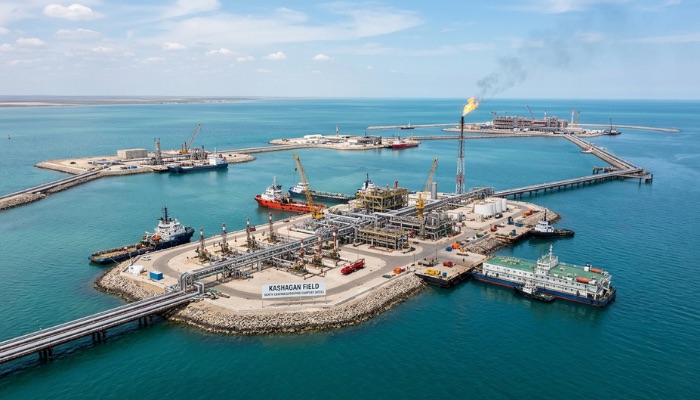
On September 10 Kazakhstan consortium North Caspian Operating Co. (NCOC) announced about the commencement of oil and gas production on the giant field Kashagan located in the Kazakh sector of the Caspian Sea. Geological oil reserves of the field, located 80km to the south-east from Atyrau, and its satellite islands total about 35 bln barrels. Of this total, 90-13 bln barrels (approx 1.5 bln tons) are recoverable reserves. Formation fluids contain approx 15% of hydrogen sulphide and 4% of carbonic acid.
Production started on 8 wells of A artificial island. Production facilities located on another artificial island D have also reached final stages of commissioning. 20 out of 40 wells have been drilled down to the reservoir with high formation pressure (drilling depth totaled 4200m, water depth reach 3-6 m) within the framework of Phase-1. 11 wells have been drilled partially.
The start of oil production on the Caspian field, Kashagan, was postponed several times. The consortium of foreign companies chaired by the Italian ENI originally promised to start commercial production in 2008, while later it was postponed to 2011. In summer of 2010 one more memorandum was signed, postponing the start of commercial oil production on Kashagan field on the Caspian Sea shelf to 2013. Meanwhile project costs grew more than twice, reaching $38bn.
As the result of persistent negotiations ENI lost its position as the operator and North Caspian Operating Company (NCOC) became the operator of the Kashagan project. In the process of specifying the terms of postponement of commercial production, Kazakhstan raised its share in the project from 8% to 16.8% and achieved payment of royalty originally missing in the first agreement.
Thus, at the price of $85 per barrel the Consortium is to pay $72 billion as royalty to Kazakhstan during the project lifetime. Under the reached agreement, if industrial production on Kashagan starts after December 31, 2013, Kazakhstan will not cover expenditures of the Consortium of foreign companies and the agreement will be revised.
Phase-1 production will initially rise up to 180,000 barrels per day during 2013-2014. Then, it will grow up to 370,000 barrels per day during Phase-2. About half of produced gas will be re-injected back into the reservoir. Certain pipelines will transport produced liquid fractions and crude gas to Bolashak plant where oil is prepared for export. Part of processed gas will be re-injected into the reservoir to provide performance of operations. The other part will be used as fuel in the plant itself. Phase-1 cost $41.2 bln.
Late in 2012 NCOC announced about startup of commercial production on Kalamkas-sea field, a part of the contract area Kashagan-Kalamkas-Aktoty-Kayran. Based on the evaluation results, NCOC notified (November 2012) an authorized body of the RoK about the start of commercial production on Kalamkas-sea field. Geological reserves of the field are estimated at least at 160 mln tons of oil. According to more optimistic forecasts, they may reach up to 1 bln tons.
As far as performance of offshore oil operations on Aktoty and Kayran fields is concerned, the concepts of development of these fields depend on solution of gas injection and utilization issues as Aktoty, in particular, is a gas condensate field.
In 2012 Kazakhstan produced in total 79.2MT of oil and gas condensate (80.06MT in 2011) vs. scheduled 81MT. Also, in 2012 Kazakhstan produced 40.09bcm of gas (up 1.5%). Some 20.31bcm of them accounted for natural gas (increase of 5.2%), 19.78bcm for associated petroleum gas (reduction of 2.1%).
Despite the earlier projected Eskene-Kuryk-Baku-Tbilisi-Ceyhan Kazakhstan-Caspian pipeline system (KCPS), oil transportation from Kashagan field is now to be transported via the system of the Caspian Pipeline Consortium (CPC) to Novorossiysk. Until the end of 2013 Kazakhstan will end Stage 1 of expansion from present 32MT to 42-48 MTa, according to the statement of the Chairman of KazTransOil Kairgeldy Kabyldin.
The CPC had been considered a priority route for export of Kashagan oil. However, the situation may change after Chinese CNPC acquired the share in Kashagan.
On September 11, 2013 the Lower Chamber of the Parliament of Kazakhstan approved the bill on capacity of export oil pipeline towards China. According to the bill, by the end of the current year the throughput capacity of the export oil pipeline to China will have been doubled and make 20 MTa. Kairgeldy Kabyldin claims that there is a resource base to fill the pipeline. Though, there are no other large PSA on the Caspian Sea, besides Kashagan, in Kazakhstan.
On behalf of the group consisting of 7 companies, NCOC is developing a field covering the area of 5,600km2 within the framework of the North Caspian Production Sharing Agreement. It assigns operations to four companies: Agip, Shell Development Kashagan, ExxonMobil Kazakhstan Inc. and NC Production Operations Co.
NC Production Operations Co is a joint venture of the state company KMG (KazMunayGas) and Shell Kazakhstan Development.
Partner companies of Kashagan project are: Eni, KMG Kashagan B.V. (daughter enterprise of KazMunayGas), Total, ExxonMobil and Royal Dutch Shell possess 16.81% each, Inpex – 7.56%, CNPC – 8.4%.