


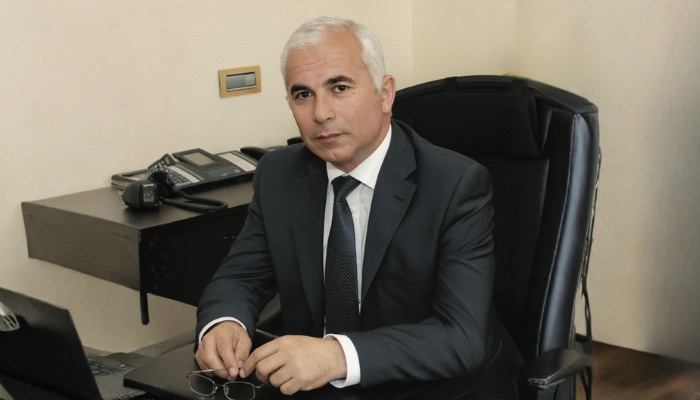
Caspian Energy (CE): Mr. Pashayev, how do you evaluate the development pass that the gas processing plant has passed?
Aqshin Pashayev, Director, Gas Processing Plant: Gas Processing Plant, one of the structural subdivisions of the State Oil Company of Azerbaijan (SOCAR), has been operating continuously for 52 years. The plant has made a worthy contribution to the development of the oil-gas sector of the country over this period. It is clearly seen when considering the path that the plant has been following since its establishment. The project of the plant was designed by Giproazneft institute in 1958. The main objective of SOCAR Gas Processing Plant is to process natural gas, gas condensate and broad fraction of light hydrocarbons by using advanced techniques and technologies aiming at manufacturing of competitive products. The first stage of construction of the gas processing plant was completed in 1961.
Units for recovery of petrol out of gas (process shop #3), units for processing of gas condensate and fractionation of non-stable natural gasoline (process shop #4) were commissioned during the first stage.
During the second construction stage the units recovering petrol out of gas at process shop #2 were commissioned in 1963. The similar units were launched at process shop #1 in 1964. The initial rated capacity of the plant enabled to process 4.5 bcm of gas per year. Reconstruction work was carried out in 1986 on basis of the project implemented jointly with YUJNIGIIPROGAZ institute (Donetsk) so that to increase the production capacities of the plant. As the result, the processing capacity grew up to 6.5 bcm per year. An underground pipeline designed for natural gas transportation was laid above the trestle, an underground water pipeline was replaced with the sub-surface line and two gas-measuring units were built within the framework of the reconstruction project. The unit #5 (process shop #3) for petrol recovery out of gas was thoroughly repaired and commissioned after a 10-year standstill in 2001. Operations on assembling and linking of process lines of first stage absorbers K-1 with other process chain units were performed through 2004-2008 to increase gas processing capacity, reduce operational costs and energy wastes, as well as reduce absorbent consumption on the units for recovery of petrol out of gas (process shops #1-3).
A new development stage at the plant has begun since 2007 after it became a part of the State Oil Company of the Republic of Azerbaijan. Special importance was attached to the issues concerning technical re-equipment.
Construction of measuring units for gas intake and transfer was completed in 2003-2004. Based on these units, a gas distribution station of the gas process plant was built in 2007. Two new air compressors L 110-10 produced in Germany were installed at the air compressor plant in 2007.
In spite of the fact that the unit #6 for petrol recovery out of gas was taken out of commission in 1994 after a long-period operation, the plant managed to restore capacities in 2008 after conduction of reconstruction work (first stage absorber K-1 was linked with the scheme of the unit recovering petrol out of gas #5).
Units # 1, 2, 3, 4 and 5 for separation of gas from petrol underwent capital repair at process shops 1-3 during 2007-2009. Large-scale operations on capital repair of tank and intermediary-tank farms were performed at shops #4 during the same years.
Apart from this, installed were advanced devices designed for measuring of gas volumes in tank farms, measuring of consumption rate at shop #7, as well as devices similar to FloBoss 407 for measuring of gas delivered to the plant and measuring of dry gas released from the plant.
Installation and commissioning of the systems controlling the level of market products in the capacities was completed in 2010. Since 2010 the dispatching point has established online control by means of measuring networks over incoming gas volumes and volumes supplied to the domestic market. A 600 diameter pipeline was laid from Garadagh gas compressor station to GPP and linked to a 700mm Dashgil-MSU-GPP gas pipeline in 2011 with the purpose to ensure direct delivery of gas from Main Sangachal Units (MSU) to the gas processing plant. Thus, gas is flowing from main Sangachal units directly to the gas processing plant bypassing Garadagh gas compressor station.
CE: What could you tell about the operating results of GPP through the first half of 2013?
Aqshin Pashayev: Azneft PA supplied 1,835,729,413 cubic meters of gas for processing in the first half of this year. As the result, a total of 1,802,790,133 cubic meters of dry gas was delivered to the customer. Gas losses for every 1,000 cubic meters were reduced from scheduled 4.4 cubic meters down to 3 cubic meters. The percentage rate of processed gas exceeded the plan by 0.09% and totaled 98.21% instead of planned 98.12%.
25,248 tons of unstable natural gasoline was produced within the first half of 2013 out of total amount of raw materials supplied to GPP. A total of 25,204 tons of unstable natural gasoline was delivered for processing over the reporting period. The volume of commercial butane and natural gasoline produced at GPP totaled 9,367.2 tons and 15,622.5 tons respectively. The plan on production of finished liquid product was fulfilled by 103% over the reporting period.
23,723 thousand cubic meters of gas were produced as the result of desorption over the reporting period. Of this total, 23,035 thousand cubic meters of gas or 97.1% were used as fuel: 19,757 thousand cubic meters were consumed by the unit for petrol recovery out of gas; 580 thousand cubic meters were consumed at fractionation unit #7; 2,698 thousand cubic meters were consumed by boiler houses. Another 689 thousand cubic meters of gas were flared.
The unit for processing of gas condensate and fractionation of unstable natural gasoline (process shop #7) processed 25,203.856 tons of unstable natural gasoline within the first half of 2013. As the result of fractionation of produced unstable natural gasoline, released were 9,367.215 tons of commercial butane and 15,622.541 tons of natural gasoline.
Losses fixed throughout gas storage right up to its shipment totaled 335.2 tons. It is 884 tons below the normative figure.
Average daily output of processing totaled 10,142 thousand tons of natural gas within the first half of this year.
1160.3 thousand AZN was allocated in the first half of 2013 for an overhaul repair of process units, buildings and facilities within the framework of the capital maintenance program.
CE: What importance does the plant attach to social issues and environmental protection?
Aqshin Pashayev: Over the period of operation GPP attached serious importance to issues concerning improvement of labor conditions, setting of proper control over observance of safety rules, accident-free and safe operation of equipment, setting of safety techniques in accordance with the requirements of the “single system”, modernization of process sections, buildings and working places in accordance with world standards. All necessary measures are undertaken to prevent accidents, occupational injuries and improve labor conditions. Respective commissions are regularly inspecting labor conditions of employees. All revealed short-comings are considered timely. No cases of halting of operation of facilities by control bodies were fixed over the reporting period.
Capital and maintenance repair work is regularly conducted on process units, equipment and operation rooms in order to improve their technical condition.
Environmental protection issues are under daily control. The plant has started introduction of the international standard on environmental management ISO 14001 since 2012. Apart from this, environmental projects preventing pollution of atmosphere and water bodies were prepared. In particular, necessary measures are undertaken to reduce emission of hydrocarbon gases into the atmosphere from process furnaces, boiler uptakes, burning torches, ventilation units, compounds of process communications, safety valves, etc. Sources of pollution are eliminated at the area of the plant. Measures are undertaken for cleansing and planting of greenery. 5,140 trees and bushes were planted over the past year in the area surrounding the plant. Polluted areas around the plant were improved. All production wastes that emerge during production process at the plant are sorted and placed on specially allocated sites in terms of prevention of environmental pollution.
Issues of improvement of social wellbeing of employees as well as efficient use of leisure time are also in the center of attention of GPP.