


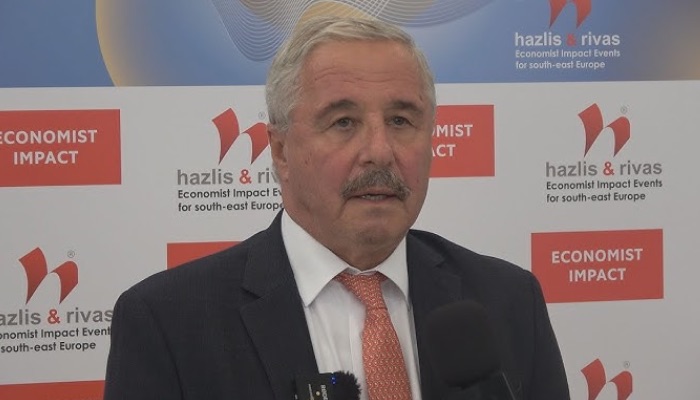
Caspian Energy (CE): Mr. Minister, how do you evaluate EU’s energy security system, which changes and transformations are expected to be made in Greece’s energy system in coming years?
Yannis Maniatis, Minister for the Environment, Energy and Climate Change of the Hellenic Republic: The EU’s energy security system has evolved in response to the challenges facing its Member States which are also relevant to Greece. While it is important for the Member States to maintain their right to determine their own energy mix, Greece considers that common challenges are most effectively addressed by joint action at the EU level. Apart from the reduction of GHG (Green House Gases) through a policy of gradual de-carbonization of our energy mix, Europe’s highest energy priority is the management of its increasing import dependency, especially when it comes to oil and natural gas that will continue to dominate the Union’s primary energy supply.
Part of the EU’s response to these challenges is the promotion of market liberalization and de-regulation that has been consolidated by the so-called 3d Energy Liberalization “package” introduced in 2009. Greece has helped to shape this new body of legislation along with the other Member-States and has taken the necessary steps to fully conform to EU regulations and policies. As a result of these initiatives Greece is currently in compliance with its 20-20-20 targets primarily due to an impressive increase over the last five years of wind energy generation and notable improvement in our energy efficiency.
With regard to the hydrocarbon sector, our primary concern is to minimize the risks inherent in our energy dependence via the diversification of sources, routes and supplies. Greek policy choices are therefore designed to promote the EU’s Southern Gas Corridor strategy. In addition, recent hydrocarbon discoveries in Israel and Cyprus could emerge as a new and important source of natural gas (and may be) oil imports for Greece and the EU.
In short, the reduction of our import dependence through the diversification of our import sources and routes, the emergence of Greece as a major regional hub for the export of Caspian and Middle Eastern hydrocarbons to the EU, the exploitation of potential on-shore and off-shore indigenous energy sources, the increasing role of Renewable Energy Sources (RES) and the promotion of energy efficiency constitute the main priorities of our medium-term and long-term national energy planning.
CE: What could you tell about the policy of demonopolization of the Greek energy market in accordance with the guidelines of the European Commission?
Yannis Maniatis: Greece’s regulatory and legislative framework is fully harmonized with EU legislation. Greece was one of the first EU Member States to transpose the 3rd energy package. Since 2009 significant progress has been made towards the liberalization of the Greek electricity and natural gas market. It is an ongoing process. In 2011 Greece adopted the 3rd EU internal energy market package (law 4001/2011).
Since then the country’s largest electricity company DEH or PPC (Public Power Company) was vertically unbundled while we further divided the former Transmission System Operator (TSO) for Electricity (DESMHE) in the Independent Transmission Operator (ADMHE) and DEDDHE, the legally unbundled electricity Distribution Operator. Furthermore, recently the Ministry has put forward a three phase privatization program for PPC which should be completed by 2015.
In the gas sector the TSO (DESFA S.A.) has already been privatized (66% of the shares have been transferred and the State keeps 34%) while the privatization of DEPA is underway. Since 2010 the Greek natural gas market has been fully liberalized and the independence of the Regulatory Authority for Energy (RAE) is fully protected by the existing provision of national and EU legislations. RAE has all the respective legal, institutional, administrative and financial capabilities to fulfill its tasks.
CE: To what extent do the conditions of the third energy package comply (within the framework of TAP project) with the terms of gas sale in Greece? How will you overcome the conditions of the third energy package after privatization of the Greek gas system by SOCAR?
Yannis Maniatis: The legal and regulatory environment was of course taken into account in the drafting of the terms and conditions of the call for offers for the privatization of DEPA and DESFA. The tendering procedure was fully compliant to European Legislation and therefore a positive reply by the European Commission is expected regarding the privatization of DESFA to the Azeri company SOCAR.
CE: What are Greece’s expectations from implementation of TAP project? What are the conditions for transit of Azeri gas to other countries of Europe?
Yannis Maniatis: TAP consolidates Greece’s position as the gateway for the transit of Caspian gas to Europe and strengthens the country’s significance as a hub in the South East European region. Moreover, the boost that TAP is expected to give to the further development of the natural gas sector throughout the SEE region, by fostering additional smaller infrastructure such as IGB, the interconnection between Greece and Bulgaria, and promoting the use of gas is beneficial for the region as a whole. In economic terms, TAP constitutes one of the largest sources of foreign direct investment in Greece, and is estimated to cost approximately Euro 1.5 bn for the Greek section.
According to TAP, during construction, TAP is anticipated to create some 2,000 direct, and up to 10,000 indirect, new jobs across a number of industries including manufacturing and utilities, transport, communications and financial and business services. At the same time, the diversification of sources, which is the main contribution of TAP in the security of supply in Europe, will enhance the competition among the suppliers and subsequently lower gas prices could be offered to the market, to the benefit of the final consumers. The conditions for transit will mainly depend on the commercial conditions offered by the suppliers of gas and the owners of TAP, at least for the part of TAP’s capacity that has not been exempted from third party access.
CE: Which factors must the gas price formula take into account? Do you support pegging of gas price to the spot market?
Yannis Maniatis: The competitive position of important sectors of the European economy depends significantly on the availability of competitively priced energy, given that energy constitutes a substantial part of the total production costs of key industries, including large but also small and medium enterprises. Therefore the fundamental principle for pricing natural gas is that it needs to be competitive with other sources that make up the national energy mix, as well as affordable to consumers, while taking into account the need for an adequate return to investors. Increasingly in Europe, pricing is strongly influenced by regional pricing hubs while oil indexation of natural gas contracts is falling. According to the latest EU figures, since 2010 its share went down by 8% reaching 51% of gas consumption in Europe. In contrast, over the past 5 years spot-priced volumes have doubled, reaching 44% of gas consumption in 2012.
The integration of the internal market and the increased interconnection of markets through the development of infrastructure support the trend towards greater liquidity, hub pricing and gas-to gas competition which is currently more in evidence in the more developed north-west markets. South Eastern European markets should also benefit from such developments to ensure competitiveness.
Overall the impact of high energy prices and costs on the EU’s economy is an issue of increasing concern, in light of indications of Europe’s eroding competitiveness and the European Commission is currently preparing an analysis of the composition and drivers of energy prices due by the end of the year. In this context, the Heads of State and Government, meeting in the European Council summit in May 2013, specifically requested the Commission to look into the issue of the contractual linkage of gas and oil prices and we look forward to debating further this matter.
CE: How does Greece develop cooperation with the Caspian countries - Kazakhstan, Azerbaijan and Turkmenistan?
Yannis Maniatis: Greece enjoys excellent diplomatic relations with these countries and has been developing bilateral relations in the political and economic fields. Cultural ties are also important, aided by the existence of descendants of the Black Sea Greeks of Asia Minor. Indeed it is noteworthy that the Greek language is taught at the universities of Baku and Almaty. Moreover ties with Azerbaijan have evidently become closer lately, due to the purchase of DESFA by SOCAR and the selection of the Trans Adriatic Pipeline (TAP) by the Shah Deniz II Consortium. We look forward to strengthening this position with the development of future supplies of gas beyond the second phase of the Shah Deniz field.
While bilateral relations are based on meetings of Inter-Ministerial Committees with our partners and a range of agreements, Greece also advocates cooperation within multilateral fora, including the BSEC and OSCE, where Greece supported Kazakhstan’s bid for the 2010 Chairmanship. Of course we advocate closer relations between the region’s states and the EU, which we will be able to promote during Greece’s six-month Presidency of the European Council that starts on 1st January 2014. As you know these countries have already signed energy specific MOU’s with the EU which constitute a good starting point.
CE: Will EU buy gas on the border of Turkmenistan which puts forward this proposal?
Yannis Maniatis: For this to take place, the issue of the transportation to the EU borders should be solved, which is not yet the case.
CE: Do you support the Trans Caspian gas pipeline project?
Yannis Maniatis: Greece values the contribution that natural gas from Turkmenistan could potentially make, to enhance the energy security of the European Union and supports initiatives which could further develop the Southern Corridor and enhance security of supply. In this context Greece, together with its EU partners endorsed the mandate to enable the European Commission to negotiate a treaty between the EU, Azerbaijan and Turkmenistan to build the project. However this project will have to be realized with the mutual consent of all interested parties. The EU does not support any politically motivated pipelines. Only projects that are proven to be marketable can be actually implemented.
CE: Which sources and types of energy resources are more attractive for the Greek economy?
Yannis Maniatis: Currently oil remains the dominant fuel for transport, in industry, as well as in the building sector, although important steps are being made to increase the participation of biofuels in the country’s transportation fuel mix in accordance with our 20-20-20 obligations. Indigenous coal remains the principal electricity generation fuel for the medium-term although by 2020 natural gas and Renewables will further increase their shares by helping the gradual de-carbonization of our electricity mix.
As already mentioned, important investments have materialized on the renewables sector, where the country has experienced a significant increase of installed electricity production capacity.
Another important priority is the interconnection of our RES-rich islands with the mainland’s electricity network. The tender for the interconnection of the southern and central Cycladic Islands has been issued while we are studying the details for the interconnection of Crete. This interconnectivity is strategically important for Greece for reasons that go far beyond the increase of their respective RES potential.
The share of Natural Gas is expected to increase for residential, commercial and small industrial users with the establishment of three new regional distribution companies. Moreover DEPA has recently launched a program for the extension of the network of gas filling stations that will further the penetration of gas in the transportation sector.
Apart from TAP – we have the Interconnector Greece-Bulgaria promoted by DEPA with its Italian and Bulgarian partners, and there are proposals for both LNG and gas storage in the northern Aegean area. Moreover the national network is being expanded and recently the EIB (European Investment Bank) extended a €25 million loan to DESFA for the expansion of the national transmission system to the Peloponnese through the construction of a high-pressure pipeline.
Moreover Greece is aggressively promoting the re-birth of its upstream hydrocarbons industry where the initial results of a 12.500 km2 seismic survey study in the Ionian Sea and the Sea to the South of Crete have been very encouraging. By the end of the year, the study of the seismic survey, carried out by PGS, will be completed so as to be able, by 2014, to demarcate at least 15 offshore blocks that would be subsequently tendered through the “Open Door” process.
The rebirth of our upstream hydrocarbon industry can become one of the drivers for the exit of Greece’s economy from years of recession. Private investments of up to $ 60.000.000 were announced last month for the support of ongoing oil exploitation in the Kavala region. In the next few weeks the Greek Parliament will be ratifying the contracts with the winners of the tenders for the exploration and exploitation of three areas, one onshore and two offshore, in Western Greece.
CE: Do you find Greece’s energy sector attractive in terms of investments?
Yannis Maniatis: Greece’s geographic location is advantageous for the transit of natural gas from new sources in the Caspian Sea and the Eastern Mediterranean region. This and the potential increase of energy consumption expected following the end of the recession period makes the energy sector in Greece attractive. Moreover, the transposition of the EU’s 3rd energy package, on the basis of which the Greek energy markets are being further opened up coupled with the necessary liberalizing reforms of its regulatory framework, as well as Greece’s privatization program, make Greece extremely attractive for investors and create major opportunities.
For example, the recently announced plans for the restructuring of the Public Power Corporation are expected to create greater competition in the Greek electricity market, which in turn will lead to further investment opportunities, for the benefit of our consumers. The “South Kavala” natural gas field is another example of possible interest for major investors. Our objective is to review alternative ways of exploitation of the rights over the nearly depleted South Kavala offshore natural gas field, via its usage, development and commercial exploitation as a natural gas storage facility. Moreover, as I already mentioned, developments in the hydrocarbon sector, are especially interesting offering opportunities for major investments and this has already been demonstrated by the interest expressed by major oil companies for the tendering processes launched so far.
Finally it is noteworthy that major Greek projects have already been short-listed as EU Projects of Common Interest (PCI), pending the final decision by the end of the year. This creates opportunities for investors, since, as you know, the PCI label will facilitate the financing of projects which will be fast-tracked in terms of getting all necessary permits and licenses. Prospective PCI’S include: For Gas, the Interconnector Greece-Bulgaria, proposed projects for the development of an LNG terminal in the Northern Aegean area, the East Med pipeline from offshore gas fields in Cyprus to the Greek mainland via Crete and the Interconnector Greece-Italy. For electricity, the line between Greece and Bulgaria (Maritsa-Nea Santa) and the Euro-Asia Interconnector linking Israel to mainland Greece via Cyprus and Crete.
CE: Does the country plan to develop LNG market?
Yannis Maniatis: Greece is developing an LNG market. Already about 20% of its natural gas supply is based on a Long term contract with Algeria’s Sonatrach and amounts are supplemented with gas purchased on the spot market. Due to its geographical location, Greece has the potential to provide access to LNG to other regions of Europe including land-locked areas in South East Europe. Currently there is an LNG terminal, south of Athens, on Revythousa Island, with two storage tanks (capacity 65.000 m3 each) and plans are underway for its expansion. Its benefits were most apparent during the 2009 gas crisis, when shipments minimized the effects of the disruption and enabled Greece to assist Bulgaria with emergency supplies. There are also planned projects for LNG in the North Aegean, which would be instrumental in enhancing the security of supply of South East Europe and pending a final decision due at the end of the year, 2 such projects are being earmarked as EU Projects of Common Interest.
Finally, we expect that LNG will develop into a key fuel for the shipping industry in Greece.
Thank you for the interview