


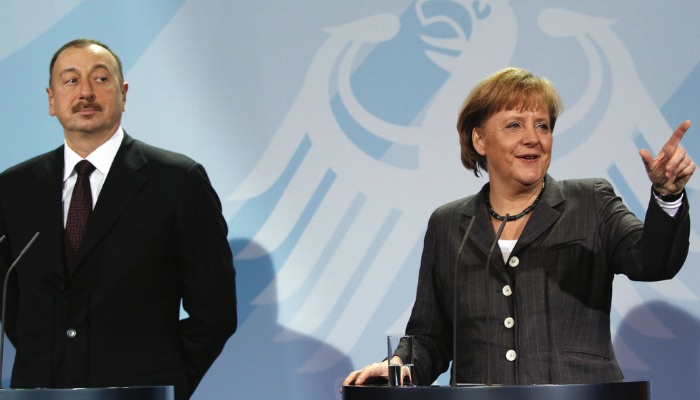
Europe and the Caspian Region share common interests, above all: energy. Although their centers of both regions, Berlin and Baku, are separated by 3500 kilometers, Caucasian countries are considered neighbors. Caspian region is part of EU neighborhood policy, and as well in a partner in the so called Eastern Partnership, that was created to ensure stability and peaceful development in the region.
Europe needs more gas, and especially Germany. To reduce emissions and to back up volatile production from renewable power installations a lot need to be done in the coming years. While EU is struggling for a common energy plan, every state has its own idea how to generate power for machines and heat for homes. Sweden, in the very north of the Union, generates a lot of electricity with water power, France depends largely on nuclear energy and Italy on gas. The contrasting policies are easy to see along the Rhine river, where you find neighbors with completely different energy politics. Nuclear power plants line the French side of the river, while on the other side Germany has decided to leave nuclear energy completely until 2022 and to shut down nuclear power plants one by one.
In Germany, the country of new techniques and renewable energy, half of the electricity is still produced from coal, steam coal and lignite. Some is found in the country, but the largest share is imported from several countries around the globe. It is for the good that coal is a globally well distributed commodity. Engineers are constantly trying to improve techniques and to gain more efficiency out of fossil fuels, and find new ways for reducing CO 2 and other emissions. But although a lot of money has been spent to improve efficiency of power plants running on fossil energy, even more efforts are directed to renewable energies: new technologies to get power from Wind, sun and water and bio gas.
Today, almost 25 percent of the electricity in Germany is produced from renewable sources, ten years ago the rate was only 5 percent.
The government was very successful with its measures to encourage solar installations and wind mills. Tax reduction and value add for every watt produced helped raise the interest of private households to invest in renewable energy. Farming communities in the windy north of the country set up wind parks with shared interest. In some villages along the North Sea coast every household bought shares. Interest rates have climbed much higher than farming ever could.
Wind power onshore is well in business in many parts of the country. Wind power offshore is still under exploration. So far three offshore parks in deep water are producing and sending electricity onshore. But until now it is not yet proven, if the investment is feasible. Offshore energy needs huge investments, a lot of service and still lacks experience.
Generally speaking, renewable energy seems a good solution for a country scarce of natural resources. But even if these new technologies are introduced on a large scale, fossil fuels are still needed to fill in times of low production and to fill the peaks. Production of renewable energy is not predictable. So in case the windmills do not turn there need to be power stations that can operate and produce quickly on a short time basis. For these needs there are only two options: coal and gas.
Gas is the better option
Coal is an option that will not meet to CO 2 emission targets set in the Kyoto Protocol if it is fired in the old power plants. New ones are set up, with chances to capture some CO 2 and filter some of the emissions. But still gas seems the much better option.
Getting gas to substitute for renewable energies in times of less production seems easy at first sight. Several surrounding countries of Europe produce considerable amounts: Norway, Great Britain, Netherlands, small quantities even in Germany. But production is decreasing in Norway and Great Britain. Russia is well in business selling large quantities via several pipelines, and it is planning to sell more. Only 18 months ago Russian gas pipeline North Stream started delivering 55 bcm every year. Long quarrels about the route and a political debate about the high quantities of gas Russia deliveries to Germany could not stop the project. Those in favor want pipelines to ensure sufficient amounts of gas, those against it complain about a high dependency on Russia economically that could lead to a political dependency. So far, slightly over 40 percent gas in Germany is of Russian origins. When two more pipes to be built across the Baltic will start to pump Russian energy to the West, this will raise to about 60 percent, not counting the quantities that would come in if South Stream was built, a pipeline also fed with Russian gas.
Strong interest for Caspian gas for diversification
Therefore, there is a strong interest in the European Union to get Caspian gas. The Southern Corridor, meaning gas deliveries from Baku through Azerbaijan, Georgia and Turkey, is of high interest in all parties in Germany. Most people had been hoping that Baku would decide in favor of Nabucco pipeline. But the decision was made for TAP. It was a disappointment, but most important is the fact that the Southern Corridor will be opened and Caspian gas will come to Europe.
After the coming elections in Germany on September 22 it could become interesting, where the new government will lead its interests. Asked for their opinion about the importance of the Caspian region and Caspian gas for Europe, all parties in Germany agree that the Caspian region is of superior importance to Europe. Considering the unrest in the Arab world, Caspian gas seems to gain even more importance.
Accordingly, the German Ministry of Economy and Technology states: “In the Caspian Region are large resources of natural gas and oil. Already today, this region plays an important role to provide Europe with sufficient fossil energies. By transporting oil and gas i.e. through the Southern Corridor this regions helps to diversify in ways of transport and sources of delivering countries of energy, via BTC-Pipeline [Baku-Tbilisi-Ceyhan], the South Caucasus-Pipeline [SCP] or BTE [Baku-Tbilisi-Erzurum-pipeline].”
Most important countries are Azerbaijan and Kazakhstan. “Already today, they are important for Europe’s need of oil.” During the first six months of 2013 Germany covered 12 % of its needs for oil from these countries. “In future, Azerbaijan will play an even more important role to deliver natural gas to Europe via TANAP (Trans-Anatolian pipeline) and TAP (Trans-Adriatic-Pipeline). First Azerbaijan gas should be received by 2018. The EU and Germany are also working to find ways for getting access to large resources of Turkmen gas for Europe.”
Stronger ties are needed
Azerbaijan, Kazakhstan and Turkmenistan invest in large projects for exploration of oil and gas, some with foreign partners (Shah Deniz II, Absheron, Kashagan, Galkynysh). In the coming years there will be more quantities from these countries for the international market. Through the Southern Corridor they will also find their way to the European market. So “the importance of the Caspian Region for Europe is growing!”
Energy security is a high priority on the agenda of the Ministry of Foreign Affairs in Berlin. “The Caspian Region is of high importance for Germany and the European energy market”. The ministry states in Berlin: “The whole region has large fossil energy resources. With the opening of the Southern Corridor and the decision in June this year to build the Trans Adriatic Pipeline the importance for energy politics in the region for Europe will grow even more in the future”. The ministries as well as the political parties agree on the growing importance of the Caspian.
In the latest polls, Chancellor Markel’s ruling Christian Democratic Party has the highest chances to win the elections. Their energy coordinator Thomas Bareiss states at beginning of September in Berlin: “The Caspian area is of special interest for Germany and for Europe, because their large amounts of natural gas resources can offer diversification and energy security. Azerbaijan, Kazakhstan and Turkmenistan play the most important role due to their reserves. But also transit the countries are of very high importance to provide energy security. Germany will have to intensify its partnership relations with these countries. There is a growing demand worldwide for these natural energy resources. An example for cooperation are the treaties about natural resources and partnership with Mongolia and Kazakhstan.”
The Green Party that strongly encourages renewable energies also agrees that gas and oil from the Caspian region will play an important role in the near future. But Hans-Josef Fell, their energy specialist states that the Green Party wants to “end the use of fossil energy by 204o. The World expo in Astana 2014 offers a chance to look for more techniques in renewable energies.” he points out. “Natural gas will still be needed for some time, but we should keep the consumption stable and then reduce. But we should not set up new gas power stations.” Especially the “dependency on oil needs to be reduced”, he says. That is very important for the climate as well as for the milliards of Euro, that “cause a spending deficit of 120 Billion in the European Union.” And he explains: “If your income is lower than your heating costs, you will have to reduce your heating.”
He knows that things are not quite that simple. But the green party wants to slowly reduce the use of all fossil energy and replace it by renewable. Gas is still needed for the coming years, but the Greens want to bring more bio gas into business. “New pipelines are needed” Fell says, “but for bio gas.” At the same time he knows that Caspian Region is needed to satisfy European energy needs, and looking at today’s political development in Near East he mentions, that the Caspian Region may become much more important quickly, because some deliveries from that part of the world may even have to be substituted.
To sum it up: wherever you look, it is very clear and agreed by all that the Caspian region is of growing importance for Germany and for Europe as a whole. Now it is time to deepen contacts and build closer ties.