

Heavy industry and machine building
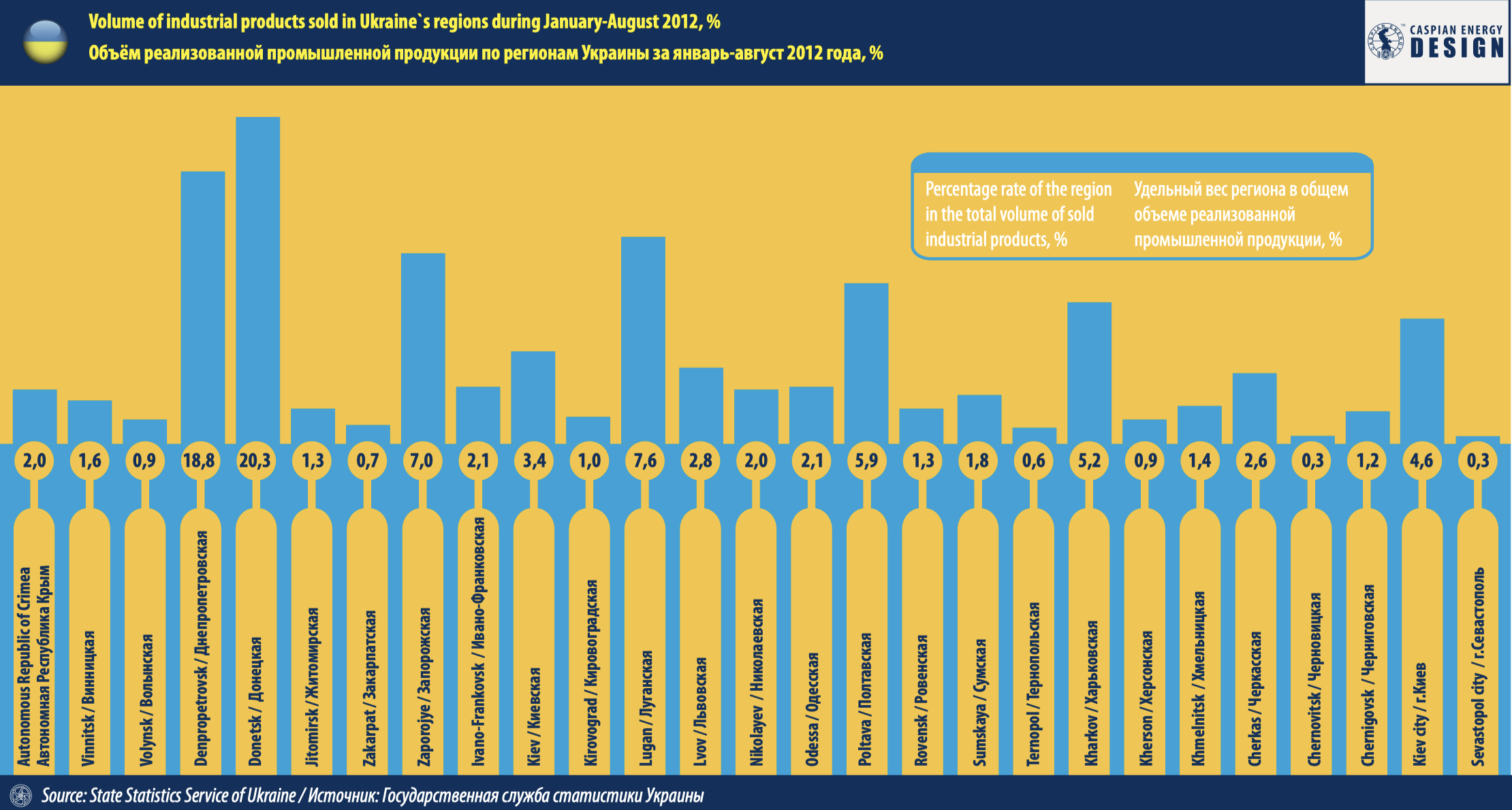
Industrially developed regions, including Donbass (Lugansk and Donetsk areas), Kharkov, Lvov, Odessa, the Zaporozhye and Dnepropetrovsk areas and also the Ukrainian capital, Kiev city, form the cornerstone of the national economy. The Donetsk oblast is presented mainly by enterprises of coal and metallurgy industries, Lugansk by coal production, oil processing and machine building enterprises. The Kharkov area specializes in machine building and metalwork, industrial production of construction materials. Pridneprovye’s industrial regions, the Zaporozhye and Dnepropetrovsk oblasts, are presented in the national economy by ferrous and nonferrous metallurgy, mechanical engineering, metalwork.
Heavy engineering and ores production constitute a leading direction for the Dnepropetrovsk Oblast. The Krivorozhye coal basin considerably contributes into the national economy. Industrial enterprises of Odessa play an outstanding role for the economy of Ukraine and are represented by machine-tool factories, mechanical engineering and metalwork enterprises. During certain years the GDP of Ukraine had been growing mainly at the expense of contribution of industrial enterprises of the the Kiev Oblast. This region is represented by machine-building and metalcutting enterprises, manufacturers of construction materials. Kiev’s enterprises regularly account for 18% of total GDP. The contribution of Donetsk and Lugansk Oblasts to GDP comprised in total about 20%, about 10% accounted for the Dnepropetrovsk Oblast and approx. 5% to Zaporozhye.
Mechanical engineering has been playing a special role in strengthening of economy of Ukraine and her becoming an independent highly-developed state. The “Economic miracle” of Germany, Japan, South Korea and other states once started with development of its modern branches. Mechanical engineering is one of the leading links of heavy industry. The machine-building industry creating the most active part of the fixed business assets (labour instruments), essentially influences rates and directions of the scientific and technical progress in various branches of economy, labor productivity growth, other economic indicators defining efficiency of the social production development.
In Ukraine this complex is among the most developed spheres. It accounts for more than 40% of the total industrial and manufacturing potential of industrial production. The production of this complex accounts for 29% in the total production of the industry.
The role of mechanical engineering in country’s development is defined by its serving function in all interbranch complexes: fuel, agroindustrial, construction and others. The status of the country and her place in international economic integration processes in many respects depends on the share of machine-building products in the structure of export. Especially significant is the role of mechanical engineering of Ukraine in economic integration of the CIS states.
The production of metallurgical equipment is almost completely (95.5%) concentrated in the Donetsk and Pridneprovye economic regions.
The centers of the power equipment are: Kharkov (providing 40% of the total power equipment of Ukraine), Zaporozhye, Kiev, Dnepropetrovsk, Melitopol, Lvov, Ternopol, Poltava, New Kakhovka, Tokmak (Zaporozhye Region), Odessa.
Automobile factories of Ukraine produce oversize vehicles (Kremenchug), buses and auto-loaders (Lvov), cars (Zaporozhye), cars for rural areas (Lutsk), automobile motors (Melitopol), and minibuses (Simferopol).
The aviation industry produces planes and knots, devices and spare parts. The greatest development of this industry is especially obvious in Kiev and Kharkov where factories manufacture passenger and heavy aircrafts, including one of world’s largest ones, AN-225. In connection with the conversion of production this industry has recently began to manufacture a lot of products of wide consumption.
Tractor construction is a consumer-oriented industry. Its major center is Kharkov where such factories as the tractor factory, tractor self-propelled chassis factory, and engine-building factory operate. Wheel tractors are manufactured in Dnepropetrovsk and tractor units in Vinnitsa. Some large enterprises manufacturing details and spare parts for tractors work in Simferopol, Kremenchug, Chuguyev, Kiev, White Church, Lugansk, and Odessa.
Machine-tool construction is concentrated in large cities including Kiev, Kharkov, Kramatorsk, Odessa, Zaporozhye, Lvov, and Zhitomir.
Ukraine completely covers her local needs with own iron ore, coke, manganese and other auxiliary materials. As to reserves of iron ores, Ukraine is the fourth largest country in the world (27 billion tons; following Russia, Brazil, Australia) and the sixth largest country in terms of ores production (48 million tons; following the People’s Republic of China, Brazil, Australia, India, the USA). The Krivorozhye iron producing area (Dnepropetrovsk Oblast) is the largest iron-ore basin. Here 75% of iron ore is produced by open way. Rich iron ores (with up to 60% of Fe content) there are almost exhausted. So now produced in Krivbass are mainly poor ores (with 35% of Fe content) that considerably increases wastes. After enrichment on the Southern, Krivorozhye, Central, Northern and Inguletsk ore mining and processing enterprises ore turns into a concentrate with about 62% of iron content, then arrives on agglomeration plants and further goes to blast furnaces. More than a half of enriched ore is supplied to steel works of the European part of Russia, Slovakia, Hungary, and Poland.
The Kerch (Crimea) iron-ore basin accounts for 4.2% of total ore production in Ukraine and steel works of Mariupol are the main consumers.
The development of fields of Kremenchug iron producing area (Poltava region) and large reserves, including rich ores, of Belozerskoye (Zaporozhye Oblast) iron producing area continues.
The Pridneprovsk manganese ore basin (Dnepropetrovsk oblast, Nikopol, Ingulets fields and Zaporozhye Tokmatskoye field) is world’s largest one in terms of production and the second largest considering reserves after the Republic of South Africa. The two thirds of production is carried out by open way and mine way. Ukraine supplies manganese ore to metallurgical enterprises of Russia and some European states.
Half of coke for metallurgy is provided by coke-chemical factories of Donbass where 13 out of 18 coke-chemical enterprises of Ukraine are located. Big coke-chemical factories of Donbass and Pridneprovye are located in Makeyevka, Mariupol, Gorlovka, Stakhanov, Zaporozhye, Dnepro-Dzerzhinsk, Krivoi Rog, Dnepropetrovsk.
Gumboils, metallurgical quartzites, refractory clay constitute a component part of the raw materials base of the metallurgical complex. Refractory clay is produced in Donetsk region, and high-quality flux limestone and dolomite are produced in Donetsk, Dnepropetrovsk oblasts and the Autonomous Republic of the Crimea.
Production of ferrous metals is concentrated mainly on the full-cycle enterprises located in three areas: Pridneprovye (Dneprodzerzhinsk, Dnepropetrovsk, Krivoi Rog, and Zaporozhye), Donbass (Donetsk, Makeyevka, Alchevsk, Konstantinovka, Kramatorsk), Priazovye (Mariupol). The largest iron and steel plants are: Krivorozhstal, Azovstal (Mariupol), Zaporozhstal and also Donetsk and Makeevsky metallurgical complexes.
Nonferrous metallurgy in Ukraine as compared with ferrous metallurgy is less developed, first of all because of the inefficient developed industrial categories of raw material resources. In Ukraine there are numerous fields of mineral resources for nonferrous metallurgy: aluminum raw materials (alunite of Zakarpatye, bauxites of Cherkashchina, nephelines of Priazovye), polymetals, mercury, nickel, titan, zinc, etc. But their exploration conditions are not sufficient.
Leading branches of nonferrous metallurgy are aluminum, zinc, magnesium, titanic, mercury, and ferronickel.
In the structure of non-ferrous metals production of Ukraine the aluminum industry goes first. It works on imported bauxites and consists of production of alumina and aluminum. Their production accounts for nearly 20% of total nonferrous metallurgy production. Aluminum oriented at the source of cheap electric energy and imported from Nikolayev alumina (produced from import bauxites of Hungary and Guinea) is melted in Zaporozhye. Sverdlovsk (Lugansk Region) manufactures aluminum alloys.
Fuel & Energy Complex
One of the most important structural components of Ukraine’s economy and the key factor of ensuring vital activities of the state is the fuel and energy complex (energy industry).
The structure of FEC’s enterprises includes coal mines, oil and gas wells, power plants, overhead lines. They are grouped into branches that act as basic elements of the branch structure of the energy industry.
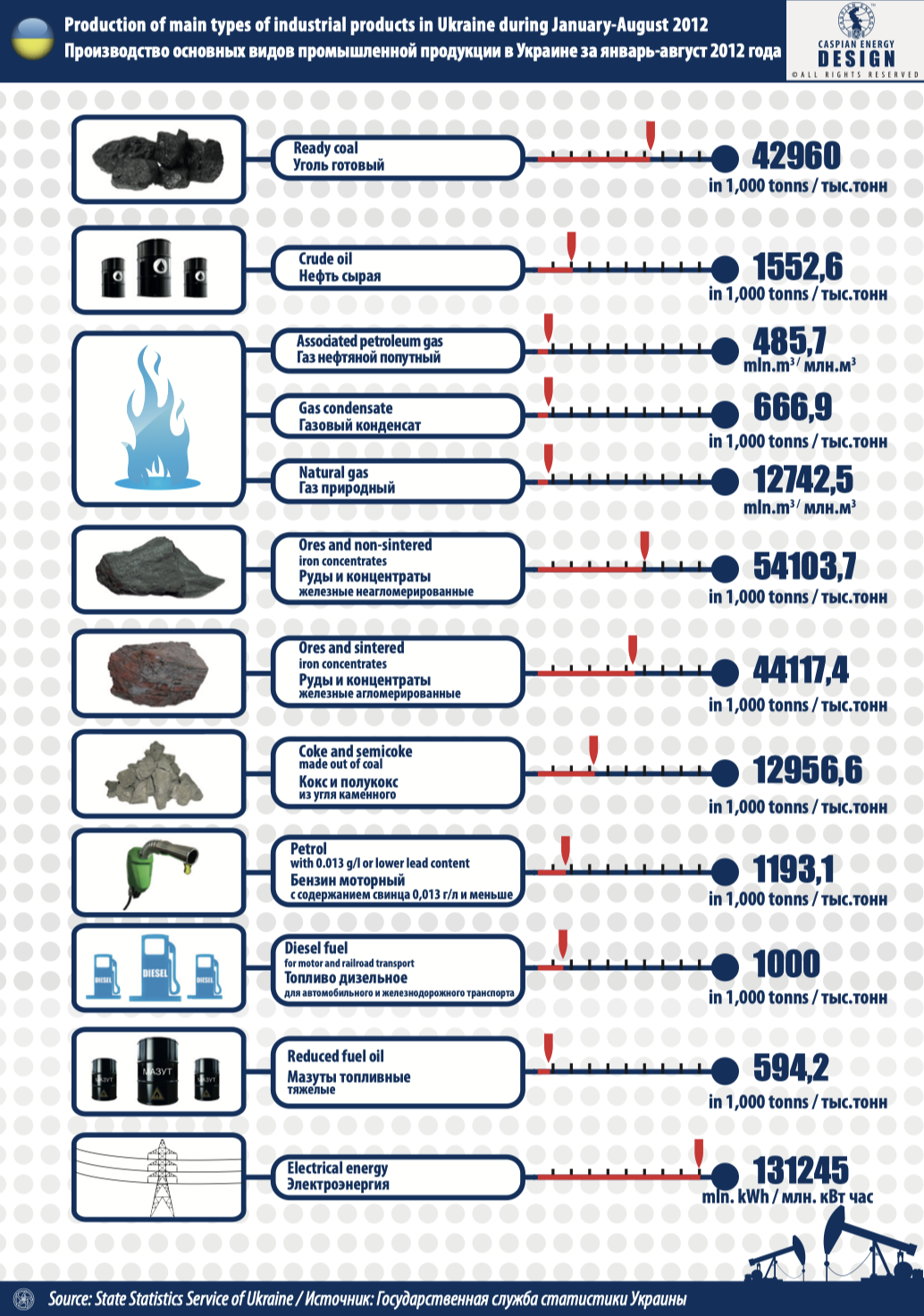
The coal industry in Ukraine is the old and traditional industry, dominating among fuel branches. Ukraine has large reserves (up to 200 billion tons) of high-quality coal that lies mainly on the considerable depth in Donetsk, Lvov-Volynskiy and Pridneprovsky (brown) basins. 75% of coal is used as fuel and 25% as process feedstock for ferrous metallurgy, chemical industry and other branches. The Donbass basin remains the largest coal producing area in the country. Carboniferous areas in Donbass make more than 50,000 square kilometers and possess about 98% of coal reserves of Ukraine.
The oil industry of Ukraine features low indicators, though potential possibilities of oil production and refining are rather higher. Oil produced in Ukraine has rather high prime cost because of imperfect technologies of production: production by progressive gushing has almost stopped here. Today every year own oil production comprises about 3 million tons vs. required 20 million tons of crude oil. Therefore Ukraine is a considerable importer of oil and oil products (mainly from Russia).
Oil processing industry of Ukraine is represented by several oil refineries with total capacity of 80-90 mln tons of oil per year. An oil terminal with the capacity of 25 mln tons of oil per year with possible capacity growth up to 100 mln tons has been recently built in Odessa. It is possible to pump oil from Azerbaijan, Kazakhstan, Iran, Iraq, Saudi Arabia, Yemen, Syria and UAE.
The Ukrainian terminals received Azeri Light oil in 2011 for further transportation along the Odessa-Brody oil pipeline in the averse regime as well as along one of the lines of Drujba oil pipeline to Belarusian Oil Refinery. According to the current contract signed between Ukrtransnafta and Belarusian Oil Company CJSC the Belarusian party was obliged to pump (in transit regime) 4 mln tons of oil per year along the oil transportation system of Ukraine. However, less than 1 mln tons of oil was pumped following the results of 2011. Odessa-Brody oil pipeline did not operate in the averse regime in 2012.
Construction of the Odessa-Brody oil pipeline branch was commenced for Caspian oil transportation. Ukraine is also ready to take part in construction of Ceyhan-Samsun oil pipeline in Turkey.
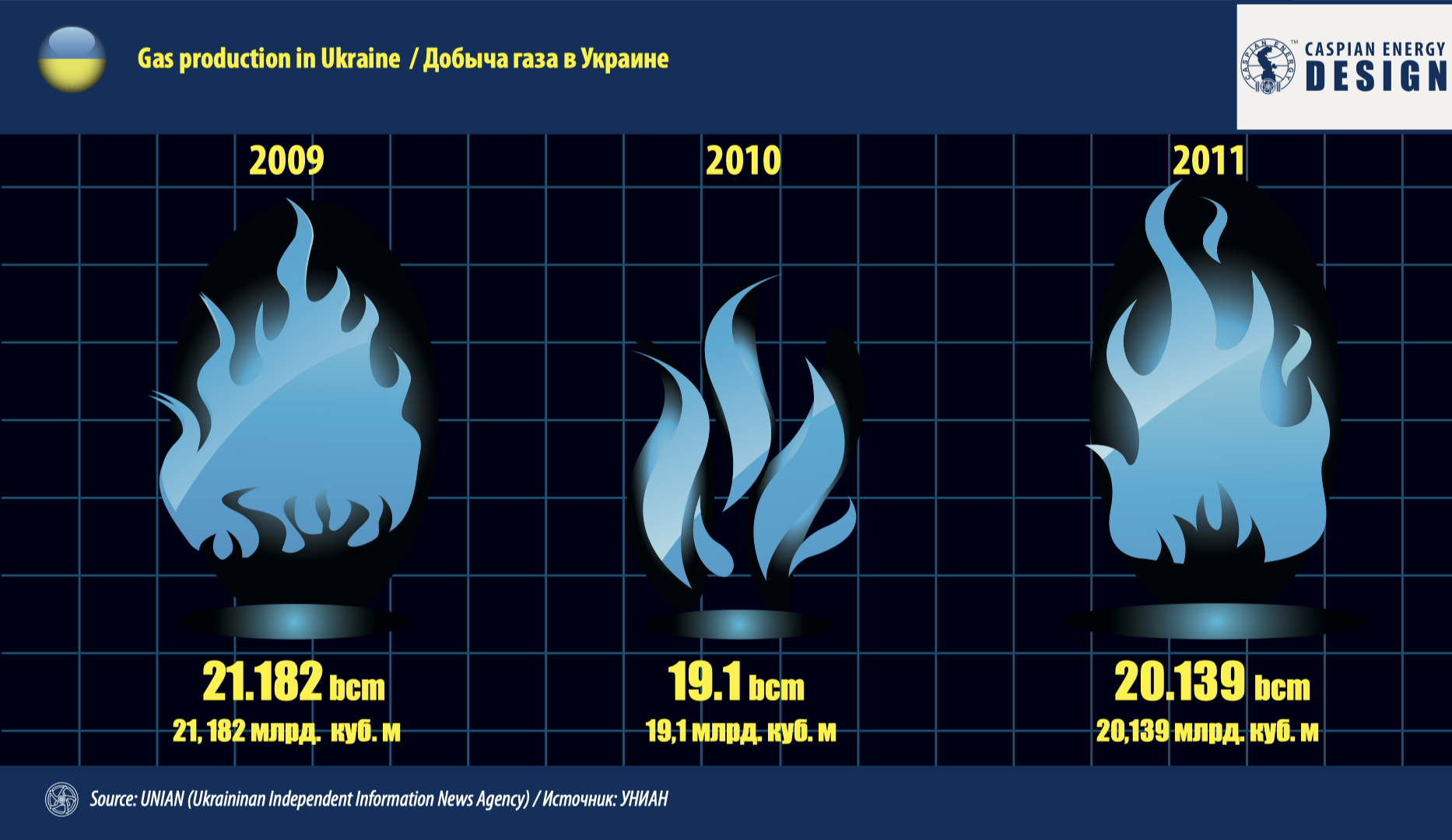
Gas industry is quite a young and promising branch therefore. Gas production in Ukraine totaled 20.1 bcm in 2011 including 18.1 bln as the share of daughter companies of Naftogaz. NJSC says that these indicators were achieved at the expense of measures undertaken for the growth of efficient use of production and resource base as well as commencement of development of new fields and reserves. According to the forecasts, Ukraine will increase gas production up to 21 bcm and 22 bcm in 2012 and 2013 respectively.
It is necessary for Ukraine to produce about 85 bcm of gas each year. The main reserves of gas production growth in Ukraine are the search for perspective fields and introduction of new technologies.
Ukraine is the biggest gas consumer in Europe today. 65%-70% out of 60 bcm that the country consumes each year is imported. Neftegaz Ukrainy and ExxonMobil signed a Memorandum on cooperation in exploration of reserves of unconventional hydrocarbons in Ukraine on February 16, 2011. Shevron Corporation was announced the winner of the tender for production of hydrocarbons in the area of Oless field (Lvov and Ivano-Frank regions) on May 14, 2012. Shevron presented the draft of the agreement on distribution of products during the development of Oless gas bearing field to the Cabinet of Ministers on August 23, 2012.