


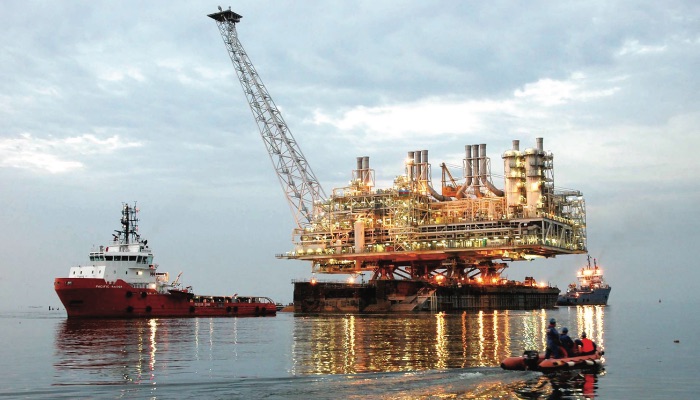
The price growth of oil-gas assets worldwide caused by political instability in traditional oil producing centers, lack of discoveries of new mega-fields, consumers’ ambition to demonopolize sources of supply of energy resources, emergence of new technologies providing high-performance production of oil and gas resources that used to be hard to reach before, and high environmental requirements of consumers led to a new stage of importance of “old-new” oil-gas producing centers of the world. High-technology companies keep discovering new commercial reserves in “depleting” North Sea while big oil companies return to exploration of the Caspian gas reserves which they found unattractive only 10 years ago.
A new cycle of global oil-gas industry development is nowadays associated with natural gas as its market outlooks are becoming much closer to those of oil (it is assumed that 50% of natural gas trade and its liquefied fractions will have been conducted through swap operations by 2015). At first, it will not be able to provide stability for the participants of the whole “well-consumer” process, however an adequate construction of appropriate infrastructure (floating LNG plants, high-tonnage tankers, regasification capacities and gas storages) will enable to have this energy resource, underestimated earlier, globalized and make it a real global energy carrier.
The Caspian region with its almost 55-year oil-gas production traditions is attached particular importance from this point. Forecast data provided by various sources about the Caspian reserves differs. The Russian sources divide reserves along the Caspian water boundary, i.e. they reach from 15 up to 18 bln tons of reference fuel depending on sectoral division. The present oil reserves of the Caspian basin were estimated approximately at 200 bln barrels (about 27.5 bln tons) in the report of the State Department and National Security Council of the USA.
Indeed, every state manages its own Caspian reserves independently and builds own strategy for exploration and development of the Caspian resources regardless of any estimates and forecasts.
Comparing oil-gas reserves and production ranges of Russia and Iran in the Caspian, it is becoming clear why their Caspian resources are not in the list for immediate development, why they do not and will not play a special role in GDP of both Russia and Iran.
Development of the Caspian resources is a top priority matter for other three countries such as Azerbaijan, Kazakhstan and Turkmenistan. Meanwhile, the period coming after 2014 will mark the boost of exploration drilling for new drilling units are to be built in Azerbaijan and Kazakhstan. Kazakhstan will finally receive the first volumes (about 3-6 mln tons) of annual production from Kashagan in 2014 and deserves congratulations in this regard.
This period will also mark the growth of oil-gas production in the Turkmen and Russian sectors due to the commissioning of already ordered riser and producing platforms at Jigalibek and Filanovsky fields respectively.
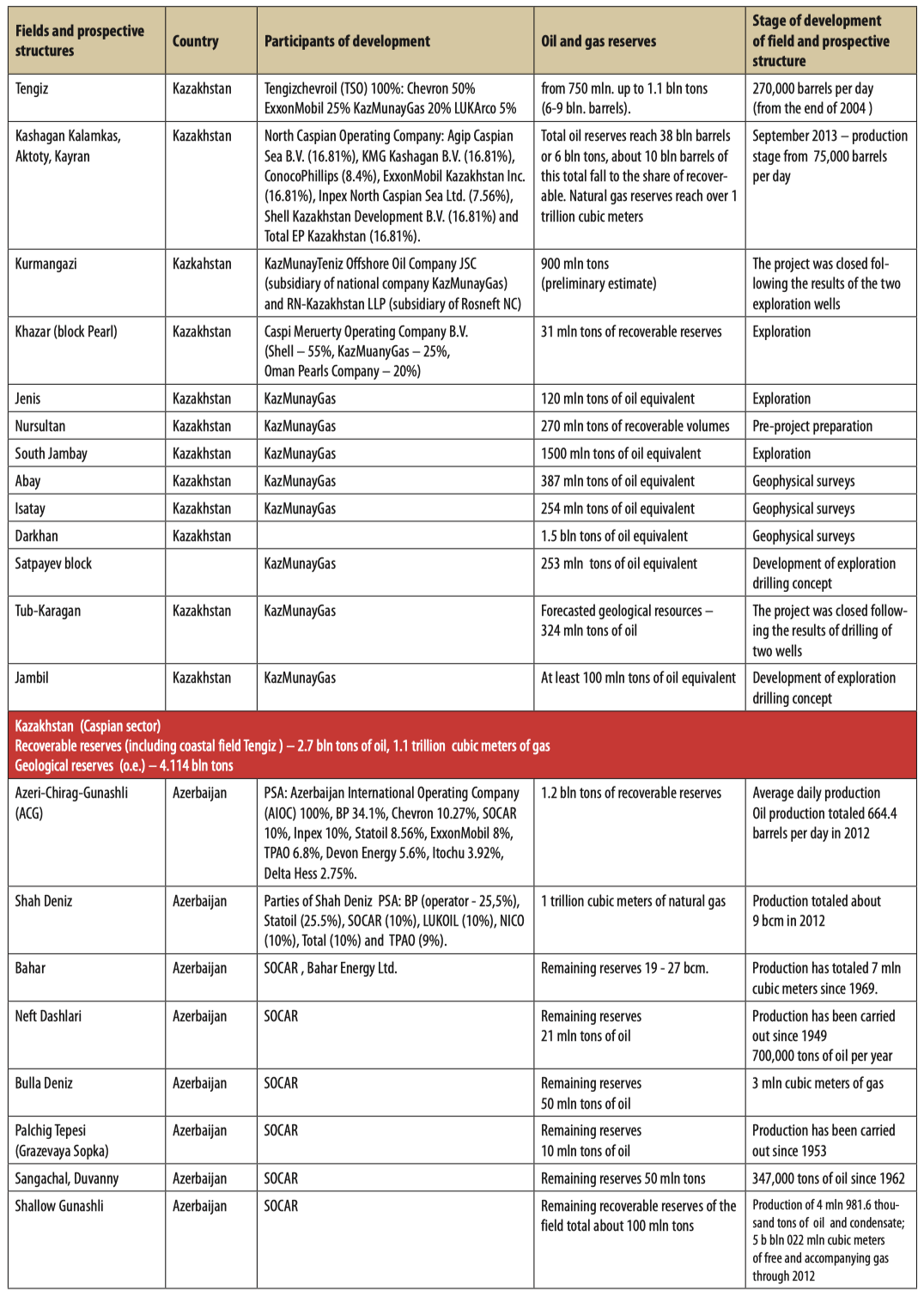
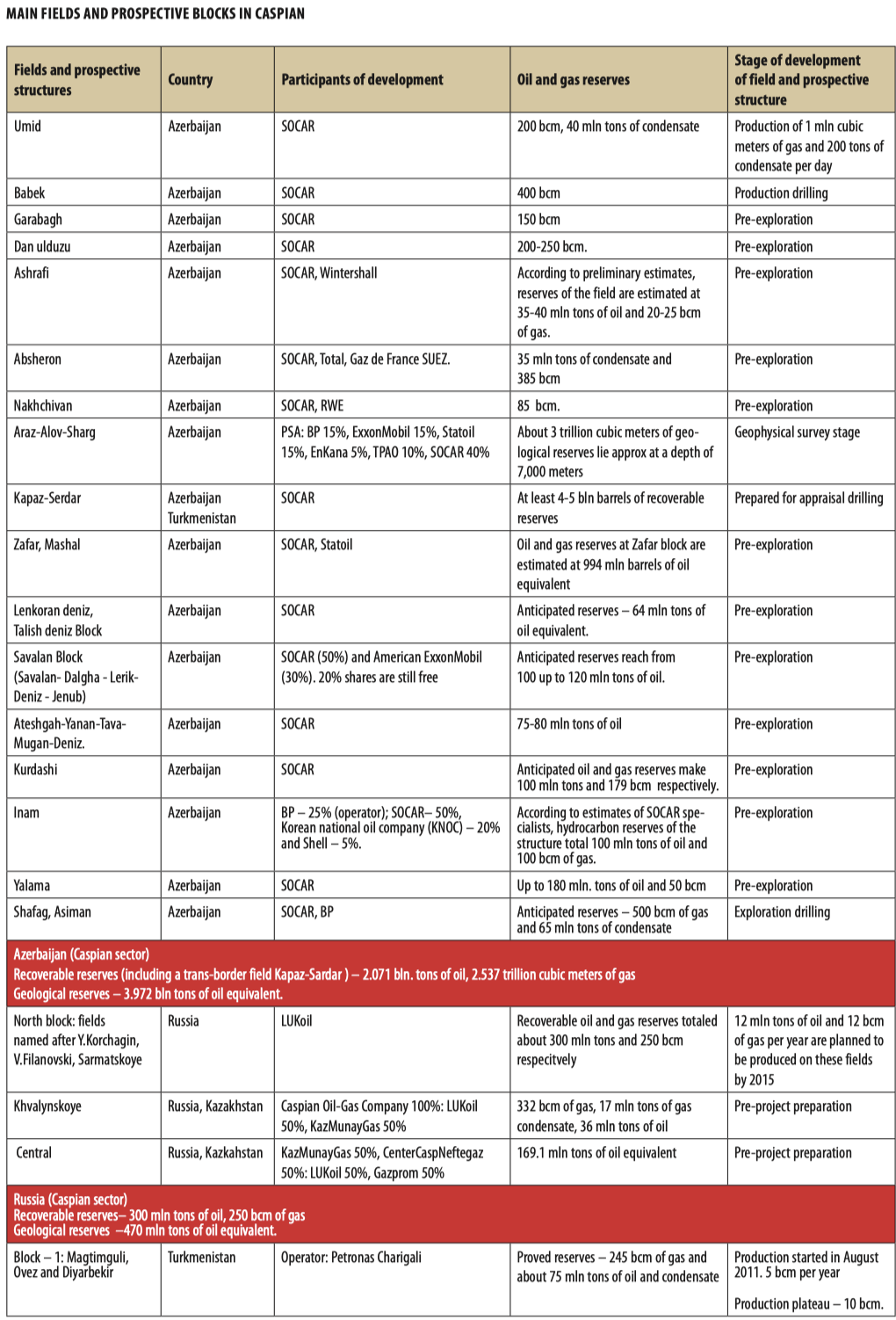
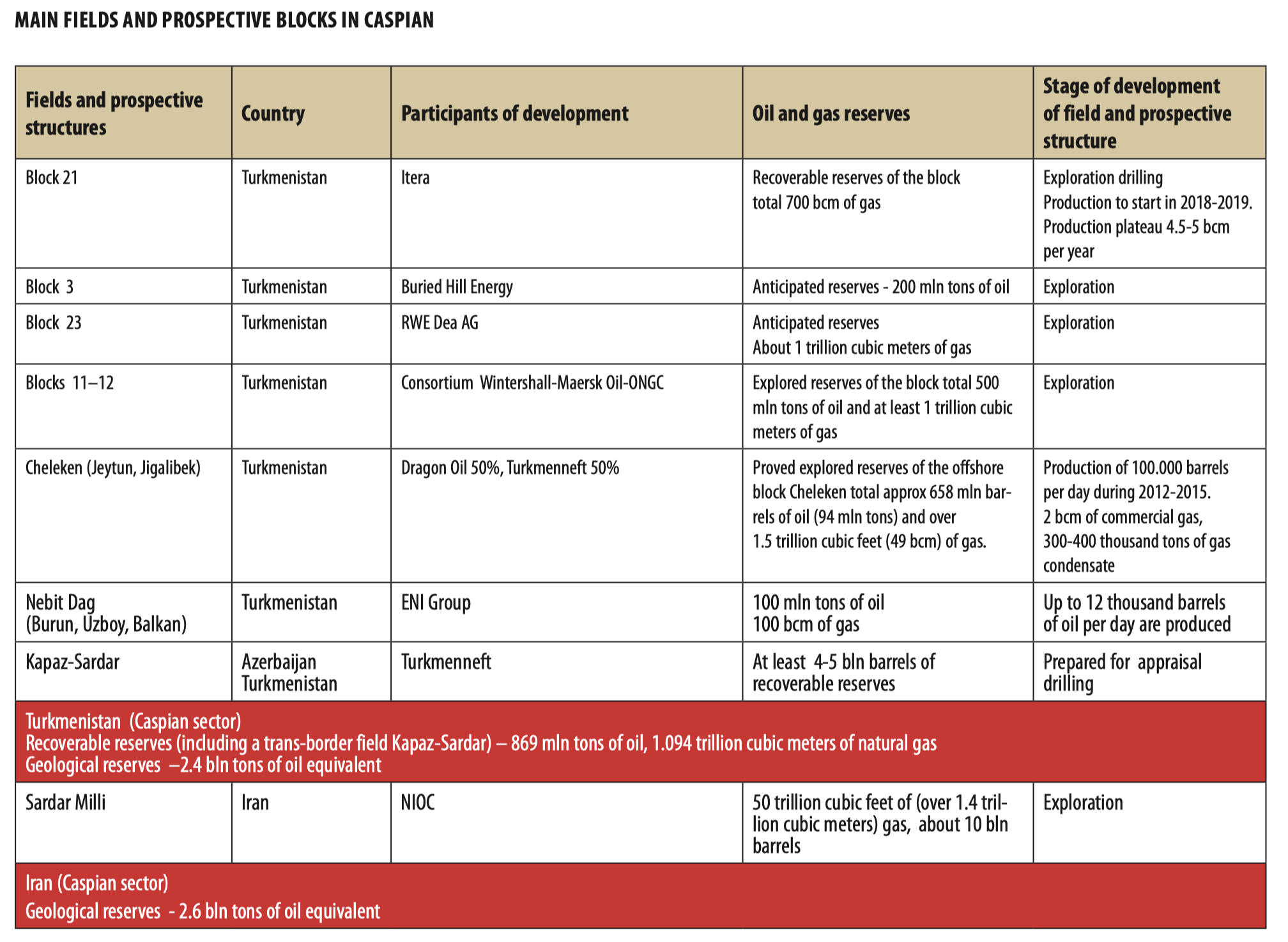
Considering numerous requests of the readers, on the basis of the biggest fields to be explored or already producing resources, Caspian Energy prepared its own rating of Caspian reserves and divided them into two categories: recoverable and predictive estimates.
Azerbaijan
Azerbaijan is standing first in the line of the Caspian countries producing energy resources as it has been developing its offshore reserves since 1949. Since then the country has considerably succeeded both in determining a geological structure of its sector fields, the routes and priorities of its energy resources export to the world markets. Over 160 fields, which mainly have anticlinal highs, have been discovered in the Azeri sector of the Caspian Sea so far. 69 fields were opened including 27 offshore fields; commercial production is running on 61 fields (21 of them are located in the Sea shelf). SOCAR, a state operator of the oil-gas production industry of Azerbaijan, is performing operations on oil fields where production has been running for over 50 years and already reached the decline stage. “Gas discoveries at great depths (6-7,000 meters) are mainly expected in Azerbaijan”, says Academician Khoshbakht Yusifzade, First Vice-President of SOCAR for Geology, Geophysics and Development of Fields, at the event of the Caspian-European Integration Business Club (CEIBC).
Shortage of units affects the development terms of new fields as a new SSDR (semi-submersible drilling rig) will be ready in 2014. According to the Chief Geologist of Azerbaijan, anticipated reserves of Azerbaijan are estimated at 6 trillion cubic meters of gas. Proved oil reserves in Azerbaijan total 2 bln tons. Anticipated oil reserves total another 2 bln tons. Altogether, anticipated reserves of Azerbaijan total 10 bln tons of oil equivalent.
In 2012 oil production in Azerbaijan totaled 43 mln tons including ACG. Compared to the indicators of 2011, oil production declined by 2.4 mln tons (45.4 mln tons). It is 5.434 mln tons lower compared with the indicators of 2010. SOCAR’s own production totaled 8.241 mln tons of oil in 2012. Oil production reduced by 2% compared to 2011.
Azerbaijan produced 17.2 bcm of marketable gas during 2012. Compared to 2011, production of marketable gas grew by 5.4%. Of this total, oil-gas producing department of the State Oil Company of Azerbaijan (SOCAR) produced 6.289 bcm of gas in 2012. It is 3% lower than the indicators of the past year.
Kazakhstan
- Recoverable oil reserves - 5 bln tons; gas - 3.7 trillion cubic meters
- Anticipated oil reserves - 17 bln tons; gas - 8 trillion cubic meters
- Total geological reserves of hydrocarbons in the Kazakh sector of the Caspian Sea - 12-17 bln. tons (2/3 of all hydrocarbon resources of the Caspian)
- Oil and condensate production of Kazakhstan - about 65 mln. tons per year; gas - 27 bcm per year
- Oil production was planned to be increased up to 140 mln tons per year by 2015, mainly at the expense of shelf projects (90 mln tons per year)
Kazakhstan holds the 13th position in the world and the 4th among CIS states on recoverable natural gas reserves. Commercial gas and oil reserves are located in the western regions of the republic (98%). Meanwhile, most of them are concentrated in Karachaganak and Janojolsk fields.
In coming 10 years KazMunayGas will invest 1.5 trillion tenge (almost $10 mln) into geological survey operations. Lyazzat Kiinov, Chairman of the Board of the National Company, clarified: there are 2.3 bln tons of perspective energy resources in Kazakhstan without considering discovered fields. “These big numbers were provided to us by a well-known geological survey company, and this conclusion makes us feel confident about the success of massive exploration”, Kiinov says. For comparison: the present proved reserves of Kazakh hydrocarbons total 800 mln tons.
According to the results of 2012, consolidated production of oil and gas condensate by KazMunayGas totaled 21.4 mln tons. There are plans to increase oil and gas production volumes up to 35 mln tons per year (over 21 mln tons were produced over the past year) and 1.5 bln cubic meters respectively.
Exploration work is delayed due to the lack of own drilling rigs of KMG in the Caspian Sea. The company attracts Russian and Azerbaijani drillers for boring wells. Now KMG has allocated means for construction of its own self-lifting drilling unit which is planned to be built late in 2014. Apart from this, KMG together with the Korean national oil company are completing construction of the drilling barge Caspian Explorer which is currently undergoing a pre-commissioning work. The barge will drill the first well at Jambil field.
Turkmenistan
144 oil-gas fields have been discovered in the country. Crude hydrocarbon resources total 34.6 bln of oil equivalent. 70 oil-gas bearing structures were revealed in the Turkmen sector of the Caspian Sea. However, prospecting-exploration drilling was performed at only 12 of them located mainly at sea depths reaching up to 100 meters.
Turkmenistan holds a leading position among Caspian region countries owing to its gas reserves and its production volume. 33 gas, gas condensate and gas-oil fields are under development now. Turkmengaz state concern is developing 21 gas and gas condensate fields. Turkmenneft state concern is producing natural gas on its own 12 fields.
There are reserves reaching 11 bln tons of oil and 5.5 trillion cubic meters of gas in the Turkmen sector of the Caspian Sea without considering contracted blocks. In general, the resources of the Turkmen sector of the Caspian Sea are estimated at 12 bln tons of oil and 6.5 trillion cubic meters of gas.
Early in 2000s the government of Turkmenistan allocated 32 blocks in the Turkmen sector of the Caspian Sea, for signing PSA with foreign investors for exploration and development of oil-gas fields. According to the information of Turkmen geologists and American Company Western Geco, total resources of blocks are estimated at 6.5 trillion cubic meters of gas and 12 bln tons of oil.
The fact that ВР, OMV, Shell, ExxonMobil, Marathon Oil Corp, Chevron, ТХ Oil, ConocoPhillips, Mubadala Development negotiate with Ashkhabad for signing new contracts tells about the promising outlook of offshore blocks that have not been distributed yet. Thus, it may be said with confidence that a large-scale base of gas resources which may be directed both into existing export gas pipelines (toward Russia and China) and in other planned directions is developing dynamically in the Turkmen sector of the Caspian Sea.
In 2013 Turkmenistan set the task to optimize its present potential in the gas industry and increase gas production up to 77 bcm. About 44 bcm of this total shall be the share of export.
According to a five-year program of development of the oil-gas complex of the country for 2012-2015 approved by President of Turkmenistan G.Berdimuhammedov, total volume of gas produced in Turkmenistan must total 448.7 bcm.
Russia
According to the information published by the World Organization of Creditors in spring of 2012, oil reserves of Russia total 60 bln barrels. This volume will suffice for Russia for 21 years. Financial group UBS estimates oil reserves of Russia at 77 bln barrels which must also suffice for 21 years.
Russia is among top 10 world countries on the size of oil reserves. Meanwhile, it holds the first position on natural gas reserves (47.5 trillion cubic meters). It is assumed that Russia accounts for 25-30% of world gas reserves. These reserves will suffice for almost 80 years.
The government of Russia estimates oil and gas reserves in the Russian sector of the Caspian Sea at 2.95 bln tons and 3.1 trillion cubic meters respectively. 10 fields, which altogether may ensure production of 40 mln tons of oil per year, have been discovered in the Caspian region so far.
Iran
Iranian oil and gas reserves are estimated at 155 bln barrels and 35 trillion cubic meters respectively. Thus, Iran possesses one of the biggest reserves of hydrocarbons worldwide. 22% of determined crude oil reserves were extracted in Iran over the past 100 years.
Daily gas production reached over 650 mln cubic meters in Iran (237.2 bcm of gas per year).
Total length of gas distribution network pipelines and high pressure gas pipelines totals 34,000km within the whole country. Up to 750 mln cubic meters of natural gas is transported along them every day. Iran is the first in the Middle and Near East on the length of gas pipelines for it holds the 4th position in the world following Russia, USA and Canada. According to estimates of IEA, crude production in the Islamic republic fell down (in January 2013) to minimum figure over the past 30 years (2.65 mln barrels per day (967.2 mln barrels per year). Iran had produced 3.7 mln barrels per day before the EU sanctions gained force. The production volumes reached up to 4.2 mln barrels in mid of 2000s.