


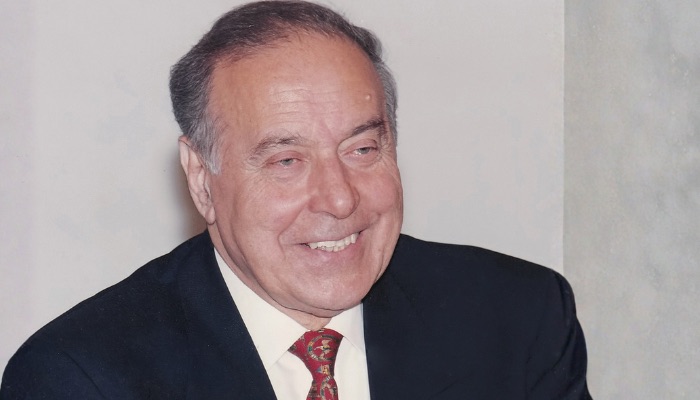
Heydar Alirza oglu Aliyev was born on May 10, 1923 in the Azerbaijan city of Nakhchivan. After graduating from the Nakhchivan Pedagogical School in 1939, he studied architecture in the Azerbaijan Industry Institute (now the Azerbaijan State Oil Academy). Due to the outbreak of the war, he left his education unfinished.
After working as the head of department in the Nakhchivan ASSR People Internal Affairs Commissariat and Nakhchivan ASSR People’s Commissars Soviet, he was assigned to work in the state security bodies in 1944. Heydar Aliyev, working since that time in the security bodies, from 1964 held the post of a deputy chairman, and from 1967 a chairman of the Committee for State Security under the Cabinet of Ministers of the Azerbaijan Republic, and in this post he rose to the rank of a general-major. In these years, he received special higher education in the city of Leningrad (now St. Petersburg) and graduated from the History faculty of the Azerbaijan State University in 1957.
Being elected at the Plenum of the Central Committee of the Communist Party of Azerbaijan in July 1969 as the first secretary of the Central Committee of the Communist Party of Azerbaijan, Heydar Aliyev headed the Republic. In December 1982, Heydar Aliyev was elected a member of Politburo of the Central Committee of the Communist Party of the Soviet Union, and appointed the first deputy chairman of the USSR Cabinet of Ministers and became one of the leaders of the USSR. During twenty years, Heydar Aliyev was a deputy of the Supreme Soviet of the USSR and for five years was a deputy chairman of the Supreme Soviet of the USSR.
In October 1987, as the sign of objection to the policy conducted by Politburo of the Central Committee of the Communist Party of the Soviet Union and personally the Secretary General Michael Gorbachev, Heydar Aliyev resigned from his posts.
In connection with the bloody tragedy the soviet troops committed on January 20, 1990 in Baku, appearing the next day in the representative office of Azerbaijan in Moscow with a statement, Heydar Aliyev demanded to punish both the organizers and executors of the crime against the people of Azerbaijan. Protesting against the hypocritical policy of leadership of the USSR in connection with the Daglig Garabakh conflict, he left the Soviet Union Communist Party in July 1991.
On his return to Azerbaijan in July 1990, Heydar Aliyev lived at first in Baku, then in Nakhchivan, and on the same year he was elected a deputy to the Supreme Soviet of Azerbaijan. In 1991-1993, he held the post of the chairman of the Supreme Majlis of the Nakhchivan Autonomous Republic, the deputy chairman of the Supreme Soviet of the Azerbaijan Republic. In 1992, at the constituent congress of the Yeni Azerbaijan (New Azerbaijan) Party in Nakhchivan, Heydar Aliyev was elected the chairman of the Party.
In May-June 1993, when the country was at the verge of a civil war and loss of independence because of extreme tension of the governmental crisis, the people of Azerbaijan demanded to bring to power Heydar Aliyev. The leaders of Azerbaijan of that time were obliged to officially invite Heydar Aliyev to Baku. On June 15, 1993, Heydar Aliyev was elected the chairman of the Supreme Soviet of Azerbaijan, and on July 24 on resolution of the Milli Majlis, he began performing the powers and authorities of a president of the Azerbaijan Republic.
On October 3, 1993, as the result of the nationwide voting, Heydar Aliyev was elected a president of the Azerbaijan Republic. In the elections, held with the active participation of the nation on October 11, 1998, he was re-elected a president of the Azerbaijan Republic with 76.1% of the total votes.
The urgent measures implemented by Heydar Aliyev enabled, on the one hand, to make important steps connected with formation of the National Army, creation of the regular armed forces capable to guard the national interests of Azerbaijan and protect our lands, and, on the other hand, to involve all diplomatic and political instruments to achieve a ceasefire mode. As a result this mode, with a vital significance for our country, was established in May 1994.
During all these years it was Heydar Aliyev who managed to announce resolutely the truth about Azerbaijan to the entire world. Only after Heydar Aliyev's return to the power Azerbaijan could realize its geopolitical opportunities and overcome the threat of isolation of Azerbaijan from the international community.
In October 1994 and March 1995 attempts of coups were prevented, and the state independence was preserved. The state-building process was started in Azerbaijan with the first Constitution adopted by independent Azerbaijan as a basis.
Heydar Aliyev’s return to leadership in Azerbaijan laid a basis of a new ideology with the key focus on such universal values as independence, statehood, justice, democracy, and national progress. The consecutive priority directions included implementation of economic reforms, establishment of market economy, ensuring economic development, integration of Azerbaijan into the world economy, implementation of the privatization and agrarian reforms programme.
The signing of the first oil contract, entitled the Contract of the Century, with foreign oil companies in September 1994 and its subsequent prompt implementation after the established stability have improved the image of Azerbaijan and the trust of investors in the international arena. It served the start to realization of the oil strategy of Heydar Aliyev, which laid basis for not only economic development of Azerbaijan, but also for global energy security.
Due to Heydar Aliyev’s active diplomacy, Azerbaijan successfully achieved the fundamental change in the attitude of democratic states and world’s public organizations to Azerbaijan and the armed conflict in which it was violently involved. Peace, respect to international laws, integrity and inviolability of borders, territorial integrity of the states and principles of mutually beneficial cooperation underlay the foreign policy of Heydar Aliyev.
Heydar Aliyev was conferred a number of international awards, the title of honored doctor of universities of different countries as well as other high honors. He was conferred the Lenin Order four times, the Red Star Order and many medals, and Hero of Socialist Labor (twice), was awarded orders and medals of many foreign states.
Heydar Aliyev, who agreed to be nominated as a candidate at the October 15, 2003 presidential elections, relinquished to run at the elections in connection with health problems.
Despite his death on December 12, 2003, the powerful basis of historical development laid by the Nationwide Leader of Azerbaijan Heydar Aliyev will enable state-building and future generations of Azerbaijan to develop successfully for many decades to come, and also feel resolutely and confidently in any epoch of geopolitical changes in the system of international relations of the future.
Therefore the cherished memory of the Nationwide Leader of the Azerbaijani people Heydar Alirza oglu Aliyev will eternally live in the hearts of Azerbaijan people.