


Global demands
Low economic growth, high prices and active development of renewable energy sources will hinder gas consumption growth in Europe in coming 4-5 years. According to the forecast of IEA, gas prices in Europe may reduce by 18% by 2025.
According to the estimates of the agency, global gas demand will grow by 576 bcm (up to 3.937 trillion) by 2017. Besides, China will account for one fourth of this growth and hold the third position in the world on gas consumption after USA and Russia. Gas consumption in China will double in coming 5 years: from 132 bcm fixed last year up to 276 bcm in 2017.
IEA predicts that the USA will become the biggest world gas producer only by 2035. Meanwhile, the share of Russia and Near East countries in the world gas trade shall have fallen from 45 down to 35% by 2035. USA already left Russia behind as early as in 2009 as its production volume was by 55 bcm (583 bln) higher. These figures totaled 22 bcm (611 bcm) in 2010. According to calculations of Bloomberg, gas prices in USA fell by 62% (down to $2.502 per 1 mln of British thermal units) over the past year and now gas costs much cheaper in the USA than in Russia.
Technologies will play the role of the main driver of the gas market but not absolute reserves of resources. The share of unconventional gas (mainly shale gas) will rise from 14 up to 32%, IEA forecasts. Expansion of unconventional gas is the main challenge for present players – Russia and Near East, which probably will have to revise programs of development of new fields, the report says.
Worldwide gas consumption will have grown almost by 50% by 2035. India and China will account for 95% of the growth. Gas consumption rate will increase in electricity generation. Gas sector has a good resource sufficiency even without shale gas and gas-hydrates.
Spot natural gas trade is rapidly growing in the European Union countries. The volume of gas trade grew by 11% at all European hubs within a year and covers over 80% of gas needs of Italy, Great Britain, France, Germany, Belgium, Netherlands and Austria.
Considering the capacity of the European gas market, the growing demand for gas, EU countries link part of their future needs with the deposits of the Caspian Sea where Shah Deniz field is the main asset located in the Azeri sector of the Caspian.
Gas asset
First gas volumes are to be extracted within the framework of the second stage of Shah Deniz in 2018, says the consortium for Shah Deniz field development in its report for the first quarter of 2013. SOCAR announced that the final investment decision on full-scale development of Shah Deniz would have been made by October 2013. “A number of agreements signed with the consortium and SOCAR, makes it clear that the final investment decision will be made in 2013, the report of the consortium says.
Investment value of Shah Deniz Stage II is estimated at $25 bln today. This stage of development of the field shall ensure production of at least 16 bcm of gas per year. Peak production figures which total 27 mln cubic meters of gas and 55,000 barrels of condensate per day were reached during the first stage of Shah Deniz. 40 bcm of gas and 85 mln barrels of condensate (10.7 mln tons), shipped to the world market, have been produced at Shah Deniz since the end of 2006 until present.
The project participnats signed (December 16, 2012) a Memorandum on expansion of the South-Caucasian gas piepline (Baku-Tbilisi-Erzurum). The State Oil Company has already declared that it would keep 51% out of 80% in the Trans-Anatolian gas piepline project (TANAP).
The Shah Deniz consortium began evaluating final offers, envisaging legal obligations on transportation of Shah Deniz gas into Europe and made by the two consoritums.
Nabucco Gas Pipeline International and Trans Adriatic Pipeline (TAP) consortiutms held extensive negotiations with the Shah Deniz consortium and submitted initial gas transportation offers at the end of March 2013. “These offers have been approved by their shareholders and have become final and binding”, says the consortium.
European investors and potential consumers activated their work over implementation of these main projects (TAP and Nabucco West) as the time for selecting the route for transportation of Azeri gas to Europe is approaching. Parliament of Greece has ratified an intergovernmental agreement on TAP project. Ecological permits have been provided to Albania within the framework of the project. Nabucco West in its turn offers Shah Deniz consortium a 50% stake in the project. Ukraine which counts on promising supplies of both gas and oil has also joined the dialogue. The parties also consider swap supplies as an option.
Austrian hub
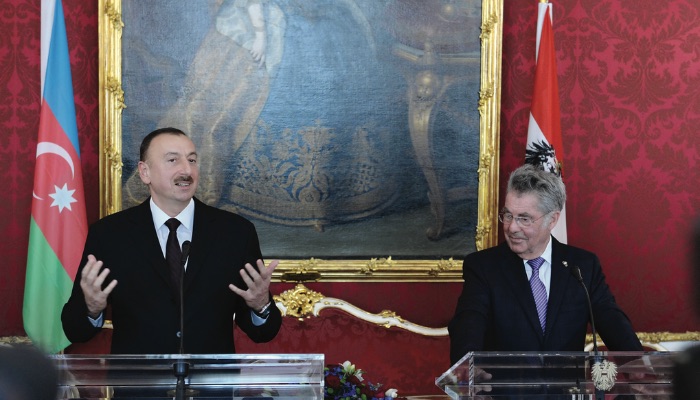
During his visit to Austria in May, President Ilham Aliyev signed a Declaration of Friendship and Partnership with his Austrian counterpart Heinz Fischer. Issues concerning supplies of Azerbaijani gas to Europe were the main topic of negotiations President of Azerbaijan held in Vienna. Ilham Aliyev met with General Director of Austrian company OMV AG Gerhard Roiss right after his arrival in Vienna. OMV purchased from RWE almost a 17% stake in the Nabucco West gas pipeline construction project, and now it applies all efforts for delivery of Azerbaijani gas to Austrian Baumgartner, where one of the biggest gas hubs of Europe is located.
Speaking at the joint press-conference together with the Austrian President, President of Azerbaijan said that Azerbaijan expects a decision on selection of Azeri gas delivery route to Europe to be made in near future. “It is going to be a joint decision of Shah Deniz group”, the head of Azerbaijani state noted.
“We hope that this decision will be made exclusively from the point of the commercial profitability. We undertook a big step toward the realization of the Southern gas corridor. Here, in particular, we mean an agreement on TANAP project reached between Turkey and Azerbaijan. It will considerably facilitate the implementation of the project and open doors for Azeri gas to the European continent. In a word, we are ready to assume all main technical and financial obligations. We are making a certain contribution to the implementation of the strategic route since it will turn Azerbaijan into an important gas exporter to the European continent. It will also enable us to implement our big gas potential and ensure the economic independence of our country for many decades and centuries to come”, President I.Aliyev continued.
The head of Azerbaijan state expressed his satisfaction with the level of cooperation between the European institutions and Azerbaijan. Speaking about competing gas projects which are currently being implemented in the region and projects scheduled for future, President I.Aliyev said: “We do not worry about competition. It is quite the opposite, since I think that a fair competition is a fundamental condition for gaining success. It is also important for consumers as they will have a chance to choose. It is also beneficial for producers as they will have to work more efficiently. But when speaking about diversification, I assume that we all should take into account that the main diversification is provided by diversification of sources but not the routes”.
According to I.Aliyev, Shah Deniz is currently assessing the commercial side of proposals. “We hope for the decision to be made in near future and Azeri gas to be delivered to the European continent”, President Ilham Aliyev emphasized.
Speaking at the press conference together with his Azerbaijani counterpart Ilham Aliyev, Austrian President Heinz Fischer also confirmed that the financial decision on implementation of the Nabucco-West gas pipeline project (designed for delivery of Azeri gas to Europe) might be made in coming weeks.
Along with it, the process of allocation of environmental permits for the Bulgarian section of the pipeline has already been completed. Thus, Bulgaria became the second country following Hungary that completed the process on providing of environmental permits for the pipeline route. Commenting this event, Reinhard Mitchek said that completion of the environmental impact assessment in Bulgaria is another milestone in the project. “It demonstrates the stage of technical development of Nabucco”, he noted.
Concerning Romania, the pipeline shall pass through its territory, Bucharest will host (late in May) a session with participation of Energy Ministers of countries involved in Nabucco project. Romanian Energy Minister Constantin Nita said. In the meantime, he noted that Nabucco project was of economical and political importance both for Central and Eastern Europe.
The route that Shah Deniz consortium chooses, will be a part of the large-scale Southern Gas Corridor project envisaging transportation of Caspian gas to the European countries.
Struggle intensifies
But the struggle between the European consortiums is being intensified. The Nabucco consortium has declared the open season process during which the traders will have the opportunity to reserve necessary volumes of gas.
According to sources in the consortium, the first stage of the open season process offers the potential shippers an opportunity to announce their interest officially and request access to the relevant documents. “The open season process will be brought in compliance with the principles of open access and diversification of supplies”, Executive Director of International Consortium Nabucco R.Mitchek said.
Mitchek also noted that the Nabucco West pipeline will provide access for producers and shippers to the growing markets of South-Eastern and Central Europe, as well as the Central-European gas hub.
The Nabucco pipeline will be connected to the Transanatolian pipeline (TANAP) on the Turkish-Bulgarian border ensuring transit gas supply to the Central European gas hub in Austrian Baumgartner via Hungary, Bulgaria and Romania. Over 500 million customers throughout Europe can be supplied with gas via Baumgartner.
Nabucco West envisages construction of 1,300 kilometers of pipeline (412 km in Bulgaria, 469 km in Romania, 384 km in Hungary, 47 km in Austria) from the Turkish-Bulgarian border to Austrian Baumgartner.
The shareholders of the Nabucco pipeline are Austrian OMV (33.3%), Hungarian FGSZ (16.67%), Bulgarian Bulgargaz (16.67%), Romanian Transgaz (16.67%), Turkish Botas (16.67%).
Greek scenario
The list of the project shareholders - active participants of the growing spot market, access to the southern and southwestern markets of Europe, shorter route and possible integrated approach in case SOCAR wins the tender for privatization of Greek DEPA, all these facts are in favor of the TAP route. The winners of the tender will be defined in late May. At present the Greek government holds 65% of stocks in DEPA and the rest 35% belong to local oil refining company Hellenic Petroleum.
In addition, the TAP project is aimed directly at supplies of Azerbaijani gas from Stage II of Shah deniz to the European market, whereas Nabucco envisages supplies of Iraqi and Iranian gas, and further the Turkmen gas to the European markets.
It is noteworthy that TAP project is intended for transportation of natural gas from the Shah Deniz field as part of Stage-2 via Greece and Albania to Western Europe. The pipeline has the capacity of 10bn cubic meters with possible expansion to 20bn cubic meters a year, depending on demand and offer.
The financial leadership over the first stage of the TAP pipeline project has been laid on French Societe Generale. At that, TAP may be at least 450 kilometers shorter than the competitor-project-Nabucco West. The TAP pipeline will be connected to the Tran Anatolian pipeline (TANAP) on the Turkish-Greek border.
The participants of the Shah deniz consortium have also been provided with an opportunity to receive up to 50% share in TAP. This project will help supply gas to Italy at a very favorable price and can also be further prolonged towards Western Europe (till France and further).
According to the announcement, the trilateral committee for cooperation between the governments of Greece, Albania and Italy held a session for coordination of support to the Transadriatic Pipeline (TAP). The committee was created after the indicated parties signed an intergovernmental agreement on TAP in Athens in February 2013. This agreement was further ratified by the parliaments of Greece and Albania, sources in TAP said.
The works on the Transadriatic pipeline project proceed rapidly. The Greek parliament has recently approved the intergovernmental agreement between Albania, Italy and Greece on construction and operation of the Transadriatic pipeline. The intergovernmental agreement signed between the three countries in Athens on 13 February 2013 evidences the support of the recipient countries for TAP, as well as their cooperation for the timely implementation of the project, sources in TAP report.
The Transadriatic pipeline declared that the Environmental and Social Impact Assessment (ESIA) was approved in Albania by the Ministry of Environment, Administration of Forest and Water Resources.
Selection of route
Besides Shah Deniz, now there are at least two fields under development in the Azerbaijan sector - Absheron and Umid (see the article “Rating of Caspian fields”). Both fields have reserves equivalent to those of Shah Deniz’s and together with Shah Deniz by 2020 - 2025 the production will have reached 30-50bcma at least. Besides, this year the hi-tech company Statoil is going to sign one more PSA contract in the Azerbaijani sector concerning Zafar-Mashal project. The considerable part of gas volume will be exported. It will require corresponding capacities of more than one gas pipeline.
Diversified oil and gas export underlies the oil and gas strategy of Azerbaijan. Moreover, the toughening competition for the European markets, spot nature of trade along with a low demand for gas envisage the similar competition of pipelines, alternativeness of export routes. Therefore, Azerbaijan as the main exporter and its partners – foreign companies – will be interested in boosting today’s level of competition of the two routes – TAP and Nabucco for a more remote prospect. The European Commission has already mentioned the intention to support this decision as well.
The European Commission has made the official decision to prolong the existing exceptions of the EU legislation concerning the access of third parties and tariff standards for the TAP (the Trans Adriatic Pipeline) and Nabucco West projects. The information was provided by EU’s representative office in Azerbaijan.
Ambassador of the European Union to Azerbaijan Roland Kobia said this decision is certainly an important step in implementation of the Southern Gas Corridor and also shows EU’s serious commitment to concrete work with Azerbaijan in the field of implementation of joint projects of mutual interest.
“The decision concerns important regulatory issues for both projects - TAP and Nabucco West. Now the positions of the two projects have reached comparable level that will allow the Shah Deniz Consortium to adequately estimate both pipelines in connection with a decision on an European route for gas transportation from Shah Deniz Stage II expected in June”, Kobia said.
“Both TAP and Nabucco West are priority for the EU. In talks with us they say “it is your choice”, Minister of Industry and Energy Naitg Aliyev says in his exclusive interview. When people say so, we respond that it is a choice of foreign oil companies since these projects bear a commercial interest for them. The companies heavily invest in upstream and these funds should be returned. Therefore, in late June we expect a decision on a route for gas supplies to be made. It will be either Greece-Albania-Italy or Bulgaria-Romania-Hungary-Austria. Both projects have advantages and shortcomings”, Natig Aliyev said.
Frankfurter Allgemeine Zeitung published the article that reflected the main theses from the speech of the EU Commissioner Günter Oettinger within the frame of the German-Azerbaijani economic symposium dated for the 90th anniversary of Nationwide Leader of Azerbaijan Heydar Aliyev. “EU’s demand for imported gas will continue growing at least against declining gas production in Europe. For this reason suppliers from the Caspian region (Azerbaijan, Turkmenistan, Kazakhstan) and the Mediterranean Sea (Israel, Cyprus) start playing more and more important role”, the newspaper quotes Oettinger’s thoughts.
Commenting on the forth-coming decision concerning the choice of a route for supply, Oettinger said that the EU supports both options. For Europe it is virtually important to construct new pipelines capable to transport growing volumes of gas.
At the initial stage Azerbaijan plans to supply 16bcm of gas, here 10bcm will be intended for the European market, the EU Commissioner says.
The release of Shah Deniz Consortium says the consortium had received offers on purchase of over 30bcma of gas from more than 15 different buyers from the entire Europe. Offers on gas purchase will be considered simultaneously with the offers on transportation to determine the commercial value of pipeline routes and the relevant markets.
Stage II of the Shah Deniz field located 70km off the Azerbaijan sector of the Caspian Sea includes construction of two bridge-connected producing platforms, drilling of 26 offshore wells by means of 2 semisubmersible drilling rigs, construction of 500 km of offshore pipelines at the water depth of 550m.
As far as the Trans Anatolian Gas Pipeline is concerned, the project is ready and there are no obstacles for its construction, the Minister of Industry and Energy of Azerbaijan Natig Aliyev said during the recent meeting of the Caspian-European Integration Business Club (CEIBC).
“Presidential and parliamentary decrees and laws were approved in Azerbaijan, the legal part of preparatory work is complete, the company responsible for construction of TANAP was established and at the end of 2013 we are going to begin physical works”, Minister Aliyev said. “No technological problems may arise befor the Construction of TANAP because since 1993 Azerbaijani builders and energy specialists have accumulated enough skills expertise for construction of any energy facility. Financial problems have also been solved, 80% of funds for the project shall be provided by Azerbaijan”, the Minister added.
Therefore, summarizing all these factors, most likely the markets of Central and Southeast Europe will be chosen for gas export from Shah Deniz, whereas the markets of Southern and Southwest of EU – Italy, France, etc. will be chosen for Absheron gas field and other fields of the Azerbaijani sector. Moreover, the French capital is provided both in Shah Deniz and Absheron. It is not excluded that Nabucco and TAP will be implemented in different periods, probably simultaneously, but on the high technological level, with simultaneous making some integrated business solutions, promoting the most effective delivery of Azeri gas to free markets.